
Psychopomp Nosoi – Masked Scribe and Soul-Courier of the Dead
The smallest clerk of death can still decide whether a soul is remembered, misfiled, stolen, or delivered.
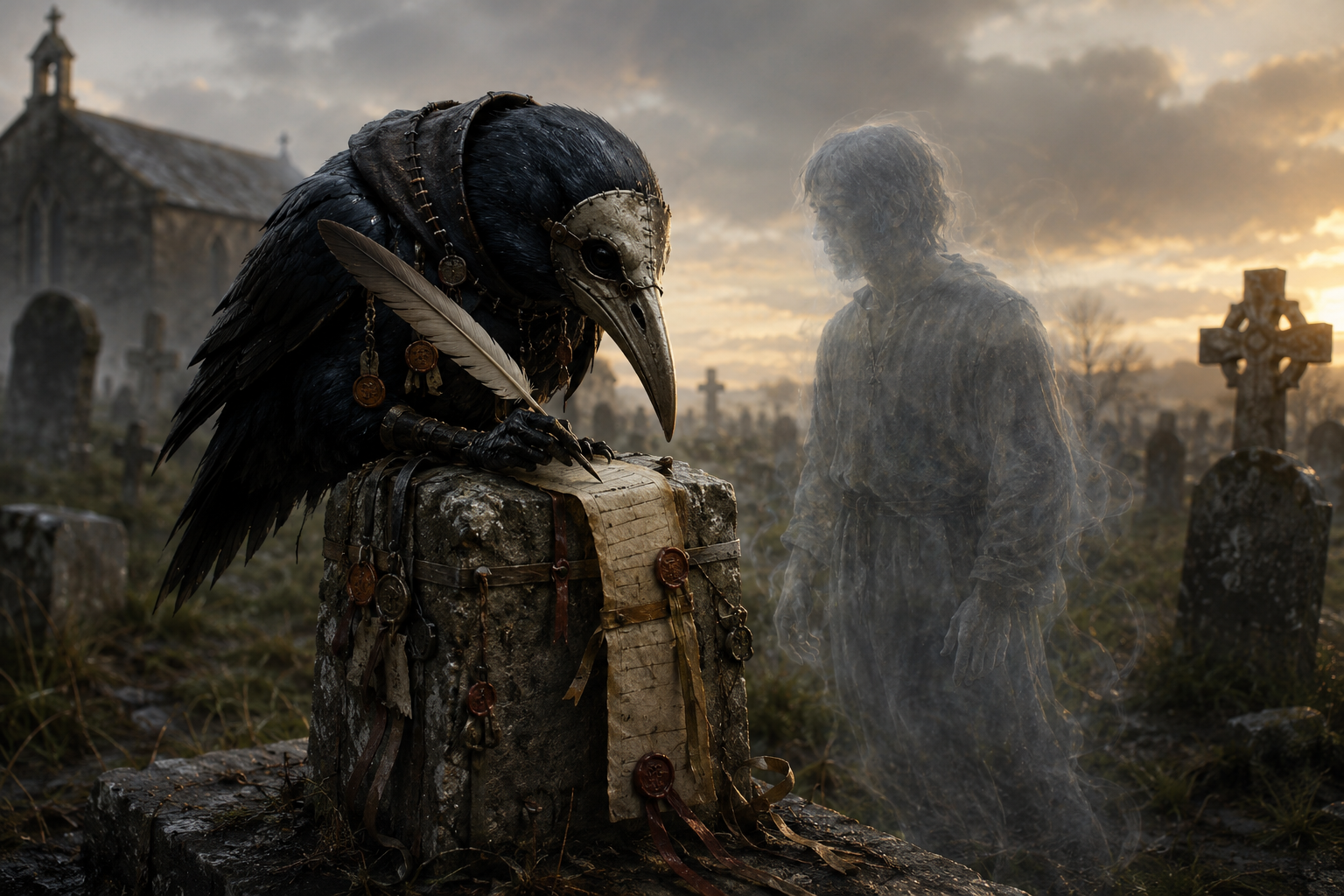
A nosoi is a tiny masked psychopomp: a black bird-spirit that arrives where death has become a matter of record.
It perches on gallows beams, plague-house rafters, battlefield standards, graveyard walls, shipwreck spars, and the backs of judges’ chairs. It watches. It listens. It writes.
A nosoi is not a reaper, executioner, plague demon, undead raven, or omen of doom. It is a clerk of the dead: part witness, part courier, part scribe, part funeral official. Its duty is to record the facts that allow a soul to pass toward judgement rather than be stolen, misnamed, hidden, misfiled, bound, eaten, or forgotten.
That makes it more dangerous than it first appears.
A nosoi rarely threatens the living with violence. It threatens them with accuracy.
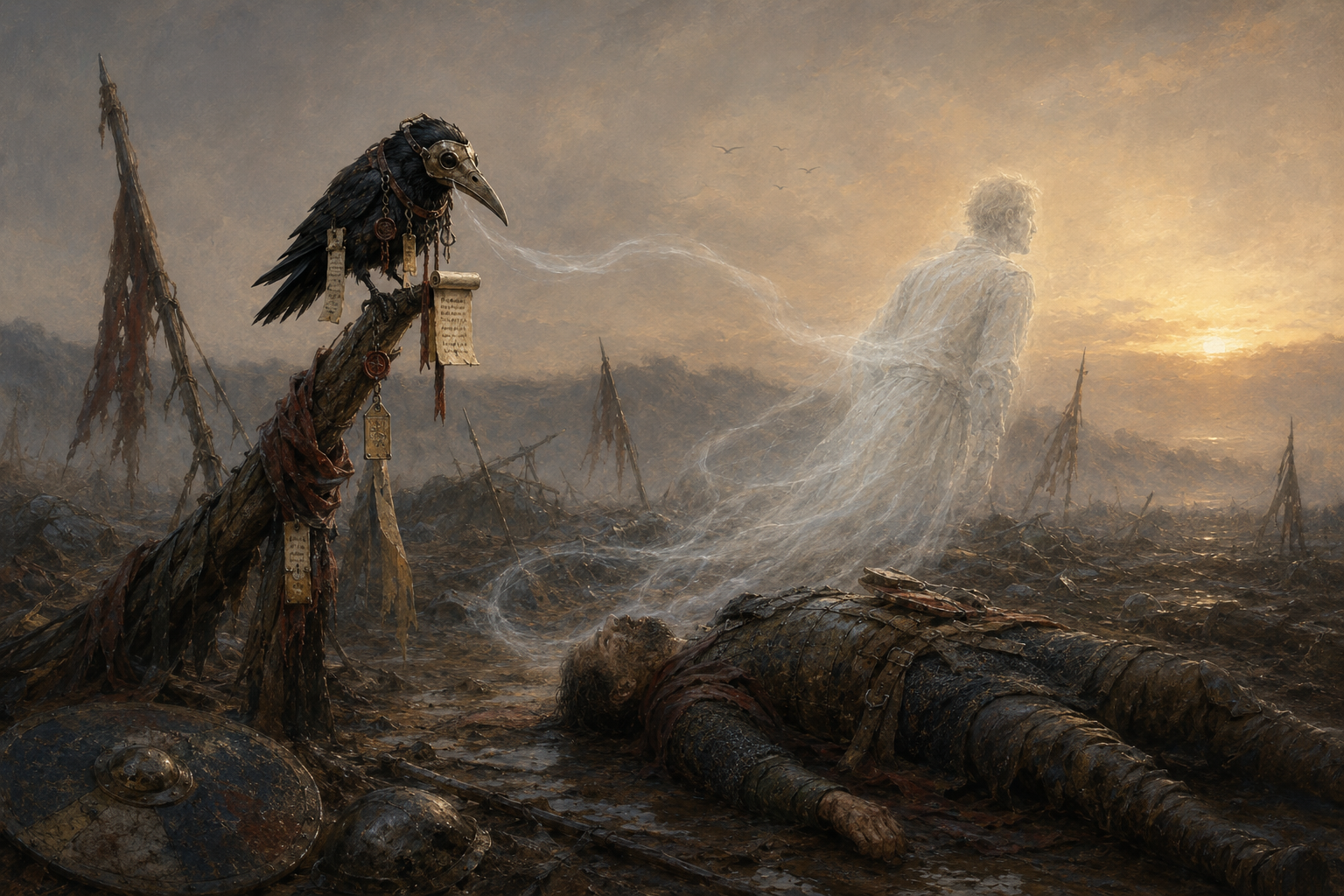
When a murderer lies, when a noble family alters a death register, when a battlefield captain claims prisoners died “in combat,” when a necromancer traps a soul before burial, or when a corpse rises during a Red Death outbreak, a nosoi may be the only honest witness left.
Quick Rules Reference
- Creature Role: Tiny neutral psychopomp, soul-courier, death-scribe, supernatural witness.
- Best Use: Murder scenes, disputed burials, plague houses, battlefields, wrongful executions, necromancy investigations, undead outbreaks.
- Combat Role: Evasive support creature, not a boss monster.
- Primary Threat: It records the truth of death and may draw stronger psychopomp attention.
- Campaign Function: Turns death into evidence, testimony, consequence, or spiritual jurisdiction.
- Do Not Use As: A generic evil plague bird, undead raven, comic mascot, celestial messenger, or swarm monster.
Appearance
A nosoi resembles a small black bird wearing a long-beaked funerary mask. Its body may suggest a raven, sparrow, blackbird, nightjar, or whippoorwill, though its weight and stillness make it feel wrong for any ordinary animal.
Its mask may appear to be leather, lacquered wood, bone, parchment, waxed linen, or all of these at once. The long beak gives it a plague-doctor silhouette, but the mask is not medical equipment. It is a sign of office. It marks the creature as a servant of the boundary between death and judgement.
Many nosois trail artificial tails made from burial ribbons, brass name-tags, wax seals, coffin nails, beads, prayer strips, broken charms, or torn strips of funeral cloth. These are not decorations. Each piece may correspond to a death recorded, a witness heard, a soul escorted, or a case still unresolved.
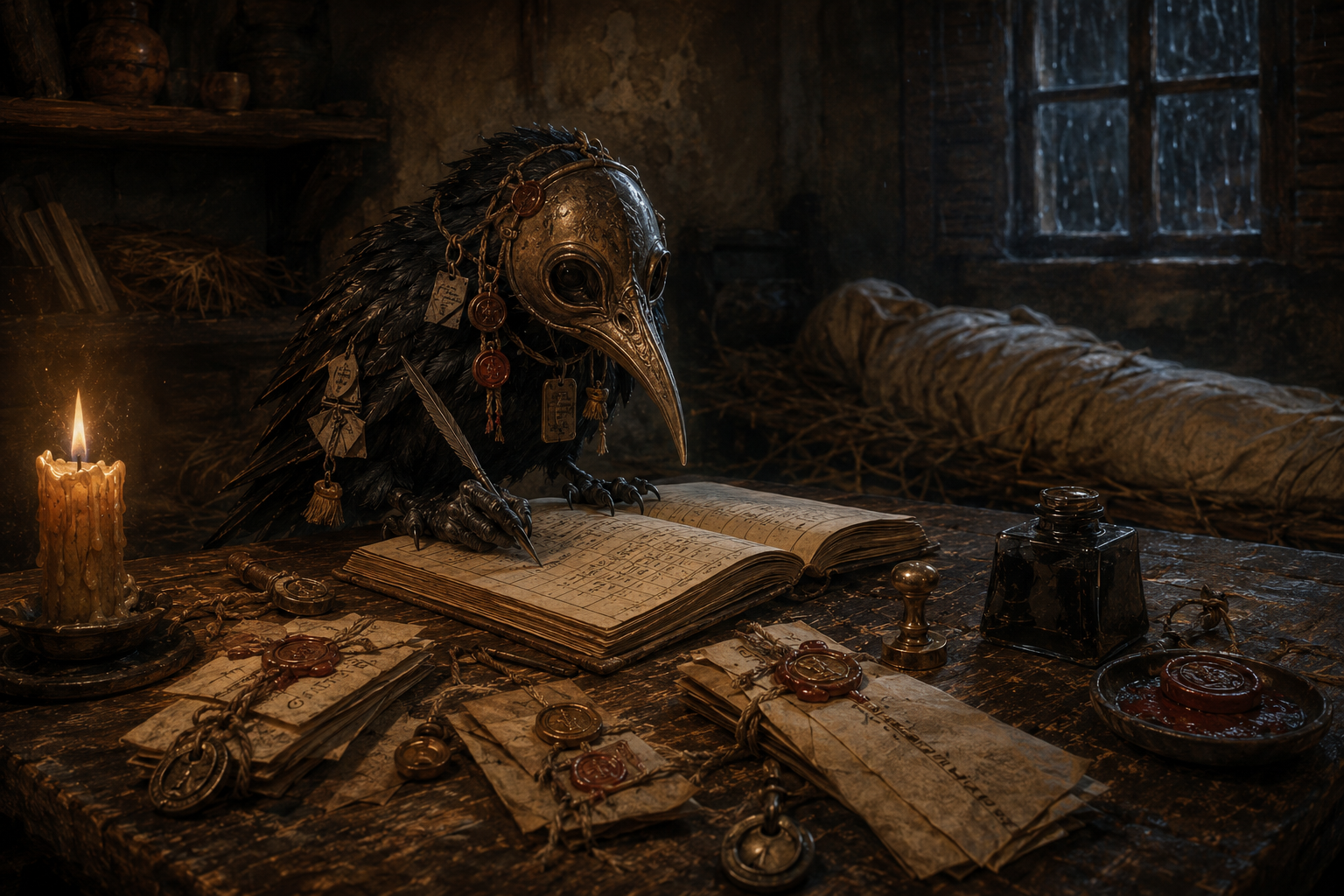
A nosoi can grip quills, styluses, tiny ledgers, wax tablets, and scroll rods with impossible precision. Its claws often leave ink marks on whatever it touches.
Behaviour
Nosois are fussy, observant, bureaucratic, and oddly talkative.
They mutter while working. They correct dates. They object to imprecise language. They care whether someone died “in battle,” “under safe-conduct,” “after surrender,” “of neglect,” “by lawful execution,” “before testimony,” or “while already under a curse.”
To mortals, this may seem absurdly pedantic.
To the dead, it can determine everything.
A nosoi is not sentimental, but it is not cruel. It may pity the murdered, the abandoned, the plague-dead, the misburied, and the nameless. It may also record, without hesitation, that a beloved hero killed prisoners, that a revered judge lied, that a priest took payment, or that an adventuring party’s “necessary killing” was not as clean as they later claimed.
A nosoi can be distracted by good ink, preserved fruit, honeyed seeds, funeral cakes, clean vellum, rare death registers, old legal seals, or a properly witnessed correction to a false record. It cannot usually be bought in the ordinary sense. It values accuracy, procedure, and the right of the dead to be carried onward under their own names.
Habitat
Nosois appear where death produces consequence.
They may be found in plague wards, gallows fields, charnel houses, shipwreck coasts, royal tombs, battlefield ditches, crossroads graves, temple archives, underworld courts, execution yards, murder rooms, violated cemeteries, and houses where someone has died under a false explanation.
They are especially likely to appear when a death involves:
- disputed cause,
- stolen inheritance,
- wrongful execution,
- violated guest-right,
- broken safe-conduct,
- concealed murder,
- false burial,
- necromantic interference,
- soul theft,
- plague irregularity,
- undead manifestation,
- divine, infernal, ancestral, or cosmic jurisdiction.
A nosoi does not attend every death. Its presence means the death matters beyond grief.
The Clerk at the Edge of Death
A nosoi gives death a witness.
Where mourners remember only grief, it records names. Where soldiers claim necessity, it records sequence. Where nobles alter registers, it preserves the missing line. Where necromancers bind souls, it marks the interruption. Its work is small, precise, and difficult to silence.
This is why a nosoi can unsettle murderers, priests, magistrates, grave-robbers, soldiers, and adventurers without raising its voice. It does not need to accuse. It only needs to write accurately.
A ghost may demand remembrance. A revenant may demand vengeance. A wraith may consume the living. A nosoi does something quieter and, in many courts of death, more dangerous: it makes the truth portable.
A soul misnamed, misburied, stolen, or falsely judged may be lost for generations. A nosoi’s record can restore the name, expose the theft, correct the rite, or summon powers that do not answer mortal law.
When a nosoi appears, the question is not whether death has happened.
The question is what death now proves.
Nosoi Psychopomp 5.5e / 2024
Psychopomp, Nosoi, Pathfinder
Nosoi Psychopomp, Pathfinder 1e / 3.5e
Nosoi Psychopomp 5.5e / 2024
Tiny Psychopomp, Neutral
Armor Class: 14
Hit Points: 22 (5d4 + 10)
Speed: 15 ft., fly 40 ft.
Initiative: +3
Proficiency Bonus: +2
| STR | DEX | CON | INT | WIS | CHA |
|---|---|---|---|---|---|
| 6 (-2) | 16 (+3) | 14 (+2) | 12 (+1) | 14 (+2) | 16 (+3) |
Saving Throws: Dex +5, Wis +4, Cha +5
Skills: History +3, Insight +4, Perception +4, Performance +5, Religion +3, Stealth +7
Damage Resistances: Cold, Lightning, Necrotic, Poison
Condition Immunities: Poisoned
Senses: Darkvision 60 ft., Spirit Sense 60 ft., passive Perception 14
Languages: Abyssal, Celestial, Infernal, plus any one mortal language associated with the death it is investigating
Challenge: 1 (200 XP)
Traits
Psychopomp Nature. The nosoi does not require food, drink, or sleep, though it may eat as a social ritual.
Spirit Sense. The nosoi knows the location of living creatures, undead creatures, incorporeal spirits, and dead-but-unjudged souls within 60 feet, provided they are not behind total cover. This sense can detect invisible or incorporeal presences, but it does not reveal exact identity, alignment, guilt, or intent. The nosoi knows only whether each presence is living, undead, spirit, or dead-but-unjudged.
Funerary Scribe. The nosoi has advantage on ability checks made to identify cause of death, read funerary markings, interpret burial customs, recognise forged death records, or understand magical writing related to death, souls, burial, necromancy, or judgement.
Ghost-Touch Beak. The nosoi’s Beak attack can affect incorporeal undead and spirits as though they were fully physical.
Actions
Beak. Melee Attack Roll: +5, reach 0 ft., one target in the nosoi’s space. Hit: 5 (1d4 + 3) piercing damage, plus 3 (1d6) necrotic damage if the target is living or 3 (1d6) radiant damage if the target is undead.
Haunting Melody. The nosoi sings a thin, formal death-song. Each living or undead creature of the nosoi’s choice within 60 feet that can hear it must succeed on a DC 13 Wisdom saving throw or have the Charmed condition until the end of the nosoi’s next turn. While charmed in this way, the creature is Incapacitated and its Speed is 0 as it stares, listens, or remembers the dead.
A creature that succeeds on the save is immune to this nosoi’s Haunting Melody for 24 hours.
Speak with the Dead Witness. The nosoi targets one corpse, one skull, one substantial bodily remain, or one soul-fragment it can sense within 30 feet. For 1 minute, the nosoi may ask up to three questions about the creature’s death, burial, killer, final command, last fear, stolen soul, or interrupted passage.
The dead answer as clearly as they are able, but the answers may be incomplete if the creature did not perceive the relevant event, died instantly, was deceived, has had its soul stolen, is trapped inside an undead body, or is being suppressed by stronger magic. A destroyed corpse, missing soul, unwilling bound spirit, or undead remnant may answer only in images, fragments, sensations, or repeated final words.
This feature does not compel a soul already judged by a higher power to return. Once the nosoi uses this action, it cannot use it again until the next dusk.
Invisibility of the Clerk. The nosoi becomes Invisible until it attacks, uses Haunting Melody, speaks louder than a whisper, writes visible script in the air, or casts a visible shadow of its true masked form. This invisibility lasts for up to 10 minutes.
Bonus Actions
Change Shape. The nosoi magically takes the shape of an ordinary raven, sparrow, whippoorwill, blackbird, or similar small bird. Its statistics do not change. Its mask and artificial tail vanish from ordinary sight but remain visible to truesight, spirits, and creatures able to perceive psychopomps.
Reactions
Objection Noted. When a creature within 30 feet lies about a death, destroys evidence of a death, falsifies a death record, or attempts to command an undead creature, the nosoi may force that creature to make a DC 13 Charisma saving throw. On a failed save, the creature has disadvantage on the next attack roll, ability check, or saving throw it makes before the end of its next turn as the sound of scratching quills fills its ears.
Encounter Use
Use a nosoi as a witness, guide, warning, or complication.
It should rarely be the main combat threat. Its best scenes happen before or after violence: perched above a corpse, following a murderer invisibly, objecting during a trial, arguing over a battlefield report, or calmly writing while everyone else panics.
A nosoi works especially well when the party needs one of the following:
- confirmation of cause of death,
- testimony from a corpse,
- proof that a soul was stolen,
- warning that an undead outbreak is not natural,
- evidence that a legal execution was murder,
- a guide through a haunted graveyard or battlefield,
- a neutral witness in a dispute between mortals, spirits, priests, and nobles.
The party may not need to defeat the nosoi. They may need to convince it, protect it, follow it, recover its stolen ledger, or stop someone else from silencing it.
Notes
Can a nosoi be trusted?
Usually, yes. A nosoi may be irritating, literal, cautious, and incomplete, but it should not casually lie. Its role depends on record-keeping.
Does Spirit Sense solve mysteries automatically?
No. It reveals the presence and broad spiritual category of creatures, undead, spirits, and unjudged souls. It does not identify murderers, motives, contracts, legal status, or exact events.
Can Speak with the Dead Witness bypass a whole investigation?
It should provide a strong lead, not replace play. The dead may not know who killed them. A corpse may have been moved. A soul may be missing. A victim may remember a smell, voice, emblem, weapon, prayer, or final sensation rather than a full answer.
What happens if the party kills a nosoi?
Do not punish them with instant cosmic lightning. Make the consequence procedural. A record goes missing. A corpse refuses to answer. A stronger psychopomp arrives later. A devil exploits the missing testimony. A ghost becomes harder to settle. The next death the party needs explained becomes dangerously silent.
Psychopomp, Nosoi, Pathfinder
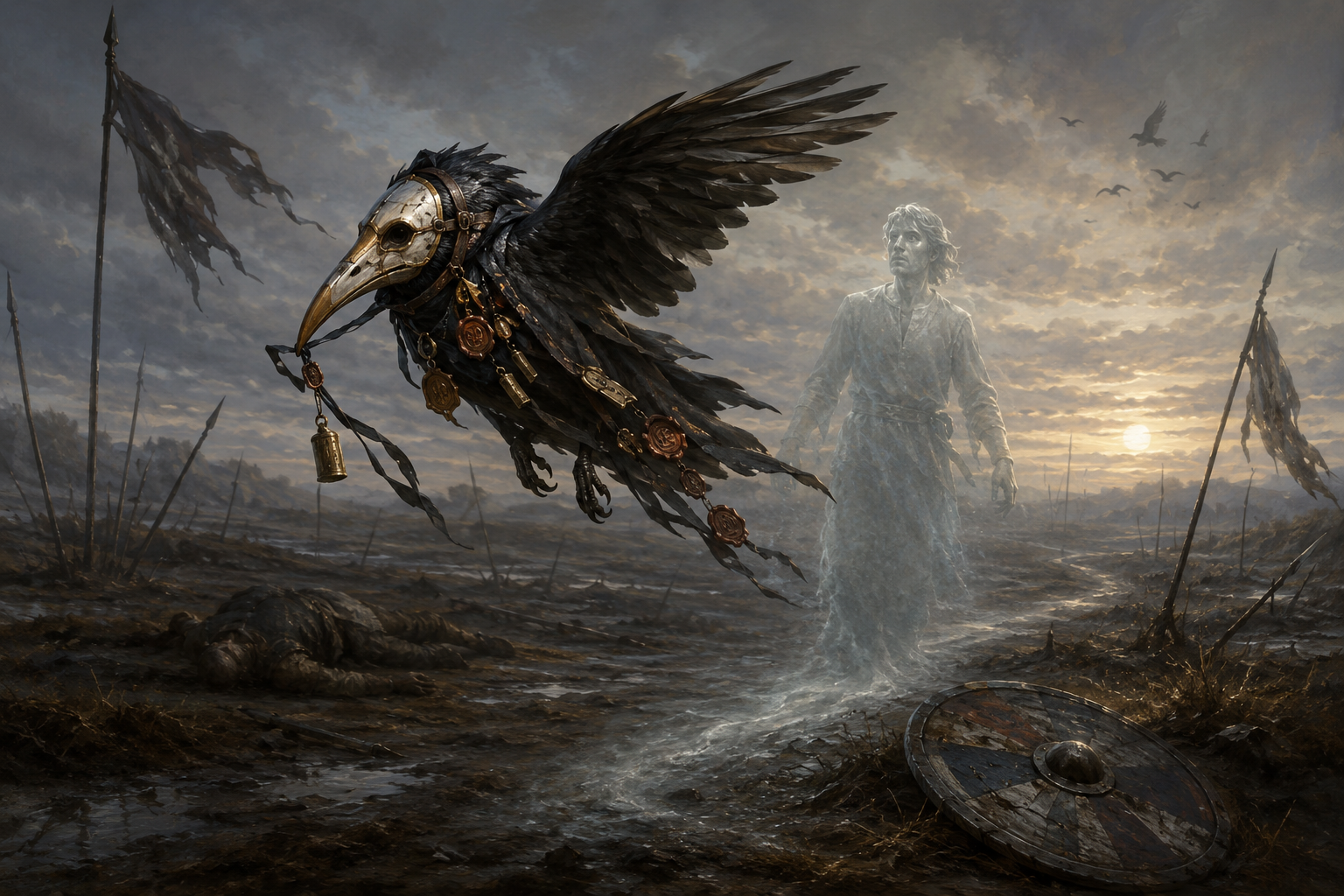
Perched awkwardly, this strange songbird stares with a glint of intellect in its empty eyes. A stylish plaster mask conceals its face, while two pairs of wings ruffle over its body’s somber shades.
Nosois eagerly fill the roles of clerks, scribes, and messengers in the bureaucracy of the hereafter. They record the circumstances of each mortal’s death, any judgments for and against its soul, and its final destination along the Outer Planes. But unlike more tireless, mechanical outsiders, nosois are also prone to powerful whims, boasting contests, and petty theft.
Mortals recognize nosois in their roles as messengers, counselors of troubled or disbelieving dead, and guides along the River of Souls, and some ancient texts refer to them as scribe psychopomps, death’s messengers, and yanakeion.
Many large and well-tended graveyards or catacombs play host to a nosoi who tends to the newly passed and keeps a watchful eye out for the looming taint of undeath. Nosois’ bodies take the form of mortal songbirds ‘usually crows, sparrows, and especially whippoorwills, though like all other psychopomps they wear graceful, elegant funerary masks that accentuate their sharp beaks and empty eyes. Many also craft decorative artificial tails from small bric-a-brac that trail behind them as they soar through the Boneyard.
Nosois are typically measure about 1 foot in length, though their tails may double or triple that length. They are deceptively heavy, weighing between 10 and 15 pounds.
| Nosoi |
| CR 2 XP 600 N Tiny outsider (extraplanar, psychopomp) Init +3; Senses Darkvision 60 ft., Low-Light Vision, spiritsense; Perception +9 |
| DEFENSE |
| AC 15, touch 15, flat-footed 12 (+3 Dexterity, +2 size) hp 19 (3d10+3) Fort +2, Ref +6, Will +4 DR 2/adamantine; Immune death effects, disease, poison; Resist cold 10, electricity 10 |
| OFFENSE |
| Speed 20 ft., Fly 50 ft. (good) Melee bite +8 (1d3-1) Space 2-1/2 ft.; Reach 0 ft. Special Attacks haunting melody Spell-Like Abilities (CL 3rd; concentration +6) At willinvisibility (self only) 3/dayspeak with dead (6 questions, CL 12th) 1/dayhide from undead (DC 14), sound burst (DC 15) |
| STATISTICS |
| Strength 8, Dexterity 16, Constitution 12, Intelligence 11, Wisdom 13, Charisma 16 Base Atk +3; CMB +4; CMD 13 Feats Alertness, Weapon Finesse Skills Fly +17, Knowledge (history) +6, Knowledge (planes) +6, Perception +9, Profession (scribe) +7, Sense Motive +3, Stealth +17 Languages Abyssal, Celestial, Infernal SQ change shape (raven or songbird [same statistics], Beast Shape II), spirit touch |
| SPECIAL ABILITIES |
| Haunting Melody (Su) A nosoi’s song has the power to grip the spirits of those that hear it. All living and undead creatures within a 60-foot spread must succeed at a DC 14 Will saving throw or be fascinated. A creature that successfully saves is not subject to that nosoi’s song for 24 hours. This effect continues for as long as the nosoi sings and for 1 round thereafter. A nosoi can sing for a number or rounds per day equal to twice its Hit Dice. This is a sonic mind-affecting charm effect. This ability can affect undead creatures, even though the undead subtype makes such creatures immune to mind-affecting effects (though undead creatures with immunity to mind-affecting effects from a source other than their creature type are still immune). The save DC is Charisma-based. |
| ECOLOGY |
| Environment any (Purgatory) Organization solitary, pair, or group (3-15) Treasure standard |
Ecology
Nosois serve within libraries and scriptoriums, tirelessly scribbling away without rest. Being social creatures, however, they frequently chatter with one another – boasting of past deeds, arguing over notation, and exchanging gossip from the far corners of creation. The immortal creatures toil for centuries before ascending to become higher psychopomps or, more likely, reincarnating on the mortal world.
Though outsiders have no need to eat, nosois consider doing so a rare treat. Their frequent sojourns to the Material Plane and many Outer Planes involve frequent snacks and tastings. Being dutiful but not unwavering, nosois sometimes succumb to bribes and share the information they possess, and mortal treats loosen their secrets far faster than gold or magic.
Nosoi Familiars
Nosois sometimes depart from their service to the bureaucracy of death to act as familiars to spellcasters with a special connection to or interest in death. Most relish the opportunity, and make useful assistants to spellcasters who keep extensive libraries or prefer meticulous records. They can be troublesome, though, given their natural curiosity and tendency to steal small objects. Any neutral caster of 7th level or higher and who has the Improved Familiar feat may summon a nosoi.
Nosois often use their skill as scribes to aid their mortal masters. Despite their size and apparent lack of hands, they may use medium-sized drawing and writing tools without penalty. They grant their masters a +2 bonus on skill checks made to scribe scrolls. Like all psychopomps, nosois loathe the undead. They immediately leave the service of any master who creates or permanently becomes such an abomination.
Section 15: Copyright Notice
Statistics from Pathfinder Roleplaying Game Bestiary 4 © 2013, Paizo Publishing, LLC; Authors: Dennis Baker, Jesse Benner, Savannah Broadway, Ross Byers, Adam Daigle, Tim Hitchcock, Tracy Hurley, James Jacobs, Matt James, Rob McCreary, Jason Nelson, Tom Phillips, Stephen Radney-MacFarland, Sean K Reynolds, F. Wesley Schneider, Tork Shaw, and Russ Taylor.
Ecology from Pathfinder Adventure Path #47: Ashes at Dawn. © 2011, Paizo Publishing, LLC; Author: Neil Spicer.
Nosoi Psychopomp, Pathfinder 1e / 3.5e
CR: 2
XP: 600
Alignment: N
Size and Type: Tiny Outsider, Extraplanar, Psychopomp
Initiative: +3
Senses: darkvision 60 ft., low-light vision, spiritsense 60 ft.; Perception +9
Defense
Armor Class: 15, touch 15, flat-footed 12 (+3 Dex, +2 size)
Hit Points: 19 (3d10 + 3)
Saving Throws: Fort +2, Ref +6, Will +4
Defensive Abilities: spirit touch
Damage Reduction: DR 2/adamantine
Immunities: death effects, disease, poison
Resistances: cold 10, electricity 10
Offense
Speed: 20 ft., fly 50 ft. good
Melee: bite +8 (1d3–1 plus spirit touch)
Space/Reach: 2-1/2 ft./0 ft.
Special Attacks: haunting melody
Spell-Like Abilities: CL 3rd; concentration +6
At will — invisibility self only
3/day — speak with dead
1/day — hide from undead, sound burst
Statistics
| STR | DEX | CON | INT | WIS | CHA |
| 8 | 16 | 12 | 11 | 13 | 16 |
Base Attack: +3
CMB/CMD: +4 / 13
Feats: Alertness, Weapon Finesse
Skills: Fly +17, Knowledge (history) +6, Knowledge (planes) +6, Perception +9, Profession (scribe) +7, Sense Motive +3, Stealth +17
Languages: Abyssal, Celestial, Infernal
Special Qualities: change shape, funerary scribe, spirit touch
Special Abilities
Change Shape (Su). A nosoi can assume the appearance of a raven, sparrow, whippoorwill, blackbird, or similar small bird. This functions as beast shape II, except that the nosoi’s statistics remain unchanged unless the GM decides ordinary disguise details matter.
Funerary Scribe (Ex). A nosoi gains a +4 racial bonus on checks to identify cause of death, interpret death records, understand burial customs, detect forged funerary documents, or record testimony from the dead.
Haunting Melody (Su). A nosoi can sing for a number of rounds per day equal to twice its Hit Dice. Living and undead creatures within 60 feet that can hear the song must succeed on a DC 14 Will save or become fascinated for as long as the nosoi sings and for 1 round thereafter. A creature that succeeds on the save is immune to that nosoi’s melody for 24 hours.
This is a sonic, mind-affecting charm effect, but it can affect undead despite their normal immunity from the undead type. The save DC is Charisma-based.
Spirit Touch (Su). A nosoi’s natural attacks are treated as ghost touch weapons.
Spiritsense (Su). A nosoi notices and locates living creatures, undead creatures, incorporeal spirits, and dead-but-unjudged souls within 60 feet, and can distinguish between those categories. This functions like blindsight for that limited purpose. It does not reveal identity, alignment, guilt, or intent.
Ecology
Environment: battlefields, cemeteries, plague sites, temples, underworld courts, psychopomp archives, and places of disputed death
Organization: solitary, pair, inquest of 3–6, or filing chorus of 7–15
Treasure: standard, usually in the form of tiny scrolls, rare ink, grave goods, wax seals, ivory tags, silver styluses, spirit-ledgers, or keys to funerary archives
Notes
A nosoi should not be run as a tiny damage-dealer. Its strongest play functions are scouting, witnessing, corpse-questioning, undead detection, and afterlife procedure.
Its speak with dead ability should provide useful but limited testimony. If the corpse has been mutilated, the soul is absent, the victim never saw the killer, or necromancy has interfered, the answer may be partial, symbolic, or procedural rather than complete.
A nosoi’s neutrality should matter in play. Intelligent undead, fiends, priests, necromancers, underworld officials, and creatures that understand the laws of death may recognise that killing one can have consequences beyond the immediate encounter. That recognition should influence behaviour, but it should not function as automatic immunity or diplomatic protection.
Treasure
A nosoi’s treasure is rarely coin. It carries tools, records, seals, and evidence.
Typical nosoi treasure may include:
- Silver funerary stylus: 25 gp.
- Vial of black grave-ink: 10 gp; worth 25 gp to a temple scribe, necromancer, psychopomp cult, or underworld court.
- Wax seal from a dead court: 5–50 gp, depending on age and political relevance.
- Ivory or brass death-tag: 10 gp as an object; far more valuable if it identifies a missing body.
- Tiny scroll tube of death records: 50–200 gp to the right court, temple, noble house, historian, or blackmailer.
- Spirit-ledger fragment: 100–500 gp if it proves inheritance, murder, battlefield misconduct, false execution, or soul theft.
- Funerary archive key: usually worthless to merchants, but priceless if it opens a sealed tomb, underworld registry, plague ledger, or ancestral hall.
The most valuable item is usually not obviously valuable. A single ledger page may prove that a noble heir was murdered, that a village plague was caused by corpse handling rather than divine punishment, that a battlefield “hero” executed prisoners, or that a ghost has been haunting the wrong house for fifty years.
Taking a nosoi’s records by force is not simple theft. It is interference with the passage of the dead.
Tactics
A nosoi avoids fair fights.
It watches invisibly, records what matters, and withdraws before violence begins. If cornered, it uses its song to delay attackers, slips into a mundane bird shape, or hides among rafters, branches, roof beams, or grave markers.
Against undead, it becomes braver. A nosoi may risk itself to identify a trapped soul, mark a corpse that must be burned, expose a necromancer’s interference, or guide adventurers toward the place where the dead are being held.
Against mortals, it prefers embarrassment, exposure, and procedure. It names witnesses. It repeats final words. It corrects false accounts. It leaves ink marks on guilty hands. It summons attention from stronger psychopomps when ordinary record-keeping is no longer enough.
Duties and Casework
A nosoi is usually defined by the death it has been sent to record. These duties do not create separate breeds of nosoi. They describe the kind of case occupying the creature’s ledger.
Battlefield Casework
On battlefields, a nosoi records the deaths most likely to be lied about afterward: prisoners killed after surrender, envoys murdered under truce, wounded soldiers abandoned, bodies stripped before identification, officers falsely credited with courage, and common soldiers buried beneath the wrong banner.
Such a nosoi may carry torn cloth, broken arrow tags, ransom knots, scraps of armour-lacing, or strips cut from the clothing of the unidentified dead. These objects are evidence, not trophies.
Use battlefield casework when war-law, ransom, safe-conduct, military honour, battlefield ghosts, or political aftermath matter.
Plague Casework
In plague houses and charnel yards, a nosoi records which deaths followed the sickness, which came from neglect, which bodies were burned too early, which names were omitted from the rolls, and which corpses failed to remain properly dead.
A plague nosoi may wear a darker, smoke-stained mask and carry vinegar-darkened records, grave-herb ink, and folded burial tags. It does not spread disease. Its presence means the boundary between ordinary death and failed death needs watching.
Use plague casework when the Red Death, corpse handling, mass burial, false death counts, plague panic, or undead emergence matters.
Court Casework
In halls of judgement, noble houses, ancestral shrines, royal tombs, and underworld archives, a nosoi records deaths whose legal meaning may outlive the body: executions, inheritances, disputed successions, suspicious accidents, broken oaths, concealed heirs, and murders disguised as lawful punishment.
A court nosoi knows seals, titles, witness forms, burial rights, and the difference between a lawful sentence and a killing made respectable after the fact.
Use court casework when succession, sacred law, trial procedure, ancestral judgement, disputed burial, or noble crime drives the adventure.
Adventure and Worldbuilding Hooks
The Bird on the Gallows
A nosoi perches on the town gallows every night and sings the same four notes. Anyone who hears the song dreams of a man hanged under the wrong name.
The magistrate wants the bird driven away before the execution anniversary. The dead man’s family wants the truth restored. The priesthood refuses to reopen the case unless someone can find the original death writ.
The Missing Line
A noble family’s death register contains one line scratched out so thoroughly that ordinary magic cannot restore it. A nosoi arrives to correct the omission, but three factions try to capture it before it writes the missing name.
The erased line is not a death.
It is a birth that changes the inheritance of a whole province.
The Plague Ledger
During a Red Death outbreak, a nosoi records which corpses rise and which remain properly dead. A frightened magistrate orders the ledger burned to prevent panic.
The ledger is the only evidence showing that every failed death passed through the same charnel house.
The Bribed Clerk
Someone has learned how to distract a nosoi with impossible food: seeds from trees that grow only in the land of the dead. The nosoi is not corrupt, but it is delayed, hungry, and increasingly addicted to memories that are not its own.
Each delay gives a necromancer more time to move stolen souls beyond ordinary recovery.
The Witness Under the Eaves
The adventurers kill a dangerous creature in self-defence. A nosoi records the death accurately. Later, a powerful faction claims the killing was murder.
The nosoi’s testimony can save the party, but only if they find it before someone else steals its record.
Using Nosois
A nosoi belongs wherever death has status.
That is the key test. Not every corpse needs one. A deer killed by wolves does not draw a death clerk. A murdered envoy might. A plague cart full of miscounted bodies might. A hanged innocent almost certainly might. A corpse hidden to steal land, title, dowry, debt, or blood-price is exactly the sort of death that draws a nosoi’s attention.
Nosois fit naturally into SpiralWorlds because they connect death to consequence without turning every scene into combat. They support murder investigations, undead stories, plague law, wrongful executions, battlefield aftermath, ancestral judgement, infernal contract disputes, and the legal status of intelligent beings.
They are also a useful check on adventurers.
A nosoi does not punish the party for fighting monsters. It does, however, make the world less disposable. If the party kills a prisoner, burns unidentified corpses, conceals a death, ignores a soul trapped by necromancy, or accepts a bounty without asking who legally authorised it, a nosoi may quietly appear.
It will not shout.
It will write.
Consequences of Interfering with a Nosoi
Harming a nosoi is rarely a local crime by itself. Many mortal courts may not even know what the creature is.
The consequences are usually stranger.
A death record may vanish. A corpse may refuse to answer. A ghost may become harder to lay to rest. A funeral rite may fail. A stronger psychopomp may arrive to ask why a neutral clerk was attacked. A devil may exploit the missing record. A murderer may walk free because the only accurate witness has been silenced.
If adventurers protect a nosoi, they may gain access to testimony no mortal court could obtain. If they destroy one, they may not be punished immediately, but the next death they need explained may remain stubbornly, dangerously silent.
Frequently Asked Questions
Is a nosoi undead?
No. A nosoi is a psychopomp, not an undead creature. It serves the order of death; it is not a corpse, ghost, wraith, plague spirit, or necromantic remnant.
Is a nosoi celestial?
No. In this entry, a nosoi is treated as a psychopomp: a neutral servant of death, passage, record, and judgement. It is not a good-aligned heavenly messenger.
Does a nosoi spread plague?
No. Even a plague nosoi does not spread disease by default. It records plague deaths, tracks failed death, and identifies when corpses or souls have been disturbed.
Can a nosoi lie?
A nosoi should not casually lie. It may withhold information, speak in procedural language, refuse to answer without proper cause, or record only what it can prove. Its power depends on being a reliable witness.
Should players fight a nosoi?
Usually no. A nosoi is better used as a witness, guide, clue-bearer, or complication. If players do fight one, the result should matter because a death record has been damaged or silenced, not because the nosoi was physically powerful.
Source, Natural History, and Mythic Context
The nosoi comes from the Pathfinder psychopomp tradition, where psychopomps are neutral servants of death, judgement, and the safe passage of souls. The nosoi is one of the smallest of these beings: a masked bird-spirit that serves as clerk, messenger, scribe, and witness. For rules reference, see the Pathfinder 1e Nosoi entry on Archives of Nethys and the Pathfinder 2e Nosoi entry on Archives of Nethys.
The nosoi should not be treated as an undead creature, celestial messenger, plague monster, or evil omen. Its proper role is administrative, spiritual, and judicial. It does not make death more horrible by adding gore or disease. It makes death more consequential by adding record, witness, procedure, and the possibility that a death may be corrected, challenged, or carried onward under its proper name.
The creature’s imagery draws on several older death-symbols at once: black birds as watchers of battlefield and graveyard, funerary masks as signs of ritual office, scribes as preservers of judgement, and the long-beaked plague-doctor silhouette as an image of formal distance from contagion and grief. The historical plague doctor is later than the default late medieval frame, but the image remains useful fantasy language when treated as a sign of office rather than as modern medical costume. For real historical context, see Encyclopaedia Britannica’s overview of the plague doctor.
The nosoi also belongs to the much older mythic pattern of the psychopomp: the figure who guides, escorts, records, judges, or witnesses the dead. Hermes, Charon, Anubis, the Valkyries, Yama’s servants, ancestral death-messengers, graveyard birds, and underworld officials all express different parts of this idea. Death is not only an ending. It is a crossing, and crossings require names, witnesses, offerings, laws, and memory.
In SpiralWorlds, this makes the nosoi especially useful. It gives the dead a small but persistent bureaucracy. It turns murder, plague, burial, execution, battlefield loss, disputed inheritance, and necromancy into matters of record. A nosoi’s mask is not there to make it monstrous. It is there to make it official.