
Jakotsubaba
An old woman wreathed in serpents, remembered above all for the blue snake at one hand and the red snake at the other.
The snakes are certain. Almost everything else is interpretation.
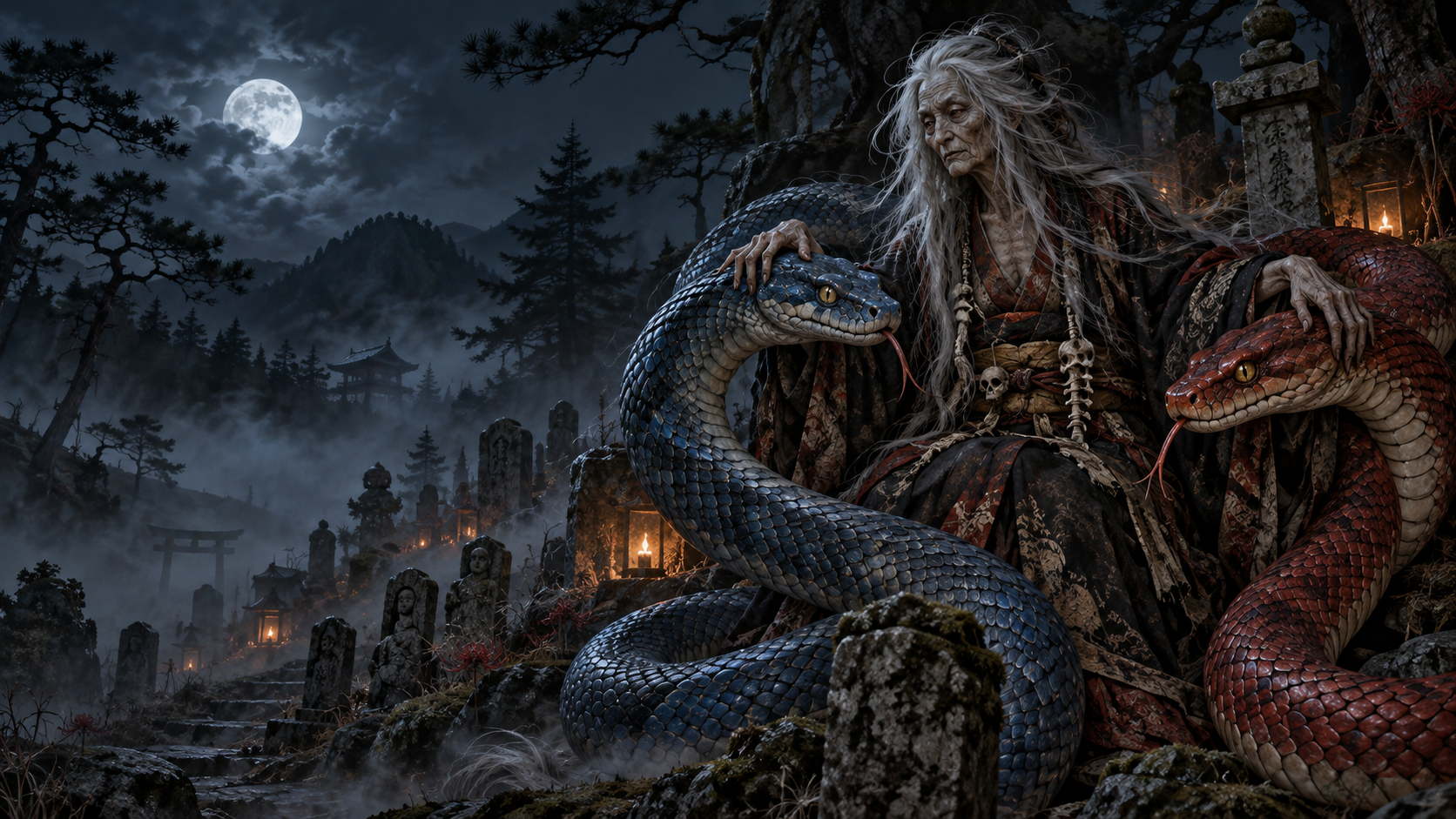
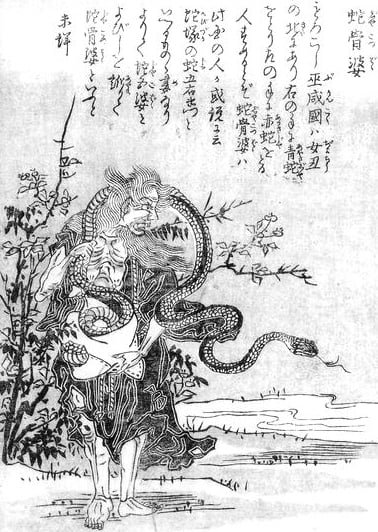
Jakotsubaba—蛇骨婆, the “Snake-Bone Hag”—is a yokai given enduring form by Toriyama Sekien in Konjaku Hyakki Shūi. His image shows an aged woman associated with enormous serpents, and his note reaches toward the Chinese Shan Hai Jing, whose Wuxian people are described with a blue snake in the right hand and a red snake in the left.
The historical tradition is unusually thin. There is no secure old body of stories describing Jakotsubaba as a cemetery guardian, an undead-hunter, or a creature with a fixed suite of magical powers. Even Sekien treats her origin uncertainly. Later writers expanded the image into stories about snake mounds, grave-keeping, elemental serpents and other powers.
Within the campaign, kami-aligned Jakotsubaba are warding spirits who bind themselves to old graves, serpent mounds and ancestral sites. That role preserves the useful older site material, but it is a campaign interpretation built on Sekien’s imagery rather than a claim about the historical folklore.
Game Statistics
No official D&D or Pathfinder Jakotsubaba statblock is used here. The older CR 8 rules on this page originated in Demiurge113’s Year of Yokai homebrew. The four versions below preserve that useful campaign concept while correcting the mechanics and separating it from the historical folklore.
Jakotsubaba — 5.5e / 2024
Medium Fey, Neutral • CR 8
Skills Intimidation +7, Perception +6, Religion +5, Stealth +7
Resistances Cold, Fire
Senses Darkvision 60 ft.; Passive Perception 16
Languages Common, Celestial; Telepathy 60 ft.
CR 8 (3,900 XP; PB +3)
Traits
Wardbound. While within 120 feet of the grave, mound or ancestral site it currently guards, the Jakotsubaba has Advantage on saving throws against spells and magical effects and regains 5 Hit Points at the start of its turn if it has at least 1 Hit Point.
Sense the Restless Dead. The Jakotsubaba knows the location of any Undead within 60 feet that isn’t behind total cover.
Actions
Multiattack. The Jakotsubaba makes two Twin Serpent attacks.
Twin Serpent. Melee Attack Roll: +7, reach 10 ft. Hit: 11 (2d6 + 4) Piercing damage plus 7 (2d6) Fire or Cold damage (Jakotsubaba’s choice).
Spectral Serpents (Recharge 5–6). Dexterity Saving Throw: DC 15, each creature of Jakotsubaba’s choice in a 20-foot-radius sphere within 60 feet. Failure: 27 (6d8) Force damage, and the target has the Restrained condition until the end of its next turn. Success: Half damage only.
Reaction
Defend the Ward. When a creature within 30 feet damages a corpse, grave marker, funerary object or the Jakotsubaba’s ward, the Jakotsubaba moves up to half its Speed without provoking Opportunity Attacks and makes one Twin Serpent attack against that creature.
Jakotsubaba — 5e / 2014
Medium fey, neutral
Armor Class 17 (natural armor)
Hit Points 136 (16d8 + 64)
Speed 30 ft.
Saving Throws Dex +7, Con +7, Wis +6
Skills Intimidation +7, Perception +6, Religion +5, Stealth +7
Damage Resistances cold, fire
Senses darkvision 60 ft., passive Perception 16
Languages Common, Celestial, telepathy 60 ft.
Challenge 8 (3,900 XP)
Traits
Wardbound. While within 120 feet of the site it guards, the Jakotsubaba has advantage on saving throws against spells and other magical effects and regains 5 hit points at the start of its turn if it has at least 1 hit point.
Detect Undead. The Jakotsubaba is continuously aware of undead within 60 feet as though using detect undead.
Actions
Multiattack. The Jakotsubaba makes two Twin Serpent attacks.
Twin Serpent. Melee Weapon Attack: +7 to hit, reach 10 ft., one target. Hit: 11 (2d6 + 4) piercing damage plus 7 (2d6) fire or cold damage.
Spectral Serpents (Recharge 5–6). Serpentine spirits fill a 20-foot-radius sphere centred on a point the Jakotsubaba can see within 60 feet. Each chosen creature in the area must make a DC 15 Dexterity saving throw, taking 27 (6d8) force damage and becoming restrained until the end of its next turn on a failure, or taking half damage without becoming restrained on a success.
Jakotsubaba — Pathfinder 1e
CR 8 XP 4,800
N Medium outsider (kami, native)
Init +8; Senses darkvision 60 ft., detect undead; Perception +17
Aura unnatural aura (30 ft.)
Defense
AC 21, touch 14, flat-footed 17 (+4 Dex, +4 armor, +3 natural)
hp 93 (11d10+33); fast healing 4
Fort +10, Ref +11, Will +10
DR 10/cold iron; Immune bleed, mind-affecting effects, petrification, polymorph; Resist acid 10, electricity 10, fire 10; SR 19
Offense
Speed 30 ft.
Melee 2 snakebites +16 (2d4+4/19–20 plus poison)
Space 5 ft.; Reach 5 ft. (10 ft. with snakebites)
Spell-Like Abilities (CL 11th; concentration +16)
Constant—detect undead, mage armor
3/day—spectral serpent (DC 18)
1/day—disrupting weapon, mass cure moderate wounds (DC 21)
Statistics
Str 18, Dex 19, Con 17, Int 13, Wis 16, Cha 20
Base Atk +11; CMB +15; CMD 29
Feats Combat Casting, Combat Reflexes, Dazzling Display, Improved Critical (snakebite), Improved Initiative, Weapon Focus (snakebite)
Skills Intimidate +19, Knowledge (religion) +15, Perception +17, Sense Motive +17, Spellcraft +15, Stealth +18, Survival +17
Languages Common, Celestial; telepathy 100 ft.
SQ merge with ward, ward (grave, serpent mound or ancestral site)
Ecology
Environment temperate land
Organization solitary
Treasure standard
Special Abilities
Poison (Ex). Snakebite—injury; Fortitude DC 18; frequency 1/round for 6 rounds; effect 1d3 Dexterity damage; cure 2 consecutive saves.
Spectral Serpent (Sp). This functions as spiritual weapon, except a creature struck must succeed on a DC 18 Reflex save or become entangled for 1 round. Treat it as a 3rd-level spell.
Jakotsubaba — D&D 3.5e
| Size/Type | Medium Outsider (Native) |
|---|---|
| Hit Dice | 11d8+33 (82 hp) |
| Initiative | +8 |
| Speed | 30 ft. (6 squares) |
| Armor Class | 21 (+4 Dex, +4 armor, +3 natural), touch 14, flat-footed 17 |
| Base Attack/Grapple | +11/+15 |
| Attack | Snakebite +16 melee (2d4+4/19–20 plus poison) |
| Full Attack | 2 snakebites +16 melee (2d4+4/19–20 plus poison) |
| Space/Reach | 5 ft./5 ft. (10 ft. with snakebites) |
| Special Attacks | Poison, spectral serpent, spell-like abilities |
| Special Qualities | Darkvision 60 ft., fast healing 4, DR 10/cold iron, resistance to acid 10, electricity 10 and fire 10, SR 19, wardbound |
| Saves | Fort +10, Ref +11, Will +10 |
| Abilities | Str 18, Dex 19, Con 17, Int 13, Wis 16, Cha 20 |
| Skills | Concentration +17, Intimidate +19, Knowledge (religion) +15, Listen +17, Sense Motive +17, Spellcraft +15, Spot +17, Survival +17 |
| Feats | Combat Casting, Combat Reflexes, Improved Critical (snakebite), Improved Initiative, Weapon Focus (snakebite) |
| Environment | Temperate land |
| Organization | Solitary |
| Challenge Rating | 8 |
| Treasure | Standard |
| Alignment | Usually neutral |
| Advancement | 12–18 HD (Medium) |
| Level Adjustment | — |
Special Abilities
Poison (Ex). Injury, snakebite; Fortitude DC 18; initial and secondary damage 1d3 Dexterity.
Spectral Serpent (Sp). Three times per day, the Jakotsubaba creates a spectral serpent that functions as spiritual weapon. A creature struck must also succeed on a DC 18 Reflex save or become entangled for 1 round.
Wardbound (Su). The Jakotsubaba designates one grave, mound or ancestral site as its ward. While within 120 feet of that place, its fast healing functions; if the ward is destroyed or desecrated, the fast healing is suppressed until the site is restored or a new ward is established.
Behaviour
A Jakotsubaba does not wander without purpose. In the campaign, she chooses a place that matters—an ancestral grave, serpent mound, forgotten battlefield burial, or old funerary enclosure—and becomes part of its defence. She watches first, frightens second and attacks only when a trespasser refuses to withdraw or begins disturbing the ward.
Her two serpents are not pets in the ordinary sense. They move with her attention, taste the air when she senses danger and strike along impossible angles. The red and blue colouring comes directly from the imagery associated with Sekien’s source; the campaign gives those colours supernatural force, but historical accounts do not securely assign them fixed fire-and-ice powers.
Jakotsubaba are especially hostile to creatures that disturb corpses or manipulate the dead. That makes Jikininki, necromancers and grave robbers natural enemies, but it also means an adventuring party can earn cooperation by proving that it has come to stop the same desecration.
If Violence Starts
She warns before she commits. A hiss from both serpents, a sudden spectral coil across the path or a display of supernatural force gives intruders one last chance to leave.
She controls movement. Spectral serpents restrain or entangle enemies while the living snakes attack from ten feet away.
She prioritises desecrators. Anyone touching a corpse, grave marker, funerary object or ward becomes the immediate target.
She uses the ward as terrain. Narrow grave paths, stones, trees and burial mounds force attackers to approach on terms that favour reach and magical restraint.
She does not chase far. Once intruders abandon the protected place, a Jakotsubaba normally breaks pursuit and returns to the ward.
The Snake-Bone Hag in Sekien
Jakotsubaba appears in Toriyama Sekien’s late-eighteenth-century Konjaku Hyakki Shūi. The name can be read as “Snake-Bone Hag.” Sekien connects her to a passage in the Chinese Shan Hai Jing describing the people of Wuxian, who carry a blue snake in the right hand and a red snake in the left.
That does not give us a complete old legend. Modern researchers and translators regularly note that Jakotsubaba has no securely attested local tradition comparable to better-known yokai. The name had also circulated as an insulting term for an old woman before Sekien gave it a monstrous image. Later stories about a husband, a snake mound, grave-keeping and elemental serpent powers are useful descendants of the image, but they should not be projected backwards as certain Edo-period folklore.
Relationships & Other Creatures
Aoandon. Both are yokai strongly associated with Toriyama Sekien, but Aoandon grows out of ghost-story ritual and blue lantern-light while Jakotsubaba is defined first by the old woman and her serpents.
Oni. Oni are far more openly predatory and physical. A Jakotsubaba guarding a site may oppose an oni that treats the same place as hunting ground.
Jikininki. Corpse-eating undead are exactly the kind of threat the campaign’s grave-warding Jakotsubaba has reason to fight.
Guardian Naga. The two creatures come from different traditions, but both make useful comparisons for a serpent-associated guardian whose first purpose is protecting a place rather than hunting travellers.
Encounter Ideas
The Grave She Will Not Leave
A ruined burial mound blocks the only safe route through a valley. The Jakotsubaba guarding it is not the reason travellers have vanished nearby.
The Corpse-Eater
A Jikininki has learned to lure travellers into attacking the terrifying old woman who keeps it away from a mass grave.
Blue Snake, Red Snake
Only one serpent is visible when the party arrives. The missing snake has followed somebody who removed an object from the ward.
The Empty Mound
The Jakotsubaba is gone, the grave is open and every snake in the surrounding forest is moving in the same direction.
Detecting the Wrong Dead
A use of detect undead reveals something beneath the ward that the Jakotsubaba has spent decades containing rather than destroying.
The Serpent Guardian
A Guardian Naga and Jakotsubaba both claim responsibility for the same sacred threshold—and disagree about who is trespassing.
Explore Further
Sources & Licensing
Historical folklore: Toriyama Sekien’s Konjaku Hyakki Shūi is the core historical source for Jakotsubaba. Modern yokai scholarship and translations are used to distinguish Sekien’s image and uncertain etymology from later elaborations.
Legacy RPG material: the older CR 8 Jakotsubaba formerly reproduced on this page originated in Demiurge113’s Year of Yokai. Its grave-guardian role, kami classification and several abilities are retained here as campaign adaptation rather than presented as historical folklore or official Pathfinder material.
5.5e / 2024, 5e / 2014, Pathfinder 1e and D&D 3.5e: campaign conversions using the shared CR 8 concept, with edition-native mechanics and corrected legacy arithmetic.
Further folklore reading: Matthew Meyer — Jakotsu Babā.
Historical image: Toriyama Sekien, public-domain scan via Wikimedia Commons.