
Iron Golem — The Furnace Sentinel
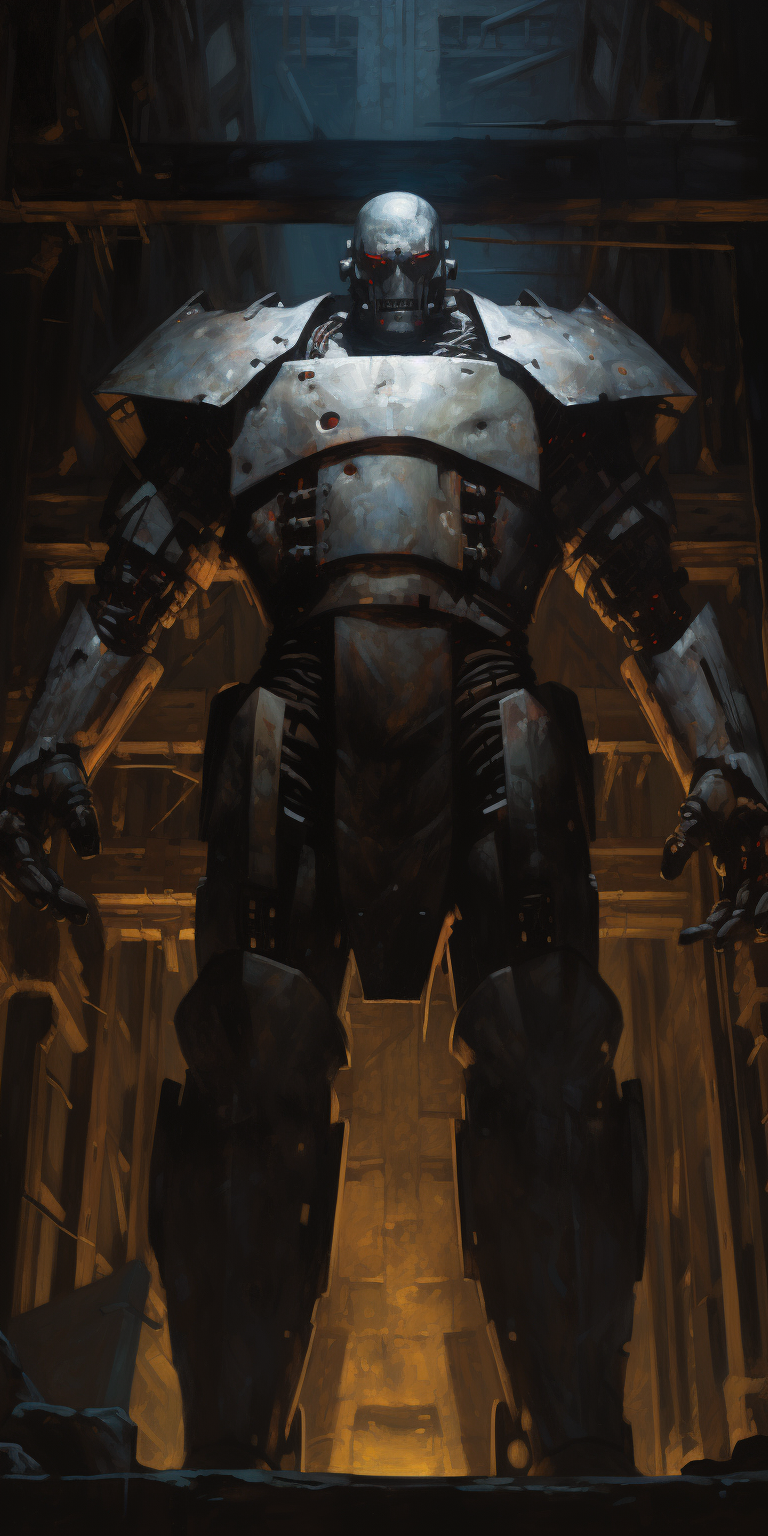
The forge was abandoned long ago. Rust collects on the chains above the furnace, and a collapsed catwalk hangs over the unlit coals. Yet someone has been polishing the lock of the inner armoury. When the iron guardian steps from behind the blast door, its feet strike the flagstones with the sound of falling anvils. Its orders do not end with the death of the smith who wrote them.
Behaviour and Binding
An iron golem does not crave violence or delight in fear. Its makers have imprisoned an animating force inside a body of forged plates, heavy rivets and worked iron. It holds a post, follows a written pattern of patrols, or strikes anyone the binding defines as a threat. A centuries-old instruction may turn today’s rightful keeper into a trespasser. An heir with a false seal may command a loyal guardian as easily as an honest master with the true one.
Dwarven ward-smiths first established enduring mortal golem-making as a way of protecting refuge gates, clan stores and workshops from the giant successor kingdoms. Ironworking guilds have refined the tradition into some of its hardest guardians. Elsewhere, master artificers, princely patrons and specialist divine forges have built similar beings by borrowing, buying or stealing the method; some claim instruction from the divine smith Hephaestus.
Appearance, Habitat and Makers
Unlike a clockwork automaton, an iron golem need not have visible gears. Some resemble a knight cast as a single walking suit of armour, others a helmeted smith, an ancient city’s gate warden or a figure from a forgotten dwarven victory. Most stand about twelve feet tall. Their mass makes wooden floors and unsupported galleries unsafe; stone vaults, foundry halls, siege arsenals and underground holdfasts provide firmer footing.
Heat can be a sign that the bound forge-magic remains active, but flames do not harm a golem in the fifth-edition versions. Older rulesets make the relationship more particular: Fire repairs damaged iron, Electricity can slow its movement, and powerful rusting magic can unmake even the finest shell.
What the Iron Golem Is Doing Now
Deep beneath a merchant town, a guild furnace has begun burning without coal. Each night the golem gathers scrap metal from bridges and gates, then carries it into the sealed foundry. It has been ordered to assemble replacement weapons for a war that ended three generations ago. The smiths want the furnace reclaimed, the town watch fears the missing gate fittings will make the walls unsafe, and an ageing dwarven magistrate knows whose signature remains pressed into the original command plate.
Meeting the Golem in Play
A golem is most threatening when the party must hold ground: a bridge they cannot abandon, an armoury they need to enter, a gallery too narrow for everyone to escape or a market crowded with innocents. Its obedience can be exploited, but only if the adventurers understand the wording of the command. Anyone who mistakes an old forge servant for a creature that can be bribed may learn otherwise with the first blow.
Know the edition. In 2024 it can make fiery ranged attacks and breathe poison across a broad cone; in 2014 it wields a sword or fist and carries narrower poison breath. Pathfinder and 3.5e employ a lingering toxic cloud and a particular response to Electricity, Fire and rust. Those abilities must not be mixed between tabs.
Iron Golem Stat Blocks
Select the edition used at the table. The four versions below reproduce their different sizes, hit points, attacks and magical traits rather than adding legendary actions to a standard monster.
Iron Golem — D&D 2024
Large Construct, Unaligned · CR 16 (15,000 XP; PB +5)
AC 20 · Initiative +9 (19) · HP 252 (24d10 + 120) · Speed 30 ft.
| STR | DEX | CON | INT | WIS | CHA |
|---|---|---|---|---|---|
| 24 (+7) | 9 (−1) | 20 (+5) | 3 (−4) | 11 (+0) | 1 (−5) |
Immunities Fire, Poison, Psychic damage; Charmed, Exhaustion, Frightened, Paralyzed, Petrified, and Poisoned conditions. Senses Darkvision 120 ft.; Passive Perception 10. Languages Understands Common plus two other languages but can’t speak.
Traits
Fire Absorption. Whenever Fire damage would be dealt to the golem, it instead regains that many Hit Points.
Immutable Form. The golem can’t shape-shift. Magic Resistance. The golem has Advantage on saving throws against spells and other magical effects.
Actions
Multiattack. The golem makes two attacks, using Bladed Arm or Fiery Bolt in any combination.
Bladed Arm. Melee Attack Roll +12, reach 10 ft.; hit 20 (3d8 + 7) Slashing plus 10 (3d6) Fire damage.
Fiery Bolt. Ranged Attack Roll +10, range 120 ft.; hit 36 (8d8) Fire damage.
Poison Breath (Recharge 6). Constitution saving throw DC 18 for every creature in a 60-foot cone; failure 55 (10d10) Poison damage, success half.
Published 2024 Basic Rules: Iron Golem, SRD 5.2.1 (CC BY 4.0).
Iron Golem — D&D 2014
Large construct, unaligned · CR 16 (15,000 XP)
AC 20 (natural armor); HP 210 (20d10 + 100); Speed 30 ft.
| STR | DEX | CON | INT | WIS | CHA |
|---|---|---|---|---|---|
| 24 (+7) | 9 (−1) | 20 (+5) | 3 (−4) | 11 (+0) | 1 (−5) |
Damage Immunities Fire, Poison, Psychic, and Bludgeoning/Piercing/Slashing from nonmagical attacks that aren’t adamantine. Condition Immunities Charmed, Exhaustion, Frightened, Paralyzed, Petrified, Poisoned.
Senses Darkvision 120 ft.; Passive Perception 10. Languages Understands its creator’s languages but can’t speak.
Traits
Fire Absorption. When Fire damage would be dealt, the golem takes none and instead regains an equivalent number of Hit Points.
Immutable Form. Immune to any effect that would alter its shape. Magic Resistance. Advantage on saving throws against spells and other magical effects. Magic Weapons. Its weapon attacks are magical.
Actions
Multiattack. Two melee attacks with Slam or Sword.
Slam. Melee Weapon Attack +13, reach 5 ft.; hit 20 (3d8 + 7) Bludgeoning damage.
Sword. Melee Weapon Attack +13, reach 10 ft.; hit 23 (3d10 + 7) Slashing damage.
Poison Breath (Recharge 6). The golem exhales poison gas in a 15-foot cone. Creatures in the area make a DC 19 Constitution saving throw, taking 45 (10d8) Poison damage on failure or half on success.
Published D&D 2014 SRD 5.1: Iron Golem (CC BY 4.0).
Iron Golem — Pathfinder 1e
CR 13 · XP 25,600 · N Large construct
Initiative −1; Senses Darkvision 60 ft., low-light vision; Perception +0.
Defence
AC 28 (touch 8, flat-footed 28; −1 Dex, +20 natural, −1 size); HP 129 (18d10 + 30); Fort +6, Ref +5, Will +6. DR 15/adamantine; immune to construct traits and most magic.
Offence
Speed 20 ft.; Melee two slams +28 (2d10 + 16, critical 19–20); Space/Reach 10 ft./10 ft.; Special Attacks Breath Weapon, Powerful Blows.
| STR | DEX | CON | INT | WIS | CHA |
|---|---|---|---|---|---|
| 32 (+11) | 9 (−1) | — | — | 11 (+0) | 1 (−5) |
Base Atk +18; CMB +30; CMD 39; Organization solitary or gang (2–4); Treasure none.
Special Abilities
Breath Weapon (Su). A 10-foot cube of poisonous gas as a free action every 1d4 + 1 rounds. The cloud persists for one round. Inhaled poison: Fort DC 19, once per round for four rounds; each failed save inflicts 1d4 Constitution damage; two successful saves cure it.
Powerful Blows (Ex). The golem adds one and a half times its Strength bonus to Slam damage and threatens a critical hit on 19–20.
Immunity to Magic (Ex). Immune to spells and spell-like abilities that allow spell resistance. Magical Electricity slows it for three rounds, no save. Magical Fire breaks any such slowing and heals 1 HP per 3 points of Fire damage that would have been dealt; excess healing becomes temporary HP. Rusting grasp and rust-monster attacks work normally.
Construction
5,000 lb. of iron treated with rare tinctures costing 10,000 gp. CL 16th; Price 150,000 gp; Cost 80,000 gp. Requires Craft Construct, cloudkill, geas/quest, limited wish, and polymorph any object; Craft (armor or weapons) DC 21, creator CL 16th.
Published Pathfinder 1e Bestiary: Iron Golem (OGL).
Iron Golem — D&D 3.5e
Large construct, neutral · CR 13
HD 18d10 + 30 (129 HP); Initiative −1; Speed 20 ft. (4 squares).
AC 30 (−1 size, −1 Dex, +22 natural), touch 8, flat-footed 30; DR 15/adamantine; immune to construct traits and most magic; Darkvision 60 ft., low-light vision.
Base Atk/Grapple +12/+28; Attack Slam +23 melee (2d10 + 11); Full Attack two slams +23 (2d10 + 11); Space/Reach 10 ft./10 ft.
| STR | DEX | CON | INT | WIS | CHA |
|---|---|---|---|---|---|
| 33 (+11) | 9 (−1) | — | — | 11 (+0) | 1 (−5) |
Saves Fort +6, Ref +5, Will +6. Skills —; Feats —; Organization solitary or gang (2–4); Treasure none; Alignment always neutral; Advancement 19–24 HD (Large), 25–54 HD (Huge).
Special Abilities
Breath Weapon (Su). As a free action every 1d4 + 1 rounds, a 10-foot cube of poison gas persists for one round. Fort DC 19 negates; initial damage 1d4 Constitution and secondary damage 3d4 Constitution.
Immunity to Magic (Ex). Spells and spell-like abilities that allow spell resistance usually fail. Magical Electricity slows the iron golem for three rounds without a save; magical Fire breaks this slow effect and repairs 1 HP per 3 points of Fire damage that would otherwise be dealt, with excess becoming temporary HP. Rust-monster attacks and rusting grasp affect it normally.
Construction
The body requires 5,000 lb. of iron and 10,000 gp in rare treatments; Craft (armorsmithing or weaponsmithing) DC 20. CL 16th; Price 150,000 gp; Cost 80,000 gp + 5,600 XP. Requires Craft Construct, cloudkill, geas/quest, limited wish and a creator of at least level 16.
Published D&D 3.5e SRD: Iron Golem (OGL).
Warnings Before the Fight
The scraping of a fist against a passage wall is the nearest thing an iron golem has to a threat. In older halls, a ward-smith may have painted caution marks at ankle height, the level a fleeing child could see. Iron spikes hammered into the floor may mark a safe stopping point. A sealed chimney could carry poisonous vapour away from the guardroom; if someone has blocked it, the same defensive weapon can harm those the golem was made to protect.
Adventure Encounters
The Armoury That Never Empties
A guild’s iron guardian has stripped the town gates for scrap, obeying an obsolete wartime order to prepare a reserve arsenal. The adventurers can negotiate with its claimants, recover the original maker’s seal, reopen its intended ore store, or trap the creature until the command can be rewritten. Breaking it ends the thefts but may destroy the only defender capable of stopping a coming siege.
The Furnace Oath
A patron promises access to a forgotten furnace in return for escort through a dwarven ruin. The iron golem guarding it was instructed to keep molten iron from leaving the chamber. The patron’s plan is to cast ingots outside the furnace door, making them technically no longer molten; the golem’s interpretation could turn that legal trick into a massacre. A missing phrase in the smelting charter may be the only safe key.
The Smith’s False Hand
An impostor in Prague bears a command gauntlet stolen from a dead ward-smith and is using a golem to seize guild property. A rival mason can prove the hand is forged but cannot convince the construct. The party must recover the real signet, expose the claimant at the guild meeting, or lure the golem away from the crowded hall without letting the thief escape.
Rewards and Consequences
A functioning golem may be worth more than its raw iron. A binding plate, command gauntlet, annotated golem manual, forge diagrams, or the legal right to maintain a dwarven gate can change the power of an entire district. Destroying an iron guardian wins access to a vault but may leave the vault unguarded when a worse enemy arrives.
Related Monsters, Magic and Materials
Explore the golem family, Stone Golem, Clay Golem, Clockwork Golem, adamantine, rusting grasp, and cloudkill. Other metalwork in the world’s holds tells a different story of what a maker considers worth defending.
Rules sources: D&D SRD 5.2.1 and SRD 5.1 (CC BY 4.0); Pathfinder 1e and D&D 3.5e SRDs (Open Game License). The scenario material is original campaign content. Follow edition references for full rule definitions and licensing.
Keep this reference growing
If this page helped with your reading or game, you can support its upkeep or explore the curated books.
Explore the Bookshop — epics, classics and stories behind imagined worlds.