
Wolf-in-Sheep’s-Clothing
Aberration • Forest Ambush Predator • Corpse-Lure Hunter
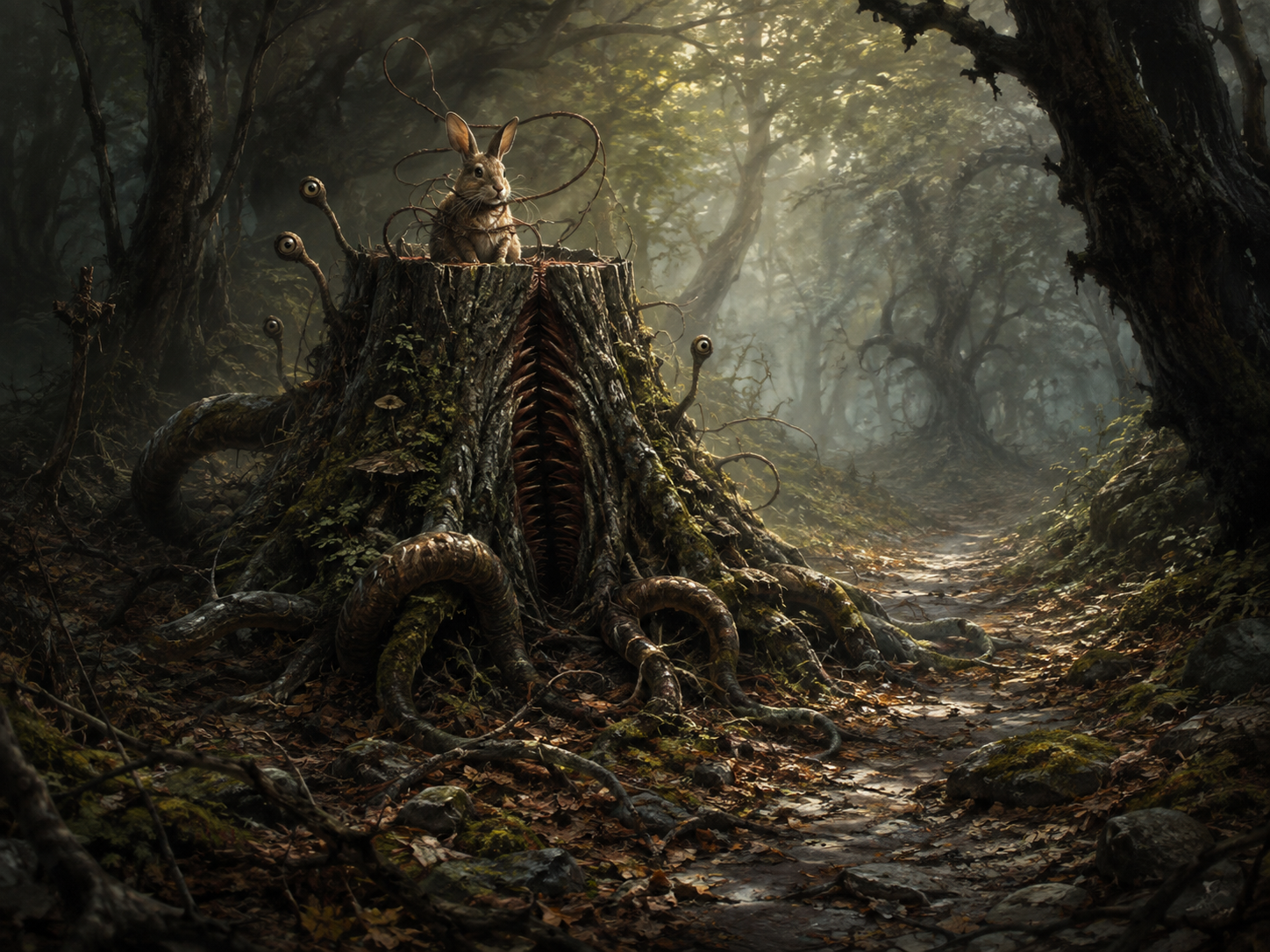
A harmless animal sits upon a weathered stump beside a lonely forest trail. The animal is already dead. The stump is watching.
The wolf-in-sheep’s-clothing does not imitate innocence with an illusion. It kills something innocent, threads the corpse with living filaments, and makes the dead creature move.
Appearance
At rest, a wolf-in-sheep’s-clothing resembles a broad, decaying tree stump whose exposed roots disappear into the soil. The resemblance is biological rather than magical. Its bark-like hide is leathery flesh, its thick roots are muscular tentacles, and narrow eyestalks can lie against neighbouring vegetation until the creature chooses to reveal them.
A closed vertical mouth can pass for a split in old timber. When prey is dragged close, that seam opens into a powerful feeding maw.
Its apparently harmless passenger is more disturbing still. In the corpse-lure form of the monster, the rabbit, bird, squirrel or similar creature sitting upon the stump is genuinely dead. Fine filaments grow through the carcass and pull its limbs, head and skin into crude approximations of life.
A normal adult is roughly four to five feet across and weighs about 200 pounds. Exceptional specimens continue growing long after maturity, but they retain the same fundamental body plan: a low, root-heavy mass disguised as dead or damaged wood.
Behaviour
The wolf-in-sheep’s-clothing is a creature of patience rather than pursuit. It chooses a place where a harmless animal would not immediately appear suspicious, settles into the surrounding soil and can remain almost motionless while its lure provides the movement that attracts attention.
The puppet may look around, shiver, attempt to hide or appear injured. Predators approach because they see easy prey. Travellers may approach because they believe the animal is trapped, wounded or strangely tame. The aberration needs only to bring a victim within reach of its root-tentacles.
It is not compelled to attack everything that passes. A wolf-in-sheep’s-clothing can recognise an obviously dangerous group and remain dormant until the threat has gone. Older specimens often become more selective, preferring intelligent or powerful prey.
Habitat
Wolves-in-sheep’s-clothing favour forests because their permanent stump-like anatomy provides natural camouflage there. Old game trails, logging tracks, woodland clearings, overgrown ruins, hunting paths and isolated forest roads are particularly effective hunting grounds.
Their apparent rootedness is deceptive. Movement is extremely slow, but an individual can crawl upon its root-tentacles and force itself through loose earth when relocation becomes necessary.
Fire is normally met by working into the soil, throwing loose earth over the exposed body and remaining underground until the immediate danger has passed.
Game Statistics
The Pathfinder and SpiralWorlds 5.5e versions use the corpse-lure incarnation of the creature. The older D&D 3.5e conversion retains its earlier self-grown lure. Advancement, Challenge Rating and rarity are handled independently inside each rules edition.
Wolf-in-Sheep’s-Clothing
Medium Aberration, NeutralArmor Class 18 (natural armor)
Hit Points 152 (16d8 + 80)
Speed 10 ft., burrow 5 ft., climb 10 ft.
Saving Throws Con +8, Wis +5
Skills Perception +8, Stealth +6
Senses darkvision 60 ft., passive Perception 18
Languages —
Challenge 8 (3,900 XP; Proficiency Bonus +3)
SpiralWorlds Rarity Rare
All-Around Vision. The wolf-in-sheep’s-clothing has Advantage on Wisdom (Perception) checks that rely on sight.
False Appearance. While the wolf-in-sheep’s-clothing remains motionless and partly buried in natural forest terrain, its main body is visually indistinguishable from an old tree stump until it moves, attacks or is physically examined.
Corpse Lure. Over the course of 10 minutes, the wolf-in-sheep’s-clothing can thread fine filaments through the corpse of a Tiny or smaller creature and secure it to the top of its body. It can manipulate the corpse on its turn without taking an action, causing crude but convincing movements appropriate to the dead creature.
The corpse cannot leave the surface of the monster or perform meaningful actions. A creature within 10 feet that deliberately examines the lure can make a DC 16 Intelligence (Investigation) or Wisdom (Medicine) check. On a success, it recognises signs of death, unnatural movement or the fine filaments controlling the body.
When preparing a corpse lure, a mature wolf-in-sheep’s-clothing can seed the carcass with one of its eggs. A creature that consumes part of such a lure must succeed on a DC 16 Constitution saving throw or become implanted as described under Implant Egg. This does not expend the monster’s daily use of Implant Egg.
Rooted Stability. The wolf-in-sheep’s-clothing has Advantage on ability checks and saving throws made to resist being pushed, pulled, knocked Prone or otherwise moved against its will.
Many Tentacles. The creature possesses eight major root-tentacles but brings only part of this mass to bear efficiently at any one time. It can have up to four creatures Grappled simultaneously. A tentacle grappling a creature cannot be used to attack another target until that grapple ends.
Multiattack. The wolf-in-sheep’s-clothing makes three Tentacle attacks and then makes one Bite attack against a creature it is Grappling. If it has no eligible creature to Bite, it makes a fourth Tentacle attack instead.
Tentacle. Melee Attack Roll: +7, reach 15 ft., one target. Hit: 8 (1d8 + 4) Bludgeoning damage. If the target is Large or smaller, it is Grappled (escape DC 15), and the wolf-in-sheep’s-clothing can pull it up to 5 feet toward itself.
Bite. Melee Attack Roll: +7, reach 5 ft., one creature Grappled by the wolf-in-sheep’s-clothing. Hit: 13 (2d8 + 4) Piercing damage.
Implant Egg (1/Day). The wolf-in-sheep’s-clothing targets one creature it is Grappling that is also Restrained, Incapacitated or Unconscious. The target must succeed on a DC 16 Constitution saving throw or become implanted with a parasitic egg.
Constrict. One creature Grappled by the wolf-in-sheep’s-clothing takes 11 (2d6 + 4) Bludgeoning damage and becomes Restrained until the grapple ends.
The wolf-in-sheep’s-clothing can have only one creature Restrained by Constrict at a time. Using Constrict against a different creature ends the Restrained condition on the previous target but does not end that creature’s grapple.
Implanted Egg. After 24 hours, and again after each subsequent 24 hours while the egg remains, the host must make a DC 16 Constitution saving throw.
On a failed save, the host’s Hit Point Maximum is reduced by 10 (3d6), and any accumulated successful saves are lost. On a successful save, no reduction occurs. Three consecutive successful saves destroy the egg.
If the host’s Hit Point Maximum reaches 0 while implanted, the host dies and the juvenile emerges.
Magic capable of ending a disease or parasitic infestation destroys the egg. It can also be removed by a one-hour surgical procedure followed by a successful DC 20 Wisdom (Medicine) check. The procedure deals 10 (3d6) Slashing damage to the host whether the check succeeds or fails.
Once the egg dies or is removed, any Hit Point Maximum lost to the infestation is restored after a Long Rest.
5.5e Tactics
The monster waits until at least one creature is well within tentacle reach before revealing itself. Its first priority is to seize several targets while preventing the most vulnerable victim from escaping.
Constrict allows it to pin one captive securely while its other tentacles hold companions at a distance. Against prey suitable for reproduction, it may maintain that restraint long enough to use Implant Egg on its following turn.
The statistics above represent the normal adult. Exceptional individuals can continue growing for decades or centuries. The following are distinct SpiralWorlds encounter forms rather than automatic age bonuses.
| Form | Rarity | Benchmark CR | Dormant Appearance | Mechanical Changes | Corpse Lure |
|---|---|---|---|---|---|
| Adult | Rare | 8 | A broad rotten stump roughly four to five feet across. Root-tentacles resemble exposed tree roots and its eyestalks can pass for shoots or fungi. | Medium; PB +3; AC 18; 152 hp; Str 18; Con 20; Tentacle +7, 15-ft. reach, 8 (1d8 + 4); Bite +7, 13 (2d8 + 4); Constrict 11 (2d6 + 4); escape DC 15; Implant Egg DC 16; up to four creatures Grappled. | Tiny |
| Large Elder | Very Rare | 12 | Resembles the enormous stump of a felled old-growth tree, often eight to twelve feet across. Moss, ivy, fungi and leaf litter may genuinely grow over its hide. Its mouth looks like a rotten cavity or deep lightning split. | Large; PB +4; AC 19; 195 hp (17d10 + 102); Str 22; Con 22; Tentacle +10, 20-ft. reach, 15 (2d8 + 6); Bite +10, 19 (3d8 + 6); Constrict 16 (3d6 + 6); escape DC 18; Implant Egg DC 18; up to four creatures Grappled. | Small |
| Huge Ancient | Extremely Rare | 15 | Looks like the shattered base of an ancient tree, roughly fifteen to twenty-five feet across. Broken hollow-looking lobes resemble the remains of a storm-split trunk while its root-tentacles spread across much of a clearing. | Huge; PB +5; AC 19; 243 hp (18d12 + 126); Str 24; Con 24; Tentacle +12, 25-ft. reach, 20 (3d8 + 7); Bite +12, 25 (4d8 + 7); Constrict 21 (4d6 + 7); escape DC 20; Implant Egg DC 20; up to five creatures Grappled. | Medium |
| Primeval Specimen | Legendary | 18 | May be mistaken for an entire ancient tree ruin or root-covered mound occupying thirty to fifty feet of forest floor. Several stump-like crowns can rise from one connected body. Moss, shrubs, fungi and even small saplings may genuinely grow upon it. Until it attacks, travellers may mistake the monster for part of the clearing itself. | Gargantuan; PB +6; AC 20; 296 hp (16d20 + 128); Str 28; Con 26; Tentacle +15, 30-ft. reach, 27 (4d8 + 9); Bite +15, 31 (5d8 + 9); Constrict 26 (5d6 + 9); escape DC 23; Implant Egg DC 22; up to six creatures Grappled. | Large |
A larger lure does not by itself increase Challenge Rating. The higher benchmark CR of an elder reflects increased durability, Armor Class, attack bonus, damage, reach, grapple capacity and saving throw DCs.
Wolf-in-Sheep’s-Clothing
CR 8 • N Medium AberrationXP 4,800
Init +4; Senses all-around vision, darkvision 60 ft.; Perception +14
SpiralWorlds Rarity Rare
AC 21, touch 10, flat-footed 21 (+11 natural)
hp 97 (13d8 + 39)
Fort +9, Ref +6, Will +10
Speed 5 ft., burrow 5 ft., climb 5 ft.
Melee bite +12 (1d6+3), 8 tentacles +11 (1d4+1 plus grab and pull)
Space 5 ft.; Reach 5 ft. (15 ft. with tentacle)
Special Attacks constrict (tentacle 1d4+3), implant, pull (tentacle, 5 ft.)
Base Atk +9; CMB +12 (+18 grapple); CMD 22 (can’t be tripped)
Feats Great Fortitude , Greater GrappleB, Improved Initiative , Improved Lightning Reflexes , Lightning Reflexes , Multiattack , Skill Focus (Perception), Weapon Focus (tentacle)
Skills Climb +15, Disguise −1 (+11 as tree stump), Knowledge (nature) +4, Perception +14, Sense Motive +8, Stealth +9; Racial Modifiers +12 Disguise as a tree stump
SQ corpse lure
Corpse Lure (Ex). The creature can place a corpse on top of its body and lace it with fine living filaments, allowing it to manipulate the carcass as a crude puppet. The corpse cannot leave the stump or perform complex actions.
A corpse used in this fashion can be no larger than two size categories smaller than the wolf-in-sheep’s-clothing. A Medium specimen can therefore manipulate a Tiny or smaller corpse. While using such a lure, the monster gains an additional +8 bonus on Disguise checks supporting the deception.
Implant (Ex). A creature that eats a corpse being used as a lure automatically becomes implanted with an egg. Once per day, the wolf-in-sheep’s-clothing can instead attempt to implant an egg into a helpless or pinned creature as part of a grapple action. The victim can resist this deliberate implantation with a DC 19 Fortitude save.
An implanted parasite can be removed with a successful DC 25 Heal check performed over one hour. The procedure deals 3d6 slashing damage whether it succeeds or fails. Remove disease or a comparable effect also destroys the egg.
Wolf-in-Sheep’s-Clothing Egg: infestation—ingestion; save Fortitude DC 19; onset 1 day; frequency 1/day; effect 1d4 Strength damage until the host reaches 0 Strength, then 3d6 damage as the parasite emerges; cure 3 consecutive saves. The save DC is Constitution-based.
Environment any forest
Organization solitary
Treasure incidental
The normal Pathfinder specimen is a 13 HD, CR 8 Medium aberration. The brackets below are SpiralWorlds advancement benchmarks for elder specimens rather than a claim that the original Pathfinder creature possesses a fixed published advancement line.
| Form | Rarity | Suggested CR | Advancement | Dormant Appearance | Corpse Lure |
|---|---|---|---|---|---|
| Adult | Rare | 8 | 13 HD, Medium | Broad rotten woodland stump with thick root-like limbs concealed among genuine roots. | Tiny |
| Advanced Adult | Rare | 9 | 14–16 HD, Medium | An unusually broad, deeply weathered stump, often covered in moss, fungi and leaf mould. | Tiny |
| Large Elder | Very Rare | 10–11 | 17–20 HD, Large | The stump of a felled ancient tree. Its thicker tentacles look like enormous roots, while its feeding mouth resembles a hollow or deep split in the wood. | Small |
| Ancient | Extremely Rare | 12–13 | 21–24 HD, normally Large | An enormous decayed tree base whose hide may have accumulated decades of genuine woodland growth. | Small |
| Primeval Specimen | Legendary | 14+ | 25+ HD; individually rebuilt. A Huge specimen requires a complete size-and-CR recalculation. | A shattered giant-tree base or root-covered mound that can dominate an entire clearing. At this age the creature may be easier to mistake for terrain than for a monster. | Small while Large; Medium if Huge |
Each additional aberration Hit Die increases hit points and can improve base attack bonus, saves, skill ranks, feats and ability scores according to total Hit Dice. Recalculate CMB, CMD, grapple modifiers and Constitution-based saving throw DCs after advancement.
If a SpiralWorlds specimen advances from Medium to Large, apply the appropriate monster size advancement adjustments and recalculate its statistics before assigning its final CR.
Wolf-in-Sheep’s-Clothing
CR 8 • Medium Aberration • Always NeutralHit Dice 9d8+18 (58 hp)
Initiative +3
Speed 5 ft.
Armor Class 16 (−1 Dex, +7 natural), touch 9, flat-footed 16
Base Attack/Grapple +6/+9
SpiralWorlds Rarity Rare
Attack tentacle +10 melee (1d4+3)
Full Attack 7 tentacles +10 melee (1d4+3) and bite +7 melee (2d4+1)
Space/Reach 5 ft./5 ft. (10 ft. with tentacles)
Special Attacks improved grab, constrict, tear
Special Qualities all-around vision, darkvision 60 ft., lure-growth
Fort +5, Ref +2, Will +8
Feats Alertness , Improved Initiative , Multiattack , Weapon Focus (tentacle)
Skills Hide +7*, Listen +10, Search +2, Spot +14
Racial Modifiers +4 Search and Spot from all-around vision; +8 Hide in forested surroundings
Improved Grab (Ex). To use this ability, the wolf-in-sheep’s-clothing must hit an opponent with a tentacle attack. It can then attempt to start a grapple without making a separate initial touch attack. If it gets a hold, it can constrict.
Constrict (Ex). The wolf-in-sheep’s-clothing deals 1d4+3 points of damage with a successful grapple check.
A single tentacle can be severed by a slashing attack that deals at least 10 points of damage to it. A tentacle has AC 20. Severing a tentacle does not reduce the creature’s current hit points.
Tear (Ex). A wolf-in-sheep’s-clothing automatically hits an opponent it holds with its melee attacks in each round that it successfully maintains that hold.
Lure-Growth (Ex). The older incarnation grows a small animal-like structure upon the top of its body rather than using a corpse. The lure resembles a small furry creature such as a rabbit and can be manipulated to look toward approaching prey, move nervously and then freeze as though attempting to hide.
All-Around Vision (Ex). The wolf-in-sheep’s-clothing’s long eyestalks allow it to look in every direction, granting a +4 racial bonus on Spot and Search checks. It cannot be flanked.
Climate/Terrain temperate land and underground
Organization solitary
Treasure none
Advancement 10–16 HD (Medium); 17–27 HD (Large)
| Hit Dice | Rarity | Approx. CR | Size | Dormant Appearance |
|---|---|---|---|---|
| 9 HD | Rare | 8 | Medium | Standard broad stump with a small self-grown animal lure. |
| 10–12 HD | Rare | 8 | Medium | A broader, older-looking stump with thicker root-tentacles. |
| 13–16 HD | Very Rare | 9 | Medium | A massive weathered stump covered in genuine moss, fungi or ivy. |
| 17–20 HD | Very Rare | 11 | Large | Looks like the stump of a felled ancient tree rather than a larger animal-like monster. |
| 21–24 HD | Extremely Rare | 12 | Large | Resembles the deeply rotten base of a centuries-old tree with a broad exposed root system. |
| 25–27 HD | Legendary | 13 | Large | A vast ancient stump that can dominate a clearing and may support genuine woodland vegetation upon its body. |
Additional aberration Hit Dice increase Hit Points, base attack bonus, saving throws, skill points, feats and ability scores according to total Hit Dice.
At 17 HD the creature becomes Large. Recalculate its size-based Armor Class, attack, grapple, reach and natural-weapon damage together with the appropriate physical ability and natural-armor changes.
The CR values above are advancement benchmarks. A particularly effective combination of improved grapple, reach and damage can justify a further individual CR increase.
Modus Operandi
A newly settled wolf-in-sheep’s-clothing normally begins by finding a game trail, forest road or other route used by both small animals and larger predators. It settles into the terrain and waits for an appropriately sized creature to pass within reach.
In the corpse-lure lineage, the first victim is not primarily a meal but bait. The aberration attempts to kill the small animal without excessively damaging its body, then fixes the corpse to its upper surface and threads it with fine tendrils.
The monster’s intended victims are those that subsequently approach to hunt, rescue or investigate the apparent animal.
The attack itself is abrupt. Root-tentacles whip outward from what appeared to be harmless vegetation, seize nearby prey and pull it toward the concealed mouth. The creature’s extremely low speed matters little when its preferred encounter begins with a victim already inside its reach.
Ecology
Despite resembling a plant, a wolf-in-sheep’s-clothing is a carnivorous aberration. Its thick root-tentacles serve both for movement and for capturing prey, while smaller sensory stalks watch the surrounding terrain.
Its feeding mouth remains closed when the creature is hiding, allowing the opening to pass for an ordinary wound or split in dead wood.
The monster can survive for long periods without feeding. This allows it to ignore unsuitable prey rather than ruin an established hunting ground by revealing itself unnecessarily.
An individual that has occupied the same clearing for years may become extremely good at judging the behaviour of local animals and the routines of hunters, foresters and travellers.
Because stone, metal and many manufactured objects cannot be digested, old specimens frequently accumulate a buried layer of debris beneath themselves. Buckles, knives, coins, arrowheads, jewellery and magical equipment may remain long after the bodies of their former owners have vanished.
Their ultimate origin remains uncertain. Natural philosophers have proposed extraplanar ancestry, arrival from another world or an aberrant terrestrial lineage whose evolutionary history has simply never been discovered. None of these theories is treated as established fact.
Reproduction and Life Cycle
Wolves-in-sheep’s-clothing reproduce without forming pairs or colonies. In the corpse-lure lineage, a mature individual produces parasitic eggs that can be hidden within a prepared carcass or deliberately implanted into a captive host.
The developing parasite feeds upon the host before eventually emerging and seeking an appropriate wilderness location in which to establish itself.
A successful juvenile begins life smaller and more mobile than the familiar adult. As it matures, its body thickens, its root-tentacles strengthen and its outer tissues harden into the characteristic stump-like form.
The Pathfinder rules provide the principal mechanical treatment of this parasitic life cycle. The D&D 5.5e statistics translate the same concept into a modern SpiralWorlds encounter, while the older D&D 3.5e treatment preserves its historical lure-growth ability.
Habitat and Society
A wolf-in-sheep’s-clothing has little social instinct. Two adults attempting to claim the same hunting ground are more likely to fight than cooperate. Their territories are therefore normally widely separated even in forests capable of sustaining several specimens.
The monster’s relationship with ordinary wildlife can nevertheless become complicated. Local animals may learn that a particular clearing is dangerous to larger predators and flee through the area when pursued.
A sufficiently observant wolf-in-sheep’s-clothing may tolerate this behaviour while it continues to deliver more substantial prey. This is opportunism, not friendship or guardianship, and the arrangement ends whenever the creature decides the smaller animals themselves are the better meal.
Treasure
Wolves-in-sheep’s-clothing do not normally value coins, gems or crafted objects. Treasure accumulates because the monster cannot digest everything it consumes.
A young specimen might conceal little more than a hunter’s knife and a few coins. A monster that has occupied the same woodland trail for decades may sit above the accumulated possessions of merchants, soldiers, adventurers and spellcasters.
Some unusually experienced elders eventually understand that valuable-looking objects can themselves attract intelligent prey. A fine weapon, abandoned pack or glittering jewel may therefore replace the traditional animal lure when such a monster has developed a taste for humanoid victims.
Elder Specimens
All elder wolves-in-sheep’s-clothing retain the same fundamental body plan. They do not grow into walking trees, develop true branches or abandon their stump-like camouflage. Instead, age makes them resemble progressively older, larger and more deeply rooted remnants of ancient woodland.
Adult
A broad rotten stump, usually only a few feet across. Its root-tentacles lie among genuine roots, and small sensory stalks can be mistaken for shoots, fungi or knots in the wood.
Large Elder
Resembles the massive stump of a felled old-growth tree. Moss, shelf fungi, ivy and accumulated leaf litter may genuinely colonise its hide. Its feeding mouth looks like a rotten hollow or a split caused by age or lightning.
Huge Ancient
Looks like the shattered base of a great storm-broken tree. Several hollow-looking lobes can resemble remnants of a broken trunk, while its root-tentacles spread through much of the surrounding clearing.
Primeval Specimen
Can resemble an entire ancient tree ruin or root-covered mound. Several stump-like crowns may rise from one subterranean body, and genuine shrubs, fungi or saplings can grow upon its back. A traveller may enter its hunting ground without realising that the apparent clearing itself is alive.
The older these creatures become, the more convincing their camouflage tends to become. Size gives an elder more surface area on which genuine moss, lichen, fungi and woodland vegetation can establish themselves. A dormant primeval specimen should therefore be less obviously monstrous than a young one, not more.
In the corpse-lure lineage, increased body size also permits larger bait. A corpse must remain at least two size categories smaller than the creature manipulating it: a Medium adult uses Tiny prey, a Large elder can manipulate a Small corpse, a Huge ancient can employ a Medium corpse, and only a Gargantuan primeval specimen can manipulate a Large one.
Age alone does not increase Challenge Rating. The exact mechanical advancement, rarity and encounter strength of each elder form are given inside the appropriate rules-edition tab above.
Campaign Use
The wolf-in-sheep’s-clothing works best when its lure gives the characters a genuine reason to approach. A random rabbit can create a memorable ambush, but a lure connected to the adventure can transform the creature into a much stronger encounter.
- A missing familiar appears to be alive beside a woodland path.
- Game animals have begun disappearing around an isolated settlement.
- A collector has unknowingly acquired a juvenile specimen for a private menagerie.
- An old stump outside a supposedly haunted house always seems to have the same crow sitting upon it.
- A valuable weapon protrudes from the earth beside an unusually experienced specimen.
- Adventurers familiar with the ordinary creature encounter an ancient version whose corpse lure is vastly larger than the rabbit or squirrel they expected.
Encounter Signals
The creature is most effective when observant characters have a fair opportunity to suspect the trap.
Possible clues include an animal that never leaves one precise patch of wood, an absence of ordinary insects around a supposedly living corpse, tracks that end before reaching the clearing, fragments of metal in disturbed soil or movements that become subtly less convincing when watched from close range.
Such clues should build tension rather than automatically reveal the monster. The central question is not simply whether the characters can defeat it, but whether curiosity, compassion, hunger or greed draws them within reach.
Videos
 Dungeons & Dragons Lore: Wolf-in-Sheep’s-Clothing
 This D&D Monster Is an Alien? — Wolf-in-Sheep’s-Clothing
Sources and Edition Notes
- Pathfinder Roleplaying Game Bestiary 3: source for the Pathfinder CR 8 statistics, corpse lure, implantation mechanics and principal physical description.
- Misfit Monsters Redeemed: additional ecological inspiration for hunting behaviour, elder specimens, treasure accumulation and campaign use.
- Legacy D&D conversion: source for the older lure-growth incarnation and the 10–16 HD / 17–27 HD advancement progression. The SpiralWorlds 3.5e statistics normalise obvious conversion-era arithmetic and progression inconsistencies.
- D&D 5.5e / 2024: the statistics and elder variants presented here are original SpiralWorlds conversions preserving the corpse-lure incarnation of the creature.
- Rarity: Rare, Very Rare, Extremely Rare and Legendary are SpiralWorlds population classifications. They describe how frequently a form exists in the setting and are not magic-item rarity categories.