
Beastlands · Sovereign Animal Powers
Animal Lords of the Beastlands
The Animal Lords are the great sovereign powers of living instinct: immortal mantles bound to animal kinds, ancient territories and the unwritten laws of migration, hunting, shelter, mating, survival and the defence of the wild.
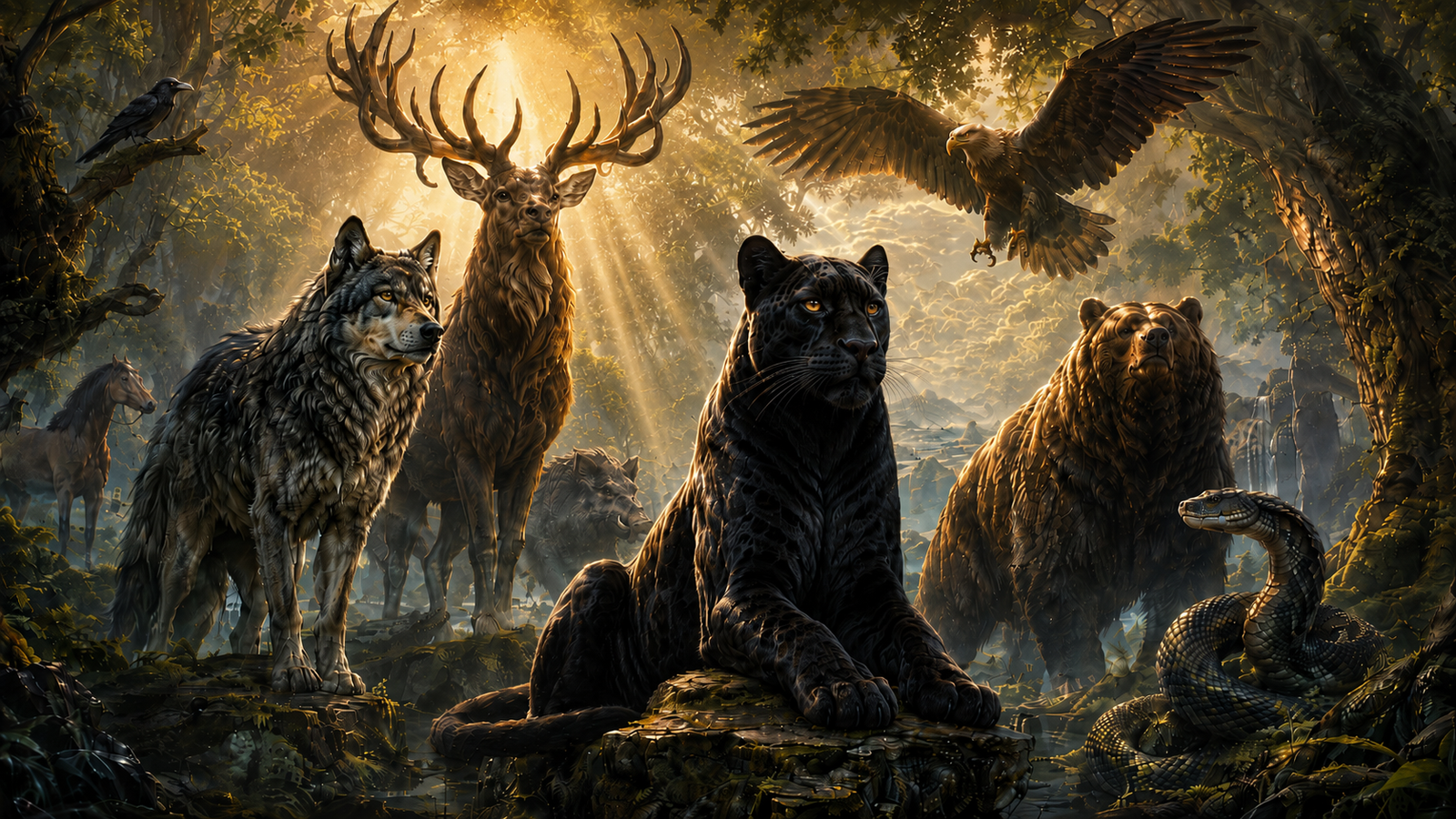
An Animal Lord is more than the strongest member of a species and less easily defined than a god. Each is the current bearer of an ancient sovereignty through which the Beastlands recognises an animal kind as a living power in its own right.
A Lord remembers trails, breeding grounds, hunting customs, migrations, disasters and ancient agreements extending far beyond the life of any single beast. Its judgement is not human judgement. Predation is not a crime to the Wolf Lord, nor is carrion shameful to the Raven Lord. What matters is whether life continues according to its nature rather than being reduced to cruelty, waste, domination or extinction.
The Animal Lords belong to the Beastlands. They may travel through the Fey World, the mortal world and other planes, and some maintain ancient agreements with fey courts, gods or celestial kingdoms. Such relationships do not make those places their collective homeland.
What an Animal Lord Is
A Sovereign Mantle
Only one recognised bearer normally holds a particular great mantle at a time. The bearer can change while the sovereignty itself continues.
A Voice of Its Kind
An Animal Lord understands the instincts, needs and signals of its kin and can communicate with them without reducing them to mindless servants.
A Power, Not Necessarily a God
Animal Lords may receive offerings, reverence and petitions, but worship alone does not turn the office into a conventional divine portfolio.
A Guardian, Not an Owner
The Cat Lord does not magically command every cat, nor does the Wolf Lord own every wolf. Their authority is expressed through kinship, recognition, ancient law and supernatural presence.
A Creature of Judgement
Animal Lords can bargain, remember offences, recognise courage, reward restraint and distinguish necessary hunting from pointless destruction.
An Enduring Office
Killing a manifestation may end the present body without ending the mantle. A Lord may reform, or a successor may inherit the sovereignty.
The Eleven Great Animal Lords
Countless animals live within the Beastlands, and lesser or regional Animal Lords may arise around narrower kinds. Eleven sovereign mantles, however, are recognised across the plane as the Great Animal Lords.
Bear Lord
Sovereign of endurance, winter sleep, defended territory, maternal ferocity, solitary strength and the right to withdraw from the world without surrendering it.
Bee Lord
Sovereign of the hive, pollination, common labour, swarming defence and the countless exchanges between flowering land and the creatures that sustain it.
Boar Lord
Sovereign of stubborn survival, fearless defence, rooting, forest disturbance and the brutal determination of creatures that refuse to yield ground.
Cat Lord
Usually encountered as a great black panther, the Cat Lord is sovereign of wild and domestic felines, stealth, independence, patient hunting, territorial instinct and the freedom to approach civilisation without belonging to it.
Eagle Lord
Sovereign of eyries, far sight, altitude, open sky and the sudden decisive strike of a hunter descending from beyond its prey’s reach.
Horse Lord
Sovereign of speed, herd bonds, migration, endurance and the ancient tension between freedom and the bargains by which horses live beside mortal peoples.
Raven Lord
Sovereign of observation, memory, adaptability, carrion and the intelligence that thrives wherever opportunity survives after strength has failed.
Serpent Lord
Sovereign of hidden movement, patience, venom, ambush, shedding and renewal: neither wicked nor benevolent merely because its kind kills differently from warm-blooded hunters.
Stag Lord
Sovereign of rut, antler cycle, migration, forest margins, seasonal challenge and the alert grace of creatures perpetually balancing display against flight.
Whale Lord
Sovereign of ocean migration, deep water, song, family memory and routes older than the coastal kingdoms whose ships now cross them.
Wolf Lord
Sovereign of pack, pursuit, territory, cooperation, endurance and the old hunting law by which predator and prey together shape the living wilderness.
Lesser and Regional Animal Lords
The eleven Great Lords do not exhaust the Beastlands. A distinct animal kind with sufficient continuity, supernatural importance or ancient territory can possess a lesser sovereignty of its own. Hawk, Fox, Mouse, Crocodile, Shark, Elephant and other Lords may therefore exist without each automatically standing as a peer of the Great Eleven.
The boundaries are mythic rather than zoological bureaucracy. A lesser Lord may grow in importance, disappear after the loss of its kind, divide when an ancient lineage becomes truly distinct or join a broader sovereignty through covenant and shared inheritance.
The Cat Lord and Bast
The Compact of Claw and Sistrum
Two feline powers, neither subordinate to the other
The Cat Lord and Bast are ancient allies whose spheres meet wherever felines and mortal civilisation share the same ground.
Bast is a goddess of protection, cats, fertility, childbirth, joy, music, dance and the sacred life of the household. The Cat Lord, most often manifested as an immense black panther, is the Beastlands sovereign of feline nature itself: lions, tigers, leopards, lynxes, wildcats, domestic cats and the countless other branches of the feline kind.
Its concerns are hunting, territory, independence, patience, lineage and the inherited instincts by which cats remain cats whether they stalk an untouched forest or sleep beside a mortal hearth.
Their alliance is remembered as the Compact of Claw and Sistrum. Neither grants the other ownership of cats. Instead, each recognises the other’s authority where their concerns overlap.
cats living beside mortals are persecuted, sacred felines are threatened, households require protection or divine enemies attack the bond between people and feline guardians.
feline populations are exterminated, hunting territories are destroyed, cats are supernaturally enslaved or the nature of feline life itself is corrupted.
The two powers can disagree over captivity, breeding, ownership, domestication or the treatment of magically altered felines, but such disputes take place within an enduring alliance rather than a war for control of the feline kind.
Animal Lords, Gods, Fey and Arcadian Animal Sovereigns
| Power | Primary Realm | Authority | Relationship to Animals |
|---|---|---|---|
| Animal Lords | Beastlands | Primal sovereign mantle | Embodies and guards the continuing nature of an animal kind. |
| Animal Sovereigns | Arcadia | Celestial office, covenant and ordered stewardship | Protects sacred species, recognised rights, sanctuaries and lawful relationships. |
| Animal-Associated Gods | Divine realms | Divine portfolio | May protect, personify or receive worship connected with particular animals without becoming that animal’s Beastlands Lord. |
| Fey Powers | Fey World | Fey sovereignty, court, place or season | May bargain with animals and Animal Lords but do not collectively govern the Beastlands. |
The distinction is practical. The Tiger General of Arcadia may possess enormous authority over celestial tigers without becoming the Cat Lord. The office belongs to Arcadian order; the Cat Lord’s sovereignty belongs to the living nature of felines.
Predation, Cruelty and the Law of the Wild
Animal Lords do not judge nature by the comfort of civilisation. A wolf killing a deer to feed its pack has not committed evil. A serpent striking prey, a raven feeding upon the dead or a bear defending cubs are acting according to the necessities of life.
Pointless cruelty is different. So are extermination, supernatural corruption, deliberate destruction of breeding grounds and the enslavement of an entire animal population. Such acts turn an ordinary ecological conflict into something capable of drawing a Lord’s personal attention.
For this reason an Animal Lord may respect a mortal hunter who kills cleanly and uses what is taken while becoming the mortal enemy of a noble who destroys a forest merely to deny game to a rival.
Death, Succession and the Enduring Mantle
An Animal Lord can be wounded and its manifested body can be slain. Neither fact necessarily destroys the sovereignty behind it.
A defeated Lord may reform after returning to the Beastlands. If the bearer has truly failed, surrendered the mantle or become unable to represent its kind, the sovereignty may instead awaken in a successor. The new bearer inherits the authority of the office but need not inherit every opinion, friendship or grievance of the predecessor.
Permanent destruction requires a greater event: extinction of the kind, severance of the mantle from the Beastlands, destruction of the sovereignty itself or another consequence powerful enough to alter the nature of the plane.
Game Mechanics
The rules below establish a shared campaign framework for Great Animal Lords. Individual Lords can exceed these guidelines and should receive their own statistics when they become active encounter powers.
D&D 5.5e Campaign Baseline
A Great Animal Lord is normally a unique Celestial (Shapechanger). Most should fall around CR 18–25, although an ancient or exceptionally powerful Lord can exceed that range.
- Sovereign Shape: The Lord can assume its archetypal animal form and one or more emissary forms without losing its essential powers.
- Voice of the Kind: The Lord can communicate with animals belonging to its recognised kin and is understood by them.
- Sovereign Instinct: Great Lords possess exceptional resistance to fear, charm and effects that would compel them to betray their own nature.
- Call the Kind: The Lord can summon, rally or awaken appropriate animals when defending its territory or kin.
- Wild Passage: A Lord can cross planar boundaries through suitable Beastlands paths, natural thresholds and established planar routes.
- Legendary Presence: A Great Lord can use Legendary Actions where appropriate and should shape the surrounding environment through domain or environmental effects based on the behaviour of its animal kind.
- Enduring Mantle: Reducing the Lord’s current manifestation to 0 Hit Points does not by itself permanently destroy its sovereignty.
Pathfinder 1e Campaign Baseline
A Great Animal Lord is a unique outsider (shapechanger) whose home plane is the Beastlands, rather than a standard mortal creature with a minor template applied. When encountered away from the Beastlands, it gains the extraplanar subtype as normal.
- Use high outsider Hit Dice appropriate to the individual Lord’s importance.
- Grant change shape between sovereign animal and emissary forms.
- Grant supernatural communication and affinity with the Lord’s recognised kin.
- Use strong Wild Empathy, appropriate extraordinary senses and animal-derived movement modes.
- Great Lords normally possess damage reduction, spell resistance and powerful saving throws appropriate to high-level planar beings.
- Affinity summoning, planar travel and territory-specific supernatural abilities should reflect the individual Lord rather than a universal spell list.
- Permanent destruction requires a campaign condition capable of ending or severing the mantle.
D&D 3.5e Campaign Baseline
A Great Animal Lord is a unique outsider (shapechanger). It gains the extraplanar subtype when encountered away from its native Beastlands.
- Great Lords should normally be epic or near-epic creatures rather than ordinary advanced animals.
- Ability scores are determined by the individual Lord and are not restricted to mortal limits.
- Change shape, communication with affinity animals, powerful senses, damage reduction and spell resistance form the common chassis.
- Natural weapons and special attacks should be derived from the Lord’s animal kind and then raised to an appropriate planar scale.
- Planar movement and calling of kin replace a generic one-size-fits-all spell package.
- Defeating the current body does not permanently destroy the Animal Lord unless the mantle itself is also overcome.
Relations with the Fey World
The Animal Lords are frequent visitors to the Fey World because ancient forests, impossible seasons and fey hunting grounds create natural points of contact between the two realms.
No universal allegiance binds the Lords to a single fey faction. Individual Lords make agreements according to territory, ancient obligation and the needs of their kin. A bargain made by the Wolf Lord does not bind the Cat Lord, and a seasonal pact with one fey court creates no automatic obligation to support that court elsewhere.
Using Animal Lords in a Campaign
Animal Lords work best when an adventure concerns a conflict larger than one dangerous animal. Their appearance means that a species, migration, covenant or piece of wilderness has become important enough for the Beastlands itself to take notice.
- The Broken Migration. A new fortress cuts across an ancient animal route. The animals refuse every alternative path, and their Lord wants to know which old promise gave mortals permission to build there.
- The Empty Mantle. A Great Lord has vanished without reforming. Several candidates begin displaying fragments of its power while predators, rivals and planar powers race to influence the succession.
- The Hunter’s Defence. A mortal accused of slaughtering sacred animals insists the killings were necessary to stop a supernatural disease. The relevant Animal Lord demands truth rather than ritual apology.
- Claw and Sistrum. Bast and the Cat Lord invoke their ancient compact after an enemy begins transforming ordinary cats into obedient magical weapons.
- Two Laws of the Tiger. An emissary of the Cat Lord and an officer of Arcadia both claim standing in a dispute involving celestial tigers. Neither claim is false, but the two authorities rest upon entirely different laws.
Historical & Mythic Context
The idea that the wild possesses its own rulers, guardians and supernatural voices appears again and again in the myths and sacred art of mortal civilisations. These traditions do not describe the Beastlands with perfect accuracy, nor do they all refer to Animal Lords. They show, however, how often mortals have understood the boundary between humanity and the animal world as something inhabited by powers worthy of reverence, caution and negotiation.
In SpiralWorlds, such stories may preserve memories of genuine encounters with gods, spirits, awakened beasts, planar creatures or Animal Lords. Generations of retelling frequently blur those distinctions. A hunter who meets a supernatural stag in a forbidden wood may return convinced that he has seen a god; a priest may recognise the same being as a messenger; a planar traveller may realise that neither explanation is quite correct.
The Master and Mistress of Animals
One of the oldest recurring images in ancient art is a powerful figure standing among, holding or governing animals. Museum collections preserve examples of the Master of Animals motif across ancient Near Eastern art, while related Mistress of Animals images spread through the Mediterranean. The traditions are diverse, but repeatedly place supernatural authority at the boundary between human order and the animal world.
These images do not represent one universal deity or a single unbroken religion. Their meaning varies according to culture, period and place. What they share is the recurring idea that the wild has powers of its own, and that humanity must sometimes bargain with, appease or respect them.
This is close to the role Animal Lords occupy in the Beastlands, but resemblance should not be mistaken for identity. An ancient carving of a supernatural figure between lions does not automatically depict the Cat Lord. It may represent a god, hero, protective power or an entirely different tradition.
Artemis and the Mistress of Wild Animals
In Greek tradition, the title Potnia Theron — Mistress of Animals became particularly associated with Artemis. Archaic representations show her holding or accompanied by wild animals, expressing divine authority over the untamed world.
That authority differs from an Animal Lord’s sovereignty. Artemis remains a goddess whose concerns extend beyond any single animal kind. The Animal Lords instead represent the continuing nature of their respective kin.
Nevertheless, hunters and travellers encountering an Animal Lord may easily interpret the meeting through traditions associated with Artemis or other divine guardians of wilderness.
Bast and the Sacred Feline
Ancient Kemet provides an especially important parallel through Bast. Her cult associated her strongly with feline imagery, protection, fertility and the sacred power of the household. Surviving Bastet statuettes show the familiar cat-headed goddess while also preserving the older leonine aspect of her imagery.
Within SpiralWorlds, this does not make Bast another name for the Cat Lord. The distinction is fundamental. Bast is a goddess; the Cat Lord is the sovereign Beastlands mantle of feline nature.
The overlap between the two powers instead lies behind the Compact of Claw and Sistrum. Mortal stories do not always preserve the distinction. A black panther appearing beside a shrine of Bast may be remembered as Bast herself, one of her servants, an omen sent by the goddess or an appearance of the Cat Lord. On rare occasions, more than one of those explanations may be true.
Horned Powers and the Sovereignty of the Wild
Antlered and animal-associated supernatural figures also appear in the traditions of ancient Europe. One of the clearest surviving examples comes from first-century Lutetia. The Pillar of the Boatmen names Cernunnos beside a bearded divine figure with animal ears and stag antlers from which torcs hang.
The monument preserves the image and divine name more securely than it preserves the full theology surrounding them. Mortal stories may therefore associate such horned powers with forests, animals, hunting, fertility or other aspects of the wild without every later interpretation representing the same ancient belief.
Within SpiralWorlds, such traditions provide another reason mortals may confuse gods of wilderness with the sovereign creatures of the Beastlands. A Stag Lord may resemble what a traveller expects a forest god to command, but the Stag Lord possesses its own mantle, memory and authority.
Animal Gods Are Not Animal Lords
The distinction matters throughout the world’s mythologies. Gods can take animal forms, claim animals as sacred creatures, send animal messengers or protect particular species without possessing an Animal Lord’s mantle. Likewise, an Animal Lord can receive offerings and become the centre of local legends without thereby becoming a god.
At the table: similar imagery does not require identical beings. A sacred wolf might belong to a god, answer to the Wolf Lord, be an independent spirit or simply be an unusually formidable wolf. Myth becomes richer when several explanations can coexist.
Why Mortal Traditions Differ
Animal Lords rarely establish organised mortal churches. Their encounters with civilisation are episodic, local and often mediated through animals, dreams, sacred places or temporary manifestations. As a result, knowledge of them becomes fragmented.
One culture may remember the Bear Lord as an ancestral guardian. Another may tell of a great bear that judges hunters. A third may treat the same signs as manifestations of a local god. None needs to possess a complete understanding of the Beastlands for its traditions to contain part of the truth.
Scholars, priests, hunters and planar travellers may compare such traditions and recognise recurring patterns, but the Animal Lords themselves have little interest in correcting mortal theology. They care whether their kin and ancient obligations are respected, not whether mortals have classified them correctly.
Related SpiralWorlds Entries
Keep this reference growing
If this page helped with your reading or game, you can support its upkeep or explore the curated books.
Explore the Bookshop — epics, classics and stories behind imagined worlds.