
Jikininki
A corpse-eating ghost condemned by hunger, able to pass for human until the dead are left alone.
Its horror is not simply that it eats the dead. It may remember exactly why it deserves the hunger.
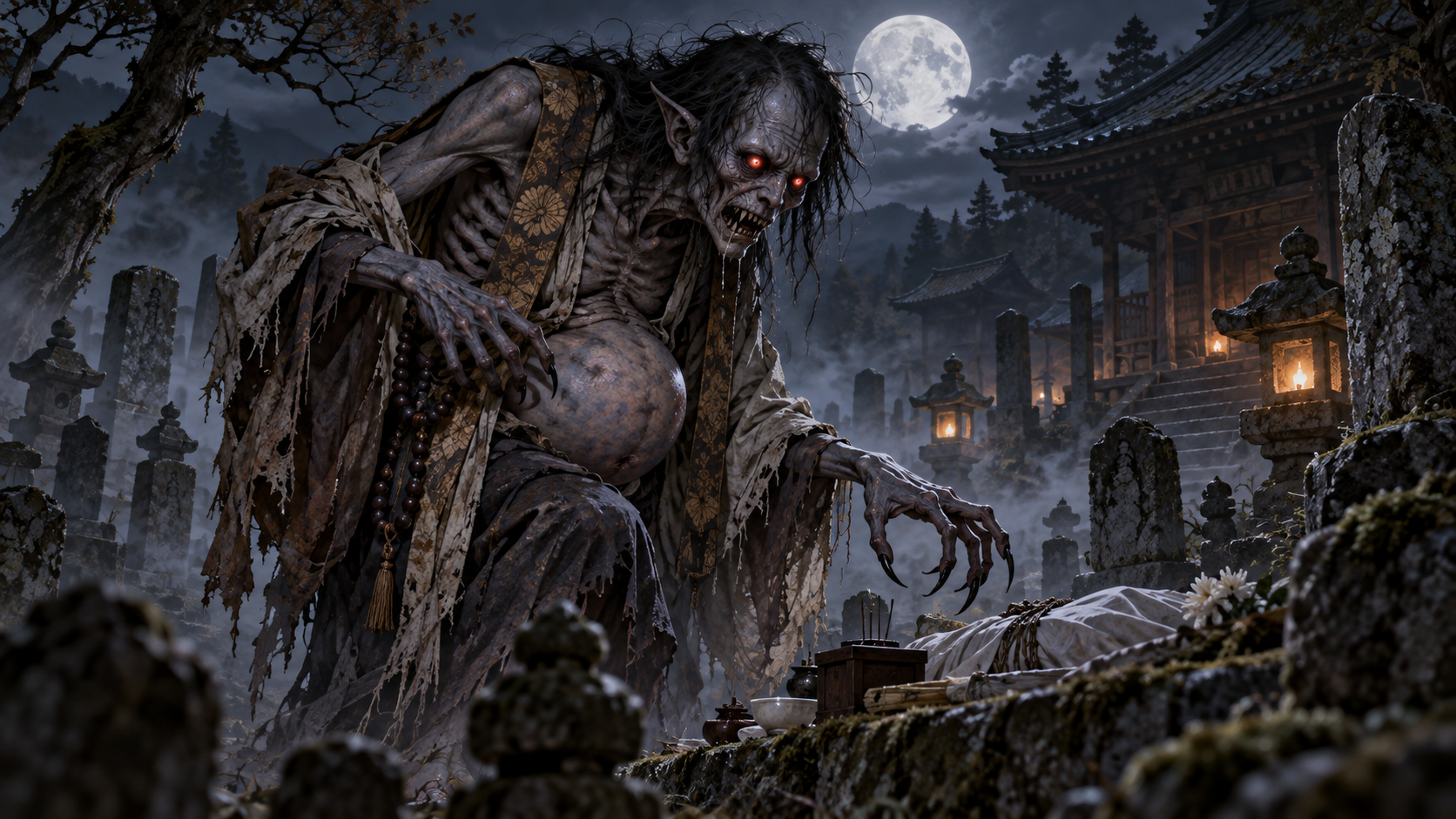
Jikininki are corpse-eating ghosts associated with the punishment of greed, selfishness and impious treatment of the dead. The best-known English-language account appears in Lafcadio Hearn’s Kwaidan, where a travelling priest watches a monstrous shape devour a corpse, its shroud and the funeral offerings laid beside it.
The creature later appears as an old recluse and confesses that it was once a priest who performed funerary rites only for personal gain. After death, that selfishness condemned it to consume every corpse brought into the district. The jikininki is therefore more than a graveyard predator: it is a punishment made visible, with hunger replacing the compassion it failed to show in life.
Within the campaign, jikininki remain undead hungry ghosts. Some surrender completely to appetite and become dangerous hunters around battlefields and burial grounds. Others retain enough memory and shame to bargain, warn travellers away, or seek release from their condition.
Game Statistics
Use the ruleset in play. These versions present the same CR 3 corpse-eating hungry ghost using each edition’s native mechanics.
Jikininki — 5.5e / 2024
Medium Undead, Neutral Evil • CR 3
Skills Deception +4, Perception +3, Stealth +5
Resistances Cold, Necrotic
Immunities Poison; Exhaustion, Poisoned
Senses Darkvision 60 ft.; Passive Perception 13
Languages Common
CR 3 (700 XP; PB +2)
Traits
Human Guise. The Jikininki can appear as the humanoid it resembled in life. Its game statistics don’t change. The disguise ends when it attacks, uses Carrion Breath, or chooses to reveal its true form.
Grave Hunger. The Jikininki has Advantage on Wisdom (Perception) checks made to locate a corpse, blood or funerary offering within 60 feet.
Undead Fortitude. If damage reduces the Jikininki to 0 Hit Points, it makes a Constitution saving throw (DC 5 plus the damage taken) unless the damage is Radiant or from a Critical Hit. On a success, it drops to 1 Hit Point instead.
Actions
Multiattack. The Jikininki makes two Claw attacks and one Bite attack.
Claw. Melee Attack Roll: +5, reach 5 ft. Hit: 7 (1d8 + 3) Slashing damage.
Bite. Melee Attack Roll: +5, reach 5 ft. Hit: 7 (1d8 + 3) Piercing damage.
Carrion Breath (Recharge 5–6). Constitution Saving Throw: DC 13, each creature in a 15-foot cone. Failure: 10 (3d6) Poison damage, and the target has the Poisoned condition until the end of its next turn. Success: Half damage only.
Bonus Actions
Feed on the Dead. The Jikininki consumes part of a corpse within 5 feet and regains 10 Hit Points. A corpse can provide this benefit only once.
Jikininki — 5e / 2014
Medium undead, neutral evil
Armor Class 15 (natural armor)
Hit Points 67 (9d8 + 27)
Speed 30 ft., burrow 15 ft.
Saving Throws Con +5, Wis +3
Skills Deception +4, Perception +3, Stealth +5
Damage Resistances cold, necrotic
Damage Immunities poison
Condition Immunities exhaustion, poisoned
Senses darkvision 60 ft., passive Perception 13
Languages Common
Challenge 3 (700 XP)
Traits
Human Guise. The Jikininki can use its action to appear as the humanoid it resembled in life or return to its corpse-eating form. Its statistics are unchanged.
Grave Hunger. The Jikininki has advantage on Wisdom (Perception) checks made to find corpses, blood or funerary offerings.
Undead Fortitude. If damage reduces the Jikininki to 0 hit points, it makes a Constitution saving throw with a DC of 5 + the damage taken unless the damage is radiant or from a critical hit. On a success, it drops to 1 hit point instead.
Actions
Multiattack. The Jikininki makes two Claw attacks and one Bite attack.
Claw. Melee Weapon Attack: +5 to hit, reach 5 ft., one target. Hit: 7 (1d8 + 3) slashing damage.
Bite. Melee Weapon Attack: +5 to hit, reach 5 ft., one target. Hit: 7 (1d8 + 3) piercing damage.
Carrion Breath (Recharge 5–6). The Jikininki exhales grave-stench in a 15-foot cone. Each creature in the area must make a DC 13 Constitution saving throw, taking 10 (3d6) poison damage on a failed save, or half as much on a success. A creature that fails is poisoned until the end of its next turn.
Jikininki — Pathfinder 1e
CR 3 XP 800
NE Medium undead
Init +4; Senses darkvision 60 ft., scent; Perception +8
Defense
AC 15, touch 10, flat-footed 15 (+5 natural)
hp 26 (4d8+8)
Fort +3, Ref +1, Will +5
DR 5/magic; Immune undead traits
Offense
Speed 30 ft., burrow 15 ft.
Melee 2 claws +6 (1d6+3), bite +6 (1d6+3)
Special Attacks carrion breath
Spell-Like Abilities (CL 4th; concentration +6)
3/day—alter self
1/day—gaseous form
Statistics
Str 16, Dex 11, Con —, Int 9, Wis 13, Cha 14
Base Atk +3; CMB +6; CMD 16
Feats Improved Initiative, Step Up
Skills Disguise +9, Perception +8, Stealth +11; Racial Modifiers +4 Stealth
Languages Common
SQ iron claws
Ecology
Environment any land or urban
Organization solitary, pair, or mourning party (3–8)
Treasure standard
Special Abilities
Carrion Breath (Su). Three times per day as a standard action, the Jikininki breathes a 15-foot cone of noxious fumes. Creatures in the cone must succeed on a DC 14 Fortitude save or be sickened for 1d4+1 rounds and take 1d4 points of Strength damage. A successful save reduces the sickened effect to 1 round and negates the Strength damage. The Jikininki must wait 1d4 rounds between uses. The save DC is Charisma-based.
Iron Claws (Ex). The Jikininki’s claws ignore the first 5 points of hardness possessed by an object. It can burrow through stone at half its normal burrow speed.
Jikininki — D&D 3.5e
| Size/Type | Medium Undead |
|---|---|
| Hit Dice | 4d12 (26 hp) |
| Initiative | +4 |
| Speed | 30 ft. (6 squares), burrow 15 ft. |
| Armor Class | 15 (+5 natural), touch 10, flat-footed 15 |
| Base Attack/Grapple | +2/+5 |
| Attack | Claw +5 melee (1d6+3) |
| Full Attack | 2 claws +5 melee (1d6+3) and bite +3 melee (1d6+1) |
| Space/Reach | 5 ft./5 ft. |
| Special Attacks | Carrion breath |
| Special Qualities | Darkvision 60 ft., DR 5/magic, human guise, iron claws, undead traits |
| Saves | Fort +1, Ref +1, Will +5 |
| Abilities | Str 16, Dex 11, Con —, Int 9, Wis 13, Cha 14 |
| Skills | Disguise +6, Hide +4, Listen +5, Move Silently +4, Spot +5 |
| Feats | Improved Initiative, Multiattack |
| Environment | Any land or urban |
| Organization | Solitary, pair, or mourning party (3–8) |
| Challenge Rating | 3 |
| Treasure | Standard |
| Alignment | Usually neutral evil |
| Advancement | 5–8 HD (Medium) |
| Level Adjustment | — |
Special Abilities
Carrion Breath (Su). Three times per day, the Jikininki breathes a 15-foot cone of grave-stench. Living creatures must succeed on a DC 14 Fortitude save or be sickened for 1d4+1 rounds and take 1d4 points of Strength damage. A successful save reduces the sickened effect to 1 round and negates the Strength damage.
Human Guise (Su). At will, a Jikininki can assume the appearance of the humanoid it resembled in life. This functions as disguise self, except the change is physical to the touch.
Iron Claws (Ex). Its claws ignore the first 5 points of object hardness. It can burrow through stone at half its normal burrow speed.
Behaviour
A Jikininki is driven toward the dead more strongly than toward the living. It notices funerals, fresh graves, battlefield casualties and houses where a body is being kept overnight. It may linger nearby in human guise for hours, waiting until mourners, guards or priests leave.
Not every Jikininki responds to its condition in the same way. Some become predatory and treat living witnesses as obstacles or future meals. Others retain shame, memory and enough self-control to avoid killing whenever a corpse can satisfy the hunger. The Jikininki in Hearn’s famous account is horrified by what it has become and actively seeks release.
A disguised Jikininki can be unnervingly ordinary. It may present itself as a hermit, mortician, gravedigger, traveller or elderly local who knows exactly when a death occurred. The disguise becomes less convincing around a corpse: attention drifts toward the body, speech grows distracted and the smell of decay may become impossible to hide.
If Violence Starts
It opens with Carrion Breath if several enemies close in. The goal is to sicken pursuers and create an escape lane rather than stand in the centre of a group.
It fights hardest over a corpse. A Jikininki that has already surrendered to hunger may ignore tactically better targets to reach or defend the body it came to consume.
It uses claws to break obstacles. Coffin lids, locked doors, thin walls and grave coverings are easier targets than armoured adventurers.
It retreats if the corpse is lost. Fire, radiant magic, overwhelming force or the removal of the body can break its immediate purpose.
A remorseful Jikininki may surrender. If someone demonstrates knowledge of funerary rites or offers a credible path toward release, combat can end without destroying the undead.
Jikininki in Japanese Ghost Lore
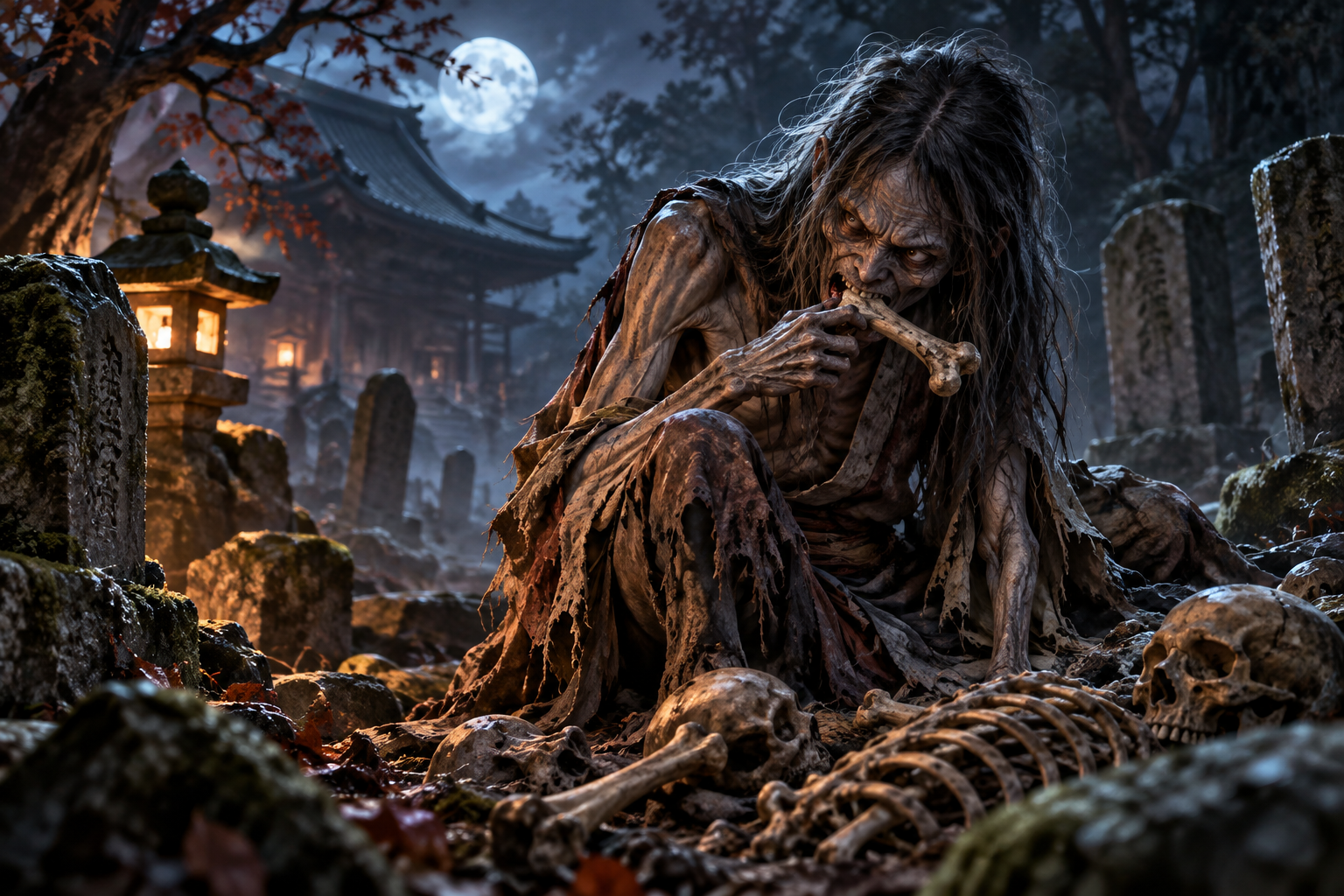
The best-known Jikininki story in English appears in Lafcadio Hearn’s 1904 Kwaidan: Stories and Studies of Strange Things. A travelling priest named Musō reaches a village where a death has occurred. The villagers leave before midnight, and while Musō keeps watch beside the corpse, a vast shape enters, paralyses him with terror or supernatural force, and consumes the body, the shroud and the offerings.
The next day an old recluse confesses that he was the creature. In life he had been a priest who performed funeral rites for profit rather than compassion. After death he was condemned to become a Jikininki and devour every corpse in the district. He begs Musō to perform a rite on his behalf; when the apparition vanishes, the hermitage vanishes with it, leaving the priest kneeling beside an old tomb.
Hearn’s notes place the Jikininki among corpse-eating hungry-ghost traditions. Modern yokai writers often compare it with gaki, but the story’s most useful feature for play is personal rather than taxonomic: the monster can remember its former life, understand its punishment and desperately want the hunger to end.
The Dead, Burial & Release
Jikininki encounters naturally connect to the care of the dead. The Burial domain provides a useful rules-and-lore bridge for protecting corpses and cemeteries, while Detect Undead can reveal a hidden corpse-eater before the funeral party leaves it alone.
Necromancy can make the situation worse as easily as it can solve it. A corpse animated, interrogated or magically altered may become the focus of the Jikininki’s hunger, and destroying the undead body does not necessarily answer the moral question of why the spirit was cursed in the first place.
Related Japanese Supernatural Beings
Aoandon. Both work well in Japanese supernatural horror, but Aoandon grows out of ghost-story ritual while Jikininki centres on death, hunger and funerary failure.
Jakotsubaba. The campaign’s grave-warding Snake-Bone Hag is a natural enemy for a corpse-eater that enters a protected burial site.
Oni. Oni are embodied predators and shapechangers rather than hungry ghosts. A Jikininki may fear them, scavenge after them, or exploit the corpses left by their violence.
For the wider cultural cluster, use Asian Mythology Monsters and the Japanese Pantheon.
Encounter Ideas
The Body Is Gone
A family leaves a corpse watched through the night. At dawn the body, shroud and offerings have vanished without a broken door.
The Helpful Recluse
An old hermit warns the party not to remain in the village after midnight. His advice is sincere; he knows exactly what happens because he is the reason.
The Funeral Road
Three bodies disappear from funeral processions travelling the same mountain pass. The thing taking them has never harmed a living mourner.
The Grave Warden
A Jakotsubaba refuses to let mourners enter a burial ground because a Jikininki is already hiding among them in human guise.
The Battlefield Feast
A Jikininki follows an army without attacking it. Every morning, however, the previous day’s dead are missing before burial parties arrive.
The Last Request
A corpse-eater approaches openly and asks the party to protect a funeral long enough for it to resist feeding—and then find a way to end its curse.
Watch: Jikininki in Yokai Lore
This focused folklore discussion is useful for the creature’s Japanese context and works best as a companion to the primary Kwaidan story rather than as a rules source.
Yokai Podcast 9: Jikininki — a focused discussion of the corpse-eating ghost tradition.
Explore Further
Sources & Licensing
Folklore: Lafcadio Hearn’s “Jikininki” in Kwaidan: Stories and Studies of Strange Things (1904) provides the core story used here: the corpse-eating apparition, the former priest, the punishment for selfish funerary practice and the possibility of release.
Legacy RPG material: the older CR 3 Pathfinder-style Jikininki formerly reproduced on this page originated with The Creature Codex. Its carrion breath, iron claws, burrowing and disguise magic are retained as campaign mechanics rather than presented as official Pathfinder or D&D material.
5.5e / 2024, 5e / 2014, Pathfinder 1e and D&D 3.5e: campaign versions built around the same CR 3 threat and adapted to each ruleset.
Primary text: Lafcadio Hearn — Jikininki. Further folklore reading: Yokai.com — Jikininki.
Keep this reference growing
If this page helped with your reading or game, you can support its upkeep or explore the curated books.
Explore the Bookshop — epics, classics and stories behind imagined worlds.