
Zutphen — The River County of Guelders
At a Glance
| Status | County of Zutphen, united under the ruler of the Duchy of Guelders |
|---|---|
| Count | Arnold of Egmont, Duke of Guelders and Count of Zutphen |
| Chief Town | Zutphen, a fortified town where the Berkel meets the IJssel |
| Landscape | IJssel meadows and the eastern fields and wooded hills of the Achterhoek |
| Nearby Routes | IJssel trade toward Deventer and Kampen, eastward roads toward the German lands and southern routes through Gelderland |
| Economic Life | Timber, herring, beer, butter, wine, river transport and town crafts |
| Sacred Life | The high temple at the old court, Broederen House, civic gods and household shrines |
| Pressure | High water at the landings, dangerous building work and a missing child in the Lochem hills |

Where the Berkel Meets the IJssel
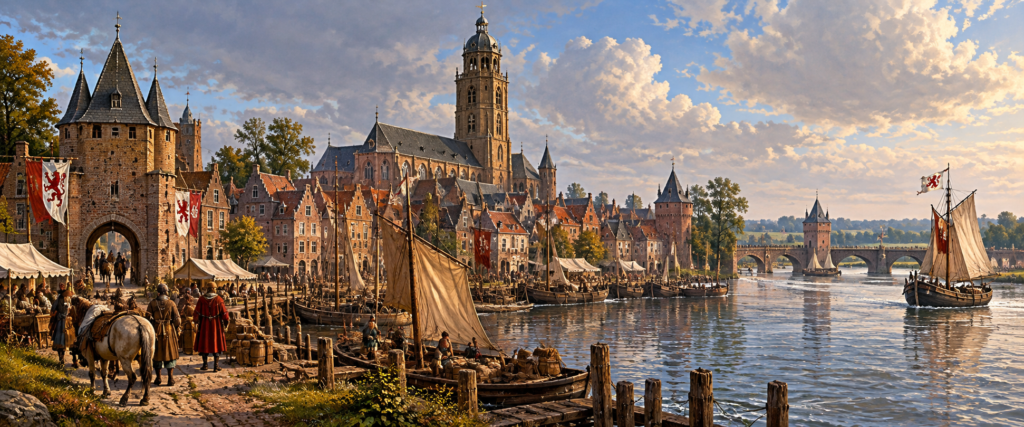
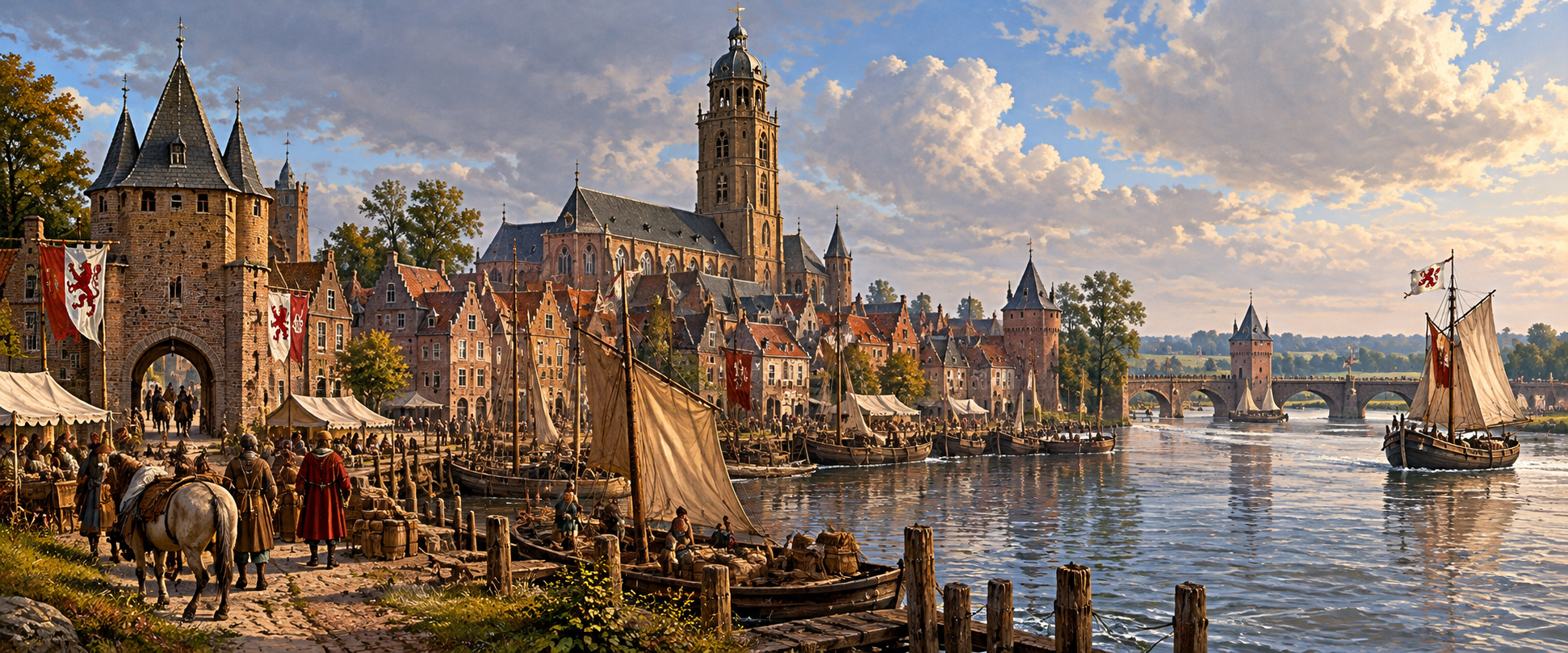
Zutphen stands where the Berkel comes in from the east and meets the broad IJssel. Barges nudge against timber landings while carriers roll barrels away from the water. There is river mud on the quays, smoke over the roof tiles and fresh bread in the streets behind the gates. Sailors bound for Overijssel share beer with traders from the German lands. Farmers arrive with poultry, vegetables and carts of grain. They all need somewhere to sleep before the gates close.
The town is built for both trade and defence. Brick-built merchants’ houses stand behind the market stalls; temple towers rise above the walls. The IJssel carries travellers north toward Deventer and Kampen, while the smaller Berkel brings people and goods out of the eastern countryside. Arnold of Egmont, Duke of Guelders and Count of Zutphen, rules the county. Yet on these streets it is the boatmen, craftspeople, temple keepers, guards and market families who decide whether a stranger has a good day.
County map · Current events · Food and lodging · Onward travel
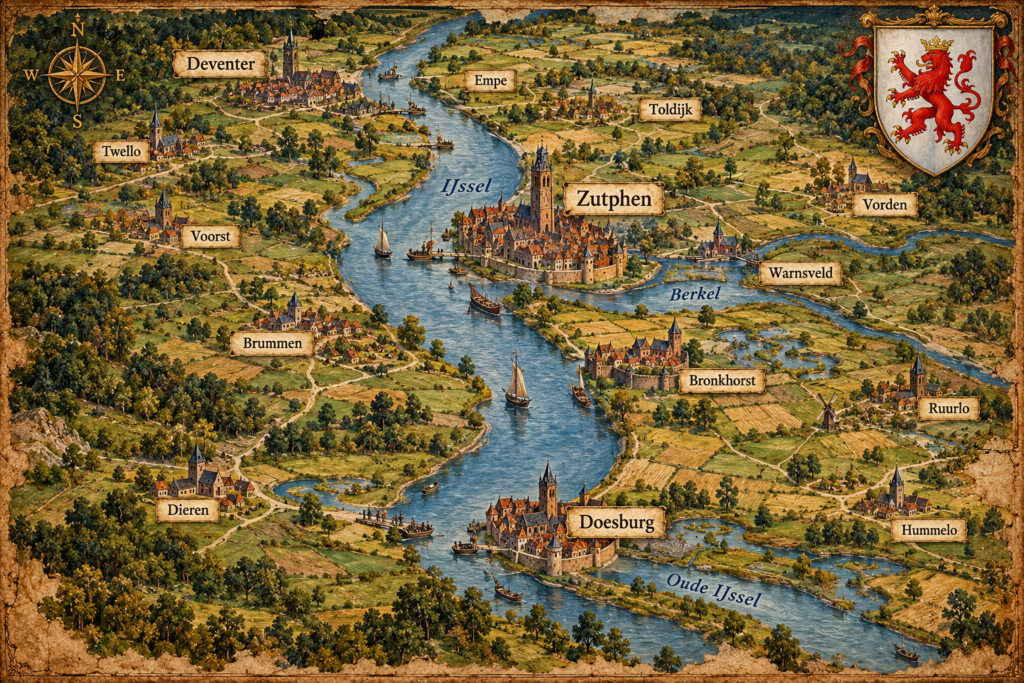
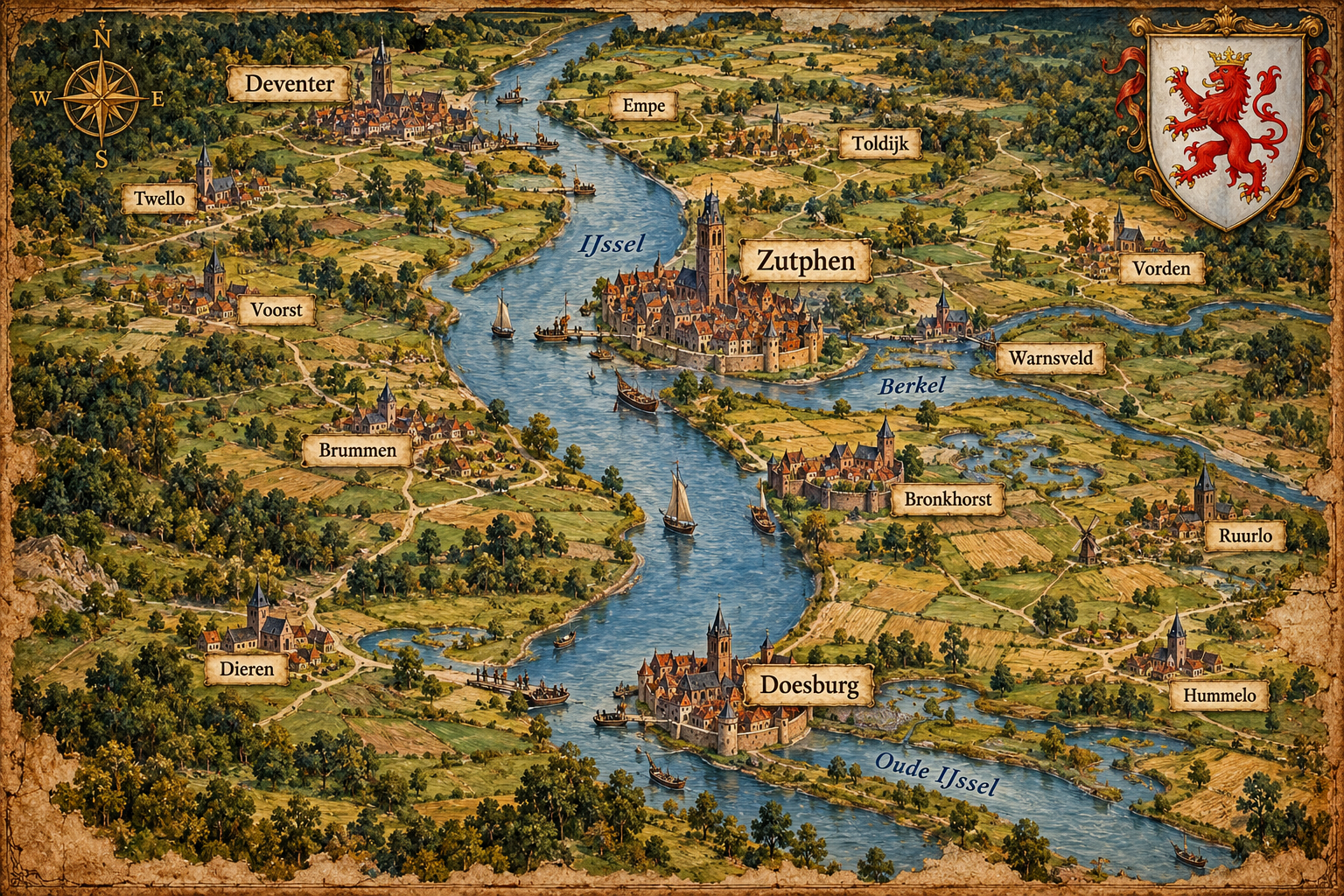
Illustrated Campaign Map of Zutphen
What Is Happening Right Now?
Work Above the Temple Floor
Scaffolds crowd the high temple at ‘s-Gravenhof. Repairs continue after lightning damaged its tower, while masons widen the great hall. A falling stone has injured a labourer. His family needs his wages, and the foreman wants work to resume before anyone examines the damaged lifting tackle.
The frayed rope is still on the scaffold. One worker saw a load catch on a projecting stone; another insists the foreman ordered it lifted anyway. A careful climb, a healer’s examination and a quiet talk with the frightened crew can establish what happened. Repairing the hoist keeps people in work. Blaming the injured man leaves his family without support and puts the next crew at risk.
Too Many Boats for the Landing
Rising water has made the smaller riverside landings awkward to use. Barges queue at the town quay, and merchants argue over space while fishmongers watch their catch spoil. A skipper from Deventer offers good pay for anyone willing to help shift his load after dark. The dockhands know his boat, but not the three passengers who boarded it farther upstream.
They are a beekeeper and his two grown daughters, with woven hives rescued from a flooded holding. Bees spill into the crowd when a porter drops one. The family needs a quiet landing and a sheltered orchard for the remaining hives. Smoke, patient handling and an introduction to Mette’s village contacts can save their livelihood. Throwing the hives into the river clears the quay quickly and ruins the family.
Within the Walls
The Quays and the Market Streets
The quays are loudest at dawn. Rope-makers mend tackle; porters shoulder sacks of grain; brewers inspect barrels; and merchants check cloth brought in from other towns. The Groenmarkt, Houtmarkt and Zaadmarkt form a busy belt of trading streets across the ground of Zutphen’s much older defences. Beneath those houses lie buried ditches and remnants of the town’s early stronghold. A careful digger sometimes turns up old leather, foreign coins or worked timber.
The High Temple and the Old Court
The great sacred hall at ‘s-Gravenhof rises above the old count’s precinct. Offerings for health and safe journeys share the aisles with ladders, stone dust and the masons’ tools. Singers practise while families wait to speak with a healer. A visitor looking for quiet should try the smaller side chambers after the workers leave.
Nearby, the former meat hall has recently become a court. Its heavy roof beams and broad interior still recall the days when butchers worked here. Behind the surrounding houses lie traces of the town’s much older defences.
The Berkel Watergate
At the edge of the Nieuwstad, the great Bovenberg watergate spans the Berkel. Its arches can be barred, and guards watch both water and the approaches to the walls. The river slips beneath stonework that looks too solid for such a narrow stream. Boatmen can tell you where the water runs fast; sentries know where children try to sneak past the walls.
Broederen House and the Nieuwstad
Broederen House offers a quiet garden, a writing room and a meal for travellers who help with its daily work. Its brothers keep books and care for people who have nobody else to ask. Beyond the older centre, the Nieuwstad has its own streets and sacred hall. Merchants’ yards stand close to workshops and modest homes; a visitor hears hammers and neighbours calling across the lane.
The Saltpoort
On the southern side of town, the recently built Saltpoort has four corner turrets and a tall pointed roof. Carts pass beneath its arch on their way to the markets. Outside the gate, open ground gives the watch a clear view of approaching riders.
Beyond Zutphen
East of town the Berkel country opens into fields, low wet ground and lanes through the Achterhoek. Warnsveld is close enough to supply the city with food and labour; farther east lie Lochem, its hills and the road toward Westphalia. The forested heights and heath of the Veluwe are on the other side of the IJssel, to the west.
South along the IJssel, travellers reach Bronkhorst and, farther on, Doesburg near the Oude IJssel. Northward are the busy waters and markets of Deventer. The roads connect farms, mills, wooded edges and riverside landings. There is no permanent bridge across the IJssel at Zutphen; the crossing depends on ferries, boats and the river’s mood. In flood or winter weather, a short journey can become a long one.
People to Know and Places to Stay
The Market Pot — Mette’s Lodging House
Mette van Warnsveld runs the Market Pot, a crowded kitchen in a lane off the Houtmarkt. Pea pottage, rye bread, cheese and fish feed carters, farm families and travellers counting their coins. Shared straw mattresses upstairs are cheap; a small private room costs more. She provides clean water, a wash tub and a locked chest. Her cousin rents stable space outside the busiest streets.
Mette hears village news before the watch does. She pays musicians in supper when the room is full and finds honest carrying work for strong guests. One regular watches unattended purses, so she warns newcomers to keep their money close. Market-day beds go quickly, but helping her unload a cart often earns a place by the hearth.
To Vreden — the City Inn
On the market, To Vreden receives merchants, visiting captains and honoured guests. Its stone ovens provide a better supper than most quay kitchens, with wine for those who can afford it. Mette’s acquaintance Griet oversees the serving room and arranges private meals, guarded rooms in neighbouring houses and introductions to buyers of foreign goods.
Comfort and discretion cost more here. Griet also finds paid performances and messengers’ work, but a quiet meeting soon becomes common knowledge if someone buys the serving lads enough drinks. Horses go to a hired stable rather than into the crowded service yard.
Harmen, Gerrit and the Working Streets
Harmen de Veerman works the ferry approach and knows which banks will take a horse safely. He crosses when conditions permit and refuses overloaded wagons. At the quay, Gerrit the boatwright patches hull planks, finds river pilots and buys sound spare timber. Both accept useful help in payment when work is busy.
Smiths off Beukerstraat shoe horses and repair ordinary weapons, tools and buckles. Complex armour work takes several days and a deposit. A harness maker replaces straps and helps with saddle sores; Mette knows which nearby farm will shelter an animal too large for an inn yard. Common equipment sells at the market, while bulky salvage needs a buyer’s inspection.
Lijsbeth and Brother Matthijs
Lijsbeth the herbwife keeps a small garden near the eastern lanes. She treats cuts, fevers and sore feet, charging those who can pay and accepting garden work from those who cannot. Grave injuries go to the high temple’s healers. Their limited divine healing goes first to urgent cases, and a crowded sleeping room is no place to hide a contagious fever.
Brother Matthijs of Broederen House reads Latin and helps visitors examine chronicles, river notes and unfamiliar writing. He trades copying work for lessons and knows people along the eastern roads. Books need an introduction and careful hands. Rare magical texts and costly components require a commission; enchanted weapons are not laid out among the market knives.
Faith, Old Stories and Things in the Mist
Bells shape the working hours inside the walls. Families leave candles for the sick, thank the gods for a safe homecoming and keep small household shrines beside the hearth. Priests, herbwives and the brothers disagree over remedies and rites, but the same neighbours carry food to a sick household.
Beyond Lochem, near Zwiep, the witte wieven leave the Witte Wievenkuil at dusk. Their white forms move through the low mist around the hollow. They turn lost walkers away from dangerous drops and sometimes accept a cake left in thanks. Mockery and iron thrown into their home bring a furious pursuit.
Farmhouse doors are shut before nightfall. A stout door has stopped a pursuer before, though the iron she hurled after the rider struck deep into its wood. Someone seeking the women waits at the hollow’s edge, leaves room to withdraw and speaks without a threat. A gift is courtesy, not a purchase of their obedience.
The rivers hold more familiar dangers. A snag can split a barge, an unseen current can pull a swimmer under, and a flooded meadow can swallow a cart. Travellers who survive the night in the countryside often credit a protective spirit; the ferrymen generally credit good rope, sound boats and knowing when not to cross.
Adventures in the County
The Child on the Hill
A boy from a farm near Lochem has not returned from collecting firewood. His older sister saw white figures moving through the trees at sundown. The village wants a search party, but its strongest men intend to bring axes and torches into the hollow. The Witte Wieven have hidden the child from a wounded wolf, and they will not tolerate the men setting fire to their hillside. Finding the child without provoking a fight wins the family’s and the hill-dwellers’ goodwill; choosing violence may make the eastern road dangerous for months.
The Silent Grain Barge
An unmanned grain boat drifts into the shallows south of the city. Its lines are cut, its cargo untouched and its pilot’s knife driven into the gunwale. One crewman lies injured on a reed island, while two others are held by river robbers who want a ransom from a Deventer merchant. The boatwright can identify the craft; the ferry operator knows the backwaters. Rescuing the crew may mean abandoning part of the cargo to the current, or bargaining with the robbers before the water rises.
The Stone Beneath the Market
A shopkeeper excavating a new cellar uncovers part of Zutphen’s old defensive ditch and a sealed, waterlogged chest. It contains a rusted blade, a foreign coin and a small bone charm. A collector offers to buy it without questions, while Brother Matthijs worries that the charm belongs to a burial. The family needs the sale to keep its shop. Deciding whether to sell, return or investigate the objects brings travellers into the city’s oldest layers—and may uncover someone willing to steal the find by night.
Roads, Boats and Onward Travel
North: the IJssel flows towards Deventer and the routes to Kampen in Overijssel. Ask Gerrit about a vessel’s next landing and space for animals. Southbound boats work against the current, towards Bronkhorst, Doesburg and the wider waterways of Guelders.
West: Harmen arranges a ferry across the IJssel towards the Veluwe. High water, debris or darkness can stop the crossing. East: the road through Warnsveld leads towards Lochem and Westphalia; Zwiep’s hills lie south of Lochem. Low cart tracks become deep ruts after rain.
Agree on the next landing, animal transport and a place to sleep before paying for passage. Take a lantern if returning late: the town gates close for defence. Mette knows guides, carters and ferrymen, and asks which roads they have actually travelled that week.
History and Sources
Zutphen grew on higher ground by the meeting of the Berkel and IJssel. Its older ringwork defended an early settlement; its markets grew over those old earthworks. It received town rights around 1190, acquired walls and water defences in later centuries, and prospered in the Hanseatic river trade. The town relies on ferries across the IJssel; its first permanent bridge belongs to the later fifteenth century.
The county is one of the quarters of Guelders. Arnold of Egmont took the ducal and comital titles in 1423 and remains the ruling duke and count. Philip the Good seeks influence in neighbouring lands, but Zutphen remains outside his direct rule.
Historical and folklore sources: Mijn Gelderland: Zutphen as a Hanseatic city; the Bovenberg watergate; the medieval meat hall and court; the Witte Wieven of Zwiep; Monumenten in Nederland: Zutphen; Arnold of Egmont biography.
Further references: the Wijnhuisfonds description of the Berkelpoort; the Zutphen guides’ chronology of To Vreden; VVV Lochem’s white-women tale; and J. Gimberg’s study of Zutphen’s medieval defences.
Related Lands

Keep this reference growing
If this page helped with your reading or game, you can support its upkeep or explore the curated books.
Explore the Bookshop — epics, classics and stories behind imagined worlds.