
Dragonslayer (1981)
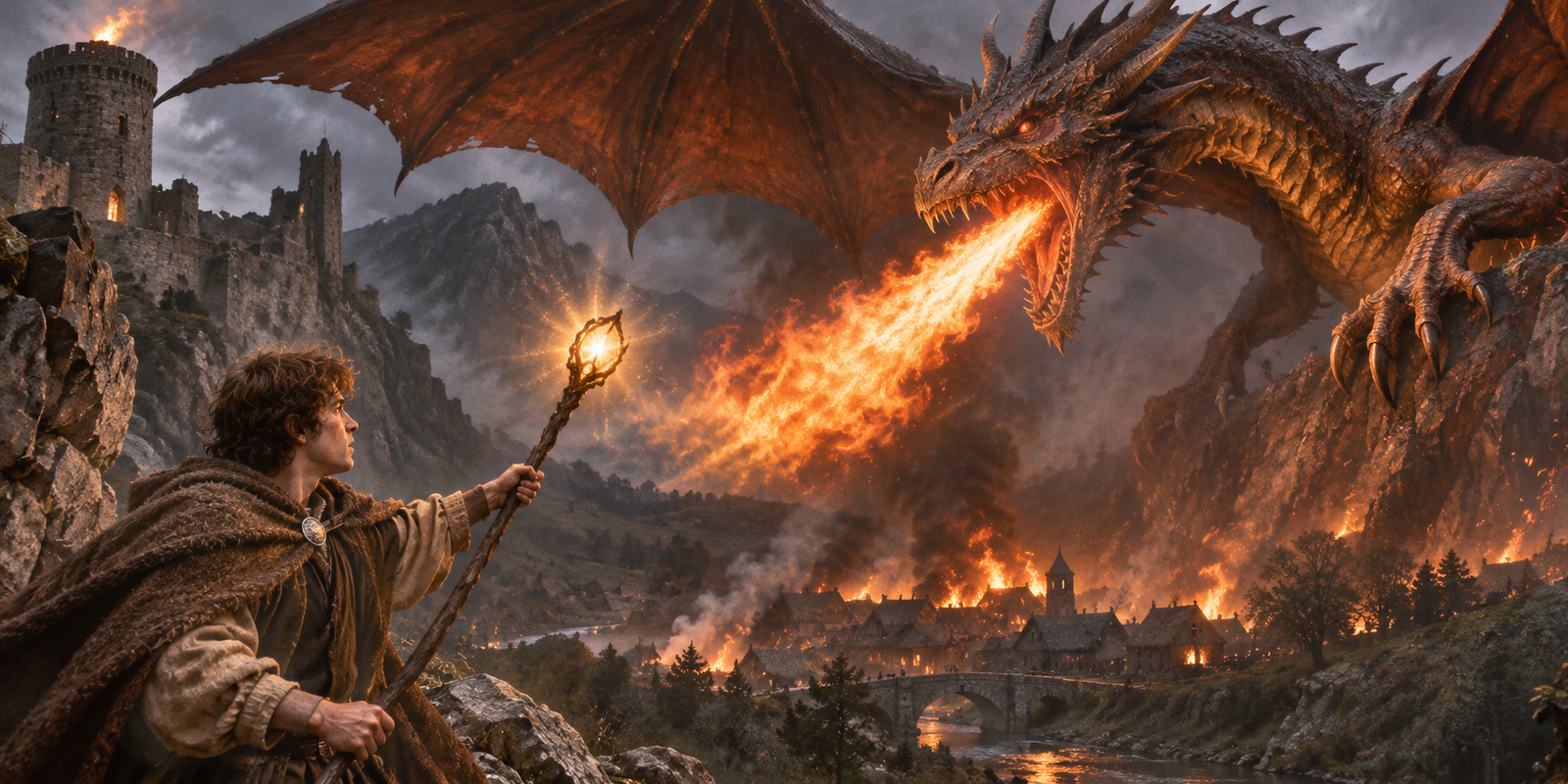
A kingdom buys time with a dreadful bargain, and a young apprentice discovers what slaying a dragon actually costs.
Matthew Robbins’s Dragonslayer is one of fantasy cinema’s most convincing portraits of a world living in fear of a dragon. Rather than treating a monster as the climax of a straightforward heroic quest, the film asks how ordinary people adapt when a terrifying creature has become part of their political and social order. Its dragon, Vermithrax Pejorative, remains a triumph of creature design and physical filmmaking.
At a Glance
| Title | Dragonslayer (1981) |
|---|---|
| Director | Matthew Robbins |
| Screenplay | Hal Barwood and Matthew Robbins |
| Principal cast | Peter MacNicol, Caitlin Clarke, Ralph Richardson and John Hallam |
| Production | Paramount Pictures and Walt Disney Productions |
| Running time | Approximately 110 minutes |
| Genre | Dark fantasy; sword-and-sorcery; creature feature |
| Signature creature | Vermithrax Pejorative |

Why This Film Matters
Dragonslayer makes the monster feel ancient, dangerous and independent of human affairs. The dragon is not a puzzle waiting at the end of a dungeon. It has shaped generations of choices: sacrifice has become policy, courage is rationed, and rulers have learned to call cowardice a form of protection. That arrangement makes the film more morally interesting than its seemingly simple title suggests.
The Story — Without Major Spoilers
In the kingdom of Urland, the ageing dragon Vermithrax Pejorative is appeased by a lottery that selects young women for sacrifice. A delegation travels to find the sorcerer Ulrich, hoping his magic can end the bargain. Events instead thrust Ulrich’s inexperienced apprentice Galen into the task. Accompanied by Valerian and confronted by the king’s interests, Galen discovers that the creature is only part of the problem: the people who benefit from the existing order also stand in his way.
The story’s strongest tension lies between public courage and private compromise. It is not clear that anyone can defeat the dragon, but keeping the peace has already demanded an intolerable price.
Characters and Performances
Galen (Peter MacNicol) is talented but immature, quick to mistake possession of magical power for understanding. The film treats his development as a series of costly corrections. Valerian (Caitlin Clarke) is resourceful and deeply aware of what the lottery means to those forced to endure it; her stake in the story is personal rather than ceremonial. Ulrich (Ralph Richardson) carries the authority and weariness of an old magical tradition. King Casiodorus (Peter Eyre) illustrates the compromises a ruler makes when survival has been mistaken for justice.
The supporting villagers matter because their terror is credible. Some act bravely, some turn away, and some prefer a cruel certainty to the risk of change.
The World on Screen
Urland is not a neat medieval theme park. Mud, smoke, rough stone, crowds and remote landscapes lend weight to the journey. Magic is rare enough to inspire awe and mistrust. Royal authority is visible, but it is not omnipotent; the king cannot simply issue an order and make Vermithrax disappear.
Most importantly, the dragon is a living presence. Its lair, movement, silhouette and violence suggest an enormously powerful animal rather than a person in costume or a harmless legend. The way it crawls and flies gives Vermithrax an identity distinct from the courtly, talking dragons of some other fantasy traditions.
Behind the Camera
Robbins co-wrote the screenplay with Hal Barwood. The Disney–Paramount co-production combined live-action sets and locations with sophisticated practical effects. Phil Tippett and Industrial Light & Magic helped realise Vermithrax through miniature models and go motion, a technique designed to add more natural motion blur to animated creatures. Full-scale mechanical constructions supplied the close-up weight that smaller models could not.
The film’s celebrated effects were not decorative embellishments: they made the central moral bargain believable. Without a dragon that truly seems too powerful for humans to control, the kingdom’s long submission would feel contrived.
Themes and Critical Assessment
The film examines the corruption of a bargain made under duress, the distinction between magic and wisdom, and the ease with which public institutions can normalise suffering. Its coming-of-age structure is conventional, but the surrounding society is not. The darkest ideas remain effective because they are presented as everyday arrangements, not melodramatic speeches.
What works: Vermithrax’s formidable design, a tangible setting, the sacrificial lottery and the uneasy relationship between rulers and the people they claim to protect. What works less well: some abrupt changes in tone and a few narrative conveniences as the quest gathers pace. The young hero is deliberately fallible, which can frustrate viewers expecting effortless competence. That imperfection is also a source of the film’s depth.
Legacy and Related Viewing
Few screen dragons have matched Vermithrax’s combination of bodily weight and menace. The film remains a useful comparison point for later fantasy productions that make dragons into political forces rather than merely spectacular opponents. For another 1981 reimagining of legend, see Fantasy Films and Television and its entries for Excalibur and other early-1980s fantasy adventures.
Explore in SpiralWorlds
Explore the site’s Dragon Bestiary, the wider Bestiary and the related film Excalibur (1981). Vermithrax Pejorative is a distinct screen creature with its own appearance and behaviour, not a standard chromatic dragon or an entity automatically present in the campaign. Use the game’s established dragons when building an original encounter, without assigning them Vermithrax’s film biography.
Ideas for the Table
Use the structure, not the named film characters. A dragon might have forced three neighbouring settlements into competing arrangements: one pays livestock, one provides tribute, and one submits a person each year. Characters should be able to question the bargain, find evidence about the monster, and decide whether ending the arrangement justifies the danger of provoking it. The dragon need not be evil in the same way as the officials who sustain the sacrifice.
Build the dragon as a creature with needs, instincts, territory and a reason to tolerate—or break—the agreement. The Dragon Bestiary provides campaign creatures and their edition-specific mechanics. Vermithrax is a film character, not a directly interchangeable stat block.
The lottery’s keeper. A village insists its sacrificial draw is fair, but the records are sealed and several powerful families never lose a child. The party can expose the fraud, challenge the system openly, or bargain for time to confront the monster itself.
The ash road. After decades of tribute, no one remembers the dragon’s true range. A lost caravan, a scorched hillside and the testimony of a former hunter offer conflicting routes to its lair. Those clues allow multiple approaches rather than a single compulsory battle.
The apprentice’s bargain. A young magician offers to defend the valley but needs a rare component held by the king’s adviser. The players must decide whether to trust an untested spell, negotiate for the component or look for an entirely different solution.
Trailer and Further Viewing
Watch a video previously featured on this page (YouTube). This external link replaces the old multi-video row; video availability may change.
Sources and Credits
- Disney D23 — Dragonslayer (production, story and runtime).
- American Film Institute Catalog — Dragonslayer (historical production and reception).
- Propstore — production references (creature effects and visual materials).
The poster and film characters remain the property of their respective rights holders. This original criticism and the game scenarios are not an official film adaptation.
Keep this reference growing
If this page helped with your reading or game, you can support its upkeep or explore the curated books.
Explore the Bookshop — epics, classics and stories behind imagined worlds.