
Myllendonk — The Water Castle of the Lower Rhine
Korschenbroich · Mirlaer-Myllendonk · Jülich · Niers marshland and feudal oaths
At a Glance
| Realm | Lordship of Myllendonk, a small Lower Rhine fief within the Holy Roman Empire |
|---|---|
| Seat | Myllendonk Castle, a moated stronghold near Korschenbroich and the Niers wetlands |
| Ruling House | The Mirlaer-Myllendonk family, whose claim descends through the earlier lords of Myllendonk and the Reifferscheid line |
| Overlordship | Earlier claims of Guelders and Cologne complicate the family’s rights; the castle was offered as a fief to Jülich in 1387 |
| Nearby Communities | Korschenbroich, Raderbroich, Pesch and adjoining rural estates |
| Neighbours | Jülich, the Lordship of Dyck, Cologne’s lands, and routes toward Guelders |
| Livelihood | Farming, cattle, mills, small-scale trade, tenants’ dues and passage over wet roads |
| Gods and Spirits | Household ancestors, field guardians, road shrines and spirits of the Niers and its ditches |
| Danger | Rival feudal warrants, disputed harvest dues, flooded roads and watchful marsh spirits |

Where the Road Enters the Water
The castle’s moat is deeper than the lord’s certainty about who may command him. At Myllendonk, a courier carrying a seal from Jülich finds another representative waiting with documents invoking Cologne. A tenant refuses to pay two sets of dues. The bailiff, whose guards are already owed their wages, insists he can resolve the quarrel without calling in foreign soldiers.
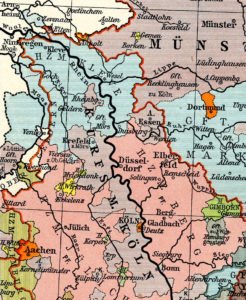
The lordship is small, but its boundaries matter. It comprises the castle and lands around Korschenbroich—not the distant borough of Grevenbroich as its own capital. The lords of Myllendonk are attested from the twelfth century. In the fourteenth century, inheritance brought the estate into the Mirlaer family, who adopted the local name. The castle and countryside keep their own rights even while greater princes compete for allegiance.
What Is Happening Right Now?
Jülich’s Claim of Service
Gerhard VII of Jülich-Berg has claims of feudal service rooted in arrangements older than his present reign. His officials request an inventory of the castle’s armed tenants. The steward answers that a levy may be lawful but only on the conditions recorded in the family’s own charter.
An Old Cologne Obligation
A messenger carrying older evidence from the ecclesiastical lands of Cologne argues that sacred estates and rights to a local tithe were never included in Jülich’s agreement. The household’s scribes cannot find the surviving copy. A temple keeper says the missing deed was witnessed beside a stream that has since changed its course.
The Niers Flooded the Road
Heavy water has reached the causeway, and pack animals are being lost in narrow ditches. A rider claims a nixie pulled his horse under; local millers say an upstream landowner closed a sluice to divert the current toward his neighbour’s fields.
Places and Powers
Myllendonk Castle
The fortified residence guards an approach through wet farmland. Its gatehouse and old records are more valuable to outside claimants than its furnishings; a stolen seal may endanger everyone who has accepted the family’s safe-conduct.
Korschenbroich
Farmers, craftspeople and tenant households bring disputes over mills, ditches and field boundaries to local officers. A travelling priest of the harvest gods may settle an oath that a noble refuses to hear.
Raderbroich and Pesch
Small estates and farm tracks lie close to rival jurisdictions. Villagers know the difference between a traditional road due and a levy invented by an armed patrol.
The Mirlaer-Myllendonk household defends its authority; Jülich’s steward wants armed support; Cologne’s claimants seek recognition of older interests. Dwarven masons, halfling wagon masters and rural temple stewards are involved according to their trades and obligations, not as united factions.
Adventure Hooks
- The Two Water Seals. A deed from Jülich and an older temple charter claim the same revenues from a flooded mill.
- Night at the Gatehouse. A guard vanishes while protecting a prisoner whom two rival courts have demanded.
- The Nixie’s Bargain. A ferry route is lost after water levels rise; an ancient river spirit demands the return of an heirloom stolen from a shrine.
- The Borrowed Retainers. An officer enlists men in the name of Jülich although no valid order has arrived from the duke.
Travel, Law and Services
The raised approaches become crowded after heavy rain. Carriers seeking safe passage should ask whose lordship controls a bridge, obtain witnesses for valuable cargo and avoid entering a rival noble’s land with an unrecognised seal. Minor healing and protective rites may be arranged through household shrines. Better equipment, legal scribes and substantial magical aid require patrons or a journey to a larger market.
Later Map of the Lordship
History and Sources
The castle is documented from the medieval period and came into the Mirlaer family’s hands in the fourteenth century. The castle was held in a complicated network of feudal obligations, including an act of homage to Jülich in 1387. Kuladig’s historical survey of Myllendonk Castle documents those connections and the older fortified fabric. The surviving grants still leave room for rival interpretations of feudal service, taxation and the rights of the castle.
Related Lands
Jülich · Berg · Guelders · The Empire
Keep this reference growing
If this page helped with your reading or game, you can support its upkeep or explore the curated books.
Explore the Bookshop — epics, classics and stories behind imagined worlds.