
Dortmund — Free Imperial City of the Hellweg
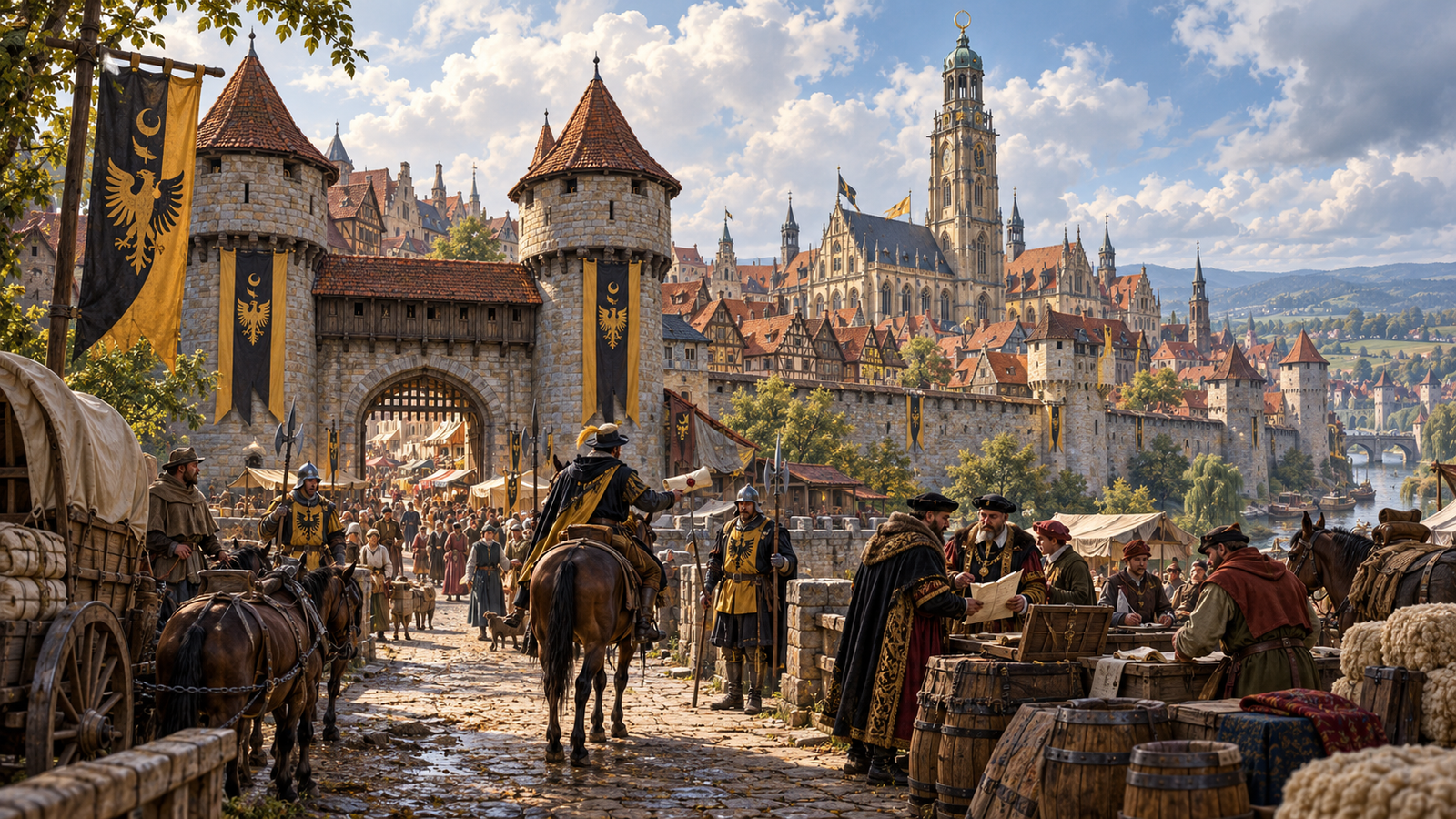
Westphalia · Free Imperial City · Hanseatic trade · Hellweg crossroads
At a Glance
| Realm | Independent Free Imperial City of the Empire, in Westphalia |
|---|---|
| Government | City council, burgomasters, merchant elites, civic courts and guild interests; no resident duke or prince-bishop rules the city |
| Trade | Hanseatic credit, English wool and cloth, metalwork, brewing, leather, transit dues and market exchange |
| Roads | Hellweg east–west route via the Westentor and Ostentor; north and south gates open toward rival jurisdictions |
| Neighbours | County of Mark, lands of the Electorate of Cologne, and the trading city of Soest |
| Factions | Hanseatic League; civic merchant houses; Westphalian free courts and their rivals |
| Languages | Westphalian Low German; Latin for some legal and learned records; visiting merchants speak other tongues |
| Worship | Several local gods, warding rites, ancestors, guild patronages and temple households; no single universal faith |
| Immediate dangers | Forged summonses, stolen merchant bonds, a neighbouring lord’s toll collectors and divided loyalties after regional wars |
A merchant arrives with a sealed letter that no one will admit to sending. Before the council can open it, three strangers claim the right to hear his case. Dortmund’s walls are strong, its merchants proud and its enemies close. The city answers to the Empire rather than the neighbouring princes, yet a wagon can leave the east gate and fall under another ruler’s law before the dust settles. Every dispute here has a price: in silver, reputation, trade privileges or lives.
What Is Happening Right Now?
The Three Seals
A wealthy trading house has demanded restitution for wool seized on the Hellweg. The council has issued one writ, an officer of Mark claims a second, and a sworn judge’s courier brings a third with an unfamiliar seal. The caravan guards will testify only if someone guarantees their families’ safety. A settlement might save the city a new trade war—but the wrong document could surrender its ancient freedom.
Peace Is Not the Same as Safety
Dortmund survived its great siege decades ago, but the expense ruined fortunes and hardened memories. Nearby Soest has recently emerged from its own bitter feud with Cologne’s ruler. Couriers now carry claims, accusations and rival accounts of who may levy duties. Dortmund’s council wants profitable peace without becoming a vassal to any victor.
The Judges Beneath the Linden
A summons names a councillor who is due to negotiate for the Hanseatic merchants. He insists the writ was forged. Genuine Westphalian free courts hear grave allegations under imperial privileges, but no single secret master directs all the tribunals. The characters must find out whether a lawful officer, a private enemy or the occult inner circle rumoured in the Vehmic Court is involved.
Places Adventurers Can Actually Visit
The Alter Markt and the Council Hall
The Old Market is the heart of the city’s commercial life. Brokers shout over cloth samples; factors examine seals; merchants debate exchange rates and the latest convoy delays. The medieval town hall stands on the market’s southern side. A stranger can find work here before noon, but cannot simply enter council deliberations without a guild patron, sworn testimony or an extraordinary message.
The Westentor and the Ostentor
The Hellweg cuts from the western gate to the eastern gate, threading the walled city. Guards examine goods, toll papers and suspicious weapons. Carters gather beneath gatehouses while smiths repair broken axles. The gates create an immediate choice for any arriving party: submit openly to inspection, negotiate through a merchant factor or risk an illicit route—and the consequences for everyone travelling with them.
The Burgtor and Wißstraßentor
The north and south approaches carry smaller convoys, local produce and travellers from the surrounding estates. The southern Wißstraßentor still has a grim reputation from the failed hay-wagon conspiracy associated with Agnes von der Vierbecke in 1378. The council uses the memory as a warning: a friendly cart can conceal armed men. This is a useful place for interrogation, pursuit or a tense inspection without a battle.
The Great Hall of Wards
The ancient sacred precinct around the monumental Reinoldi building is a civic landmark. In the campaign, its hall and older images are devoted to protective oaths, the city’s ancestral defender and several gods of craft, watchfulness and lawful roads. Temple households shelter injured travellers, preserve memorial rolls and argue over who has the right to swear an oath on behalf of Dortmund. This reimagines the historic structure rather than reproducing its real-world religious use.
The Guild Shrines and Masters’ Workshops
Carvers, painters, metalworkers and goldsmiths make Dortmund famous beyond its walls. The city’s old sacred and guild buildings provide spaces for commissions, funerary accounts and the making of votive images; a disputed work may contain a coded family bargain. Skilled patrons can hire an artisan or identify a foreign maker’s mark, but expensive commissions may take weeks.
The Freistuhl and the Femelinde
Near the traditional free court stands the great linden associated with a Westphalian Freistuhl. Its stone judgment seat is feared and respected. The judges deal in testimony, sworn jurisdiction and imperial claims; outsiders commonly exaggerate their powers. A formal accusation can take months, while a forged summons can ruin someone overnight. The Vehmic Court faction guide explains these competing courts, including their darker campaign mysteries.
People and Factions
The burgomasters and council guard Dortmund’s imperial rights and negotiate with powerful neighbours. Their opinions are divided: one faction wants to preserve every old privilege, while another will trade lesser toll rights for dependable peace.
The Hanseatic factors represent consortia of merchants, not a single state treasury. They pay for escorts, translators, reliable messages, credit recovery and discreet investigations. Rival families recall the wealth of the historic Berswordt and Klepping merchants, whose business helped connect the city to England. Individual characters and their particular quarrels on this page are invented for play.
Elis Varen, a fictional guild factor, has proof that one stolen bond was sold twice; she will give it up only if the characters protect her apprentice. Matthis Groll, a fictional council clerk, has copied two suspicious writs with the same spelling error. Ada of the Linden, a fictional sworn court messenger, believes the forged writ is endangering the credibility of lawful judgments.
Guilds, temple houses, gate wardens, the Hanseatic League and independent free-court officers often want different outcomes. None should function as an automatic ally or villain. Favour, money and public reputation are as important as a weapon.
Magic, Markets and Services
The city buys and sells cloth, hides, ironwork, tools, brewing supplies, writing materials, horses and ordinary travel equipment. Inns and guest yards cluster around the trade road and market approaches, serving caravan crews as well as guild representatives. No named historical inn is invented where the evidence is uncertain; use the West Gate Guest Yard and Three Ledgers Tavern as fictional campaign establishments.
Notaries authenticate charters; witnesses can be hired but not their testimony; guild offices connect a party with armourers, scribes, money-changers, interpreters and experienced teamsters. Healers are associated with several shrines and private households. Divinations and ritual protections exist, but civic authorities distrust anyone who promises to override contracts by magic. A spell that compels a witness may be ruled inadmissible—or the cause of a fresh accusation.
Dangers, Folklore and Adventure Hooks
Agnes and the golden spinning wheel: A genuine regional telling from the Holzwickede and Dortmund area adds a strange magical spinning wheel to the tale of Agnes von der Vierbecke. The historical accusation and her fate are fiercely disputed; later storytellers turned them into a legend of bargains with an enigmatic stranger and a wheel that spins without hands. In the campaign, a spindle marked with Agnes’s initials has appeared in a merchant’s storehouse. Does it reveal an unjust conviction, weave dangerous binding oaths, or simply inspire a convincing fraud? The regional folklore account distinguishes the tale from the documentary record.
Reinold and the four riders: The city’s historic guardian is associated in legend with Reinold and his brothers riding the extraordinary horse Bayard, strong enough to carry them all. This is an authentic heroic legend retold as an in-world account of an ancestral protector rather than religious worship. A carved horse on a guild seal could conceal the secret of a messenger’s passage. The Dortmund’s account of the Reinold and Bayard legend preserves evidence of the medieval tradition.
The tale of the restless oathbreaker is told by night watchmen along the walls: a figure carrying a broken wax seal walks between two closed gates. This is a campaign ghost story inspired by local legal traditions, not a verified traditional legend of Dortmund. If a GM makes it real, the creature may be a revenant seeking judgment, or the scene can be run as a haunt tied to an unlawful sentence.
- The Price of Free Passage: escort a wagon train through the Hellweg gates after two toll collectors each demand payment. Decide whether to challenge the forged privilege, pay, or expose the lord profiting from it.
- The Linden’s Third Summons: authenticate a Vehmic writ before a councillor’s public condemnation. A genuine accusation may still be supported by false witnesses.
- The Empty Wool Bales: discover why a merchant’s sealed bales contain stones and which guild officer knowingly certified them. Paying the wrong claimant could bankrupt an honest family.
- The Watchman’s Oath: solve the story of a figure walking the battlements before an old account of the siege is destroyed. The supernatural explanation is optional; a living witness may be using the tale to force the truth into the open.
- The Painted Bond: a goldsmith’s commissioned panel conceals the terms of a family debt, making its destruction tempting to powerful people. Protect the artisan, return the work or publish the contract—with consequences for all three.
Arriving in Dortmund: First Decisions
At the Westentor, a gatewarden asks what the party carries and whose protection they claim. A Hanseatic factor offers introductions in exchange for protecting one disputed shipment; a council runner offers official pay for finding a missing witness; and a sworn court messenger asks for discretion while checking a suspect seal. The party can follow any lead, take more than one, or pursue its own business. Each patron has useful information but conceals a cost.
For a brief session, start with The Three Seals, move to an interview at the Alter Markt or under the Femelinde, and resolve the immediate conflict with public testimony, a negotiated compromise or a pursuit through the gates. The city’s freedom, trade and jurisdiction remain in play even if the suspects escape.
Encounters on the Hellweg
Roll a d6 when travellers encounter trouble on the road or spend time among the gates and market. Not every dispute is criminal, and not every court has authority beyond its own territory.
| d6 | Encounter | Opportunity |
|---|---|---|
| 1 | A collector presents a disputed toll warrant. | Compare seals or seek a merchant’s testimony. |
| 2 | A merchant needs guards for a delayed wool shipment. | Determine who claims the cargo and negotiate escort terms. |
| 3 | A frightened courier needs protection. | Discover whether the message concerns a lawful summons or a private feud. |
| 4 | A failed axle leaves passengers exposed. | Repair the wagon or arrange shelter and transport. |
| 5 | Armed retainers seek a debtor. | Establish their authority, negotiate or warn the debtor. |
| 6 | A traveller reports a figure with a broken seal at dusk. | Trace the report to a witness, a deception or the restless dead. |
When the Three Seals Go Unanswered
After one day, rival claimants seek guarantees from the city. After three days without credible testimony, merchants divert vulnerable wagons and escort work becomes more valuable. After seven days, the council seeks a settlement while neighbouring officers press their claims. Recovering a witness, protecting an apprentice or exposing a forged writ changes these developments. Occult agents of the Vehmic Court may take an interest in supernatural evidence, but their involvement does not establish that a summons is lawful. The wider Empire offers further patrons and jurisdictions.
Travel, Borders and Law
Dortmund is an inland walled city on the Hellweg, not a seaport. Wagons travel east towards Soest and west towards the Rhine trading world; north and south routes enter lands with different courts, dues and loyalties. The walls protect the streets, not every farm on the horizon. Travellers who carry both the city’s safe-conduct and a neighbouring lord’s permit avoid problems, though those documents may contradict one another.
Local guards enforce the council’s market and peace rules. Neighbouring lords may pursue claims outside the gates. Westphalian free judges assert another form of authority for certain grave matters, but their jurisdiction is contested and not equivalent to ordinary city government. Negotiation, testimony and a well-kept seal may prevent bloodshed more effectively than force.
Why Dortmund Still Remembers the Siege
In 1388–1389 the city defied the Archbishop of Cologne and the Count of Mark, survived siege and attack, and paid dearly to secure the peace. It was not conquered, but its wealth and financial independence suffered for years. In the early fifteenth century its commerce and artistic patronage recovered; the ambitious remodelling of its great central sacred building began in 1421. The later Soest Feud again reminded Dortmund that Westphalian political borders were made by negotiation as much as war.
The historical city had its own real religious institutions, people and civic history. This campaign adaptation replaces the worship with polytheistic temple traditions while retaining the trading roads, fortifications, class conflicts and documented imperial status. The stories of Agnes’s golden spinning wheel and Reinold’s extraordinary horse come from genuine local and regional legend, adapted to this setting; the immediate disputes, inns, oathbreaker ghost and three named player-facing characters are campaign inventions.
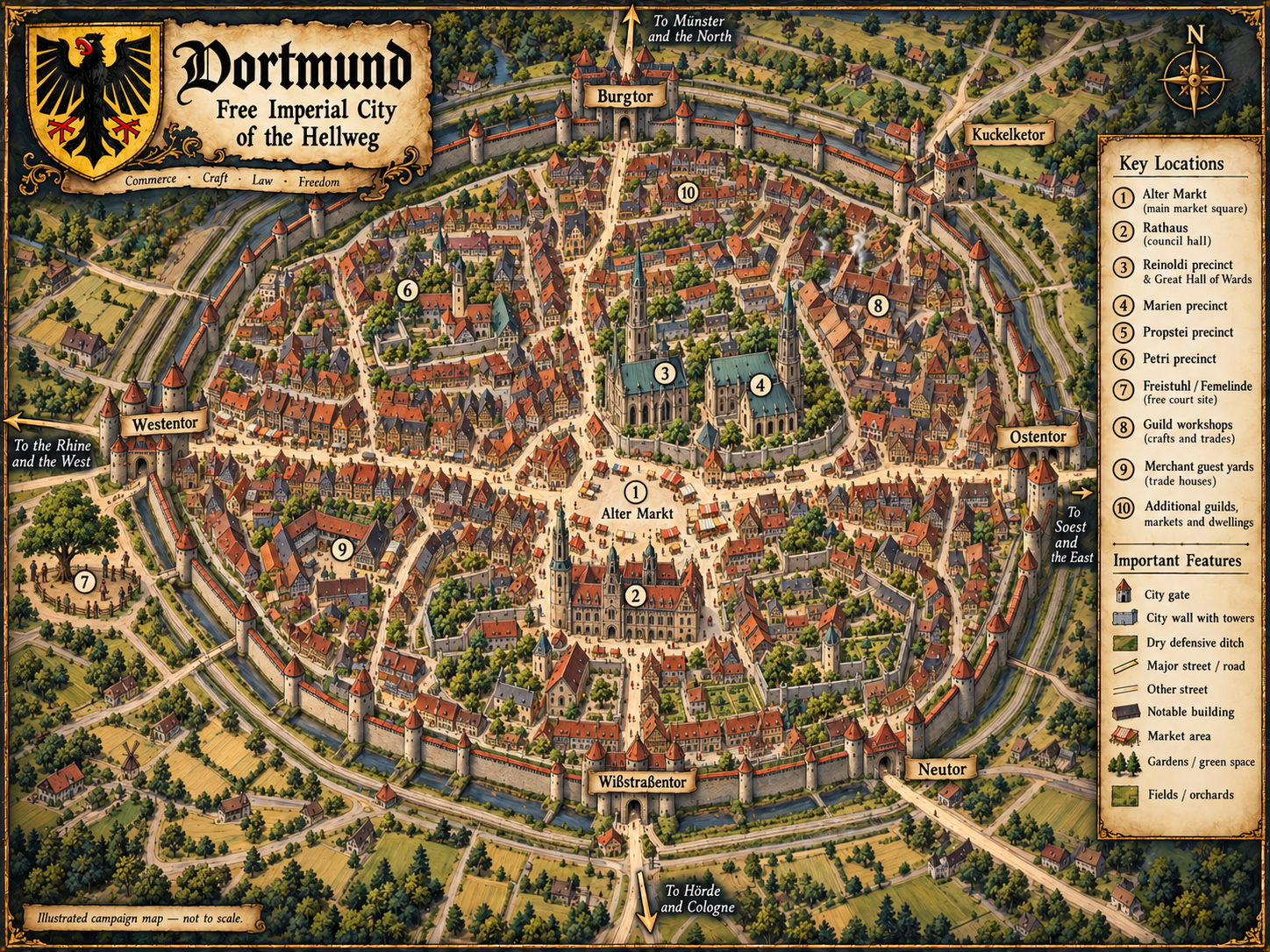
Dortmund Campaign Map
Use this map to navigate the Hellweg between Westentor and Ostentor, find the Alter Markt and Rathaus, and reach the city’s sacred precincts and outer free-court site. Its walls, routes and principal civic landmarks follow the broad historical layout; smaller buildings and their precise positions are interpreted for play. The illustrated map is not to scale.
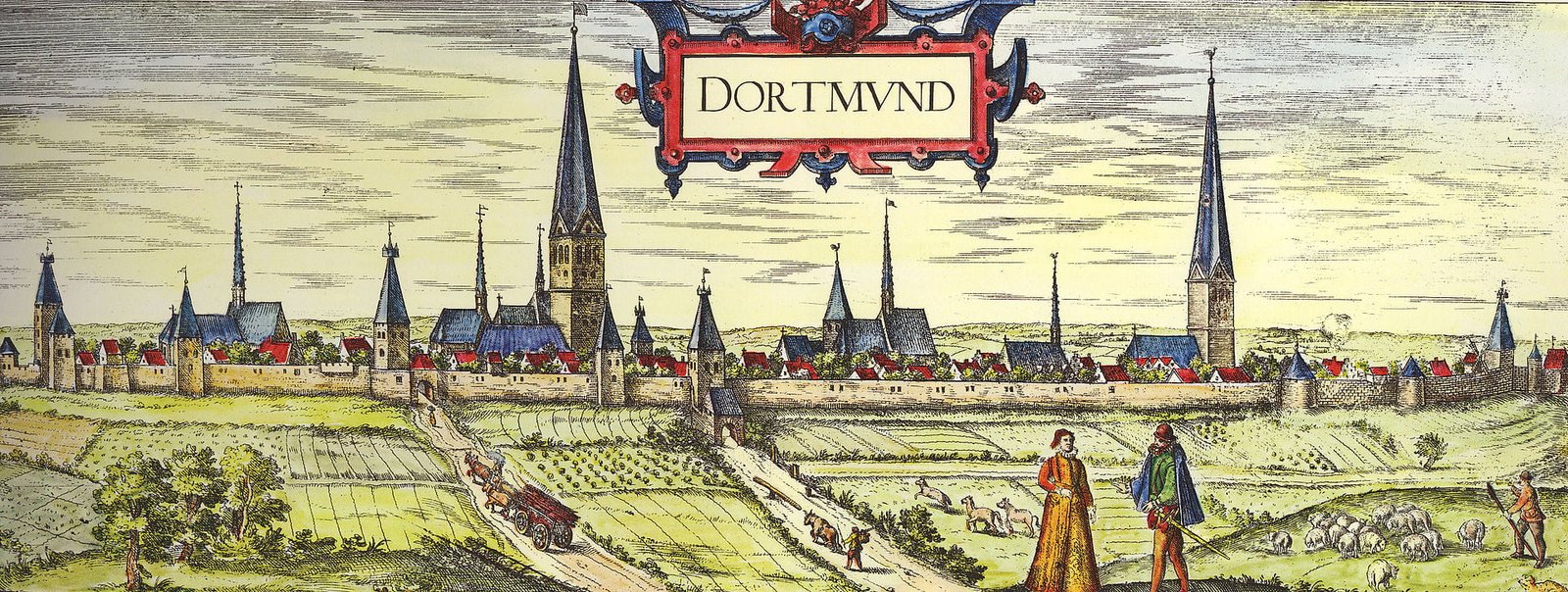
A Later View of the City
Historical References
See the City of Dortmund’s late-medieval history for the feud, trade recovery and art; its account of the old town hall; the municipal history of the Freistuhl; and Wißstraße and its gate. The dedicated painted hero and civic heraldic shield appear at the start of this entry. The illustrated Dortmund campaign map above provides a keyed overview of gates, streets, landmarks and the outside-the-wall Freistuhl. The later Braun–Hogenberg illustration remains a separate historical reference.
Keep this reference growing
If this page helped with your reading or game, you can support its upkeep or explore the curated books.
Explore the Bookshop — epics, classics and stories behind imagined worlds.