
Margraviate of Baden · Upper Rhine · Campaign Present 1454 CE
Baden-Baden — Baden in 1454
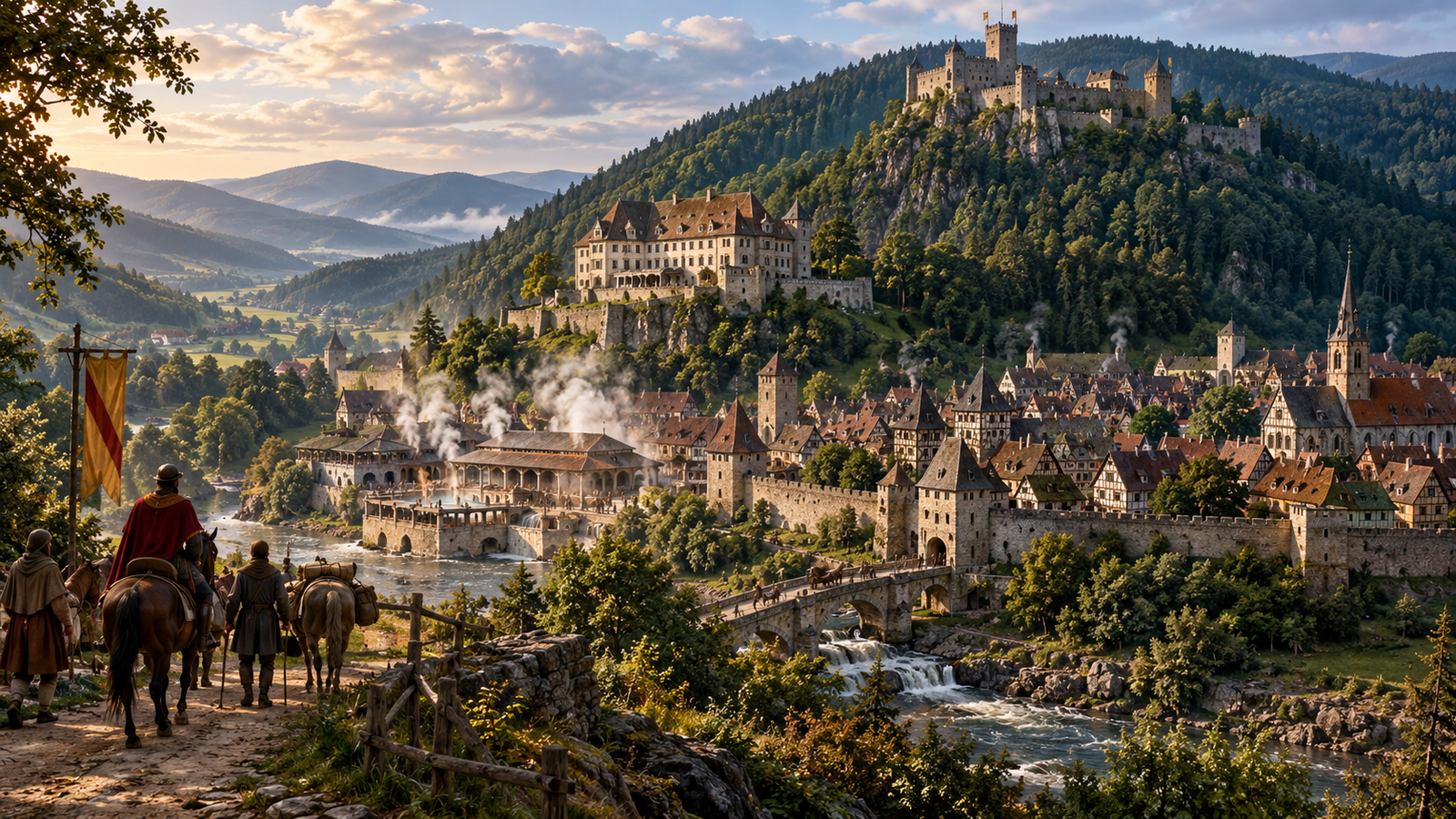
In 1454 the town is simply Baden: a fortified margravial residence built around ancient hot springs, crowded bathhouses and the roads leading into the northern Black Forest. Margrave Karl I has inherited only recently, his brothers have just surrendered their proposed shares of the family lands, and every courtier, merchant, bathkeeper and neighbouring lord is deciding what the new order means.
Baden at a Glance

The Arms of Baden
Baden’s medieval seals use the arms of its ruling house: a red bend on a gold field. The later decorative mural crown belongs to a much later age and is not used here.
Settlement Profile
The permanent population is small, but bath visitors, noble households, merchants, messengers and servants can increase the number of people inside and around Baden noticeably during busy periods.
Baden matters far beyond its population because it is a margravial residence, administrative centre and recognised destination for wealthy visitors seeking the thermal springs.
Margravial residence · thermal spa · administrative centre · Upper Rhine stopping point · gateway into the northern Black Forest.
Upper Rhine German vernacular dominates ordinary speech. Latin is used among learned visitors, some chancery work and scholarship. French and other neighbouring tongues are encountered among courtly and long-distance visitors. There is no universal Common tongue.
Farms, villages and estates outside the walls provide food and labour, while the forest supplies timber, fuel, charcoal, medicinal plants, game and access to mineral workings.
Baden draws in grain surpluses, wine, cloth, salt, luxury goods, manuscripts, medicines, alchemical materials and whatever the margravial household or wealthy bath guests are prepared to pay to obtain.
Baden’s greatest export is service: bathing, lodging, treatment, brokerage, court access and information. Timber, charcoal and other woodland products also move outward through its road network.
Baden depends on functioning thermal sources and secure supply roads. A failure of either threatens the baths, the court household and the town’s ability to feed an unusually demanding visitor economy.
Karl I holds formal authority, but everyday power is shared among the margravial household, town court, wealthy bath interests, established property holders and the people who control access to information.
The House of Baden claims lordship over the castles, government and valuable spring revenues. Local families and ministerial houses maintain older property, service and access claims beneath that authority.
The Grey Lady remains bound to Hohenbaden, while older presences linger in the thermal channels and Roman foundations beneath the bath quarter. Human ownership does not necessarily end those older claims.
Local householders, recognised retainers and established merchants possess stronger networks than temporary guests. Foreign bath visitors are welcome while they pay and keep the peace; access to the court, records and private property still requires status, patronage or permission.
Town officers and judges handle ordinary local order. Margravial guards and household retainers protect the castles, court business, high-status visitors and matters touching Karl’s authority.
Prosperous but unsettled. Baden’s baths and court attract money, yet Jakob I’s death and Karl’s fresh consolidation leave offices, property claims and loyalties in motion.
For wider campaign guidance on building and running places like Baden, see Settlements.
What Is Happening Right Now?
Baden does not wait for an adventuring company to arrive before developing problems. A party entering the gates can encounter any of these situations during its first day.
One bathhouse’s water has suddenly become hotter, metallic-tasting and faintly luminous after dark. The bathkeeper wants discretion before competitors or court officials hear of it.
If nobody acts: guests fall ill, rivals spread the story and the margravial household closes the affected source while officials search for someone to blame.
Karl I has inherited only recently. His brothers Bernhard and Georg have relinquished the proposed partition of their father’s lands, but their followers, creditors and clients have not all adjusted quietly.
If nobody acts: disappointed clients form harder factions, forged promises circulate and every unresolved dispute becomes evidence that Karl cannot control his inheritance.
Property associated with the Selbach ministerial family is passing into Gemmingen hands this year. One charter is missing, another bears a questionable seal, and several people would profit from a convenient interpretation.
If nobody acts: possession is settled by force before the town court settles it by law, leaving Karl to choose between recognising violence and reopening the dispute.
Horses have begun refusing a particular bend on the ascent to Hohenbaden after sunset. Servants blame wolves. Older residents quietly mention a grey woman.
If nobody acts: a fatal fall closes the road after dark and the haunting begins appearing inside the occupied castle itself.
Repairs beneath the bath quarter have exposed stonework older than the medieval town. The opening was ordered closed, but somebody has already been inside.
If nobody acts: objects disappear from the exposed chambers, water courses change and somebody begins selling Roman finds before officials understand what has been opened.
A wealthy visitor from Strasbourg arrives for the waters carrying a locked case, two nervous servants and instructions not to involve the margrave’s officials.
If nobody acts: the case changes hands, one servant disappears and the dispute becomes a diplomatic problem between Baden interests and powerful people in Strasbourg.
Baden Game Mechanics
Baden — 5.5e / 2024
The current rules do not provide a mandatory settlement-stat-block system. Baden therefore uses ordinary ability checks, equipment rules and GM-controlled availability rather than importing mechanics from another ruleset.
Common access
- No check: ordinary lodging, meals, stabling, baths, common tools, routine repairs, mundane supplies and ordinary market goods when the characters can pay.
- DC 10: locate a particular sort of bathhouse, tradesperson, carrier, healer or public official when time or uncertainty matters.
- DC 15: secure an introduction to a respected bath master, apothecary, court clerk, wealthy merchant or specialist craftsman.
- DC 20: gain access to restricted records, locate a discreet buyer for unusual goods, obtain entry to guarded foundations, or arrange a meeting with someone close to the margravial household.
- DC 25: uncover a carefully concealed dynastic agent, illicit magical broker or supernatural secret protected by influential people.
Use the ability and proficiency that match the approach. Charisma may secure cooperation, Intelligence may identify records or institutions, and Wisdom may reveal that the obvious contact is the wrong one. Do not call for a check when the outcome is routine and failure would add nothing.
Magic and specialist services
- Minor magical help, alchemical preparations and low-level healing can usually be found through established practitioners.
- Common consumable magic may appear through a practitioner, travelling merchant or commission, but the town does not contain a universal magic shop.
- Permanent uncommon items normally require a specialist, private owner or commission rather than sitting openly on a shelf.
- Rare and more powerful magic is exceptional and should normally create an encounter, negotiation or adventure rather than an automatic purchase.
- Spellcasters able to perform modest professional magic exist, but powerful spellcasting is attached to particular people rather than guaranteed by settlement size.
Running the baths
The thermal quarter is Baden’s best information exchange. A character who spends several hours bathing, eating and talking among guests can gather ordinary local news without a roll. Sensitive political gossip, a particular visitor’s movements or information being deliberately suppressed usually requires a suitable check.
Practical rulings
- Visible magic is not automatically criminal. Harm, coercion, theft, trespass and threats to the margrave’s peace are.
- Carrying weapons is normal for travellers, guards and retainers. Drawing them inside a bathhouse, court building or crowded market changes the situation immediately.
- A letter, seal, patron or recognised social connection can remove the need for a check or grant Advantage where appropriate.
- Hohenbaden is a working residence in 1454. Treat access to private chambers, treasury areas and court records as guarded, not as exploration of an abandoned ruin.
Baden — Pathfinder 1e
Baden uses the native settlement rules as a small town. The figures below include its prosperous bath economy and attraction to visitors.
N small town
Corruption +2; Crime −2; Economy +2;
Law +2; Lore +2; Society −2
Qualities prosperous, tourist attraction
Danger +0
Government overlord
Population about 1,500 permanent residents (campaign estimate)
| Marketplace | Value |
|---|---|
| Base value | 1,500 gp |
| Purchase limit | 7,500 gp |
| Spellcasting | 4th level |
| Minor magic items | 3d4 |
| Medium magic items | 1d6 |
| Major magic items | — |
“Overlord” is the Pathfinder government category for a community whose single ruler inherited or seized command; it does not by itself imply that Karl I is a tyrant. True neutrality supplies the +2 Lore adjustment. The prosperous and tourist-attraction qualities together raise Baden’s Economy by +2 and increase the standard small-town base value by 50%; prosperous also raises its purchase limit by 50%.
How the marketplace works
- An item priced at or below the base value has the normal settlement chance of being available.
- The purchase limit describes what an ordinary local buyer can readily pay for one item. A wealthier noble or special collector may exceed it at the GM’s discretion.
- The bath quarter, court and visiting wealthy guests justify Baden’s stronger market without turning the town into a metropolis.
- The listed spellcasting level describes purchasable local service, not a guarantee that every spell exists on demand at all hours.
Settlement modifiers in play
- Corruption +2: court patronage and personal access matter; officials can be pressured through favour, rank and money.
- Crime −2: Baden is small, watched and politically important. Serious violence is difficult to hide.
- Economy +2: bath visitors and the margravial household bring spending beyond what the resident population alone would support.
- Law +2: the margrave’s officials, town court and household retainers maintain a visible peace.
- Lore +2: visitors carry news from the Upper Rhine and beyond, while court records and bathhouse gossip provide unusual information density.
- Society −2: strangers are welcome as paying guests but entry into local political or court networks is tightly controlled.
Practical rulings
- Do not apply settlement modifiers to every roll merely because the characters are inside the walls; use them only where the settlement rules specify.
- A specific NPC can possess resources beyond the general town market.
- The baths are commercial establishments, not automatic magical healing facilities.
- Hohenbaden is an occupied noble residence with guards, servants and household traffic.
Baden — D&D 3.5e
Baden uses the native community-generation benchmark for a small town.
| Community Trait | Baden |
|---|---|
| Community size | Small town |
| Adult population benchmark | 901–2,000 |
| Campaign population | About 1,500 permanent residents |
| GP limit | 800 gp |
| Power centre | Conventional — hereditary noble ruler |
Source benchmark: Dungeon Master’s Guide v.3.5, Chapter 5, “Generating Towns,” Table 5–2: Random Town Generation, p. 137.
Purchasing and selling
The 800 gp community limit is the normal ceiling for what the town’s ordinary market can supply. More expensive goods are not simply waiting in a shop. They require a known owner, special commission, wealthy visitor, court connection or journey to a larger commercial centre.
Baden’s bath economy does, however, create unusually good opportunities to locate private buyers. A noble visitor may be able to purchase an object that no ordinary shopkeeper could afford.
Spellcasting
Do not treat community size as a universal spell-service menu. Determine powerful spellcasting from the actual NPCs present. Routine low-level services can be found among healers, learned practitioners and visiting specialists; more capable casters should be named individuals whose presence matters to play.
NPC generation
If random community generation is needed, use the small-town tables normally. For an ongoing Baden campaign, named NPCs are preferable: the court, baths and visiting clientele mean the identity of the available expert matters more than a disposable random maximum-level resident.
Practical rulings
- The GP limit governs normal community availability; it does not cap the personal wealth of Karl I, Katharina or wealthy visitors.
- Masterwork work can be commissioned where appropriate, but time, materials and individual Craft skill still matter.
- A private magical collection inside Hohenbaden is not part of the public marketplace.
- Security at the castles should be built from actual guards, locks, servants, sight lines and court routines rather than treating the structures as abandoned dungeons.
Arriving in Baden
Baden announces itself before a traveller reaches the gate. The wooded slopes tighten around the Oos valley, roofs gather beneath the castle heights and steam drifts above the bath quarter in cool weather. Hohenbaden stands above everything: not a romantic ruin, but a large occupied stronghold carrying the household, prestige and memory of the ruling family.
Travellers arrive for very different reasons. Some want the waters. Others carry petitions for the margrave, contracts for local merchants, timber and metalwork from the forest roads, letters from Strasbourg, legal business, medicines, gossip or debts. An armed adventuring company is unusual but not incomprehensible. Baden has seen nobles with retinues, messengers, wealthy invalids, escorts and people who prefer not to explain their affairs.
Ordinary visitors can buy lodging and enter the baths without needing court favour. Access to Hohenbaden, the margravial household, restricted records or certain private bath chambers is another matter.
At the table: a new party does not need an audience with Karl I to begin play. The bathhouses, town court, market, gates, castle road and visiting merchants all generate work without forcing the campaign into court politics.
Baden in 1454
Margrave Jakob I died in October 1453. His son Karl I succeeded him as Margrave of Baden and Hachberg. Jakob had intended a division of the family territory, but in 1454 Karl’s brothers Bernhard II and Georg relinquish their governmental shares in his favour.
The result is not a sleepy succession. Estates, offices, obligations and personal loyalties must be realigned around one ruler. Men who expected advancement under a divided inheritance now seek accommodation with Karl. Creditors want confirmation that old promises still hold. Retainers want employment. Local families want their property and privileges recognised.
Karl is also connected closely to wider Imperial politics. His wife, Katharina of Austria, is a member of the Habsburg dynasty, and Karl acts for Emperor Frederick III at the Frankfurt Imperial Diet in September 1454. News moving between Baden, the Rhine cities and the Imperial court therefore has practical value.
Bernhard II should not disappear from the campaign merely because he is not the ruler. In 1454 he is still a living member of the ruling house with his own connections, reputation and former expectations. A message sent “for the margrave’s brother” may matter almost as much as one addressed to Karl himself.
Town, Castles and Streets
Medieval Baden does not divide into tidy fantasy districts. Its useful geography comes from slope, walls, castle approaches, the hot springs and the distinction between upper and lower town.
Hohenbaden
Hohenbaden is the ruling family’s active residence. The large lower castle, Bernhardsbau and mid-fifteenth-century Jakobsbau make it a substantial late-medieval complex rather than an isolated keep.
Karl and Katharina have lived here since their marriage in 1447. Courtiers, guards, servants, messengers, horses, stores and petitioners move through the castle routinely.
Use it for: audiences, household rivalries, sealed correspondence, guarded archives, noble guests, missing servants and the Grey Lady.
Neues Schloss and the Oberstadt
A castle already exists on the Schlossberg above the town. It is the core of the later Neues Schloss, but it has not yet replaced Hohenbaden as the family’s principal permanent residence.
The adjoining upper town forms a natural forecourt and administrative zone between lordly space and the settlement below.
Use it for: clerks, armoury business, stores, guarded documents, official visitors and people who need the margrave’s administration rather than his dinner table.
The Unterstadt
The lower town was enclosed by walls around 1360. Houses, workshops, inns and commercial traffic are compressed inside a defended urban space where strangers are noticed quickly.
In 1454 property formerly associated with the Selbach ministerial family passes into Gemmingen possession, creating a genuine contemporary fault line for land, access and influence.
Use it for: legal disputes, rented rooms, craftsmen, servants, debt collection, missing goods and street-level investigations.
The Rathaus and Town Court
A Rathaus is documented long before 1454. Local administration centres on a Schultheiß and twelve judges; the later mayor-and-council constitution should not be projected backward into this year.
The town court deals with disputes beneath the level of the margravial household and is the obvious place for complaints involving debt, property, assault, contracts and local order.
Use it for: testimony, warrants, disputed seals, hostile witnesses and cases in which both sides insist the law supports them.
The Bath Quarter
Baden’s hot springs drive the settlement’s reputation and much of its visitor economy. Bathhouses cluster around the old sacred and Roman thermal precinct.
Steam, mineral odours, kitchens, laundry, stables, guest rooms and constant conversation make this the busiest social intelligence network in town.
Use it for: rumours, wealthy visitors, private negotiations, poisonings, healing disputes, magical anomalies and entrances into older foundations.
The Collegiate Precinct
A collegiate foundation newly reorganised in 1453 occupies a central place beside the thermal quarter. Its record keepers, memorial custodians, scholars, servants and visitors give the precinct influence out of proportion to its physical size.
The precinct is useful because documents, family memory, burial claims, old foundations and learned investigation meet only a short distance from the baths.
Use it for: archives, wills, old property evidence, memorial disputes, learned visitors, hidden foundations and questions the town court cannot answer from living memory.
The Oos and the Roads
The Oos shapes the valley and the approaches to Baden. Roads connect the town westward toward the Upper Rhine and eastward into increasingly difficult forest country.
Carters, charcoal burners, timber crews, messengers, escorts and itinerant craftsmen carry information between the town and countryside.
Use it for: toll disputes, missing wagons, forest encounters, flooded crossings, fugitives and rumours arriving before official news.
The Baths of Baden
The springs are not merely scenery. They are a margravial revenue source, a reason for wealthy outsiders to visit and the institution most likely to bring nobles, merchants, healers, scholars and adventurers into the same room.
Three bathhouse names are securely available by the campaign year: Zum Engel, documented in 1393, and Zum Salmen and Zur Sonne, both documented by 1440. Their individual personalities below are SpiralWorlds campaign treatment rather than claims about their historical proprietors.
| Bathhouse | Campaign Character | Best Used For | Current Pressure |
|---|---|---|---|
| Zum Engel | Old-established, respectable and protective of its reputation. | Established merchants, conservative local families, long-term guests and reliable gossip. | A regular guest claims somebody entered his locked chamber while every servant was accounted for. |
| Zum Salmen | Busy, commercial and well connected to carriers and Rhine traffic. | Merchants, messengers, caravan news, discreet cargo and hiring guides. | A sealed package from Strasbourg has vanished between the stable and an upstairs room. |
| Zur Sonne | Expensive, private and attractive to people seeking separation from ordinary guests. | Noble visitors, confidential meetings, private physicians and political intrigue. | One pool has begun producing a magical effect that the proprietor is desperate to conceal. |
What a Bathhouse Actually Contains
A successful bathhouse is more than a room containing hot water. It requires guest chambers, bath attendants, fires, kitchens, laundry, water management, servants, stable arrangements, food, drink and people capable of advising visitors on the use of the waters.
Around that activity grows a supporting economy of apothecaries, herbalists, barbers, physicians, alchemists, porters, laundresses, cooks, scribes, brokers and sellers of expensive comforts.
GM shortcut: if the party wants to know who entered Baden recently, who is rich, who is ill, who is travelling under an assumed name or which road has become dangerous, start at the baths before sending them to the castle.
How Baden Lives
Baden’s walls do not contain everything the town needs. Farms, villages and estates in the surrounding country feed the permanent population and much of the court, while carts bring additional grain, wine, cloth, salt and luxury goods from the Upper Rhine network. Forest workers supply firewood, charcoal and timber in quantities made especially important by kitchens, workshops and the constant need to heat water and buildings.
Baden in turn sells something more valuable than bulk manufactured goods: access. The springs draw paying visitors. The court draws petitioners, officials and suppliers. Bathhouses sell lodging, treatment and privacy. Brokers, carriers, healers, scribes and specialist craftsmen profit from the people those institutions attract.
Two failures can destabilise Baden quickly. If the thermal flow becomes unreliable, the town’s reputation and one of the margrave’s revenue streams suffer immediately. If the supply roads become unsafe, food prices rise, firewood becomes scarce and wealthy guests leave before ordinary townsfolk begin to starve. Either problem is therefore political as well as practical.
Magic, Healing and Natural Philosophy
Baden has no reason to possess a university of its own. Its magical identity comes from something more distinctive: the springs.
Learned visitors treat the waters as a legitimate subject of natural philosophy. Court physicians compare one source with another. Alchemists test mineral residues. Apothecaries mix bath treatments with herbs and salts brought from the surrounding country. Arcane practitioners ask why some flows respond differently to magical examination. Forest healers arrive with knowledge that formal scholars may dismiss until it works.
Scholars and practitioners trained in larger centres—including nearby Strasbourg—can therefore appear in Baden without requiring a permanent university faculty.
What Characters Can Find
- ordinary physicians, bath attendants, herbal remedies and apothecary supplies;
- alchemical work and specialist mineral preparations;
- practitioners capable of examining suspicious objects or residues with Detect Magic;
- specialists able to arrange or perform Identify when the right contact is available;
- translation assistance for foreign visitors and old documents, including magical solutions where appropriate;
- private commissions for modest magic rather than a warehouse full of labelled enchanted merchandise.
The Roman Problem
Baden’s medieval thermal quarter stands over far older Roman bathing works. In SpiralWorlds, those foundations are not merely archaeological remains. Channels, blocked chambers, dedicatory stones and sealed service passages can preserve traces of earlier magical practice.
A newly opened Roman chamber is therefore immediately useful as a dungeon entrance without requiring the GM to pretend that the whole medieval town sits on an enormous forgotten megadungeon. One staircase, one collapsed heating passage and one sealed sanctuary are enough.
Court and Power
Karl I of Baden
Historical figure.
The ruling margrave, only recently succeeded to his father’s position. Karl’s immediate problem is not winning the title but making a newly consolidated inheritance function.
He values useful service, reliable information and people who solve problems without creating public embarrassment.
Katharina of Austria
Historical figure.
Karl’s wife and a Habsburg princess. She has lived with Karl at Hohenbaden since their 1447 marriage and gives the Baden court connections beyond the scale of the town beneath it.
Her household creates a second network of servants, visitors, correspondence and patronage alongside Karl’s own.
Bernhard II
Historical figure.
Karl’s brother. Bernhard relinquishes governmental claims in Karl’s favour during the 1454 consolidation but remains politically significant.
Former clients may still invoke his name, honestly or otherwise.
Georg of Baden
Historical figure.
Another of Karl’s brothers involved in reversing Jakob I’s proposed partition. His future lies away from direct government of Baden, but the transition is current business rather than old history.
Factions That Matter
Officials, retainers and servants who benefit from Karl’s successful consolidation and want trouble settled before rivals can exploit it.
People who expected office, income or protection under Bernhard or Georg and now need new arrangements.
The Schultheiß, judges and householders whose concern is that high politics does not destroy ordinary property, contracts and public peace.
Owners, servants, suppliers and healers who depend on Baden remaining fashionable, accessible and safe.
A real 1454 property transition that can generate deeds, witnesses, disputed obligations and opportunistic fraud.
Especially merchants and travellers connected with Strasbourg, whose money and information make them valuable even when locals distrust their motives.
People of Baden
Humans form the clear majority of the permanent population. Baden is nevertheless accustomed to outsiders because the baths, court and road traffic continually bring people who do not belong to local families.
Dwarves appear as smiths, stoneworkers, miners, assayers and travellers moving through the wider mountain economy. A few may reside permanently, but Baden is not a dwarven settlement. Halflings are familiar among carriers, traders, household workers and travelling families. Gnome craftsmen and alchemical specialists are rarer but valuable.
Elves are conspicuous visitors rather than natives of the Black Forest. Those encountered here are most plausibly long-distance travellers from established elven regions in Britain or Scandinavia, diplomatic companions, scholars or individuals following a particular purpose.
Ancestry alone does not determine status. A recognised dwarven assayer with court clients can possess greater local standing than an unknown human mercenary. A halfling carrier who has worked the same roads for twenty years may be treated as thoroughly familiar while a wealthy foreign noble remains an outsider.
Useful Campaign NPCs
| Name | Role | What They Want |
|---|---|---|
| Anna Rüdin SpiralWorlds campaign NPC |
Senior bath mistress at Zum Engel | Keep the house respectable and solve supernatural problems before wealthy guests flee. |
| Konrad Scherer SpiralWorlds campaign NPC |
Margravial chancery clerk | Find a missing document without admitting to the court that it was ever misplaced. |
| Dorin of the Murg Road SpiralWorlds campaign NPC |
Dwarven assayer and metal broker | Determine why ore from one forest working has begun reacting to divination. |
| Mina Kessel SpiralWorlds campaign NPC |
Halfling carrier and lodging broker | Keep her road network operating despite unauthorised toll collectors and missing wagons. |
Law, Weapons and Trouble
Baden is neither a free republic nor a lawless castle village. Ultimate authority belongs to the margrave, while local justice and administration operate through the Schultheiß and town judges.
- Weapons: travellers, retainers and guards commonly carry them. Violence inside the walls is another matter.
- Magic: visible spellcasting is not automatically forbidden, but coercion, harmful magic, theft, magical fraud and interference with court security are treated seriously.
- Castle access: Hohenbaden and lordly parts of Neues Schloss are private controlled spaces. Being a famous adventurer is not a pass.
- Bathhouses: proprietors guard the privacy of paying guests. Searching rooms or questioning wealthy visitors without authority can create civil and political trouble.
- Night: gates, watches and household guards make movement more conspicuous after dark even where no curfew is formally imposed.
- Evidence: seals, witnesses, reputation and recognised patrons matter. A technically true accusation without proof can still end badly.
Local Folklore Made Real
The Grey Lady of Hohenbaden
Hohenbaden preserves the legend of a cruel margravine who oppressed those beneath her. After losing her child, she became a wandering grey apparition searching through the castle.
In SpiralWorlds the story has a real supernatural core. The apparition may behave as a Spectre, ghost or unique restless dead, but defeating it by force should not automatically resolve the haunting. The missing child, an old injustice or a concealed burial may be the actual key.
The Roman Waters
The hot springs were used on a major scale long before the medieval margraves. Ancient channels and chambers beneath the bath quarter provide a natural home for water spirits, Water Elementals, forgotten wards, mineral elementals, old offerings and things disturbed by new digging.
The useful mystery is not “are the springs magical?” Every competent investigator can test that. The question is why one spring has changed now.
The Golden Skittle of Yburg
Nearby tradition tells of mysterious men bowling by night and a golden skittle that does not remain where ordinary treasure should. Treat the story as a regional rumour leading away from Baden into the surrounding heights.
The Thing That Will Become the Keller Legend
The famous tale associated with Junker Burkhart Keller belongs to a later period, after the court’s eventual shift toward Neues Schloss. Keller himself therefore does not need to be dragged into 1454.
The supernatural presence behind the later story can already exist. A seductive image, spirit or old sacred site may simply be waiting for the later victim whose name history will remember.
d8 Encounters in Baden
| d8 | Encounter |
|---|---|
| 1 | A bath attendant runs into the street shouting that one of the hot pools has gone completely cold. |
| 2 | An Imperial courier arrives with a damaged seal and refuses to explain how it broke. |
| 3 | A Gemmingen agent and a household claiming Selbach rights are arguing over access to a locked property. |
| 4 | A merchant from Strasbourg offers excessive money for discreet guards around an ordinary-looking chest. |
| 5 | A castle horse throws its rider at exactly the same bend where servants have reported the Grey Lady. |
| 6 | Two injured charcoal burners emerge from the forest insisting that something copied their voices between the trees. |
| 7 | An apprentice apothecary asks the party to recover mineral salts he sold before realising they came from a contaminated Roman chamber. |
| 8 | A wealthy bath guest disappears. His clothing remains folded beside a pool whose drain leads toward ancient masonry. |
d10 Rumours
| d10 | What People Say | Truth |
|---|---|---|
| 1 | Karl intends to abandon Hohenbaden for Neues Schloss before winter. | False, but somebody benefits from spreading it. |
| 2 | Bernhard’s former followers are hiding money in the bath quarter. | Partly true; the money belongs to several unrelated clients. |
| 3 | A Roman chamber has been opened beneath one of the baths. | True. |
| 4 | The Grey Lady appears only before a death in the margravial family. | False, although sightings do cluster around family crises. |
| 5 | A Strasbourg merchant has bought every scrap of a particular alchemical mineral in town. | True. |
| 6 | One judge has already been bribed in the Gemmingen property dispute. | Unproven; somebody has certainly approached him. |
| 7 | The hot springs are weakening. | False overall; one source is behaving strangely. |
| 8 | A dwarf claims the stone beneath the bath quarter is “singing.” | True, though he refuses to explain the phrase publicly. |
| 9 | Something on the Yburg heights gives away gold and then steals it back. | Close enough to the truth to be dangerous. |
| 10 | A court clerk has lost a document important enough to alter who owns part of the lower town. | True. |
Adventure Hooks
1The Spring That Changed
Trigger: a bathhouse quietly hires the party.
One source has changed temperature, taste and magical signature. The cause lies not in the spring itself but in a newly breached Roman side channel where somebody has removed an object that regulated the flow.
2The Grey Lady’s Child
Trigger: repeated sightings on the castle road.
The apparition is searching rather than hunting. Old masonry in Hohenbaden conceals evidence that the accepted story of the lost child is incomplete. Destroying the spirit only delays its return.
3The 1454 Deed
Trigger: two parties produce conflicting property claims.
The Gemmingen transition has become cover for forgery. The false deed is sophisticated enough that discovering who commissioned it is more difficult than proving the parchment false.
4The Frankfurt Courier
Trigger: a damaged Imperial dispatch arrives.
Karl is expected at Frankfurt, but one packet intended for his household has been opened and resealed. The courier survived the road. His companion did not.
5The Closed Roman Stair
Trigger: repair work exposes ancient masonry.
Officials order the opening sealed until the margrave decides who may examine it. That night somebody breaks through the new barrier from the other side.
6The Guest from Strasbourg
Trigger: a wealthy visitor needs escorts who are not local retainers.
The guest claims to be carrying medical correspondence. Three different groups believe the sealed case contains something else, and at least one is correct.
7The Golden Skittle
Trigger: a child brings impossible gold into town.
The object came from nocturnal bowlers near Yburg. It vanishes if handled carelessly, but a fragment chipped from it remains—and somebody in Baden recognises the material.
8The Image in the Wood
Trigger: a missing traveller is found alive but unnaturally weakened.
He remembers a beautiful figure beside an old stone and nothing afterwards. The encounter is an early manifestation of the supernatural presence that later generations will associate with the Keller legend.
Roads Beyond Baden
Baden works particularly well as a sandbox base because the town is safe enough to recover in but small enough that wilderness begins quickly.
The easiest long-distance orientation is westward toward the Upper Rhine road network and Strasbourg, while routes pushing east and southeast climb into increasingly wooded and difficult country. Baden therefore sits between a busy commercial corridor and the forest roads that supply much of its hinterland.
Toward Strasbourg
The Upper Rhine commercial network brings merchants, news, manuscripts, specialists and political information. Strasbourg citizens have a long historical association with Baden’s baths.
Into the Black Forest
Roads become narrower, settlements thinner and local knowledge more valuable. Timber crews, charcoal burners, miners and hunters know paths that court officials do not.
Across the Margraviate
Baden is the ruler’s residence but not the whole territory. Dynastic consolidation in 1454 gives the party reasons to carry orders, investigate holdings and meet people whose loyalties lie elsewhere.
Historical & Mythic Context
The campaign town is called Baden. “Baden-Baden” is retained in the page title and modern search terminology so readers can identify the place, but the doubled city name does not belong to 1454. The territorial division that produced Baden-Baden as a dynastic designation came later, and the modern city adopted Baden-Baden officially only in the twentieth century.
Karl I, Katharina of Austria, Bernhard II, Georg, the 1454 dynastic consolidation, Hohenbaden’s continued use as a residence, Neues Schloss, the upper and lower town, the Schultheiß and twelve judges, the 1454 Gemmingen property transition and the named bathhouses all rest on historical evidence.
Baden’s exact permanent population in 1454 is not securely known. The approximately 1,500 residents used here are a campaign estimate chosen to fit the known physical scale of the settlement and the small-town rules used in the mechanics panels. Visitors, servants and court followers can make the occupied population noticeably higher at busy times.
The Grey Lady, Yburg’s golden-skittle tradition and the later Keller tale belong to regional folklore. SpiralWorlds treats the supernatural substance of those stories as real while allowing the historically recorded form of a legend to develop later.
Sources, Attribution and Licensing
Historical references
- Stadt Baden-Baden — Mittelalter — medieval city development, Hohenbaden, Neues Schloss and the 1453 collegiate foundation.
- Historischer Atlas von Baden-Württemberg 4,7 — Grundrisse mittelalterlicher Städte II — upper and lower town, town government, baths, Selbach/Gemmingen property and medieval urban development.
- Deutsche Biographie — Karl I. — succession in 1453, reversal of the proposed partition in 1454 and Karl’s Imperial political activity.
- Staatliche Schlösser und Gärten Baden-Württemberg — Hohenbaden, Anlage — Bernhardsbau, Unterburg and the mid-fifteenth-century Jakobsbau.
- Hohenbaden — Karl I and Katharina of Austria — their 1447 marriage and residence at Hohenbaden.
- Hohenbaden — Die Graue Frau — the Grey Lady tradition.
- Hohenbaden — Junker Keller — later Keller folklore used here only as supernatural foreshadowing.
Rules references
- System Reference Document 5.2.1 — current d20 tests, ability checks and typical Difficulty Classes.
- Archives of Nethys — Settlements in Play — Pathfinder settlement size, government, qualities, modifiers, marketplace and spellcasting from the Pathfinder RPG GameMastery Guide.
- Dungeons & Dragons Dungeon Master’s Guide v.3.5, Chapter 5, “Generating Towns,” Table 5–2, p. 137 — small-town adult population of 901–2,000 and 800 gp community limit.
Artwork
Baden in 1454 hero illustration, SpiralWorlds, 2026. The scene is a campaign reconstruction intended to communicate Baden’s fortified town, thermal economy, two-castle identity and Black Forest setting; it is not a literal surviving map or architectural elevation.
Painted medieval Baden heraldry, SpiralWorlds, 2026, based on the historical red bend on a gold field and intentionally omitting the later mural crown.
SRD 5.2.1 Attribution
This work includes material from the System Reference Document 5.2.1 (“SRD 5.2.1”) by Wizards of the Coast LLC, available at D&D Beyond. The SRD 5.2.1 is licensed under the Creative Commons Attribution 4.0 International License.
Legacy Open Game Content
Mechanical rules material inside the Pathfinder 1e and D&D 3.5e mechanics panels is designated as Open Game Content and may be Used only under and in terms of the Open Game License version 1.0a reproduced below.
No other portion of this page is designated as Open Game Content. Artwork, design, CSS, presentation, historical discussion, adventure material, setting material, NPCs, examples and SpiralWorlds editorial prose are excluded from that designation.
Open Game License v1.0a + applicable Section 15 notices
OPEN GAME LICENSE Version 1.0a
The following text is the property of Wizards of the Coast, Inc. and is Copyright 2000 Wizards of the Coast, Inc (“Wizards”). All Rights Reserved.
1. Definitions: (a) “Contributors” means the copyright and/or trademark owners who have contributed Open Game Content; (b) “Derivative Material” means copyrighted material including derivative works and translations (including into other computer languages), potation, modification, correction, addition, extension, upgrade, improvement, compilation, abridgment or other form in which an existing work may be recast, transformed or adapted; (c) “Distribute” means to reproduce, license, rent, lease, sell, broadcast, publicly display, transmit or otherwise distribute; (d) “Open Game Content” means the game mechanic and includes the methods, procedures, processes and routines to the extent such content does not embody the Product Identity and is an enhancement over the prior art and any additional content clearly identified as Open Game Content by the Contributor, and means any work covered by this License, including translations and derivative works under copyright law, but specifically excludes Product Identity; (e) “Product Identity” means product and product line names, logos and identifying marks including trade dress; artifacts; creatures characters; stories, storylines, plots, thematic elements, dialogue, incidents, language, artwork, symbols, designs, depictions, likenesses, formats, poses, concepts, themes and graphic, photographic and other visual or audio representations; names and descriptions of characters, spells, enchantments, personalities, teams, personas, likenesses and special abilities; places, locations, environments, creatures, equipment, magical or supernatural abilities or effects, logos, symbols, or graphic designs; and any other trademark or registered trademark clearly identified as Product identity by the owner of the Product Identity, and which specifically excludes the Open Game Content; (f) “Trademark” means the logos, names, mark, sign, motto, designs that are used by a Contributor to identify itself or its products or the associated products contributed to the Open Game License by the Contributor; (g) “Use”, “Used” or “Using” means to use, Distribute, copy, edit, format, modify, translate and otherwise create Derivative Material of Open Game Content; (h) “You” or “Your” means the licensee in terms of this agreement.
2. The License: This License applies to any Open Game Content that contains a notice indicating that the Open Game Content may only be Used under and in terms of this License. You must affix such a notice to any Open Game Content that you Use. No terms may be added to or subtracted from this License except as described by the License itself. No other terms or conditions may be applied to any Open Game Content distributed using this License.
3. Offer and Acceptance: By Using the Open Game Content You indicate Your acceptance of the terms of this License.
4. Grant and Consideration: In consideration for agreeing to use this License, the Contributors grant You a perpetual, worldwide, royalty-free, non-exclusive license with the exact terms of this License to Use, the Open Game Content.
5. Representation of Authority to Contribute: If You are contributing original material as Open Game Content, You represent that Your Contributions are Your original creation and/or You have sufficient rights to grant the rights conveyed by this License.
6. Notice of License Copyright: You must update the COPYRIGHT NOTICE portion of this License to include the exact text of the COPYRIGHT NOTICE of any Open Game Content You are copying, modifying or distributing, and You must add the title, the copyright date, and the copyright holder’s name to the COPYRIGHT NOTICE of any original Open Game Content you Distribute.
7. Use of Product Identity: You agree not to Use any Product Identity, including as an indication as to compatibility, except as expressly licensed in another, independent Agreement with the owner of each element of that Product Identity. You agree not to indicate compatibility or co-adaptability with any Trademark or Registered Trademark in conjunction with a work containing Open Game Content except as expressly licensed in another, independent Agreement with the owner of such Trademark or Registered Trademark. The use of any Product Identity in Open Game Content does not constitute a challenge to the ownership of that Product Identity. The owner of any Product Identity used in Open Game Content shall retain all rights, title and interest in and to that Product Identity.
8. Identification: If you distribute Open Game Content You must clearly indicate which portions of the work that you are distributing are Open Game Content.
9. Updating the License: Wizards or its designated Agents may publish updated versions of this License. You may use any authorized version of this License to copy, modify and distribute any Open Game Content originally distributed under any version of this License.
10. Copy of this License: You MUST include a copy of this License with every copy of the Open Game Content You Distribute.
11. Use of Contributor Credits: You may not market or advertise the Open Game Content using the name of any Contributor unless You have written permission from the Contributor to do so.
12. Inability to Comply: If it is impossible for You to comply with any of the terms of this License with respect to some or all of the Open Game Content due to statute, judicial order, or governmental regulation then You may not Use any Open Game Material so affected.
13. Termination: This License will terminate automatically if You fail to comply with all terms herein and fail to cure such breach within 30 days of becoming aware of the breach. All sublicenses shall survive the termination of this License.
14. Reformation: If any provision of this License is held to be unenforceable, such provision shall be reformed only to the extent necessary to make it enforceable.
15. COPYRIGHT NOTICE
Open Game License v 1.0a Copyright 2000, Wizards of the Coast, Inc.
System Reference Document. Copyright 2000, Wizards of the Coast, Inc.; Authors Jonathan Tweet, Monte Cook, Skip Williams, based on material by E. Gary Gygax and Dave Arneson.
Pathfinder Roleplaying Game Core Rulebook. © 2009, Paizo Publishing, LLC; Author: Jason Bulmahn, based on material by Jonathan Tweet, Monte Cook, and Skip Williams.
Pathfinder RPG GameMastery Guide. © 2010, Paizo Publishing, LLC; Authors: Cam Banks, Wolfgang Baur, Jason Bulmahn, Jim Butler, Eric Cagle, Graeme Davis, Adam Daigle, Joshua J. Frost, James Jacobs, Kenneth Hite, Steven Kenson, Robin Laws, Tito Leati, Rob McCreary, Hal Maclean, Colin McComb, Jason Nelson, David Noonan, Richard Pett, Rich Redman, Sean K Reynolds, F. Wesley Schneider, Amber Scott, Doug Seacat, Mike Selinker, Lisa Stevens, James L. Sutter, Russ Taylor, Penny Williams, Skip Williams, Teeuwynn Woodruff.
END OF LICENSE