
Baden — Karl I and the Margraviate
Jakob I is dead, and his son Karl has only just brought the Baden inheritance together. Two brothers accepted a division at their father’s death; now they have surrendered their shares. Officials are changing seals, creditors want confirmation of old promises, and neighbours watch the young margrave for weakness. The traveller who calls this a settled state is likely to be surprised at the next toll gate.
At a Glance
- Status: imperial margraviate in the Upper Rhine and northern Black Forest region, ruled by the House of Baden, a branch of the Zähringer dynasty.
- Ruler: Karl I of Baden (succeeded Jakob I in October 1453; his brothers Bernhard and Georg renounced their portions in 1454).
- Courts and main centres: Baden (the spa and castle seat), Pforzheim, Durlach and estates scattered through the northern Black Forest approaches.
- Political neighbours: the Elector Palatine, Habsburg Austrian possessions, neighbouring imperial cities and Württemberg; the neighbouring County of Württemberg itself has two ruling courts.
- Economy: vineyards, valley farms, river trade, timber, mines, workshops, castle households and tolls; Baden’s hot springs attract travellers with different means and loyalties.
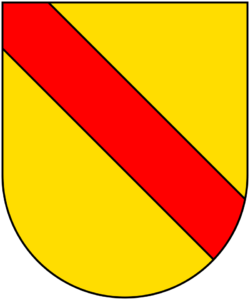
- Heraldry: the traditional red diagonal band on gold, borne by the House of Baden.
What Is Happening Right Now?
One Margrave, Several Sets of Obligations
Jakob I died in October 1453 after making provision for a divided inheritance. In 1454 his sons Bernhard and Georg have withdrawn from direct rule in favour of Karl. That settles the most visible question of succession, but not the claims that courtiers, creditors, commanders and local officials made while three portions were expected. Karl needs a usable administration before neighbouring lords decide that the family settlement will not last.
Between the Palatinate and Austria
Karl’s marriage to Katharina of Austria binds him to the Habsburg family. His relations with the Electoral Palatinate are more difficult: authority on the Rhine, obligations owed by nobles and the right to collect dues all offer opportunities for conflict. Meanwhile, Esslingen’s council, recently at war with Count Ulrich V, is asking Baden to defend its Imperial liberties. Bernhard of Baden had fought on the opposing princely side in 1449, so a new protection bargain will require care and trust. The formal Baden–Esslingen protection agreement belongs to the following year in recorded history; in 1454 its terms are still being argued.
Courts, Towns and Important Roads
Baden — The Margravial Residence
For the town, baths and fortifications see Baden’s detailed location entry. Its hot springs support bathkeepers, lodgings, physicians, cooks and servants. The margrave’s officials may be found there, but the town is not the entire margraviate.
Pforzheim — Markets and Dynastic Business
Pforzheim is another established centre of the ruling house. Merchants from the Neckar and Rhine roads pass through a town where craftsmen, account-keepers and court servants all have business. Letters issued at Baden and Pforzheim matter when an estate, debt or appointment is disputed.
Forest and Border Country
Timber and ore move out of the Black Forest along difficult valleys. Lords and communities have claims to hillsides, charcoal stands, waters and roads, some older than their current patrons. Nearby Offenburg is an Imperial city with its own council, not a Baden town whose freedom the margrave can simply cancel. The roads into the Black Forest pass timber camps, mining settlements and valleys where old rights are fiercely guarded.
People, Old Claims and Dangerous Places
Winegrowers, woodcutters, miners and traders work under a patchwork of inherited dues. A margrave’s officer bringing a new seal may be told that the bridge belongs to one family, the forest above it to another and the spring to an older agreement. Foreign artisans and merchants, including travellers from non-human communities, arrive with their own bonds and guarantors. Karl’s succession does not make these obligations disappear.
In the northern Black Forest, a lost wagon may have sunk into soft ground, broken an axle or fallen to thieves. A woodland household knows the safer ford and what it costs to hire a guide. In the deep ravines there are older tales, but no royal patrol can promise safety along every timber track. The danger to a merchant is often deciding whose word to trust when the road divides.
Disputes Travellers Can Enter
The Other Seal. A forester presents a timber charter bearing Bernhard’s old authority. Karl’s new officer calls the grant void and orders a bridge cleared for the margrave’s carts. Local families have already paid for the timber. The party can locate the original witnesses, negotiate new terms, guard the disputed road or profit by carrying the papers to Karl’s opponents. A settlement must account for whoever actually owns the adjoining land.
Letters from Two Courts. A merchant owes money in Baden but has a creditor in Pforzheim and an escort promise from an independent Imperial town. When two officers stop the convoy, none has authority to settle the whole matter. The cargo will move only when both officers accept the same guarantee, and each court expects the other to yield first.
Historical Foundations
Deutsche Biographie’s study of Karl I confirms Jakob I’s death in 1453 and the withdrawal of Bernhard and Georg from the proposed three-way rule in 1454. The Baden State Library study of Pforzheim and Baden records official documents issued in both centres under Jakob and Karl. Karl’s next demand may come from the Palatinate, an Imperial town or one of his father’s creditors.
Across the margraviate the road runs from the baths of Baden into the Black Forest and toward the contested boundaries with Württemberg. A traveller may pass through three jurisdictions before seeing the next market town, each with its own toll collector and explanation of the old agreements.
Keep this reference growing
If this page helped with your reading or game, you can support its upkeep or explore the curated books.
Explore the Bookshop — epics, classics and stories behind imagined worlds.