
Arabia — Oasis Roads, Mountain Ports and Living Jinn
A sailor on the Arabian Sea waits for the wind to turn. Inland, a gardener checks the water flowing between palms. Far to the west, a caravan packs its water before crossing a long belt of rock and sand. These journeys share a peninsula, but not the same landscape or way of life.
Arabia lies between the Red Sea, the Gulf, and the Indian Ocean. Mountains rise above southern ports, oasis settlements depend on carefully maintained water, and the central interior can exhaust people and pack animals long before a bandit appears. For travellers, learning who knows the next well or safe harbour matters more than possessing the finest map. Some springs and ruins have other inhabitants: in this fantasy world, the jinn of particular places can answer, bargain or refuse.
At a Glance
| Region | Hejaz, Najd, the eastern Gulf, Yemeni and Hadrami highlands, Dhofar, Oman and the desert margins |
|---|---|
| Present powers | The declining Rasulid legacy in Yemen, growing maritime importance of Oman, and catfolk overlordship in Yemen and the Hejaz |
| Ways through | Caravan routes between known water points, mountain tracks and seasonal wadis, coastal voyages and Indian Ocean passages |
| Everyday needs | Drinking water, provisions, shade, animal care, rope and sails, experienced pilots and information about weather and wells |
| Living wonder | Local jinn, ancient sanctuaries, sacred springs and places where old beings have interests of their own |
| Main dangers | Drought, flash floods, damaged irrigation, failed pack animals, storms at sea and inhabitants who guard their chosen places |
What Is Happening Right Now?
The thirsty orchards — interior Oman
Water once flowed by gravity through a falaj to date palms and garden plots. After a rocky slope collapsed, one branch runs dry and the downstream growers face the loss of their crops. A channel keeper knows where the underground conduit runs but cannot safely enter the damaged section. The party can help move spoil, shore the entrance, trace the blockage or arrange another source until repairs are complete. A magician might locate a hidden flow, but that does not replace the workers needed to carry water and stone.
The waiting incense ship — Dhofar
Frankincense has reached the port of Al-Baleed from the inland groves, but rough seas threaten the outbound crossing. A captain wants to sail before the goods spoil in damp storage; the local pilot says the weather will turn again. Merchants offer to send some of the cargo overland towards another anchorage, provided the travellers can take supplies through a dangerous wadi. The decision is practical: load fewer goods, hire another crew, move overland or wait for a safer sailing day.
The chamber beside the well — southern desert fringe
Wind-driven sand has buried the masonry around a caravan well. Below the stones stands an old, sealed chamber. When the travellers disturb its threshold, a powerful jinn speaks from within and orders the digging to stop. The being does not demand a sacrifice or grant an effortless wish: it fears that opening the lower passage will destroy the place it has guarded. The party can recover access to water without breaking the chamber, negotiate a safer arrangement or provoke a danger that will trouble later caravans. This well, jinn and episode are invented for the campaign.
Five Journeys Through Arabia
The Hejaz and Red Sea approaches
Rocky ground, wadis, caravan settlements and routes towards ports shape the western peninsula. Mecca and Medina are geographical centres with long histories and places in the existing political setting; their sacred precincts and inhabitants should follow this fantasy world’s established religious canon rather than a copied history of another world. The Alid family faces catfolk overlordship, but travellers still depend on guides, pack animals and the people controlling water and shelter.
Najd and the central plateau
Wells, grazing country and widely separated settlements set the rhythm of movement inland. A track that is straightforward after rain may be deadly when a source fails. Caravan leaders plan the loads carried by animals and the distance to the next dependable water, not simply the number of days between dots on a map. The Rub’ al-Khali forms a tremendous barrier along the south, not an ordinary stretch of road.
Yemen and Hadramawt
Terraced slopes, highland settlements, agricultural valleys and southern trading towns differ sharply from the dry interior. The Rasulids encouraged trade, scholarship and craft; their decline has opened a different struggle as the catfolk acquire power. Wadi Hadramawt shelters irrigated settlements on precarious ground where seasonal floods can be devastating. A visitor can find skilled builders and merchants, but should not mistake the surviving sixteenth-century towers of Shibam for buildings already standing in every earlier campaign.
Dhofar: the frankincense country
The mountains and wadis behind the Arabian Sea produce precious frankincense. Groves in Wadi Dawkah supply routes leading to the inland oasis at Shisr and the ports on the coast. Khor Rori belonged to an older age of maritime trade; Al-Baleed remains an important port through the medieval period. Resin collectors, caravan drivers, pack handlers and mariners see the same trade from very different sides. Monsoon weather can decide when a cargo moves.
Oman and the eastern sea lanes
Omani ports face the Gulf and Indian Ocean, while mountain villages and oases rely on water brought through channels called aflaj (singular falaj). These systems may be fed by springs, groundwater or surface flows and can carry water a considerable distance without pumps. Their survival depends on maintenance and careful sharing among people whose food supply relies on them. Out at sea, experienced pilots follow winds, currents and coastal landmarks towards East Africa and India.
Markets, Lodgings and Skilled Help
In a major port, travellers may find food, sleeping space, warehouse hands, carpenters, sailors, rope-makers and people able to arrange a passage. On a caravan road, a guide or animal handler may be the most valuable person the party meets. A smaller oasis is not a shop stocked for foreign adventurers: it may be able to spare only certain supplies and expects guests to understand the pressure on local wells.
A falaj keeper is responsible for water used by real households. A pilot may refuse to take a vessel through a reef or harbour bar when the conditions are wrong. A mountain messenger may know safe steps that do not appear on an outsider’s chart. Their advice can save lives, and their obligations matter just as much as a ruler’s orders.
For one deliberately invented stop, The Palm and Basin is a modest guesthouse beside an irrigated village on a route out of the Omani mountains. The keeper, Farah, can provide a meal, straw bedding and introductions to a channel engineer. She will not sell the household’s last sound pack animal while a neighbouring orchard has no water. The establishment and named keeper are campaign creations, not descriptions of a documented historical inn.
The Jinn and Their Places
Jinn belong to a varied body of Arabian and neighbouring traditions, not to a single class of wish-granting servants. In this fantasy world a particular jinn might haunt a ruined watch-place, maintain an old spring, travel a storm path or defend a concealed chamber. Its choices should matter to the people living nearby. Some beings bargain, some harm strangers and others are better left alone. No two have to offer the same challenge.
The existing Djinni gives a playable fantasy rules version of one form of genie-kind. It should not be presented as the complete folklore of Arabia. A powerful being need not demand combat or reward travellers with three wishes. Asking why it holds a place, what would change if it left and who else relies on that place produces a more distinctive adventure.
A local shrine, oasis or ancient sanctuary may be sacred within its own people’s traditions. The setting’s polytheistic history gives real divine and spirit presences a place in everyday travel without requiring every route to conceal a monster or treating unrelated communities as worshippers of one continental pantheon.
Making Travel Playable
Begin with a destination and a specific problem: the next well is inaccessible, a boat cannot safely depart, an orchard’s channel is broken or a jinn guards a source. Then give the players ways to understand and change the situation. Scouts can locate paths and weather signs, craftspeople can secure a damaged channel, spellcasters can investigate unnatural disturbances, and negotiators can earn help from people who know the country.
The return journey matters. A well left blocked harms later travellers, while an irrigation system repaired properly benefits households long after the party has gone. Those consequences should be visible, not buried in a ledger of imaginary taxes or permits.
Routes Beyond Arabia
Western ports face the Red Sea; eastern ports sail towards the Gulf and the Indian Ocean. The southern coasts connect to maritime worlds beyond the peninsula, while caravan roads and mountain tracks lead towards the northern trade networks. The journeys demand different gear, guides and seasons. Continue to the broader Asia collection or the World Atlas.
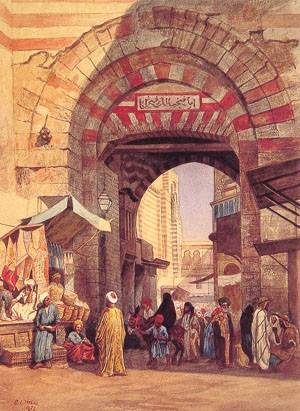
A Later View of the Bazaar
Sources and Setting Notes
- UNESCO World Heritage Centre: Aflaj Irrigation Systems of Oman — ancient water channels and managed oasis landscapes.
- UNESCO World Heritage Centre: Land of Frankincense — Wadi Dawkah, Shisr, Khor Rori and medieval Al-Baleed.
- UNESCO World Heritage Centre: Old Walled City of Shibam — surviving tower-city skyline is chiefly sixteenth-century.
- National Museum of Oman: Aflaj Gallery — engineering and water management.
- National Museum of Oman: Land of Frankincense — Dhofar resources and wider sea trade.
Catfolk rule, the supernatural jinn of the well, the fictional guesthouse and the three adventure incidents belong to the setting. They are distinguished here from historically documented geography, agriculture and trade.
Keep this reference growing
If this page helped with your reading or game, you can support its upkeep or explore the curated books.
Explore the Bookshop — epics, classics and stories behind imagined worlds.