
A Poseidon-blooded prince of Pylos, Periclymenus turns battle itself into lion, serpent, eagle, bee, ant, fly, and rooted tree.
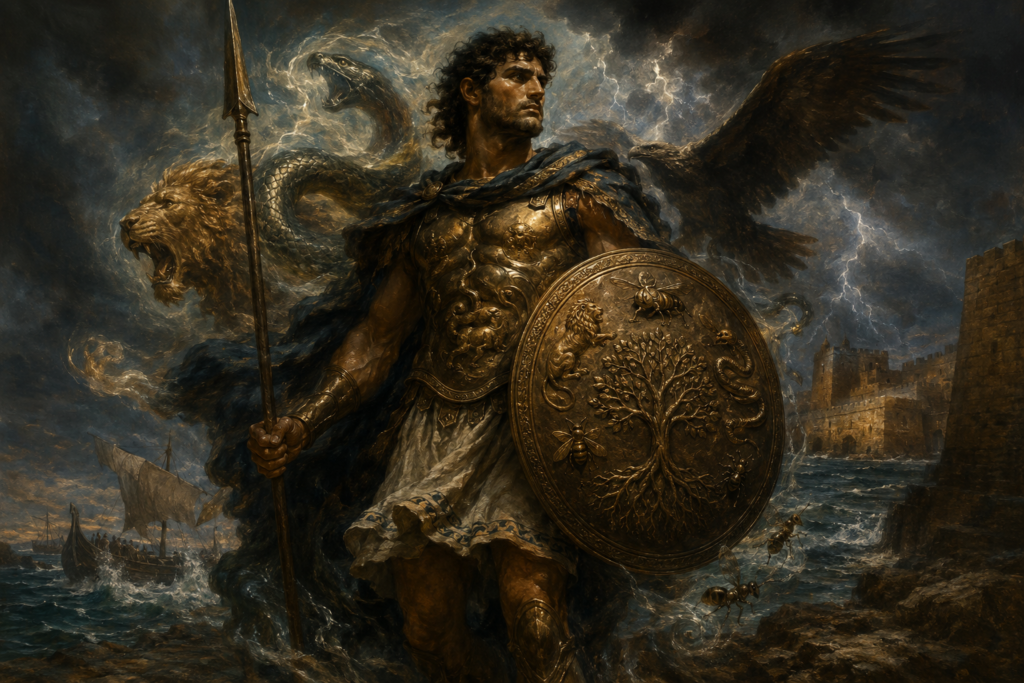
Periclymenus is the Pylian prince who can become the answer to any battle: lion, serpent, eagle, bee, ant, fly, tree, or bronze-armed man. Poseidon’s blood runs through him, and every transformation carries the pressure of sea, storm, royal pride, and heroic danger.
| Detail | Information |
|---|---|
| Name | Periclymenus |
| Greek Name | Periklymenos / Περικλύμενος |
| Meaning | Famed, much-renowned |
| Culture | Hellenic |
| Homeland | Pylos, Messenia |
| Species | Human, Poseidon-blooded shapechanger |
| Role | Pylian prince, Argonaut, royal defender |
| Family | Son of Neleus and Chloris; brother of Nestor |
| Divine Lineage | Grandson of Poseidon through Neleus |
| Religion | Hellenic Pantheon, especially Poseidon |
| Languages | Greek |
| Alignment | Neutral Good |
Overview
Periclymenus is not a wandering shapeshifter or a trickster in borrowed skins. He is royal Pylian blood, Argonautic reputation, and Poseidon’s inheritance carried in human form.
He is the eldest son of Neleus in the strongest tradition, brother of Nestor, and one of the named heroes who sails with Jason. His Argonautic role is mostly a roll-call honour rather than a long episode, which makes him useful in play: famous enough to matter, underwritten enough to expand, and dangerous enough to stand beside major heroic figures without being swallowed by them.
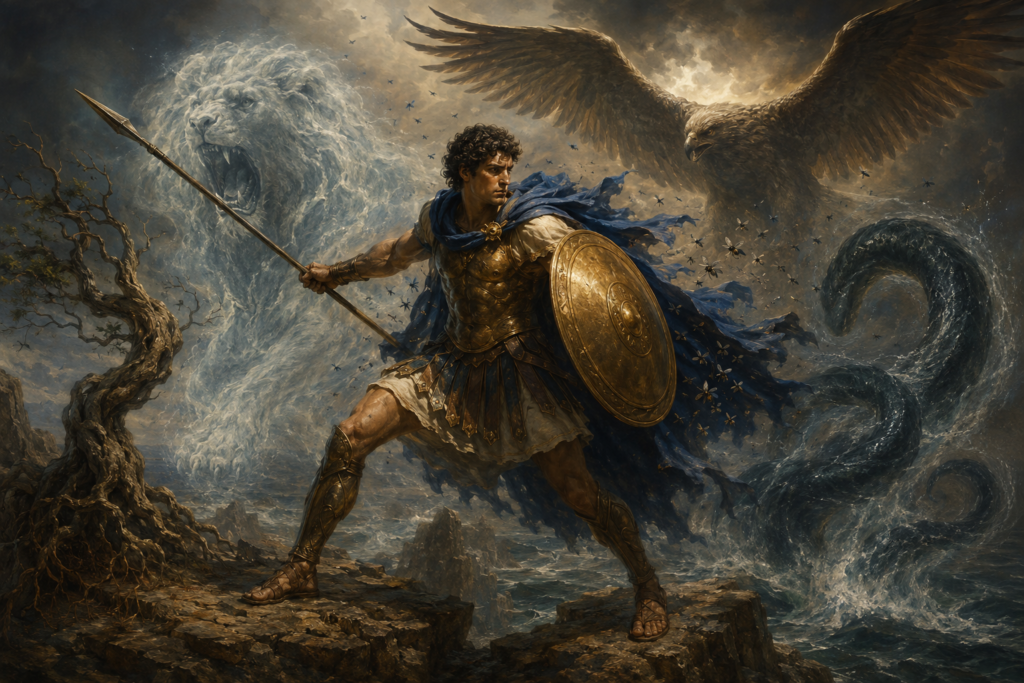
Poseidon grants him immense strength and the power to change shape in battle. He does not transform for amusement. He transforms because battle demands an answer: lion for shock, serpent for binding and escape, eagle for height and pursuit, bee or fly for impossible evasion, ant for hidden movement, tree for endurance.
Periclymenus belongs in stories about Pylos, Poseidon, heroic houses, royal inheritance, Argonautic memory, and the cost of famous men bringing war to other people’s gates.
Mechanics Tabs
The rules below are mechanics compatible for different game editions.
Periclymenus 5.5e
Periclymenus Pathfinder 1e / 3.5e
Periclymenus 5.5e-Compatible Rules
Poseidon-Blooded Shapeshifter
Medium Humanoid, Shapechanger, Neutral Good
Armor Class 18
Initiative +7
Hit Points 171
Speed 30 ft.
Proficiency Bonus +4
| STR | DEX | CON | INT | WIS | CHA |
| 20 (+5) | 16 (+3) | 18 (+4) | 13 (+1) | 16 (+3) | 17 (+3) |
Saving Throws Str +9, Dex +7, Con +8, Wis +7
Skills Athletics +9, Insight +7, Perception +7, Stealth +7, Survival +7
Senses passive Perception 17
Languages Greek
Challenge 10
Traits
Poseidon’s Grandson. Periclymenus has advantage on Strength checks and Strength saving throws. He also has advantage on saving throws against being grappled, restrained, knocked prone, or forcibly moved.
Royal Hero. Periclymenus has advantage on Charisma checks made when dealing with Hellenic warriors, sailors, Pylian nobles, Argonauts, and priests of Poseidon who recognise his lineage.
Divine Battle Shape. As a bonus action, Periclymenus changes into one of his battle forms or returns to human form. His statistics remain the same except where the form says otherwise. His gear merges into the form or remains worn, as appropriate. This is a divine inherited gift.
Lion Form. His speed becomes 40 ft. If he moves at least 20 ft. straight toward a creature and hits it with Bestial Strike on the same turn, the target must succeed on a DC 17 Strength saving throw or fall prone.
Serpent Form. He gains a climbing speed of 30 ft. and can move through openings at least 6 inches wide. When he hits a creature with Bestial Strike, he may force it to make a DC 17 Strength saving throw. On a failure, the target is grappled until the end of Periclymenus’ next turn.
Eagle Form. He gains a flying speed of 60 ft. Opportunity attacks against him are made with disadvantage while he is flying.
Bee, Ant, or Fly Form. He becomes Tiny. He cannot use Spear of Pylos in this form, but he has advantage on Dexterity checks made to hide, escape, or pass through tiny openings. Attack rolls against him are made with disadvantage unless the attacker has blindsight or another sense that clearly tracks tiny flying or crawling creatures.
Tree Form. His speed becomes 0 until the start of his next turn. While rooted, his AC increases by 2 and he has resistance to bludgeoning, piercing, and slashing damage.
Actions
Multiattack. He makes three attacks, using Spear of Pylos or Bestial Strike.
Spear of Pylos. Melee or Ranged Weapon Attack: +9 to hit, reach 5 ft. or range 20/60 ft., one target. Hit: 12 (2d6 + 5) piercing damage.
Bestial Strike. Melee Weapon Attack: +9 to hit, reach 5 ft., one target. Hit: 14 (2d8 + 5) bludgeoning, piercing, or slashing damage, depending on his current form.
Many-Form Assault Recharge 5–6. Periclymenus shifts through lion, serpent, eagle, and insect forms in a blur of divine movement. Each creature of his choice within 15 ft. must make a DC 17 Dexterity saving throw, taking 31 (7d8) damage on a failed save, or half as much damage on a successful one. Periclymenus may then move up to half his speed without provoking opportunity attacks.
Reactions
Impossible Shape. When Periclymenus is hit by an attack, he changes into serpent, eagle, bee, ant, fly, or tree form. The damage is halved. If he does not choose Tree Form, he may also move up to 15 ft. without provoking opportunity attacks.
Legendary Actions
Periclymenus can take 2 legendary actions, choosing from the options below. Only one legendary action can be used at a time and only at the end of another creature’s turn. He regains spent legendary actions at the start of his turn.
Shift Form. Periclymenus changes form.
Move. Periclymenus moves up to half his speed.
Bestial Strike. Periclymenus makes one Bestial Strike.
Eagle Over the Gate Costs 2 Actions. Periclymenus shifts into eagle form and flies up to his flying speed. This movement does not provoke opportunity attacks.
Periclymenus Pathfinder 1e / 3.5e-Compatible Rules
Poseidon-Blooded Shapeshifter
CR 10
XP 9,600
Male human unique shapechanger warrior
NG Medium humanoid, shapechanger
Init +7; Senses Perception +18
Defense
AC 24, touch 13, flat-footed 21
hp 126
Fort +13, Ref +12, Will +10
Defensive Abilities battle transformation, Poseidon-blooded resilience
Offense
Speed 30 ft.
Melee spear of Pylos +18/+13/+8 or bestial strike +18/+13/+8
Special Attacks eagle assault, insect escape, lion charge, many-form assault, serpent coil
Statistics
| STR | DEX | CON | INT | WIS | CHA |
| 22 (+6) | 17 (+3) | 18 (+4) | 12 (+1) | 16 (+3) | 17 (+3) |
Base Atk +11; CMB +17; CMD 30
Feats Combat Reflexes, Improved Initiative, Iron Will, Power Attack, Step Up, Toughness, Weapon Focus spear
Skills Acrobatics +17, Climb +20, Diplomacy +17, Intimidate +17, Knowledge nobility +15, Perception +18, Sense Motive +18, Stealth +17, Survival +17, Swim +20
Languages Greek
Special Abilities
Poseidon’s Shape-Gift Su. As a swift action, Periclymenus may change into a battle form: lion, serpent, eagle, bee, ant, fly, tree, or another living form appropriate to the scene. This is a divine inherited gift.
Lion Form. Periclymenus gains speed 40 ft., two claw attacks, a bite attack, and pounce.
Serpent Form. Periclymenus gains climb 30 ft. and a bite attack. A creature hit by the bite must succeed on a DC 19 Reflex save or become grappled.
Eagle Form. Periclymenus gains fly 60 ft. with good maneuverability. He may move before and after a melee attack, provided his total movement does not exceed his fly speed.
Bee, Ant, or Fly Form. Periclymenus becomes Tiny or smaller. He cannot use ordinary weapon attacks, but gains a +8 bonus on Stealth checks and may pass through cracks, helmets, shield-rims, broken masonry, and similar openings at the GM’s discretion.
Tree Form. Periclymenus becomes rooted until the start of his next turn. While rooted, he gains a +4 natural armor bonus and DR 10/slashing, but his speed becomes 0.
Many-Form Assault Su. Once every 1d4 rounds, Periclymenus may shift rapidly through multiple battle forms. He makes one attack at his highest attack bonus against up to three creatures he can reach during a single move. This movement does not provoke attacks of opportunity.
Poseidon-Blooded Resilience Ex. Periclymenus gains a +4 bonus on checks and saves made to resist grapples, restraints, forced movement, or being knocked prone.
Appearance
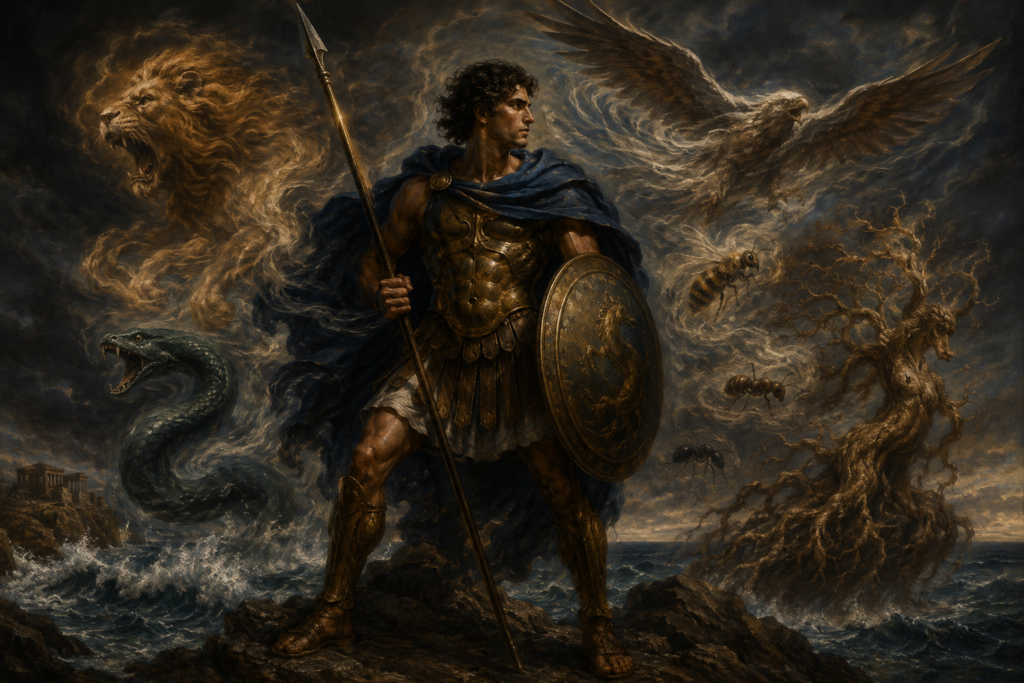
In human form, he is a powerful Hellenic warrior with the build of a spear-fighter and wrestler. He wears bronze, linen, leather, and sea-dark cloth rather than mail or plate. His shield is marked with small animal signs around the rim: lion, serpent, eagle, bee, ant, fly, and rooted tree.
His face is handsome in the severe heroic style: dark hair, strong brow, weathered skin, and eyes that seem to measure shorelines, doors, and threats before he speaks.
His transformations are not clean natural disguises. They carry divine pressure. The lion has a storm-dark mane. The serpent gleams like wet bronze. The eagle casts a shadow too large for its body. The bee and fly forms flash for a moment like sparks from a god’s forge. Even his tree form looks like a living boundary marker planted by a sea-god.
Character and Lore
He is proud, disciplined, and difficult to impress. He is a prince first, an adventurer second, and a shapeshifter only because Poseidon gives his bloodline a terrible gift.
He respects courage, oathkeeping, kin-duty, hospitality, and defence of one’s people. He dislikes boasting, careless violence, and heroes who treat other kingdoms as scenery for their own glory.
He is not a trickster. His changing forms do not make him unstable or clownish. Every form has a reason. Every movement is tactical. He is the kind of hero who wins by adapting faster than the enemy can understand him.
His flaw is royal certainty. He assumes that Pylos, Neleus’ house, and Poseidon’s favour give him the right to judge most situations. He is often right, but not always.
Public Reputation
In Pylos, Periclymenus is known as the prince who cannot be trapped in one body.
Sailors call him storm-blooded. Warriors call him unfair to fight. Priests of Poseidon treat him as proof that the sea-god’s gifts are never gentle. Noble families remember him as a defender of Neleus’ line. Argonautic storytellers name him with respect, though they rarely give him the centre of the tale.
Heraklean singers reduce him to a defeated opponent. Pylian memory does not.
Using Periclymenus in Your Game
Use Periclymenus as a prince, champion, envoy, rival, Argonautic ally, or Poseidon-marked obstacle. He works best in stories tied to Pylos, Neleus, Nestor, Poseidon, the Argo, Herakles, royal inheritance, or contested heroic memory.
He should not be a random market-square quest-giver. Put him where his status matters: a harbour gate, palace hall, storm shrine, royal tomb, Argonautic assembly, battlefield, oath-rite, or disputed border.
In play, he creates pressure because the party cannot rely on a single tactic. Nets, walls, flight, grapples, narrow passages, and brute strength all fail if he has time to answer with the right form.
Specific Relationships
Neleus
Periclymenus is Neleus’ son and defender. His loyalty to his father’s house is political, emotional, and sacred.
Chloris
Chloris connects Periclymenus to the older heroic genealogies of Greece. Her name should remain in the identity section rather than being lost under generic family notes.
Nestor
Nestor is his brother. This is one of the best reasons to use Periclymenus. Nestor is the famous survivor and counsellor; Periclymenus is the dangerous brother whose strength belongs to a harsher age.
Poseidon
Poseidon is the source of Periclymenus’ strength and shapeshifting. The power is divine inheritance, not ordinary spellcraft.
Herakles
Herakles is Periclymenus’ great heroic pressure. Some traditions place Periclymenus’ death during Herakles’ attack on Pylos; in campaign use, this works as enemy, future catastrophe, alternate mythic outcome, or grim prophecy.
The Argonauts
Periclymenus is counted among the Argonauts. He is not one of the central Argo personalities, which makes him useful for expansion without fighting the best-known stories.
Adventure Hooks
The Bee in the Bronze
A captured helmet from a Heraklean raid will not stop buzzing. The sound becomes words only when the helmet is carried near a Poseidon shrine. Periclymenus arrives to claim the object, but three rival families insist it proves three different versions of the same old battle.
The Lion at the Harbour Gate
A lion blocks the main harbour road at Pylos, refusing passage to a foreign ship. The animal does not attack sailors, only the ship’s captain. Periclymenus is testing whether the captain carries stolen cargo, broken oaths, or a hidden enemy of Neleus’ house.
The Argonaut Who Was Not Invited
A local king claims Periclymenus was deliberately left out of an Argonautic honour rite. The insult becomes political when Periclymenus appears in eagle form above the ceremony, then lands as a bronze-armoured prince and demands the rite be corrected before sunset.
Mythic and Historic Context
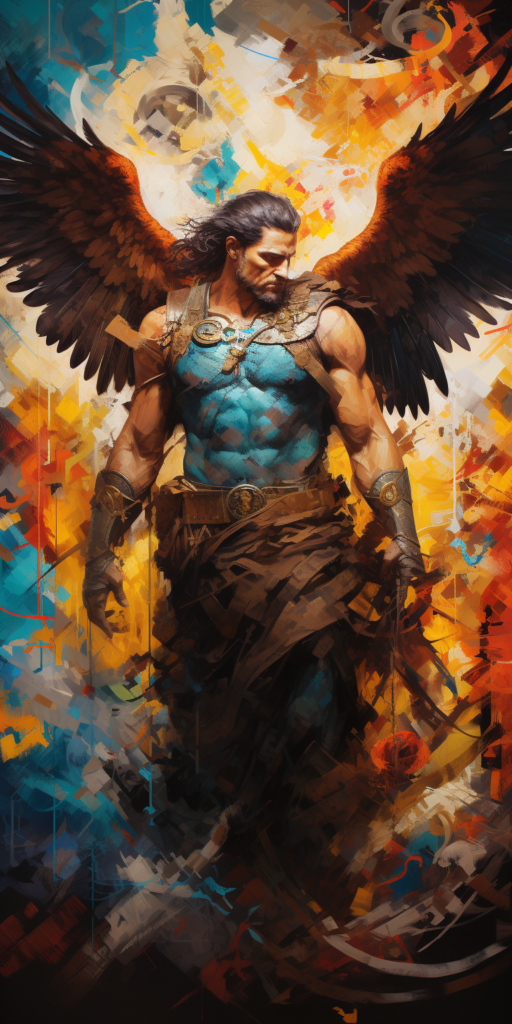
Periclymenus, also written Periklymenos, is a Hellenic heroic figure associated with Pylos, Neleus, Chloris, Nestor, Poseidon, the Argonauts, and Herakles. This entry concerns the Pylian Periclymenus, not every mythological figure who shares the same name.
In Theoi’s Periclymenus entry, he is described as the eldest son of King Neleus of Pylos and as a hero granted shapeshifting by his grandfather Poseidon. The same entry gathers traditions in which he takes the forms of lion, ant, snake, swarm of bees, and eagle during the conflict with Herakles.
Homeric tradition names Periclymenus among the children of Neleus and Chloris, alongside Nestor. This establishes him as part of the Pylian royal house rather than as a generic wandering shapeshifter.
In Apollonius Rhodius’ Argonautica, Periclymenus appears in the catalogue of Argonauts as the eldest of the sons of Neleus born at Pylos. Apollonius says Poseidon gave him great strength and the ability to assume whatever shape he desired in the stress of battle.
Pseudo-Apollodorus gives the tradition that Poseidon granted Periclymenus the power of changing shape and that, during Herakles’ ravaging of Pylos, Periclymenus changed into lion, snake, and bee before being slain with the other sons of Neleus. Another Apollodoran passage calls him the most valiant of Neleus’ sons and says that he used to change shape in battle.
The campaign version keeps the source core intact while presenting Periclymenus in present-tense heroic form. The death tradition remains part of the mythic record and can be used as prophecy, alternate heroic chronology, tragic fate, or later campaign consequence. His shapeshifting remains Poseidon’s gift.
Keep this reference growing
If this page helped with your reading or game, you can support its upkeep or explore the curated books.
Explore the Bookshop — epics, classics and stories behind imagined worlds.