
Illusion • Legacy Witch Glamour
Masque (False Visage)
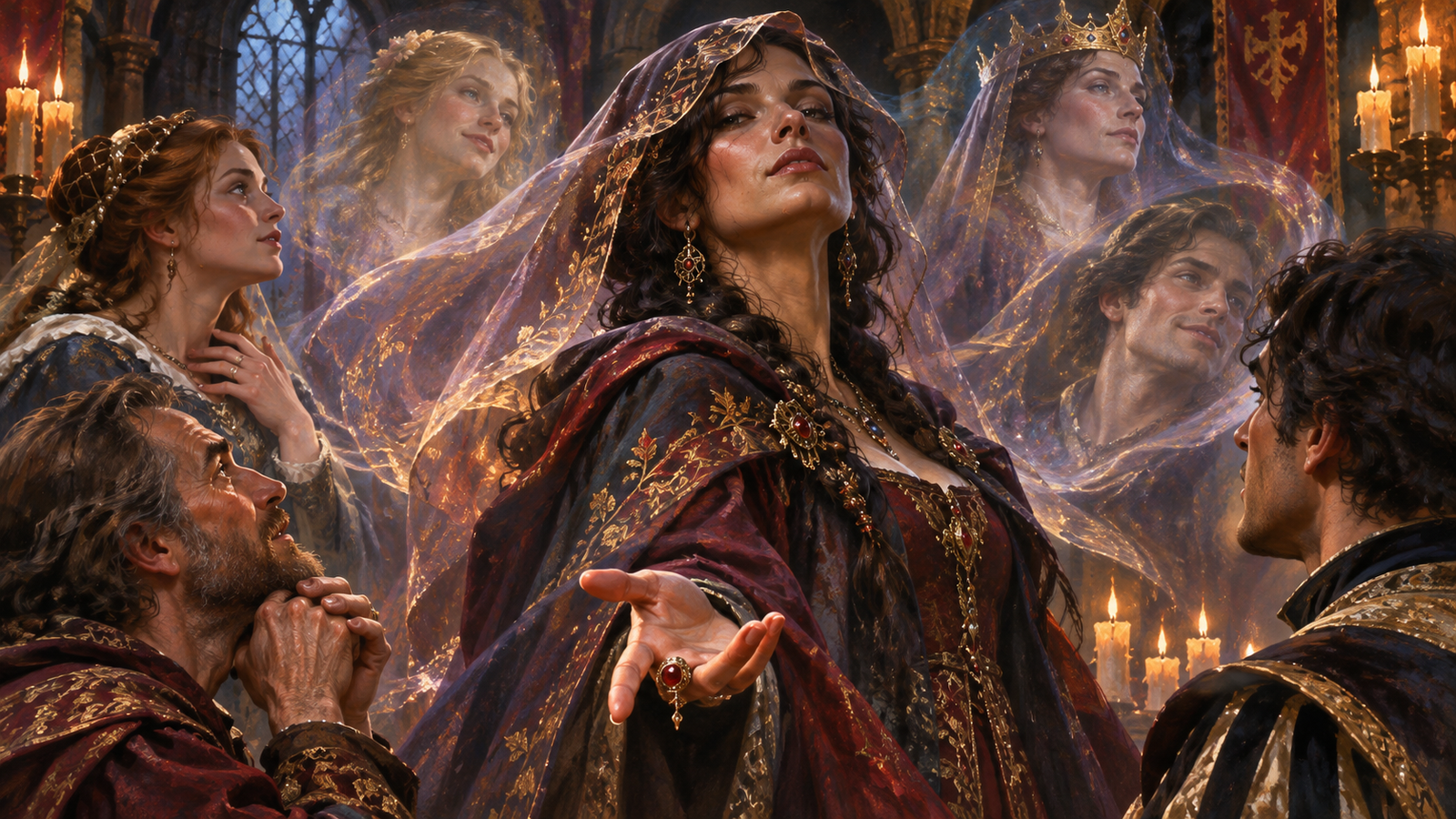
Masque makes each affected creature perceive the caster as someone that creature already loves or trusts. The illusion is supplied by the victim’s own mind, so different observers can perceive different familiar faces at the same time.
Masque at a Glance
A witch surrounds herself with an enchantment drawn from the minds of those who see her. Each person struck by the glamour perceives a different familiar face, complete with the warmth of a remembered connection. The deception neither changes her flesh nor grants the memories or habits of the identity she borrows.
| School | Illusion (mind-affecting glamour) |
|---|---|
| Spell Circle | Fourth |
| Effect | Each affected observer sees someone they love or trust |
| Counterplay | Saving throws, true sight, inconsistencies and dispelling |
| Limitation | No physical transformation, borrowed memories or compelled obedience |
Spell Rules by Edition
Masque (False Visage) — D&D 2024
Optional 2024 fourth-level conversion, not an official published spell. This is a complete playable adaptation of the source’s identity glamour; fifth-edition rules do not import the legacy +5 skill bonus or additional-spell save DC stacking.
| Spell Level / School | 4th-level Illusion |
|---|---|
| Suggested Classes | Bard, Wizard; optional Witch by GM approval |
| Casting Time | Action |
| Range | 60 feet |
| Components | V, S, M (perfume and a thin gossamer veil; neither consumed) |
| Targets | Up to three non-Undead creatures within range that can see you |
| Duration | Concentration, up to 10 minutes |
| Saving Throw | Wisdom negates; repeat saves when important evidence contradicts the disguise |
| Effect | Each target sees a different personally trusted identity; no damage or mind control |
Perceptual glamour. Each chosen creature makes a Wisdom saving throw. A creature that fails perceives you as someone it personally loves or trusts. The identity is supplied by its own memories; different observers may see different faces, hear a familiar voice or recognise mannerisms that were never truly reproduced. The illusion changes only the observer’s perception: your real identity, position, language and knowledge do not change. The target does not gain the Charmed condition, and it is not compelled to obey instructions.
Social advantage. While an affected observer accepts the perceived identity, you have Advantage on Charisma (Deception) and Charisma (Persuasion) checks against that creature which rely on the assumed relationship. Requests contrary to its safety or values can still be refused, and you cannot automatically use knowledge that only the genuine person would possess.
Disbelief and ending. A target that witnesses significant contrary evidence may repeat the Wisdom save when the contradiction occurs; a success ends the illusion for that creature. Truesight reveals your actual appearance and prevents the illusion from deceiving that observer. The effect on a target also ends if you or an ally attacks or deals damage to that target, if the target becomes aware of undeniable physical proof of the impersonation, or when you lose Concentration. This spell does not affect Undead.
At higher levels — optional scaling. Each slot level above 4 allows one additional non-Undead observer within 60 feet. Each makes a separate Wisdom save. This is part of the original conversion, not text from the official 2024 spell lists.
Masque (False Visage) — D&D 2014
Optional 2014 fourth-level conversion, not an official published spell. This is a complete playable adaptation of the source’s identity glamour; fifth-edition rules do not import the legacy +5 skill bonus or additional-spell save DC stacking.
| Spell Level / School | 4th-level illusion |
|---|---|
| Suggested Classes | Bard, Wizard; optional Witch by GM approval |
| Casting Time | 1 action |
| Range | 60 feet |
| Components | V, S, M (perfume and a thin gossamer veil; neither consumed) |
| Targets | Up to three non-Undead creatures within range that can see you |
| Duration | Concentration, up to 10 minutes |
| Saving Throw | Wisdom negates; repeat saves when important evidence contradicts the disguise |
| Effect | Each target sees a different personally trusted identity; no damage or mind control |
Perceptual glamour. Each chosen creature makes a Wisdom saving throw. A creature that fails perceives you as someone it personally loves or trusts. The identity is supplied by its own memories; different observers may see different faces, hear a familiar voice or recognise mannerisms that were never truly reproduced. The illusion changes only the observer’s perception: your real identity, position, language and knowledge do not change. The target does not gain the Charmed condition, and it is not compelled to obey instructions.
Social advantage. While an affected observer accepts the perceived identity, you have Advantage on Charisma (Deception) and Charisma (Persuasion) checks against that creature which rely on the assumed relationship. Requests contrary to its safety or values can still be refused, and you cannot automatically use knowledge that only the genuine person would possess.
Disbelief and ending. A target that witnesses significant contrary evidence may repeat the Wisdom save when the contradiction occurs; a success ends the illusion for that creature. Truesight reveals your actual appearance and prevents the illusion from deceiving that observer. The effect on a target also ends if you or an ally attacks or deals damage to that target, if the target becomes aware of undeniable physical proof of the impersonation, or when you lose Concentration. This spell does not affect Undead.
At higher levels — optional scaling. Each slot level above 4 allows one additional non-Undead observer within 60 feet. Each makes a separate Wisdom save. This is part of the original conversion, not text from the official 2014 spell lists.
Masque (False Visage) — Pathfinder 1e
Optional Pathfinder 1e conversion, not an official Pathfinder Witch spell. This keeps the original illusion concept and resists adopting its unbounded save-DC stacking.
| School | Illusion (pattern) [mind-affecting] |
|---|---|
| Level | Bard 4, Witch 4 (GM-approved) |
| Casting Time | 1 standard action |
| Range | Close (25 feet + 5 feet per 2 caster levels) |
| Components | V, S, M (a dab of perfume and thin gossamer veil) |
| Targets | One living creature per caster level, maximum 10; each must be able to see you |
| Duration | 1 minute per caster level |
| Saving Throw | Will negates; see disbelief |
| Spell Resistance | Yes |
Effect. Each affected observer perceives you as a person it loves or trusts; the mind supplies different faces and mannerisms for different observers. The spell does not actually change your body, confer knowledge or control the target’s actions. You gain a +5 circumstance bonus on Bluff and Diplomacy checks against a target when exploiting the imagined identity, subject to normal Pathfinder stacking rules. The target can refuse unreasonable or dangerous demands.
Disbelief and counters. An observer that notices significant contradiction can attempt a new Will save; success ends the effect for that observer. True Seeing exposes the illusion to a creature using it. Undead and creatures immune to mind-affecting patterns are unaffected, and spell resistance and Dispel Magic apply normally. The caster may be seen differently by several observers; resolving one target’s disbelief does not dismiss every other target’s effect.
Masque (False Visage) — D&D 3.5e
Preserved source mechanics: Liber Mysterium (2003), p. 146. This is third-party d20 material predating the official 3.5e revision, not a core 3.5e spell.
| School | Illusion (Pattern) |
|---|---|
| Level | Witch 4, Bard 4 |
| Components | V, S, M |
| Casting Time | 1 action |
| Range | Not specified in the 2003 entry; a suggested table limit is 60 feet for observers who can see the caster (GM ruling, not source text) |
| Targets | The printed line says “1 Target”, while its descriptive text allows up to twice the caster’s level in observers; use the latter as the practical default unless the GM rules otherwise |
| Duration | 1 minute/level |
| Saving Throw | Will negates |
| Spell Resistance | Yes |
Each creature that fails its save sees the caster as someone that creature loves and trusts. The caster does not need to know the person being perceived, imitate their voice or copy their behaviour; the victim’s mind supplies those details.
The legacy source grants the Witch +5 on Bluff and Diplomacy checks against an affected target and suggests a +5 bonus on a relevant non-magical seduction check at the Games Master’s discretion.
The older text also allows compatible enchantment or social spells to reinforce the deception. Treat any save-DC stacking language as legacy-only; do not carry it into later editions automatically.
Material components: a dab of perfume and a thin gossamer veil.
Original target-count discrepancy. The stat line in the source says “1 Target”, but the effect explicitly allows twice the caster’s level in affected viewers. For playable legacy adjudication, allow the described number of observers, each with its own Will save and spell resistance. Require them to be able to see the caster; the 60-foot limit above is a declared GM guideline because the source gives no Range entry.
Legacy-only interaction. The source offers a further save DC increase of +3 plus the added spell’s level for each suitable reinforcing spell. This unusually strong interaction belongs only to the preserved historical text and must not be imported automatically into Pathfinder or fifth edition. The original +5 Bluff and Diplomacy bonuses for Witches and the optional seduction check bonus are likewise legacy mechanics.
The Face Each Heart Remembers
The witch steps beneath the gatehouse lamps and three watchmen look upon her in astonishment. One sees his absent wife, another his oldest friend, and the third the officer whose voice he obeyed for years. None sees a disguise painted on the skin; the glamour lives in the beholder’s memories. If the witch speaks with the wrong manner or fails to recall a shared secret, suspicion may break the enchantment before a door can open.
Counterplay and Rulings
- True Seeing: exposes the glamour to the creature using it under the legacy rules.
- Undead: are unaffected by the original spell.
- Dispel Magic: can end an ongoing Masque effect under normal legacy dispelling rules.
- Behaviour still matters: the glamour changes perceived identity, not the caster’s actual knowledge, memories or mannerisms.
- Contradictory evidence: the Games Master can allow disbelief or other appropriate checks when the caster behaves impossibly for the perceived identity.
Using Masque in Play
Masque is strongest in social infiltration. It can get a caster through a guarded doorway, buy time during a negotiation, or make several observers independently trust the same stranger for different reasons.
Three Faces at the Gate
A witch approaches a stone gate watched by two guards and a steward. To one guard she seems to be the captain he worships, while the other recognises the face of a lost sister. The steward, whose will resists the glamour, sees the real stranger. The guards may hesitate to challenge her, but neither is compelled to abandon duty or ignore a contradiction. The steward can still sound the alarm.
The witch must maintain the illusion long enough to pass. Any witness who perceives her true form or catches an impossible mistake can begin to unravel the deception. The spell lends an opportunity for a lie, never a guarantee of trust.
Mythical Context
In Homer’s Odyssey, Athena disguises Odysseus as an aged wanderer before he returns to his own home. She later restores his appearance before Telemachus, whose astonishment shows how completely a trusted face can be transformed. Masque uses the related idea of hidden identity, but turns it inside out: rather than changing the wearer’s real form, it makes each observer supply a different beloved visage from memory.
Homer, Odyssey Book 13 — Athena disguises Odysseus · Book 16 — his appearance restored
Historical Context
In European masquerades, masks and costume obscured identities and offered temporary freedom from ordinary social expectations. The later Venetian bauta could include a cloak and face covering that concealed the wearer’s features and status. An eighteenth-century pastel portrait by Rosalba Carriera depicts Gustavus Hamilton in masquerade costume, preserving a material example of this practice. It illustrates social disguise rather than any genuine magic.
The Metropolitan Museum of Art — Gustavus Hamilton in Masquerade Costume (1730–31) · The Met — history of Venetian masks
Related Magic
Rules Sources and Licensing
Legacy original: “Masque (False Visage)”, Liber Mysterium: The Netbook of Witches and Warlocks (2003), p. 146; compiled by Timothy S. Brannan and the Netbook of Witches Team. This third-party d20 work predates the official 3.5 revision. The source’s target-count inconsistency and absence of a listed range are disclosed rather than silently attributed to the core 3.5 rules. Original source-book transcription.
Optional edition conversions: the separate 2024, 2014 and Pathfinder 1e adaptations on this page are original playable game designs, not official named spells. The modern versions use those editions’ familiar saving throw, illusion, Concentration and Advantage concepts as set out in Wizards of the Coast SRD 5.2.1 and SRD 5.1 (CC BY 4.0); the Pathfinder conversion uses the Pathfinder 1e core mechanics (OGL 1.0a). No official spell mechanics are falsely assigned to the title Masque.
Legacy game mechanics and licence: the 2003 source identifies Open Game Content under Open Game License v1.0a. The full inherited licence and copyright notices are reproduced below. The original illustration, newly authored edition conversions, examples and historical/mythical commentary are not designated as new third-party Open Game Content.
Open Game License v1.0a & Section 15 Copyright Notices
OPEN GAME LICENSE Version 1.0a
The following text is the property of Wizards of the Coast, Inc. and is Copyright 2000 Wizards of the Coast, Inc (“Wizards”). All Rights Reserved.
1. Definitions: (a) “Contributors” means the copyright and/or trademark owners who have contributed Open Game Content;
(b) “Derivative Material” means copyrighted material including derivative works and translations (including into other computer languages), potation, modification, correction, addition, extension, upgrade, improvement, compilation, abridgment or other form in which an existing work may be recast, transformed or adapted;
(c) “Distribute” means to reproduce, license, rent, lease, sell, broadcast, publicly display, transmit or otherwise distribute;
(d) “Open Game Content” means the game mechanic and includes the methods, procedures, processes and routines to the extent such content does not embody the Product Identity and is an enhancement over the prior art and any additional content clearly identified as Open Game Content by the Contributor, and means any work covered by this License, including translations and derivative works under copyright law, but specifically excludes Product Identity;
(e) “Product Identity” means product and product line names, logos and identifying marks including trade dress; artifacts; creatures; characters; stories, storylines, plots, thematic elements, dialogue, incidents, language, artwork, symbols, designs, depictions, likenesses, formats, poses, concepts, themes and graphic, photographic and other visual or audio representations; names and descriptions of characters, spells, enchantments, personalities, teams, personas, likenesses and special abilities; places, locations, environments, creatures, equipment, magical or supernatural abilities or effects, logos, symbols, or graphic designs; and any other trademark or registered trademark clearly identified as Product Identity by the owner of the Product Identity, and which specifically excludes the Open Game Content;
(f) “Trademark” means the logos, names, mark, sign, motto, designs that are used by a Contributor to identify itself or its products or the associated products contributed to the Open Game License by the Contributor;
(g) “Use”, “Used” or “Using” means to use, Distribute, copy, edit, format, modify, translate and otherwise create Derivative Material of Open Game Content;
(h) “You” or “Your” means the licensee in terms of this agreement.
2. The License: This License applies to any Open Game Content that contains a notice indicating that the Open Game Content may only be Used under and in terms of this License. You must affix such a notice to any Open Game Content that You Use. No terms may be added to or subtracted from this License except as described by the License itself. No other terms or conditions may be applied to any Open Game Content distributed using this License.
3. Offer and Acceptance: By Using the Open Game Content You indicate Your acceptance of the terms of this License.
4. Grant and Consideration: In consideration for agreeing to use this License, the Contributors grant You a perpetual, worldwide, royalty-free, non-exclusive license with the exact terms of this License to Use the Open Game Content.
5. Representation of Authority to Contribute: If You are contributing original material as Open Game Content, You represent that Your Contributions are Your original creation and/or You have sufficient rights to grant the rights conveyed by this License.
6. Notice of License Copyright: You must update the COPYRIGHT NOTICE portion of this License to include the exact text of the COPYRIGHT NOTICE of any Open Game Content You are copying, modifying or distributing, and You must add the title, the copyright date, and the copyright holder’s name to the COPYRIGHT NOTICE of any original Open Game Content You Distribute.
7. Use of Product Identity: You agree not to Use any Product Identity, including as an indication as to compatibility, except as expressly licensed in another, independent Agreement with the owner of each element of that Product Identity.
You agree not to indicate compatibility or co-adaptability with any Trademark or Registered Trademark in conjunction with a work containing Open Game Content except as expressly licensed in another, independent Agreement with the owner of such Trademark or Registered Trademark.
The use of any Product Identity in Open Game Content does not constitute a challenge to the ownership of that Product Identity.
The owner of any Product Identity used in Open Game Content shall retain all rights, title and interest in and to that Product Identity.
8. Identification: If you distribute Open Game Content You must clearly indicate which portions of the work that you are distributing are Open Game Content.
9. Updating the License: Wizards or its designated Agents may publish updated versions of this License. You may use any authorized version of this License to copy, modify and distribute any Open Game Content originally distributed under any version of this License.
10. Copy of this License: You MUST include a copy of this License with every copy of the Open Game Content You Distribute.
11. Use of Contributor Credits: You may not market or advertise the Open Game Content using the name of any Contributor unless You have written permission from the Contributor to do so.
12. Inability to Comply: If it is impossible for You to comply with any of the terms of this License with respect to some or all of the Open Game Content due to statute, judicial order, or governmental regulation then You may not Use any Open Game Material so affected.
13. Termination: This License will terminate automatically if You fail to comply with all terms herein and fail to cure such breach within 30 days of becoming aware of the breach. All sublicenses shall survive the termination of this License.
14. Reformation: If any provision of this License is held to be unenforceable, such provision shall be reformed only to the extent necessary to make it enforceable.
15. COPYRIGHT NOTICE
Open Game License v 1.0a Copyright 2000, Wizards of the Coast, Inc.
System Reference Document Copyright 2003, Wizards of the Coast, Inc.; Authors Jonathan Tweet, Monte Cook, Skip Williams, Bruce R. Cordell, based on original material by E. Gary Gygax and Dave Arneson.
“Witch-finder” Copyright 2003, Dominique Crouzet.
“Witch Knight”, Copyright 2001, Ravenscyre Grey Daegmorgan.
Ritual Magic rules from Relics & Rituals Copyright 2001, Clark Peterson, Sword and Sorcery Studios.
“Divine Dominion” and “Greater Divine Dominion”, Copyright 2001 Bradely H. Bemis.
“Extra Familiar”, Copyright 2001 Paul King.
“Leprechaun” from the Tome of Horrors, Copyright 2002, Necromancer Games, Inc.; Author Scott Greene, based on original material by Gary Gygax.
“Poppet” and “Create Poppet” from Liber Bestarius, Copyright 2002, Eden Studios. Additional non-OGC permission granted by Eden Studios May 27th, 2003.
Liber Mysterium: The Netbook of Witches and Warlocks is Copyright© 2003, Timothy S. Brannan and the Netbook of Witches Team.
All content is considered open for the Open Gaming License, unless otherwise noted. But it is not public domain. Permission is granted to make and redistribute copies of this document as long as this copyright page remains intact.
Keep this reference growing
If this page helped with your reading or game, you can support its upkeep or explore the curated books.
Explore the Bookshop — epics, classics and stories behind imagined worlds.