
Fire Trap
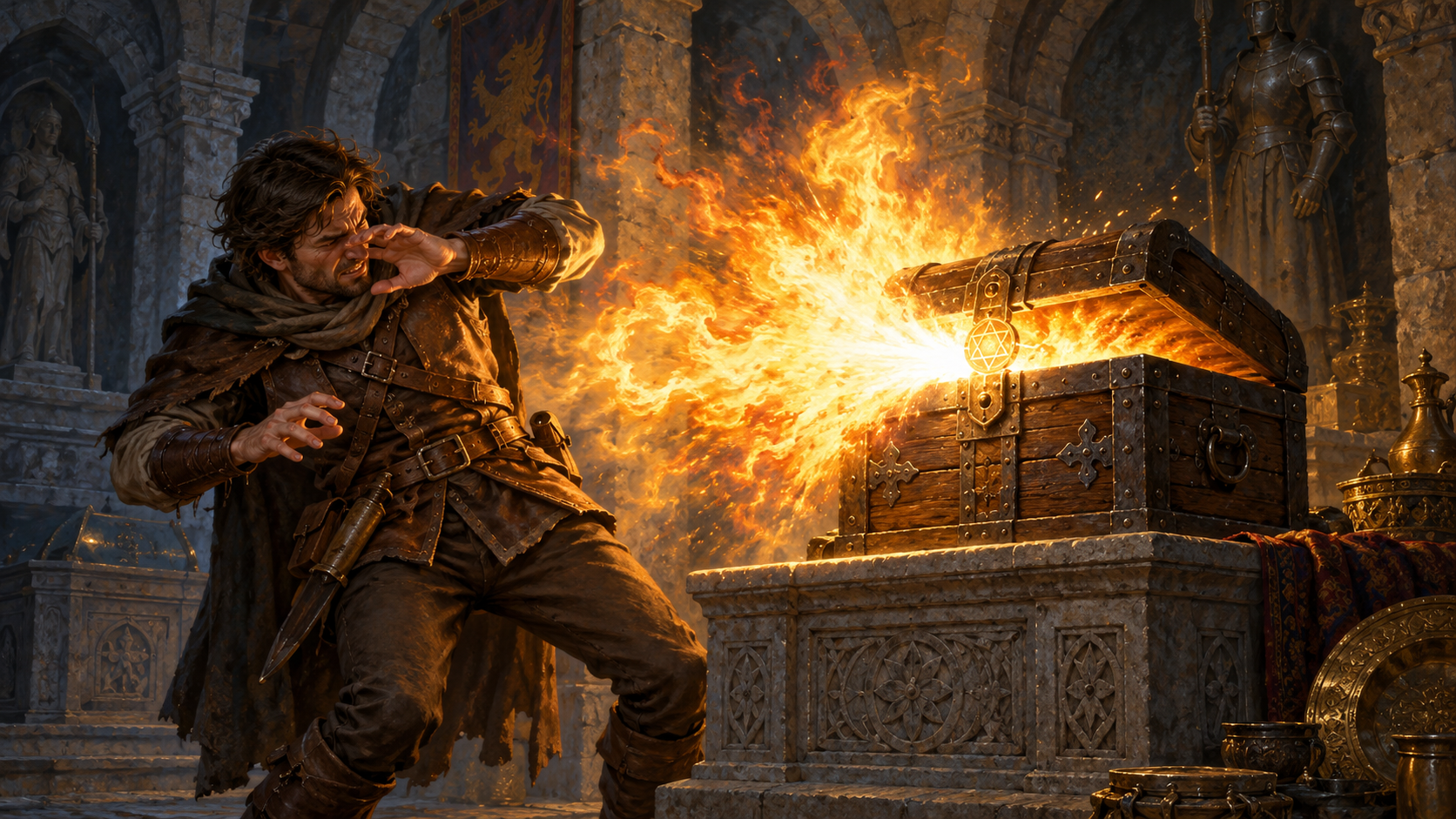
Fire Trap wards a closed object with a burst of flame. In Pathfinder 1e and D&D 3.5e, an intruder opening it triggers a 5-foot-radius explosion; the warded object is unharmed. For D&D 2024 and 2014, the panels below give the published fire option of Glyph of Warding, with its own cost, area and limits.
Fire Trap at a Glance
| PF1e / D&D 3.5e | Druid 2 or Sorcerer/Wizard 4; 10-minute casting; 25 gp of gold dust; 1d4 + caster level Fire damage (maximum +20), Reflex half. |
|---|---|
| D&D 2024 / 2014 option | Cast Glyph of Warding, choosing Fire: level 3, 1 hour, 200 gp of consumed materials, 5d8 Fire damage, Dexterity half. |
| Blast radius | Legacy Fire Trap: 5 feet. Fifth-edition fire glyph: 20 feet. |
| Moving the object | The fifth-edition glyph ends harmlessly if moved more than 10 feet from its casting location. The older Fire Trap has no such movement limit. |
| Ways past the ward | Use an authorised opener or password where set, dispel the magic, or use the edition’s stated trap-detection and disabling procedure. |
Rules by Edition
Choose the edition used at your table. The fifth-edition panels give a complete fire-glyph setup using Glyph of Warding; the legacy panels give the actual Fire Trap spell. Their different class lists, costs, areas and checks belong to those spells.
Fire Trap’s Role in D&D 2024 — Fire Glyph
Fifth-edition equivalent — published rules. Prepare and cast Glyph of Warding. “Fire trap” describes this Fire-damage use of the spell; its name on your spell list remains Glyph of Warding.
| Spell used / level | Glyph of Warding, level 3 Abjuration; choose its explosive rune and Fire damage. |
|---|---|
| Class access | Bard, Cleric, Wizard; other features may grant access. |
| Casting time / range | 1 hour / Touch |
| Inscription | A surface or the inside of a closable object; inscription no larger than 10 feet in diameter. |
| Components | V, S, M (powdered diamond worth 200+ GP, consumed) |
| Duration | Until dispelled or triggered; no Concentration after casting. |
| Effect | 20-foot-radius sphere centred on the glyph; each creature makes a Dexterity saving throw against your spell save DC: 5d8 Fire damage on failure, half on success. |
| Notice the glyph | Wisdom (Perception) against the caster’s spell save DC. |
| Higher-level slot | +1d8 damage for each slot level above 3. |
Inscribe the glyph inside the closed object, choose an opening trigger and select Fire as its damage type. You can restrict the trigger to particular creature types and set an exception such as a password. When that trigger occurs, resolve the explosion once and end the spell.
Placement matters. Moving the marked surface or object more than 10 feet from where you cast the spell breaks the glyph without an explosion. A glyph on a chest is therefore a stationary defence. Use the 2024 Sphere and cover rules when determining which creatures are in its area.
Removing it: Dispel Magic can end the ongoing ward. A level-3 glyph is within its automatic level-3 removal; a higher-level glyph uses the spell’s normal higher-level dispelling procedure. Noticing the inscription does not itself disable it.
Source: 2024 Basic Rules: Glyph of Warding.
Fire Trap’s Role in D&D 2014 — Fire Glyph
Fifth-edition equivalent — published rules. Use the explosive runes option of Glyph of Warding, choosing fire. This is the 2014 spell’s procedure for filling the older ward’s role.
| Spell used / level | Glyph of Warding, level 3 Abjuration; choose its explosive rune and Fire damage. |
|---|---|
| Class access | Bard, Cleric, Wizard; other features may grant access. |
| Casting time / range | 1 hour / Touch |
| Inscription | A surface or the inside of a closable object; inscription no larger than 10 feet in diameter. |
| Components | V, S, M (incense and powdered diamond worth at least 200 gp, consumed) |
| Duration | Until dispelled or triggered; no Concentration after casting. |
| Effect | 20-foot-radius sphere centred on the glyph; each creature makes a Dexterity saving throw against your spell save DC: 5d8 Fire damage on failure, half on success. |
| Notice the glyph | Intelligence (Investigation) against the caster’s spell save DC. |
| Higher-level slot | +1d8 damage for each slot level above 3. |
Place the glyph inside a closable object and choose opening it as the trigger. The 2014 spell permits refined circumstances, physical characteristics, creature kind or alignment, and exceptions such as a password. The fire sphere spreads around corners. It triggers once, then the spell ends.
Fixed location: moving the marked object or surface more than 10 feet from the casting location ends the glyph without triggering it. The spell is unsuitable for a travelling chest unless that limit is changed by a separate campaign ruling.
Removing it: find the glyph with the stated Investigation check, then use an appropriate countermeasure. Dispel Magic automatically ends a level-3 glyph; higher-level glyphs use its higher-level dispelling rules. The detection DC is not a printed thieves’ tools disarming DC.
Source: 2014 Basic Rules: Glyph of Warding.
Fire Trap — Pathfinder 1e
Published Fire Trap — Pathfinder 1e Core Rulebook. This is the older, small-area object ward.
| School / core class level | Abjuration [fire]; Druid 2, Sorcerer/Wizard 4. |
|---|---|
| Casting time / range / target | 10 minutes / Touch / object touched. |
| Components | V, S, M (gold dust worth 25 gp, consumed). |
| Duration | Permanent until discharged; dismissible (D). |
| Damage / area | 1d4 + 1 per caster level, maximum +20, in a 5-foot-radius burst around the point selected on the object. |
| Saving throw / spell resistance | Reflex half / Yes. |
| Trap checks | Perception and Disable Device DC 25 + spell level: normally 27 for Druid or 29 for Sorcerer/Wizard. Trapfinding permits disarming the magical trap. |
| Scaling | Caster level, up to the stated +20 cap; no fifth-edition slot-based extra dice. |
Choose the centre point on an object that opens and closes. An opening by someone other than the caster or an authorised user triggers the burst. The warded item is unharmed. Authorise users when casting, commonly with a password that can be shared.
The object cannot also receive a second closure or warding spell. Knock does not bypass the ward, and an unsuccessful Dispel Magic does not trigger it. Underwater, the spell deals half damage and produces a large steam cloud. The ward ends on discharge, successful dispelling, or the caster’s dismissal under the edition’s (D) rules.
Example: a caster-level-3 druid’s ward deals 1d4 + 3 Fire damage, with Reflex half. Its trap DC is 27; its saving throw DC comes from the caster’s spellcasting, not that detection DC.
Source: Pathfinder 1e Fire Trap.
Fire Trap — D&D 3.5e
Published Fire Trap — D&D 3.5e SRD. The original rules below retain this edition’s Search and Disable Device checks, spell levels, damage and material cost.
Abjuration [Fire]
Level Druid 2, Sorcerer/Wizard 4
Components V, S, M
Casting Time 10 minutes
Range Touch
Target Object touched
Duration Permanent until discharged (D)
Saving Throw Reflex half; see text
Spell Resistance Yes
- A fire trap can ward any object that can be opened and closed.
- When casting fire trap, you select a point on the object as the spell’s center. When someone other than you opens the object, a fiery explosion fills the area within a 5-foot radius around the spell’s center. The flames deal 1d4 points of fire damage +1 point per caster level (maximum +20). The item protected by the trap is not harmed by this explosion.
- A fire trapped item cannot have a second closure or warding spell placed on it.
- A knock spell does not bypass a fire trap. An unsuccessful dispel magic spell does not detonate the spell.
- Underwater, this ward deals half damage and creates a large cloud of steam.
- You can use the fire trapped object without discharging it, as can any individual to whom the object was specifically attuned when cast. Attuning a fire trapped object to an individual usually involves setting a password that you can share with friends.
Note Magic traps such as fire trap are hard to detect and disable. A rogue (only) can use the Search skill to find a fire trap and Disable Device to thwart it. The DC in each case is 25 + spell level (DC 27 for a druid’s fire trap or DC 29 for the arcane version).
Material Component A half-pound of gold dust (cost 25 gp) sprinkled on the warded object.
At the table: use the caster’s normal spell save DC for Reflex, separate from the DC 27/29 trap checks. Caster level increases the damage bonus to a maximum of +20. A discharged ward must be cast again. The duration’s (D) allows the caster to dismiss it using the normal 3.5e dismissal procedure; successful dispelling also ends it.
Source: D&D 3.5e SRD: Fire Trap.
What Changes Between Editions?
- Which spell you prepare: legacy Druids, Sorcerers and Wizards use Fire Trap at their listed levels. The fifth-edition option uses the Bard, Cleric or Wizard spell Glyph of Warding; a legacy Druid spell level does not grant fifth-edition access.
- Portable ward or fixed defence: the older spell can travel on its object. A fifth-edition glyph ends when moved beyond its 10-foot limit.
- Size and expense: the fire glyph has a much larger blast and more expensive consumed materials. Keep companions clear of its 20-foot radius.
- Finding it: 2024 glyphs use Perception, 2014 glyphs use Investigation, Pathfinder uses Perception, and 3.5e uses Search. Apply each panel’s DC rather than importing one across systems.
Clues, Uses and Counterplay
A closed coffer sits beside a scorched pair of gloves. A porter knows the owner’s opening phrase but wants a missing companion found before sharing it. The party can bargain, inspect the object, seek a dispelling spell or risk opening it with everyone positioned clear of the blast. The marks and the porter’s warning are clues chosen by the GM; neither is a required magical side effect.
Dispel Magic addresses the ward; Knock addresses an eligible closure. Opening a container from a distance can still satisfy its trigger. Measure the blast from the ward, and apply the edition’s cover and spell rules. The older spell explicitly protects its warded object and has its own underwater damage clause.
For more examples and design guidance, see Traps and Glyph of Warding. Legacy spell-list references: Druid Spells and Sorcerer and Wizard Spells.
Sources and Licences
The Pathfinder and D&D 3.5e Fire Trap rules sections are Open Game Content under the Open Game License 1.0a. The fifth-edition glyph summaries use the named SRDs under CC BY 4.0. Original encounter prose and the hero illustration are separate from these rules licences.
Fifth-edition source documents and attribution
2024 rules: SRD 5.2.1. 2014 rules: SRD 5.1. Fifth-edition panels summarise the published Fire option of Glyph of Warding. The two legacy panels present Fire Trap from their named source rules.
This work includes material from the System Reference Document 5.2.1 (“SRD 5.2.1”) by Wizards of the Coast LLC, available at https://www.dndbeyond.com/srd. The SRD 5.2.1 is licensed under the Creative Commons Attribution 4.0 International License, available at https://creativecommons.org/licenses/by/4.0/legalcode.
This work includes material taken from the System Reference Document 5.1 (“SRD 5.1”) by Wizards of the Coast LLC and available at https://dnd.wizards.com/resources/systems-reference-document. The SRD 5.1 is licensed under the Creative Commons Attribution 4.0 International License available at https://creativecommons.org/licenses/by/4.0/legalcode.
Open Game License and Section 15 copyright notices
Open Game License Version 1.0a
The following text is the property of Wizards of the Coast, Inc. and is Copyright 2000 Wizards of the Coast, Inc (“Wizards”). All Rights Reserved.
- Definitions:
- “Contributors” means the copyright and/or trademark owners who have contributed Open Game Content;
- “Derivative Material” means copyrighted material including derivative works and translations (including into other computer languages), potation, modification, correction, addition, extension, upgrade, improvement, compilation, abridgment or other form in which an existing work may be recast, transformed or adapted;
- “Distribute” means to reproduce, license, rent, lease, sell, broadcast, publicly display, transmit or otherwise distribute;
- “Open Game Content” means the game mechanic and includes the methods, procedures, processes and routines to the extent such content does not embody the Product Identity and is an enhancement over the prior art and any additional content clearly identified as Open Game Content by the Contributor, and means any work covered by this License, including translations and derivative works under copyright law, but specifically excludes Product Identity.
- “Product Identity” means product and product line names, logos and identifying marks including trade dress; artifacts; creatures characters; stories, storylines, plots, thematic elements, dialogue, incidents, language, artwork, symbols, designs, depictions, likenesses, formats, poses, concepts, themes and graphic, photographic and other visual or audio representations; names and descriptions of characters, spells, enchantments, personalities, teams, personas, likenesses and special abilities; places, locations, environments, creatures, equipment, magical or supernatural abilities or effects, logos, symbols, or graphic designs; and any other trademark or registered trademark clearly identified as Product identity by the owner of the Product Identity, and which specifically excludes the Open Game Content;
- “Trademark” means the logos, names, mark, sign, motto, designs that are used by a Contributor to identify itself or its products or the associated products contributed to the Open Game License by the Contributor
- “Use”, “Used” or “Using” means to use, Distribute, copy, edit, format, modify, translate and otherwise create Derivative Material of Open Game Content.
- “You” or “Your” means the licensee in terms of this agreement.
- The License: This License applies to any Open Game Content that contains a notice indicating that the Open Game Content may only be Used under and in terms of this License. You must affix such a notice to any Open Game Content that you Use. No terms may be added to or subtracted from this License except as described by the License itself. No other terms or conditions may be applied to any Open Game Content distributed using this License.
- Offer and Acceptance: By Using the Open Game Content You indicate Your acceptance of the terms of this License.
- Grant and Consideration: In consideration for agreeing to use this License, the Contributors grant You a perpetual, worldwide, royalty-free, non-exclusive license with the exact terms of this License to Use, the Open Game Content.
- Representation of Authority to Contribute: If You are contributing original material as Open Game Content, You represent that Your Contributions are Your original creation and/or You have sufficient rights to grant the rights conveyed by this License.
- Notice of License Copyright: You must update the COPYRIGHT NOTICE portion of this License to include the exact text of the COPYRIGHT NOTICE of any Open Game Content You are copying, modifying or distributing, and You must add the title, the copyright date, and the copyright holder’s name to the COPYRIGHT NOTICE of any original Open Game Content you Distribute.
- Use of Product Identity: You agree not to Use any Product Identity, including as an indication as to compatibility, except as expressly licensed in another, independent Agreement with the owner of each element of that Product Identity. You agree not to indicate compatibility or co-adaptability with any Trademark or Registered Trademark in conjunction with a work containing Open Game Content except as expressly licensed in another, independent Agreement with the owner of such Trademark or Registered Trademark. The use of any Product Identity in Open Game Content does not constitute a challenge to the ownership of that Product Identity. The owner of any Product Identity used in Open Game Content shall retain all rights, title and interest in and to that Product Identity.
- Identification: If you distribute Open Game Content You must clearly indicate which portions of the work that you are distributing are Open Game Content.
- Updating the License: Wizards or its designated Agents may publish updated versions of this License. You may use any authorized version of this License to copy, modify and distribute any Open Game Content originally distributed under any version of this License.
- Copy of this License: You MUST include a copy of this License with every copy of the Open Game Content You Distribute.
- Use of Contributor Credits: You may not market or advertise the Open Game Content using the name of any Contributor unless You have written permission from the Contributor to do so.
- Inability to Comply: If it is impossible for You to comply with any of the terms of this License with respect to some or all of the Open Game Content due to statute, judicial order, or governmental regulation then You may not Use any Open Game Material so affected.
- Termination: This License will terminate automatically if You fail to comply with all terms herein and fail to cure such breach within 30 days of becoming aware of the breach. All sublicenses shall survive the termination of this License.
- Reformation: If any provision of this License is held to be unenforceable, such provision shall be reformed only to the extent necessary to make it enforceable.
-
COPYRIGHT NOTICE
Open Game License v 1.0a Copyright 2000, Wizards of the Coast, Inc.
System Reference Document Copyright 2000-2003, Wizards of the Coast, Inc.; Authors Jonathan Tweet, Monte Cook, Skip Williams, Rich Baker, Andy Collins, David Noonan, Rich Redman, Bruce R. Cordell, John D. Rateliff, Thomas Reid, James Wyatt, based on original material by E. Gary Gygax and Dave Arneson.
Creature Collection Volume 1 Copyright 2000, Clark Peterson.
Modern System Reference Document Copyright 2002, Wizards of the Coast, Inc.; Authors Bill Slavicsek, Jeff Grubb, Rich Redman, Charles Ryan, based on material by Jonathan Tweet, Monte Cook, Skip Williams, Richard Baker,Peter Adkison, Bruce R. Cordell, John Tynes, Andy Collins, and JD Wiker
Monster Manual II Copyright 2002, Wizards of the Coast, Inc.
Swords of Our Fathers Copyright 2003, The Game Mechanics.
Mutants & Masterminds Copyright 2002, Green Ronin Publishing.
Unearthed Arcana Copyright 2004, Wizards of the Coast, Inc.; Andy Collins, Jesse Decker, David Noonan, Rich Redman.
The Hypertext d20 SRD Copyright 2004, Jans W Carton; transferred to BoLS Interactive, 2016.
Pathfinder RPG Core Rulebook. Copyright 2009, Paizo Publishing, LLC; Author: Jason Bulmahn, based on material by Jonathan Tweet, Monte Cook, and Skip Williams.
Fire Trap — Rules and Ward Options by Edition. Copyright 2026, SpiralWorlds.
Keep this reference growing
If this page helped with your reading or game, you can support its upkeep or explore the curated books.
Explore the Bookshop — epics, classics and stories behind imagined worlds.