
Arcane Eye
Arcane Eye creates a mobile magical viewpoint that can scout corridors, chambers, fortifications and dangerous ground while its caster remains elsewhere. It sees; it does not hear, touch, open, carry or fight.
What Arcane Eye Actually Does
Arcane Eye Mechanics
Use the tab for the rules system in play. Movement, concentration, sensor detection and inherited sight are deliberately kept separate because the procedures are not interchangeable.
Arcane Eye — 5.5e / 2024
You create an Invisible, invulnerable eye at a point within the spell’s 30-foot casting range. You receive its visual information mentally. It can see in every direction and possesses Darkvision to 30 feet.
As a Bonus Action, you move the eye up to 30 feet in any direction. Solid barriers stop it, but an opening at least 1 inch across is sufficient for passage.
The spell contains no instruction requiring the eye to remain within 30 feet after creation. Under the normal rules for an ongoing movable spell effect, its listed Range does not by itself impose a continuing tether. The eye can therefore continue moving away while the spell lasts.
The current spell no longer contains the older sentence expressly forbidding the eye from entering another plane. That omission should remain an omission. Whether a particular portal, Gate or other planar effect can transport the sensor depends on that effect’s wording and the GM’s adjudication.
The spell gives the eye all-direction vision and 30-foot Darkvision. It does not state that the sensor simply inherits every visual enhancement possessed by the caster.
See Invisibility and the Truesight rules expressly describe seeing creatures and objects affected by invisibility. Arcane Eye is described as an eye and a magical effect rather than being given a creature or object stat block. The rules therefore do not expressly state that either automatically reveals it. A GM may rule that supernatural sight can perceive the sensor, but that is an adjudication rather than text supplied by Arcane Eye itself.
Detect Magic can sense the presence of magical effects within its range. Its visible aura procedure applies to a visible creature or object bearing magic. It can therefore alert a caster that magic is present without automatically drawing a visible outline around the unseen Arcane Eye.
Arcane Eye is an ongoing 4th-level spell and can be chosen as the magical effect targeted by Dispel Magic. A 3rd-level Dispel Magic requires a spellcasting-ability check against DC 14. A Dispel Magic cast with a 4th-level or higher slot ends it automatically.
Invulnerable does not mean immune to dispelling. The eye cannot simply be destroyed by dealing damage to it, but magic that ends an ongoing spell can still end Arcane Eye.
Inside Antimagic Field, an ongoing Arcane Eye is suppressed. It does not function while suppressed, but time spent suppressed still counts against the spell’s duration.
The caster maintains ordinary Concentration for up to 1 hour. Moving the eye costs a Bonus Action, leaving the caster’s Action available. Casting another spell that itself requires Concentration ends Arcane Eye in the normal way.
Seeing a creature through the eye does not move the caster’s position. A spell that requires a target within range of the caster, a valid route from the caster, a touch, or some other origin requirement must still satisfy that requirement. Arcane Eye does not become a remote spellcasting turret.
Arcane Eye — Pathfinder 1e
The spell creates an invisible magical sensor at a point the caster can see. After creation it can travel outside the caster’s line of sight.
The eye moves 30 feet per round when observing an area ahead in the ordinary manner. If it carefully examines ceilings and walls as well as the floor, it moves 10 feet per round.
It sees exactly as the caster would if physically present at the sensor’s position. Solid barriers stop it, while an opening as small as 1 inch in diameter permits passage. It cannot enter another plane of existence, even through a gate or similar portal.
The duration is not a concentration-duration entry. Instead, the specific spell text requires concentration while the caster is actively using the eye. Concentrating on an active spell is a standard action. If the caster stops concentrating, the eye becomes inert rather than immediately disappearing. Concentrating again resumes its use while the original duration remains.
As a scrying sensor, the eye uses the caster’s sensory acuity, including applicable spells and effects that target the caster but not emanations. The sensor is treated as an independent sensory organ and continues functioning even if the caster personally becomes blinded after the sensor is established.
A creature can notice a scrying sensor with a Perception check against DC 20 + the spell’s level. Arcane Eye is 4th level, so the normal detection DC is 24.
The sensor can be dispelled as an active spell. Lead sheeting or magical protection can block scrying, and the caster senses that the sensor has been blocked.
Detect Scrying reveals the location of magical sensors within its area. Its additional opposed caster-level procedure may also reveal information about the originator of the surveillance.
Mind Blank expressly addresses area-scanning scrying such as Arcane Eye: the spell can continue to scan the area, but a protected creature is simply not detected.
The magical-trap construction rules allow Arcane Eye to provide a visual trigger. An Arcane Eye visual trigger has line-of-sight range and a +20 Perception bonus. Visual deception, darkness and other effects capable of defeating the chosen visual method can affect the trigger normally.
Arcane Eye — D&D 3.5e
The caster creates an invisible magical sensor at a visible point. It can thereafter travel beyond the caster’s line of sight without hindrance.
The eye travels 30 feet per round while observing ahead in the ordinary fashion, or 10 feet per round while carefully examining the ceiling and walls as well as the floor. It sees exactly as the caster would see from that position.
Solid barriers block movement. A hole or space only 1 inch across is sufficient. The sensor cannot enter another plane, including through a gate or similar magical portal.
The caster must concentrate to use Arcane Eye. When concentration stops, the sensor becomes inert. The spell specifically allows the caster to begin concentrating again later, provided its duration has not expired.
General scrying rules give the sensor the same sensory acuity as the caster, including effects that target the caster but not effects that emanate from the caster. The sensor functions as an independent sensory organ.
Do not import the Pathfinder Perception formula. In D&D 3.5e, a creature with Intelligence 12 or higher can notice a scrying sensor with a DC 20 Intelligence check.
The sensor can be dispelled as an active spell. Lead sheeting or magical protection blocks scrying, and the caster senses the obstruction.
Detect Scrying identifies magical sensors within its area and can potentially reveal information about the scryer through its opposed caster-level procedure.
An area-scanning Arcane Eye can remain active in an area containing a creature protected by Mind Blank, but the protected creature is not detected by the divination.
Arcane Eye can provide the visual component of a magical trap trigger. The 3.5e trap rules assign an Arcane Eye trigger unlimited line-of-sight range and a +20 Spot bonus.
Doors, Walls, Glass and Tiny Openings
The spell’s most important physical limit is simple: the eye can travel through a sufficiently large opening, but it does not pass through solid matter.
| Obstacle | Result | Reason |
|---|---|---|
| Open doorway | Passes | There is an unobstructed route. |
| Arrow slit | Usually passes | Provided the actual opening is at least 1 inch across. |
| Vent or grille | Possibly | At least one usable opening must meet the one-inch requirement. |
| Keyhole | Not automatically | The real opening must be large enough; the word “keyhole” does not override its physical dimensions. |
| Gap beneath a door | Possibly | The gap must actually be large enough. |
| Closed fitted door | Blocked | A continuous solid barrier stops movement. |
| Glass window | Blocked | The eye may see through transparent glass, but glass remains solid matter. |
| Intact stone wall | Blocked | The spell does not grant passage through solid stone. |
| Broken masonry | Possibly | A continuous opening of sufficient size creates a route. |
What the Eye Can—and Cannot—Do
It can
- Scout spaces reached by a valid route.
- Look around corners after moving beyond them.
- Inspect ceilings, galleries, shafts and upper chambers.
- Observe creatures, objects, doors and visible hazards.
- Travel through suitably large cracks, holes and openings.
- Remain far safer than sending a living scout into danger.
It cannot
- Hear conversations.
- Speak to creatures.
- Open doors or containers.
- Pull levers or manipulate mechanisms.
- Carry objects.
- Perform a tactile search.
- Walk through intact solid matter.
- Replace the caster as the origin point of unrelated magic.
The distinction matters in play. Arcane Eye may show that a sentry is waiting beyond a door, reveal where the keys are hanging, or expose the route used by the guard patrol. It does not open the door, retrieve the keys or disarm the trap.
Best Uses for Arcane Eye
Route reconnaissance
Check junctions, stairs, dead ends and guarded chambers before the group commits to a route.
Patrol timing
Observe how often guards pass, where they stop and which doors they use.
Fortification scouting
Arrow slits, drainage gaps, damaged stonework and ventilation openings may provide routes into heavily defended structures.
Vertical exploration
Inspect rafters, towers, galleries, shafts, ceilings and high passages without exposing a climber.
Counter-ambush
Look beyond an accessible corner or opening before the party moves through a dangerous choke point.
Siege intelligence
Identify guard concentrations, artillery positions, reserve troops, command rooms and internal routes.
Running Remote Scouting Without Stalling the Session
Arcane Eye can cover a great deal of ground. The fastest way to run it is to describe meaningful information rather than narrating every five feet of empty corridor.
- Ask for the scout’s route. The caster should say what passage, doorway, gap or feature the eye follows.
- Summarise empty ground. Compress uneventful corridors into a sentence.
- Stop at decisions. Pause when the eye reaches a branch, barrier, creature, hazard or significant room.
- Track moving inhabitants. A fortress is not frozen while the sensor explores it.
- Describe what sight can reveal. Do not accidentally give the caster sound, tactile information or hidden knowledge the eye cannot obtain.
- Remember the party remains elsewhere. Information is valuable, but acting on it still requires time, travel and risk.
From Scrying Glass to Wandering Eye
Fantasy remote-viewing magic draws on a much older family of ideas surrounding reflective surfaces, crystals, mirrors and other objects used for divination. Historical practices varied enormously and should not be treated as one continuous magical system, but the recurring image is clear: the seer looks into a prepared object in the hope of perceiving something hidden or distant.
The Wellcome Collection preserves a crystal associated with the Renaissance scholar John Dee and records its use in attempts at clairvoyance and scrying. The British Museum likewise preserves the famous obsidian object known as Dee’s magical mirror or speculum. These objects belong to real histories of divination and collecting; they do not demonstrate that supernatural remote sight actually occurred.
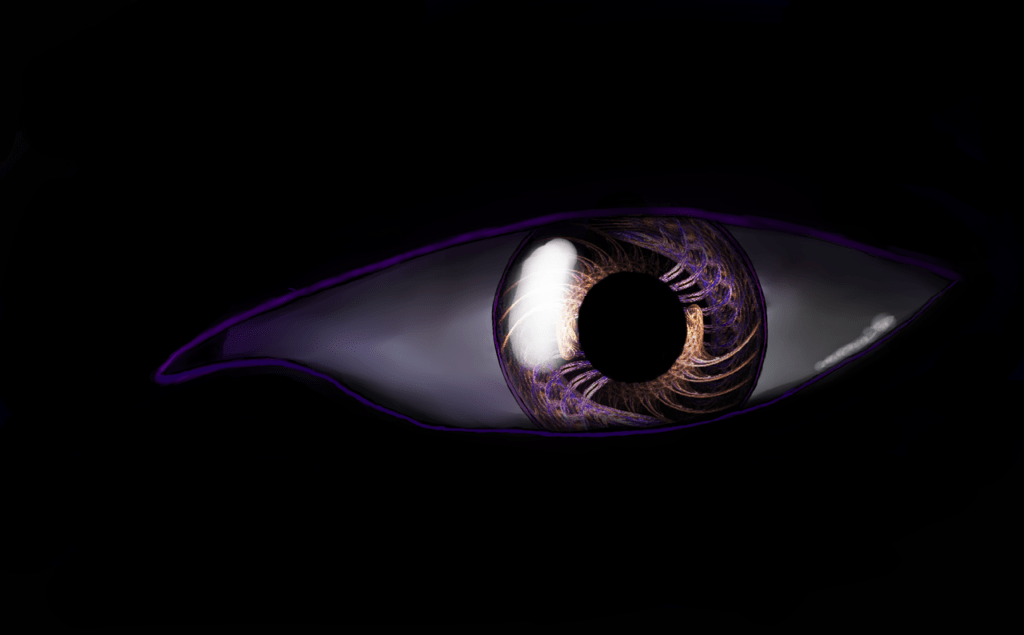
Arcane Eye transforms that familiar motif in an especially gameable way. Instead of bringing the distant scene into a mirror or crystal, the magical viewpoint itself leaves the caster and travels through the world.
Arcane surveillance in the world
A mobile magical viewpoint is useful far beyond the dungeon. Court diviners can watch restricted corridors. Siege engineers can survey gatehouses and artillery positions. Guild spies can study warehouses and counting houses. Learned natural philosophers may treat the sensor as a remarkable extension of sight: an artificial organ projected beyond the body.
Its limitations also shape defensive architecture. Important archives, treasury rooms, council chambers and prison cells benefit from close-fitting doors, intact walls, protected ventilation routes and active counter-divination. Where Arcane Eye is known, privacy becomes partly an architectural problem.
Arcane Eye FAQ
Can Arcane Eye go through walls?
No. A solid barrier blocks the eye. It needs an actual opening through which it can travel.
Can Arcane Eye pass beneath a door?
Only when the physical gap is large enough. The spell permits passage through an opening as small as 1 inch; it does not treat every door gap as automatically sufficient.
Can Arcane Eye pass through glass?
No. Transparent glass may allow sight through it, but glass remains a solid barrier and blocks movement.
Can Arcane Eye hear?
No. Arcane Eye provides visual information. It does not grant hearing unless some separate rule explicitly adds that capability.
Can Arcane Eye open a door or trigger a pressure plate?
Not normally. The sensor is a means of observation, not a physical servant. It does not manipulate objects, exert ordinary force or possess a body that walks across the floor.
Does seeing a target through Arcane Eye let me cast any spell on it?
No. Arcane Eye may solve a visibility problem, but it does not erase another spell’s range, origin, path, touch or targeting requirements. Resolve the second spell from the caster’s actual position.
Is Arcane Eye useful if enemies know it exists?
Yes. Countermeasures force both sides to think. Defenders can seal sensitive areas, use counter-divination or create misleading routes, while a caster can search for overlooked vents, cracks, arrow slits and other observation paths.
Sources and Licensing
- D&D Beyond Basic Rules — Spell Descriptions — current Arcane Eye, Detect Magic, Antimagic Field and related spell text.
- D&D Beyond — Dispel Magic — current dispelling procedure.
- D&D Beyond Basic Rules — Rules Glossary — current Truesight and related terminology.
- Pathfinder Reference Document — Arcane Eye — Pathfinder spell mechanics.
- Pathfinder Reference Document — Magic — scrying-sensor acuity, detection and blocking rules.
- Archives of Nethys — Action Types — concentration on an active spell.
- Pathfinder Reference Document — Detect Scrying — sensor detection and counter-scrying.
- Archives of Nethys — Mind Blank — interaction with area-scanning scrying.
- Pathfinder Reference Document — Environment and Traps — Arcane Eye visual trap triggers.
- D&D 3.5 SRD — Arcane Eye — D&D 3.5 spell mechanics.
- D&D 3.5 SRD — Spell Descriptions — scrying-sensor detection and sensory rules.
- D&D 3.5 SRD — Detect Scrying — counter-scrying mechanics.
- D&D 3.5 SRD — Traps — visual trigger rules.
- Wellcome Collection — Stones for Healing — historical discussion of John Dee’s crystal and scrying.
- British Museum — Dr Dee’s Magical Mirror — collection record for the obsidian magical speculum.
Licensing notice
This work includes material from the System Reference Document 5.2.1 (“SRD 5.2.1”) by Wizards of the Coast LLC. SRD 5.2.1 is licensed under the Creative Commons Attribution 4.0 International License .
Pathfinder Roleplaying Game and Revised System Reference Document rules material identified as Open Game Content is used under the Open Game License v1.0a. Original explanations, comparisons, rulings, setting material, tactical guidance and the primary illustration are SpiralWorlds editorial material except where another credit is stated.
Open Game License v1.0a + applicable Section 15 notices
OPEN GAME LICENSE Version 1.0a
The following text is the property of Wizards of the Coast, Inc. and is Copyright 2000 Wizards of the Coast, Inc (“Wizards”). All Rights Reserved.
1. Definitions: (a) “Contributors” means the copyright and/or trademark owners who have contributed Open Game Content; (b) “Derivative Material” means copyrighted material including derivative works and translations (including into other computer languages), potation, modification, correction, addition, extension, upgrade, improvement, compilation, abridgment or other form in which an existing work may be recast, transformed or adapted; (c) “Distribute” means to reproduce, license, rent, lease, sell, broadcast, publicly display, transmit or otherwise distribute; (d) “Open Game Content” means the game mechanic and includes the methods, procedures, processes and routines to the extent such content does not embody the Product Identity and is an enhancement over the prior art and any additional content clearly identified as Open Game Content by the Contributor, and means any work covered by this License, including translations and derivative works under copyright law, but specifically excludes Product Identity; (e) “Product Identity” means product and product line names, logos and identifying marks including trade dress; artifacts; creatures; characters; stories, storylines, plots, thematic elements, dialogue, incidents, language, artwork, symbols, designs, depictions, likenesses, formats, poses, concepts, themes and graphic, photographic and other visual or audio representations; names and descriptions of characters, spells, enchantments, personalities, teams, personas, likenesses and special abilities; places, locations, environments, creatures, equipment, magical or supernatural abilities or effects, logos, symbols, or graphic designs; and any other trademark or registered trademark clearly identified as Product Identity by the owner of the Product Identity, and which specifically excludes the Open Game Content; (f) “Trademark” means the logos, names, mark, sign, motto, designs that are used by a Contributor to identify itself or its products or the associated products contributed to the Open Game License by the Contributor; (g) “Use”, “Used” or “Using” means to use, Distribute, copy, edit, format, modify, translate and otherwise create Derivative Material of Open Game Content; (h) “You” or “Your” means the licensee in terms of this agreement.
2. The License: This License applies to any Open Game Content that contains a notice indicating that the Open Game Content may only be Used under and in terms of this License. You must affix such a notice to any Open Game Content that you Use. No terms may be added to or subtracted from this License except as described by the License itself. No other terms or conditions may be applied to any Open Game Content distributed using this License.
3. Offer and Acceptance: By Using the Open Game Content You indicate Your acceptance of the terms of this License.
4. Grant and Consideration: In consideration for agreeing to use this License, the Contributors grant You a perpetual, worldwide, royalty-free, non-exclusive license with the exact terms of this License to Use the Open Game Content.
5. Representation of Authority to Contribute: If You are contributing original material as Open Game Content, You represent that Your Contributions are Your original creation and/or You have sufficient rights to grant the rights conveyed by this License.
6. Notice of License Copyright: You must update the COPYRIGHT NOTICE portion of this License to include the exact text of the COPYRIGHT NOTICE of any Open Game Content You are copying, modifying or distributing, and You must add the title, the copyright date, and the copyright holder’s name to the COPYRIGHT NOTICE of any original Open Game Content you Distribute.
7. Use of Product Identity: You agree not to Use any Product Identity, including as an indication as to compatibility, except as expressly licensed in another, independent Agreement with the owner of each element of that Product Identity. You agree not to indicate compatibility or co-adaptability with any Trademark or Registered Trademark in conjunction with a work containing Open Game Content except as expressly licensed in another, independent Agreement with the owner of such Trademark or Registered Trademark. The use of any Product Identity in Open Game Content does not constitute a challenge to the ownership of that Product Identity. The owner of any Product Identity used in Open Game Content shall retain all rights, title and interest in and to that Product Identity.
8. Identification: If you distribute Open Game Content You must clearly indicate which portions of the work that you are distributing are Open Game Content.
9. Updating the License: Wizards or its designated Agents may publish updated versions of this License. You may use any authorized version of this License to copy, modify and distribute any Open Game Content originally distributed under any version of this License.
10. Copy of this License: You MUST include a copy of this License with every copy of the Open Game Content You Distribute.
11. Use of Contributor Credits: You may not market or advertise the Open Game Content using the name of any Contributor unless You have written permission from the Contributor to do so.
12. Inability to Comply: If it is impossible for You to comply with any of the terms of this License with respect to some or all of the Open Game Content due to statute, judicial order, or governmental regulation then You may not Use any Open Game Material so affected.
13. Termination: This License will terminate automatically if You fail to comply with all terms herein and fail to cure such breach within 30 days of becoming aware of the breach. All sublicenses shall survive the termination of this License.
14. Reformation: If any provision of this License is held to be unenforceable, such provision shall be reformed only to the extent necessary to make it enforceable.
15. COPYRIGHT NOTICE
Open Game License v 1.0 Copyright 2000, Wizards of the Coast, Inc.
System Reference Document. Copyright 2000, Wizards of the Coast, Inc.; Authors Jonathan Tweet, Monte Cook, Skip Williams, based on original material by E. Gary Gygax and Dave Arneson.
Pathfinder Roleplaying Game Core Rulebook. Copyright 2009, Paizo Publishing, LLC; Author Jason Bulmahn, based on material by Jonathan Tweet, Monte Cook, and Skip Williams.