
Pawnbroker & Fence — Merchant and Expert NPC
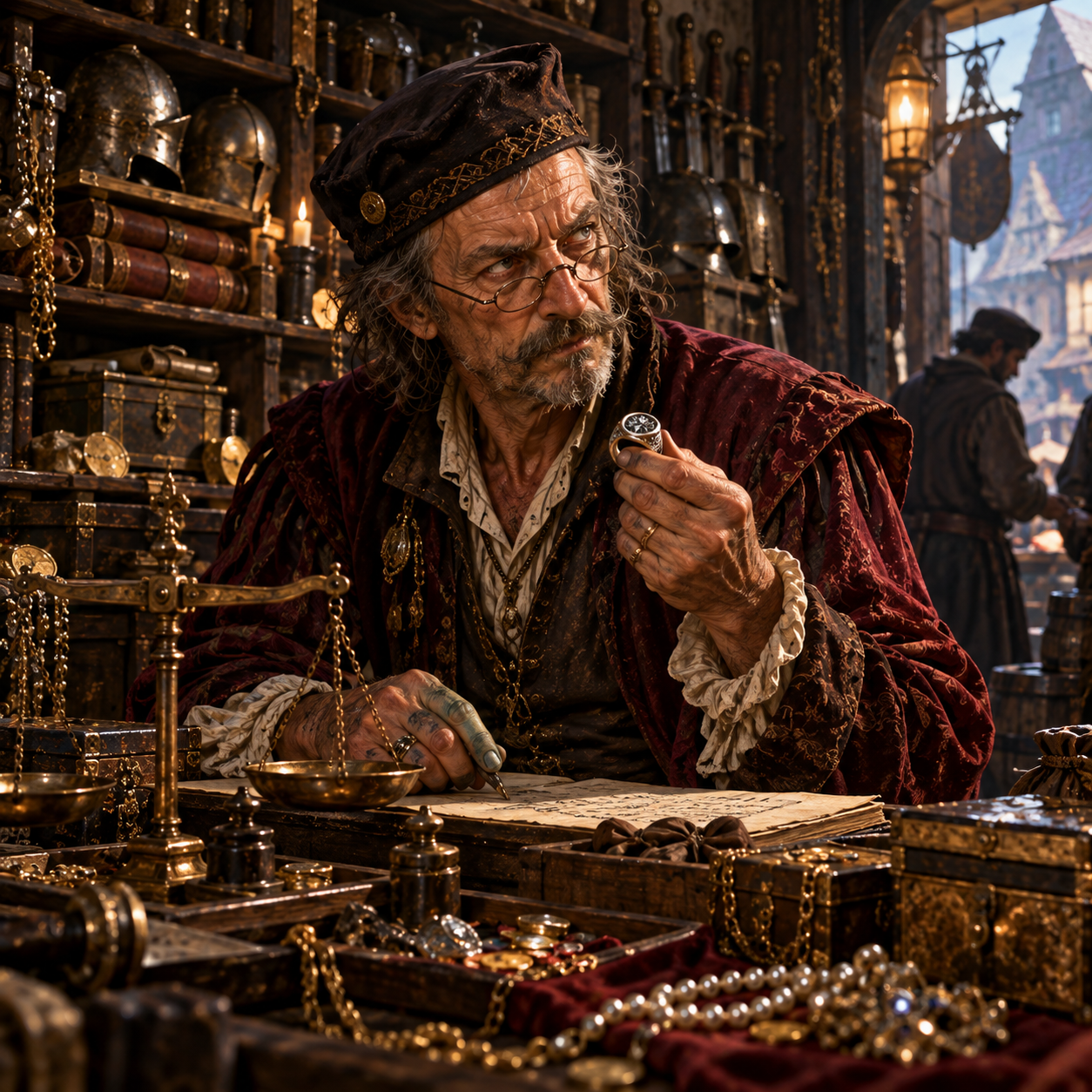
Expert NPC · Appraiser · Lender · Broker of possessions and secrets
A silver ring returns to the counter with three different owners and the same broken seal. The pawnbroker remembers each face, each loan and the name scratched away beneath the setting. Whether the next customer is a desperate widow, a wealthy adventurer or a city watch officer, the ledger may be worth more than the ring.
At a Glance
| NPC Role | Pawnbroker, moneylender, second-hand merchant, appraiser or illicit fence |
|---|---|
| NPC Class | Human Expert 4 in Pathfinder and D&D 3.5e; a skilled noncombatant in 5e. The trade does not inherently grant rogue class abilities. |
| Common Alignment | Any; legality and trustworthiness depend on the individual, not the trade |
| Premises | Shop counter, workshop, pawn ledger, secured storeroom and strongboxes |
| Specialties | Valuation, collateral, debt records, resale, hallmark recognition and tracing owners |
| Associates | Successful Merchant, Dealer, Thief-Taker, guild clerk, craftspeople and local watch |
| Equipment | Merchant’s scales, jeweller’s loupe, dagger, keys, tags, wax seals and ledgers |
| Where Found | Cities, market towns, border crossings, ports, dwarven markets and caravan centres |
| Immediate Trouble | A pledge has been stolen while under lock; the legal owner and apparent thief both demand it |
Game Statistics
Use the edition that matches your table. This is a skilled NPC rather than a covert rogue or seasoned fighter: an honest lender and a criminal fence can use exactly the same base statistics and differ through motives, contacts and choices.
D&D 5.5e / 2024
Pawnbroker / Fence
Medium Humanoid (Human), any alignment · CR 1/4 (50 XP)
Armor Class 10 (ordinary clothes); Hit Points 14 (4d8 − 4); Initiative +0; Speed 30 ft.
Skills Deception +7, Insight +6, Investigation +2, Perception +4, Persuasion +5, Sleight of Hand +2; Tools Jeweller’s tools +2; Senses Passive Perception 14; Languages Common plus one trade language; Proficiency Bonus +2.
Gear dagger, merchant’s scales, jeweller’s loupe, stamped pawn tickets, sealed ledger, iron keys, wax and a lockbox. Shop stock is not carried as adventuring equipment.
Traits
Eye for Value. The pawnbroker has Advantage on Intelligence (Investigation) checks to recognise repairs, counterfeit hallmarks, mismatched weights, alterations to mundane trade goods or suspicious pledge documents. This does not identify magical properties.
Knows the Market. After an hour speaking with merchants and porters in a familiar settlement, the pawnbroker can identify a plausible buyer or creditor for an ordinary object, subject to local law and available contacts. An unlawful sale may draw unwanted attention.
Actions
dagger. Melee Attack +1, reach 5 ft. Hit: 1 (1d4 − 1, minimum 1) Piercing; or Ranged Attack +2, range 20/60 ft., Hit: 2 (1d4) Piercing if thrown using Dexterity.
Bonus Actions
A Better Offer (1/Day). The pawnbroker takes the Help action to aid a willing creature within 5 ft. on its next Charisma (Persuasion) check about the sale, loan or ownership of an item, provided the pawnbroker can participate in the conversation. This doesn’t compel the other party to agree.
Reactions
Guard the Ledger (1/Day). When a creature the pawnbroker can see tries to take a held object from them, the pawnbroker has Advantage on the immediate ability check to retain it. The pawnbroker cannot use this against an attack.
In play. Run the fence as a social contact, witness or reluctant informant. It is not a skilled combatant, and escaping with the ledger is usually more important than fighting to the death.
D&D 5e / 2014
Pawnbroker / Fence
Medium Humanoid (Human), any alignment · CR 1/4 (50 XP)
Armor Class 10 (ordinary clothes); Hit Points 14 (4d8 − 4); Initiative +0; Speed 30 ft.
Skills Deception +7, Insight +6, Investigation +2, Perception +4, Persuasion +5, Sleight of Hand +2; Tools Jeweller’s tools +2; Senses Passive Perception 14; Languages Common plus one trade language; Proficiency Bonus +2.
Gear dagger, merchant’s scales, jeweller’s loupe, stamped pawn tickets, sealed ledger, iron keys, wax and a lockbox. Shop stock is not carried as adventuring equipment.
Traits
Eye for Value. The pawnbroker has Advantage on Intelligence (Investigation) checks to recognise repairs, counterfeit hallmarks, mismatched weights, alterations to mundane trade goods or suspicious pledge documents. This does not identify magical properties.
Knows the Market. After an hour speaking with merchants and porters in a familiar settlement, the pawnbroker can identify a plausible buyer or creditor for an ordinary object, subject to local law and available contacts. An unlawful sale may draw unwanted attention.
Actions
dagger. Melee Weapon Attack +1, reach 5 ft. Hit: 1 (1d4 − 1, minimum 1) Piercing; or Ranged Weapon Attack +2, range 20/60 ft., Hit: 2 (1d4) Piercing if thrown using Dexterity.
Bonus Actions
A Better Offer (1/Day). The pawnbroker takes the Help action to aid a willing creature within 5 ft. on its next Charisma (Persuasion) check about the sale, loan or ownership of an item, provided the pawnbroker can participate in the conversation. This doesn’t compel the other party to agree.
Reactions
Guard the Ledger (1/Day). When a creature the pawnbroker can see tries to take a held object from them, the pawnbroker has Advantage on the immediate ability check to retain it. The pawnbroker cannot use this against an attack.
In play. Run the fence as a social contact, witness or reluctant informant. It is not a skilled combatant, and escaping with the ledger is usually more important than fighting to the death.
Pathfinder 1e
The original Expert 4 statistics are reproduced below. Expertise in Appraise, Bluff, Diplomacy, Profession and local knowledge makes this NPC useful wherever goods, credit and disputed ownership matter.
Pawnbroker / Fence — Expert 4, CR 1
| Pawnbroker/Fence CR 1 |
| XP 400 Male human expert 4 N Medium humanoid (human) Init +0; Senses Perception +9 |
| DEFENSE |
| AC 11, touch 11, flat-footed 10 (+1 Dexterity) hp 10 (4d8-8) Fort -1, Ref +1, Will +6 |
| OFFENSE |
| Speed 30 ft. Melee dagger +1 (1d4-2/19-20) |
| STATISTICS |
| Strength 6, Dexterity 11, Constitution 7, Intelligence 11, Wisdom 15, Charisma 16 Base Atk +3; CMB +1; CMD 11 Feats Alertness, Deceitful, Skill Focus (Bluff) Skills Appraise +7, Bluff +15, Diplomacy +10, Knowledge (local) +7, Perception +9, Profession (pawnbroker) +9, Sense Motive +11 Languages Common NPC Gear dagger |
GM’s source note. The archived AC calculation lists a Dexterity bonus despite Dexterity 11; the original line is preserved as published. Check the AC against the actual abilities and equipment for your encounter. Replace one or more trade skills to represent a jeweller, book dealer, relic buyer or rural moneylender without automatically assigning rogue class abilities.
D&D 3.5e
Pawnbroker / Fence — Expert 4
| Size / Type | Medium Humanoid (Human) |
|---|---|
| Alignment / Challenge Rating | Usually Neutral; CR 1 (campaign adaptation) |
| Hit Dice / HP | 4d6 − 8 (6 hp) |
| Initiative | +0 |
| Speed | 30 ft. |
| Armour Class | 10, touch 10, flat-footed 10 (ordinary clothes) |
| Base Attack / Grapple | +3 / +2 |
| Attack | dagger +2 melee (1d4−1/19–20); thrown dagger +3 ranged (1d4−1/19–20, 10-ft. increment) |
| Full Attack | dagger +2 melee or thrown dagger +3 ranged |
| Space / Reach | 5 ft. / 5 ft. |
| Saving Throws | Fort −1, Ref +1, Will +6 |
| Abilities | Str 8, Dex 11, Con 7, Int 11, Wis 15, Cha 16 |
| Skills | Appraise +7, Bluff +15, Diplomacy +10, Knowledge (local) +7, Profession (pawnbroker) +9, Sense Motive +11, Spot +9, Listen +9 |
| Feats | Alertness, Deceitful, Skill Focus (Bluff) |
| Special Abilities | Expert NPC class; no sneak attack, spellcasting or supernatural powers |
| Equipment | dagger, scales, jeweller’s loupe, locked cash box, pawn tickets, wax seals and handwritten ledgers |
Trading expertise. Use Appraise for value, Sense Motive for negotiations, Gather Information or Knowledge (local) to trace buyers, and Profession to operate the shop. The business’s credit, guards and criminal contacts are narrative resources, not free combat powers.
What Is the Pawnbroker Doing Now?
The shop has received three pledges bearing one noble household’s seal. The first was a ring offered openly; the second, a sword with its maker’s mark filed away; the third, a small locked box that no one has been willing to redeem. The broker accepted them on different days, from different customers, using three different names.
A clerk from the household offers good money for the records to disappear. Meanwhile the person who pawned the ring has returned with a witness and a written claim. The broker could surrender the ledger, warn the victims, conceal the last pledge or employ adventurers to learn who is collecting these objects and why.
The Pawnshop: Goods, Loans and Ownership
A pawnbroker advances money against a pledge that can be stored and resold. A fence buys or disposes of stolen goods knowing—or strongly suspecting—their origin. Some pawnbrokers are honest, some do both trades, and some quietly refuse suspicious merchandise. A buyer who mistakes these distinctions can lose a fortune or expose an innocent shopkeeper to the watch.
| Service | What the broker needs | What may go wrong |
|---|---|---|
| Appraise a mundane item | Time to inspect the workmanship, weight, marks and condition | A forged hallmark or deliberate repair hides the true origin |
| Pawn an object | The item, agreed advance, redemption date, fee and written token | Someone presents the wrong token or a rival claims the pledge |
| Buy second-hand goods | Proof of possession, bargaining and a likely resale market | The seller is not the owner, or an embargo makes resale unlawful |
| Find a discreet purchaser | A clear description, a price and enough trust to risk an introduction | The buyer may be an informer, competitor or injured owner |
| Trace a missing possession | Recognisable marks, a witness, old ticket or entry in a ledger | The trail leads to a patron who controls the local authorities |
| Assess unusual or magical wares | Reliable evidence and, if needed, a knowledgeable spellcaster | Beautiful workmanship does not prove an item’s magical properties or safety |
Advance amounts, fees and redemption periods vary by law, scarcity, storage costs and the merchant’s risk. Agree them openly during play rather than treating every city as having the same fixed lending rate. Gold can move through a pawnshop legally even when the object it secures has a complicated history.
Personality and Conduct
The broker counts change once, but remembers a person’s hesitation longer than their purse. They may be sharp-tongued with rich customers and generous to someone who brings in the only coat they own. Every pledge is a story of need; every hidden compartment is a temptation to demand another question.
Wants: reliable repayments, a respected shop and the freedom to decide whom to trust. Fears: an inspector who can close the premises, a gang demanding that suspicious goods be accepted, or a creditor finding a secret in the books. Weakness: the broker sometimes believes that everything has a price, including loyalty.
Changing the proprietor from a human Expert to a dwarf appraiser, halfling lender, gnome jeweller or elf antiquarian changes their expertise and social ties, not the underlying dramatic situation. Their community connections should be particular to the settlement, not a list of assumed racial traits.
Relationships, Law and Reputation
The Successful Merchant may extend credit or purchase stock openly. The Dealer buys rarities and strange substances, with risks that a reputable pawnbroker may decline. A Thief-Taker can become an investigator, a customer or a threat; a judge may establish whether a seized object can legally be returned to its owner. A thieves’ guild might want a compliant fence, yet a quiet shop can be more useful to a guild when it remains beyond suspicion.
In a port, the Brethren of the Coast might seek a buyer for plunder, but that is merely one possible client. Rural debtors, town magistrates, miners, adventuring companies and travelling merchants also need the broker’s services.
How Adventurers Use the Shop
Adventurers may need to turn a heavy silver bowl into travel money, identify a stolen weapon, secure a loan against treasure they cannot yet sell or learn which stranger has been buying particular coins. A broker who has handled an object can sometimes recognise it years later by a maker’s error, unusual repair or scratched family mark.
If the characters bargain: let them test their evidence and terms rather than rolling once to set an arbitrary discount. If they threaten the proprietor: the important danger is the lost trust of the market, not the NPC’s dagger. If they investigate: a register, duplicate key, false weight and witness may reveal more than a confession.
Adventure Hooks
A Ticket for a Dead Man
A deceased soldier’s pawn ticket is redeemed by someone bearing his voice and signature. The broker knows the corpse was buried the week before. The party must distinguish forgery, conspiracy and something more uncanny before the disputed keepsake vanishes.
The Sword with Two Histories
A family sword appears in the shop after a celebrated knight reported it lost on campaign. The knight offers a reward for its return; the impoverished bearer insists it was payment for saving his life. Giving it to either party will anger the other.
Too Many Silver Seals
Coins and rings entering the market all bear one guild’s assay mark, but the weight is wrong. A dwarven metalworker knows the silver is genuine while the stamp is false. Following the marks leads to a workshop making excellent counterfeits for reasons beyond profit.
The Box Nobody Redeems
A sealed chest forfeits to the shop after months of silence. Inside lies a map, a broken miniature automaton and a child’s warning written on the lid. Three buyers arrive within an hour of the chest being opened.
Equipment, Treasure and Evidence
Carried possessions: plain clothes, a dagger for self-defence, scales, writing supplies, shop keys and a small purse. In the shop: spare weights, a loupe, measuring rods, tokens, labelled pledges, strongboxes, inventory and guarded storerooms. Security belongs to the building, its employees and relationships; it is not an unexplained combat ability.
Treasure worth finding: a sealed promissory note, the original owner’s mark, a receipt in someone else’s handwriting, a hidden collection of magical trinkets awaiting proper examination or a coded register linking an apparent benefactor to missing property.
Further Paths
Compare the Successful Merchant and Dealer; consult a Thief-Taker or judge; browse other non-player characters. Regional ties and factions should be chosen to suit the town in which this broker lives.
Sources and Licensing
The original Pathfinder Pawnbroker/Fence (Human Expert 4) CR 1 stat block is preserved in its edition, with only a malformed internal knowledge-skill URL repaired. The D&D 5.5e/2024, 5e/2014 and 3.5e versions are separate play-ready adaptations, not direct conversions of Pathfinder Challenge Rating.
Equipment and skill references: Dagger, Appraise, Bluff, Diplomacy, Profession. Original Pathfinder NPC reference.
Section 15: Copyright Notice – The War of the Goblin King
The War of the Goblin King. Copyright 2010 Necromancers of the Northwest, LLC; Authors: Alex Riggs, Joshua Zaback, Justin Holloway.
Keep this reference growing
If this page helped with your reading or game, you can support its upkeep or explore the curated books.
Explore the Bookshop — epics, classics and stories behind imagined worlds.