
Lion — The Pride Hunter of Savanna and Woodland
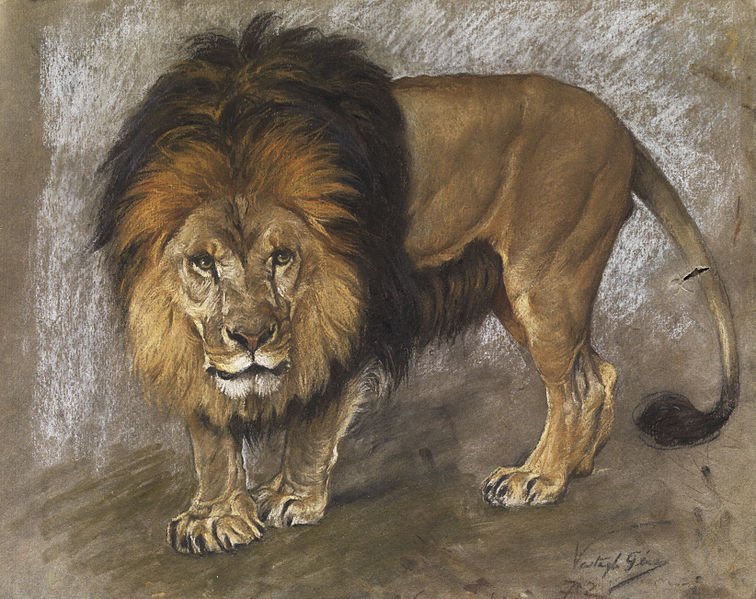
The low roar rolls across the grassland long before the travellers see the pride. Several lionesses rest near the shade of thorn trees, while the dominant male watches the horizon. Between the caravan and the next waterhole lies the route the animals use to hunt.
At a Glance
- Identity: Lion (Panthera leo), a large social cat living in prides
- Build: Heavy, muscular feline; many adult males carry a mane, while lionesses are usually less heavily built
- Habitat: Savannas, dry woodlands, open scrub and other country with suitable prey and shelter
- Range: Much of sub-Saharan Africa, with a surviving regional population in western India
- Behaviour: Social hunting and resting, care of cubs, defence of food and pride territory
- Signs: Large pawprints, roars, torn carcasses, scent marks, flattened grass and groups of animals resting in shade
- Encounter role: Pride at a waterhole, livestock threat, savanna travel hazard or animal wounded by hunters
- Danger: Multiple large predators working near one another and a sudden short attack when prey is isolated
Game Statistics
The lion is a published creature in all four rules editions, each with its own attacks and actions. Select one edition; abilities from the others do not automatically apply.
Lion — CR 1
Large Beast, Unaligned
AC 12 · Initiative +2 (12) · HP 22 (4d10) · Speed 50 ft.
| STR | DEX | CON | INT | WIS | CHA |
|---|---|---|---|---|---|
| 17 (+3) | 15 (+2) | 11 (+0) | 3 (−4) | 12 (+1) | 8 (−1) |
Skills Perception +3, Stealth +4
Senses Darkvision 60 ft.; Passive Perception 13
Languages None
CR 1 (200 XP; PB +2)
Traits
Pack Tactics. The lion has Advantage on an attack roll against a creature if one of the lion’s allies is within 5 feet of that creature and the ally isn’t Incapacitated.
Running Leap. With a 10-foot running start, the lion can Long Jump up to 25 feet.
Actions
Multiattack. The lion makes two Rend attacks. It can replace one attack with Roar.
Rend. Melee Attack Roll: +5, reach 5 ft. Hit: 7 (1d8 + 3) Slashing damage.
Roar. Wisdom Saving Throw: DC 11, one creature within 15 feet. Failure: The target has the Frightened condition until the start of the lion’s next turn.
Published D&D 2024 SRD 5.2.1 Lion (CC BY 4.0). Roar and two Rend attacks are 2024 rules, not 2014 Pounce.
Lion — CR 1
Large beast, unaligned
Armor Class 12
Hit Points 26 (4d10 + 4)
Speed 50 ft.
| STR | DEX | CON | INT | WIS | CHA |
|---|---|---|---|---|---|
| 17 (+3) | 15 (+2) | 13 (+1) | 3 (−4) | 12 (+1) | 8 (−1) |
Skills Perception +3, Stealth +6
Senses passive Perception 13
Languages —
Challenge 1 (200 XP)
Traits
Keen Smell. The lion has advantage on Wisdom (Perception) checks that rely on smell.
Pack Tactics. The lion has advantage on an attack roll against a creature if an ally is within 5 feet of the creature and isn’t incapacitated.
Pounce. After moving at least 20 feet straight towards a creature and then hitting with a Claw attack on the same turn, the target must succeed on a DC 13 Strength save or be knocked prone. If prone, the lion can make a Bite as a bonus action.
Running Leap. With a 10-foot running start the lion can long jump up to 25 feet.
Actions
Bite. Melee Weapon Attack: +5 to hit, reach 5 ft., one target. Hit: 7 (1d8 + 3) piercing damage.
Claw. Melee Weapon Attack: +5 to hit, reach 5 ft., one target. Hit: 6 (1d6 + 3) slashing damage.
Published D&D 2014 SRD 5.1 Lion (CC BY 4.0). No two-Rend Multiattack or Roar from the 2024 Lion belongs here.
Lion — CR 3
XP 800 · N Large animal
Init +7; Senses low-light vision, scent; Perception +9
Defense
AC 15, touch 12, flat-footed 12 (+3 Dex, +3 natural, −1 size)
hp 32 (5d8 + 10)
Fort +6, Ref +7, Will +2
Offense
Speed 40 ft.
Melee bite +7 (1d8 + 5 plus grab), two claws +7 (1d4 + 5)
Space/Reach 10 ft./5 ft.
Special Attacks pounce, rake (two claws +7, 1d4 + 5)
| STR | DEX | CON | INT | WIS | CHA |
|---|---|---|---|---|---|
| 21 | 17 | 15 | 2 | 12 | 6 |
Base Atk +3; CMB +9 (+13 grapple); CMD 22 (26 vs. trip)
Feats Improved Initiative, Run, Skill Focus (Perception)
Skills Acrobatics +11, Perception +9, Stealth +8 (+12 in undergrowth)
Racial Modifiers +4 Acrobatics, +4 Stealth (+8 in undergrowth)
Ecology
Environment warm plains
Organisation solitary, pair or pride (3–10)
Treasure none
Published Pathfinder Roleplaying Game Bestiary Lion (Paizo, OGL). Use Pathfinder’s own grab, pounce and rake procedures.
Lion — CR 3
Large Animal; Always neutral
Hit Dice 5d8 + 10 (32 hp)
Initiative +3
Speed 40 ft. (8 squares)
Armor Class 15 (−1 size, +3 Dex, +3 natural), touch 12, flat-footed 12
Base Attack/Grapple +3/+12
Attack claw +7 melee (1d4 + 5)
Full Attack two claws +7 melee (1d4 + 5) and bite +2 melee (1d8 + 2)
Space/Reach 10 ft./5 ft.
Special Attacks pounce, improved grab, rake (1d4 + 2)
Special Qualities low-light vision, scent
Saves Fort +6, Ref +7, Will +2
| STR | DEX | CON | INT | WIS | CHA |
|---|---|---|---|---|---|
| 21 | 17 | 15 | 2 | 12 | 6 |
Skills Balance +7, Hide +3 (+11 in tall grass), Listen +5, Move Silently +11, Spot +5
Feats Alertness, Run
Environment warm plains
Organisation solitary, pair or pride (6–10)
Treasure none
Combat
Pounce (Ex). When charging, the lion can make its full attack including two rake attacks.
Improved Grab (Ex). On a successful Bite, the lion can start a grapple without provoking an attack of opportunity, and if successful can rake.
Rake (Ex). Two attacks at +7 melee, 1d4 + 2 damage each.
D&D 3.5 System Reference Document Lion (OGL 1.0a). Its special attacks, grapple and charge rules are edition-specific.
Lions in the Living World
Lions live in prides that may include several related females, their young and one or more adult males. Social life is central to their behaviour. Some lions hunt together; others guard young, patrol the pride’s range or defend a resting place. A pride may be found around a kill or waterhole and may cross the same trail used by people, herds and caravans.
A lioness can stalk through long grass towards antelope or other grazing animals, while the rest of the pride waits at a distance. A male’s roar may be heard far beyond the place he is resting. Lions also scavenge and take opportunities to feed without exhausting themselves in unnecessary pursuit. They are strong predators, but neither tireless monsters nor enemies of every traveller.
Country and Prey
Lions are associated with savanna, open woodland, scrub and other country where prey and concealment are available. In much of Africa, herders and wildlife may share the same grassland. A smaller population of Asiatic lions also occupies a different range in western India. A lion is not automatically native to every mountain, desert or tropical jungle just because the story calls for a formidable cat.
Prides, Cubs and Outsiders
Lionesses may raise young together and defend the area around them. Solitary males, pairs of allied males and larger prides have different reasons for occupying a route. A group of lions seen near a caravan is not necessarily stalking people: it may be travelling towards water or resting after a hunt. An injured or older predator living close to settlements can create a specific problem, but should not define every lion in the region.
Signs Before Initiative
A deep roar across the grass, pawprints at a waterhole, flattened resting places and scattered prey remains can tell explorers that lions are nearby. A family group leaves more than one size of print, and young animals may be close when the trails cross repeatedly. Survival helps read signs; Perception can reveal movement through grass or a watchful face in the shade.
A lion that raises its head near a carcass may be warning intruders away, not choosing a fight. Show the approach, the wind, the distance to the pride and the possibility of retreat. If cubs are present, characters should have the chance to recognise this before entering the resting place.
Running a Lion Encounter
What It Wants
Food, water, safety and protection of its pride and young. Lions can be dangerous when threatened, but their decisions respond to immediate needs. A starving or injured lion may approach a settlement; a healthy group with plenty of prey has little reason to chase an armed company across the plains.
In a Fight
Use one edition’s complete stat block. D&D 2024 gives the Lion two Rend attacks, a Roar and Pack Tactics. D&D 2014 instead uses Bite, Claw and Pounce. Pathfinder and D&D 3.5e have their own full-attack, grapple and rake mechanics. No creature gains abilities from all four at once. Lions may try to isolate vulnerable prey, but an animal that is outmatched may withdraw if it can.
Counterplay
Keep pack animals together, avoid disturbing a kill, choose a route around a pride’s resting place and use scouts to examine a waterhole before a caravan enters. When the party can wait, travel in daylight or find another route, reward those choices. A nonviolent solution is still an encounter with consequences: delays cost supplies, while a safe path can earn future trade.
Consequences
A pride displaced from one valley may move closer to another village. Killing a lion blamed for a theft may not stop the losses if people were responsible. A herder helped by the party may return the favour with guides, water and news. The animals should affect the living countryside instead of disappearing when an encounter ends.
Encounters and Adventure Hooks
The Vanished Herd
Caravans arriving at an oasis find livestock held behind makeshift thorn fences. Herder Basira blames an enormous lion for missing animals, but several different lion tracks circle the clearing. One animal has been wounded by a snare and is approaching the settlement more often.
The characters can protect the animals, inspect the trap, trace its owner or persuade the villagers not to burn the grass in retaliation. Repairing the fence and addressing the snare-maker may earn Basira’s help on future journeys. A rash hunt might leave the village with its original livestock problem and fewer safe routes.
The Waterhole at Dusk
Merchant Idris brings wagons to the last dependable waterhole before a long dry crossing. A pride is resting beside it, while the drivers want to push the animals through at once.
Players can wait until the lions move, seek another well, guard the horses or bargain for more time with Idris. A safe crossing could win a trading contact; an impatient charge may cost the expedition water and valuable pack animals.
The Roar Beyond the Hill
Several nights of roaring have frightened the herders away from a familiar pasture. Their children think a single enormous lion haunts the ridge. Tracks reveal two adult males travelling together, but no cubs or pride.
Tracking them from a distance, moving grazing stock or convincing the headman to adjust routes can settle the fear. Attacking the animals without understanding their movement might push them towards a more vulnerable settlement.
The Injured Lioness
Forester Dalia finds a lioness limping beside a dry stream, unable to return to her pride. A poacher wants its hide; Dalia asks for help recovering the iron trap lodged against its paw.
Rescue is dangerous and requires planning, an escape route and knowledge of the terrain. A wounded wild lioness does not become a grateful companion. Whether the party helps Dalia or the poacher changes who will welcome them on the same road later.
The Missing Messenger
A courier has not reached the next market, and the last witness heard lions near the track. His employer declares the pride must have attacked him. The courier’s mule is found grazing alone, while a torn satchel lies beside a crossing.
Players can follow human prints, inspect the mule, speak to a ferryman or search the grass. Bandits stopped the courier near the crossing; the lions are merely using the same waterhole. A careful search may save a life and expose a danger the caravans had not recognised.
Trade, Rumours and Aftermath
A lion carries no coins or magical treasure. A hide might be prized by a ruler or trader, but its sale affects people who share the same land and may bring new disputes over hunting. Helping herders secure animals or finding a safer route can be more valuable than killing a predator.
The lion that rules the river: A particularly loud male may be remembered by travellers for years, yet a familiar roar does not mean every animal in the valley serves him.
The silent pride: People who hear no roar assume the animals have gone, while lionesses still travel and hunt near the same waterhole.
Related Creatures, Places and Rules
Compare the solitary Leopard, faster Cheetah and the Animal Bestiary. The legendary Nemean Lion has a distinct story and should not be mistaken for ordinary wildlife. Scenes at waterholes and cattle routes can connect to African geography, Survival, Perception and older scent rules where applicable.
Sources and Game Content
The 2024 and 2014 Lion statistics are based on the separate published entries in D&D SRD 5.2.1 and SRD 5.1 (CC BY 4.0). Pathfinder 1e uses the Lion in the Pathfinder Bestiary (Paizo, OGL). The original D&D 3.5e stat block follows the Lion in the 3.5 System Reference Document (OGL 1.0a).
The historical lion painting by Géza Vastagh remains from the original page. The five encounters and named people are original campaign material. An older embedded lion video is retained as an optional external reference, not an oversized autoplaying page element.
Keep this reference growing
If this page helped with your reading or game, you can support its upkeep or explore the curated books.
Explore the Bookshop — epics, classics and stories behind imagined worlds.