
Aspidochelone — The Living Island

The island is moving. A ship’s anchor has caught on something that should be rock. The “shore” rises beneath the crew, seabirds scatter, and deep water opens where a landing place stood a moment before.
Aspidochelone is the false island of medieval sea lore. Sailors camp on its back, sometimes lighting a fire that wakes it; in the older bestiaries it could appear as a whale, a vast fish or a shield-backed creature. The Pathfinder creature below interprets it as a sleeping, rock-skinned whale. Each other game edition is an explicitly unofficial adaptation.
At the Table
- Warning: Ropes draw taut against a changing current; a ridge of “rock” rises, then slowly settles.
- Want: Unbroken sleep until hunger returns. It does not patrol for enemies while dormant.
- Avoid the danger: Cast off the anchor, launch the boats and get clear of the creature before it dives.
- First move if attacked: Dive. The undertow, more than its teeth, makes the initial encounter deadly.
Four-edition statistics · Running the encounter · The old sea legend
Aspidochelone Monster Statistics — Four Editions
Choose an edition. Pathfinder 1e preserves the published Paizo monster; the 2024, 2014 and 3.5e entries are separate, unofficial conversions for campaign use.
Aspidochelone — D&D 2024
Gargantuan Monstrosity, Unaligned. Unofficial 2024 adaptation; not a published 2024 monster.
Armor Class 19 (natural armor)
Hit Points 350 (20d20 + 140)
Speed 0 ft., Swim 120 ft.
| STR | DEX | CON | INT | WIS | CHA |
|---|---|---|---|---|---|
| 27 (+8) | 8 (−1) | 24 (+7) | 3 (−4) | 12 (+1) | 9 (−1) |
Saving Throws Str +14, Con +13, Wis +7
Skills Perception +7
Senses Darkvision 120 ft., Passive Perception 17
Languages —
Challenge 17 (18,000 XP); Proficiency Bonus +6
Traits
False Island. While motionless on the sea surface, the aspidochelone resembles a low, rocky island covered with seabirds and plants. A creature within 100 feet can recognize the deception with a successful DC 22 Wisdom (Perception) or Intelligence (Nature) check. A creature that has seen it move recognizes it automatically.
Pressure-Hardened. The aspidochelone ignores damage caused solely by the natural pressure of deep water and can breathe underwater.
Capsize. Once on each of its turns, when it swims through the space of a vessel of Gargantuan size or smaller, the vessel’s pilot must succeed on a DC 22 Dexterity check (adding Water Vehicles proficiency if possessed) or the vessel capsizes. An unpiloted vessel capsizes automatically. The resulting consequences to passengers follow the vessel and water rules, not automatic death.
Actions
Multiattack. The aspidochelone makes one Bite attack and two Tail Slap attacks.
Bite. Melee Attack Roll: +14, reach 20 ft. Hit: 34 (4d12 + 8) Piercing damage. If the target is Huge or smaller, it has the Grappled condition (escape DC 22). Until that grapple ends, the target also has the Restrained condition, and the aspidochelone can’t Bite another target.
Tail Slap. Melee Attack Roll: +14, reach 40 ft. Hit: 30 (4d10 + 8) Bludgeoning damage.
Watery Grave (Recharge 5–6). While swimming, the aspidochelone plunges straight down up to 120 feet. Each creature on its back or in the water within 100 feet makes a DC 21 Strength saving throw, taking 35 (10d6) Bludgeoning damage and being pulled up to 100 feet downward on a failure, or half damage with no forced movement on a success. A creature cannot be pulled below the sea floor. Breath-holding and suffocation use the normal rules.
Bonus Actions
Swallow. The aspidochelone swallows one Huge or smaller creature grappled by its Bite. The creature has the Blinded and Restrained conditions, has Total Cover from effects outside, and takes 27 (5d10) Acid damage at the start of each of the aspidochelone’s turns. If the creature deals at least 40 damage to the aspidochelone from inside during one turn, it must succeed on a DC 21 Constitution saving throw or regurgitate that creature into the water within 10 feet, where it falls Prone if able. If the aspidochelone dies, the swallowed creature can escape using 20 feet of movement.
Aspidochelone — D&D 5e (2014)
Gargantuan monstrosity, unaligned. Unofficial 2014 conversion; it is not an official Monster Manual entry.
Armor Class 19 (natural armor)
Hit Points 350 (20d20 + 140)
Speed 0 ft., Swim 120 ft.
| STR | DEX | CON | INT | WIS | CHA |
|---|---|---|---|---|---|
| 27 (+8) | 8 (−1) | 24 (+7) | 3 (−4) | 12 (+1) | 9 (−1) |
Saving Throws Str +14, Con +13, Wis +7
Skills Perception +7
Senses Darkvision 120 ft., Passive Perception 17
Languages —
Challenge 17 (18,000 XP); Proficiency Bonus +6
Traits
Living Island. An aspidochelone that remains motionless at the surface resembles a rocky island. Within 100 feet, a creature that examines it can see through the disguise with a successful DC 22 Wisdom (Perception) or Intelligence (Nature) check. Movement reveals the creature immediately.
Deep Sea Creature. The aspidochelone can breathe underwater and is unharmed by ordinary deep-water pressure.
Capsize. When the aspidochelone moves through the space of a Gargantuan or smaller ship, its pilot must make a DC 22 Dexterity check, adding proficiency with water vehicles if applicable. On a failure the ship capsizes; an unpiloted ship capsizes automatically. This can occur once on each aspidochelone turn.
Actions
Multiattack. The aspidochelone makes one bite attack and two tail slap attacks.
Bite. Melee Weapon Attack: +14 to hit, reach 20 ft., one target. Hit: 34 (4d12 + 8) piercing damage, and a Huge or smaller target is grappled (escape DC 22). Until this grapple ends, the target is restrained and the aspidochelone cannot bite another target.
Tail Slap. Melee Weapon Attack: +14 to hit, reach 40 ft., one target. Hit: 30 (4d10 + 8) bludgeoning damage.
Watery Grave (Recharge 5–6). The creature dives up to 120 feet straight down. Each creature standing on it or swimming within 100 feet must make a DC 21 Strength saving throw. On a failure a creature takes 35 (10d6) bludgeoning damage and is dragged up to 100 feet underwater; on a success it takes half damage and is not dragged. Solid terrain stops the movement. Use normal rules for holding breath.
Bonus Actions
Swallow. The aspidochelone swallows one Huge or smaller creature it is grappling with its bite. A swallowed creature is blinded and restrained, has total cover against effects originating outside, and takes 27 (5d10) acid damage at the start of each aspidochelone turn. If it takes 40 damage or more in one turn from a creature inside it, the aspidochelone must make a DC 21 Constitution saving throw or regurgitate the creature into the water within 10 feet; the creature falls prone if possible. The victim can escape the corpse using 20 feet of movement.
Aspidochelone — Pathfinder 1e (CR 17)
Published Pathfinder 1e rules, sourced to Pathfinder #27: What Lies in Dust, p. 78, and preserved below; this is not a D&D 2024/2014 conversion.
Aspidochelone (CR 17)
XP 102,400
N Colossal magical beast (aquatic)
Init -3; Senses Darkvision 120 ft., Low-Light Vision; Perception -2
Defense
AC 27, touch -1, flat-footed 27 (+28 armor, -3 Dexterity, -8 size)
hp 297 (22d10+176)
Fort +23, Ref +10, Will +7
Offense
Speed 0 ft., Swim 120 ft.
Melee bite +25 (4d6+11 plus grab), tail slap +20 (4d6+5)
Space 150 ft.; Reach 20 ft.
Special Attacks capsize, swallow whole (4d6 acid damage, AC 24, 29 hp), watery grave
Statistics
Strength 32, Dexterity 5, Constitution 27, Intelligence 3, Wisdom 7, Charisma 12
Base Atk +22; CMB +41; CMD 48
Feats Diehard, Endurance, Great Fortitude, Greater Bull Rush, Improved Bull Rush, Improved Great Fortitude, Improved Iron Will, Improved Overrun, Iron Will, Power Attack, Stealthy
Skills Stealth -1, Swim +33; Racial Modifiers +10 Stealth to appear as an island
SQ deep sea denizen, hibernate, hibernation of ages
Ecology
Environment ocean
Organization solitary
Treasure incidental
Special Abilities
Capsize (Ex)
An aspidochelone can attempt to capsize a boat or ship of Gargantuan size or smaller by merely passing through its space and making a CMB check as a free action. The DC the aspidochelone must exceed is 25, or the result of the boat captain’s Profession (sailor) check, whichever is higher.
Captivating Scent (Ex)
An aspidochelone exudes intoxicating pheromones from its skin, causing nearby creatures to seek it out. Anyone within a 1-mile radius must succeed on a DC 12 Will save or feel inexplicably drawn toward the aspidochelone by the most direct route possible. This effect is not an overwhelming compulsion, but more a subtle suggestion. The save DC is Charisma-based with a −10 penalty.
Deep Sea Denizen (Ex)
An aspidochelone can travel to extraordinary depths, and has adapted to the intense darkness and water pressure of the deep. It possesses Darkvision with a range of 120 ft. and is immune to damage from water pressure.
Hibernate (Ex)
After gorging itself on innumerable tons of deep sea life and unfortunate travelers, an aspidochelone floats to the surface and goes into a deep hibernation with only its mottled back jutting from the waves. While hibernating, it appears to be little more than a rocky outcropping or, in the cases of the largest aspidochelone, an entire island. A hibernating aspidochelone is considered to have taken 20 on its Stealth check to hide in plain sight as a rock or island.
An aspidochelone rouses from its hibernation for one of two reasons: hunger or disturbance. After entering its hibernation, an aspidochelone sleeps for 2d10×10 years, rousing naturally after this time has elapsed. An aspidochelone about to awaken usually sleeps fitfully for the last year of its rest, quivering with tremors that feel like earthquakes to creatures upon it. These tremors are treated as a minor version of the earthquake spell that affects the entire island, forcing creatures on the ground to make a DC 29 Reflex save to avoid falling down and causing 30 points of damage to all structures. An aspidochelone might be awakened immediately if it takes 100 or more points of damage in a single day. If awakened in this manner, an aspidochelone typically dives to escape its attacker, then rises again to consume it. The save DC is Constitution-based.
Hibernation of Ages (Ex)
An aspidochelone in hibernation continues to exude its captivating scent. Over time, birds attracted by the aspidochelone’s pheromones come to roost on the whale, inadvertently bringing the seeds of small plants and shrubbery to grow in the cracks upon the aspidochelone’s thick hide. The preponderance of plants, seabirds, and even other beasts gives the creature the appearance of a rocky but natural island. Thus, any aspidochelone who has spent more than 10 years hibernating gains an additional +10 bonus on its Stealth check to look like a natural island.
Watery Grave (Ex)
A startled aspidochelone descends rapidly into the depths of the sea, creating an undertow in the water that pulls creatures above the whale down with it. Anyone standing on or swimming within 100 feet of the aspidochelone when it dives must make a DC 29 Reflex save or take 10d6 points of damage from the crushing waves and pressure, and be pulled 100 feet below the water. Even if a creature escapes the undertow, the water within 100 feet of a passing aspidochelone is treated as rough water, requiring a DC 20 Swim check to move at half speed. The save DC is Constitution-based.
Aspidochelone — D&D 3.5e
Unofficial 3.5e conversion of the island-whale, using traditional 3.5e stat-block field order. This is not an official 3.5e monster.
Size/Type: Colossal Magical Beast (Aquatic)
Hit Dice: 22d10+176 (297 hp)
Initiative: −3
Speed: 0 ft. (0 squares), swim 120 ft. (24 squares)
Armor Class: 27 (−8 size, −3 Dex, +28 natural); touch −1; flat-footed 27
Base Attack/Grapple: +22/+49
Attack: Bite +25 melee (4d6+11 and improved grab)
Full Attack: Bite +25 melee (4d6+11 and improved grab) and tail slap +20 melee (4d6+5)
Space/Reach: 150 ft./20 ft. (exceptional body length; adjudicate square occupancy for the ship encounter)
Special Attacks: Capsize, captivating scent, improved grab, swallow whole, watery grave
Special Qualities: Darkvision 120 ft., low-light vision, deep sea denizen, hibernate, island camouflage
Saves: Fort +23, Ref +10, Will +7
Abilities: Str 32, Dex 5, Con 27, Int 3, Wis 7, Cha 12
Skills: Hide −9 (+1 when posing as an island), Spot −2, Swim +33
Feats: Diehard, Endurance, Great Fortitude, Improved Bull Rush, Improved Overrun, Iron Will, Power Attack, Stealthy
Environment: Ocean
Organization: Solitary
Challenge Rating: 17 (provisional homebrew assessment)
Treasure: Incidental
Alignment: Always neutral
Advancement: 23–44 HD (Colossal)
Level Adjustment: —
Combat
A waking aspidochelone first dives, then uses its bulk to overturn a pursuing ship. Against prey in reach it bites, holds and swallows; it does not chase individuals ashore.
Improved Grab (Ex): On a successful bite against a creature Huge or smaller, the aspidochelone may start a grapple as a free action without provoking an attack of opportunity. On a successful grapple check it holds the target in its mouth.
Swallow Whole (Ex): If it begins its turn grappling a Huge or smaller creature in its mouth, the aspidochelone may make a new grapple check to swallow it. The swallowed creature takes 4d6 acid damage each round. A creature can cut free with a light slashing or piercing weapon by dealing 29 damage to the digestive tract (AC 24); the hole closes after the escape. An aspidochelone’s stomach can hold up to 2 Huge, 8 Large, 32 Medium or 128 Small creatures.
Capsize (Ex): When it swims through the space of a Gargantuan or smaller ship, it can attempt a special grapple check (+49) as a free action, once per turn, against DC 25 or the captain’s Profession (sailor) check result, whichever is higher. Success capsizes the vessel; passengers resolve falling and swimming normally.
Captivating Scent (Ex): Creatures within 1 mile that can smell must succeed on a DC 12 Will save or feel inclined to approach by a direct route. This is a mild suggestion, not a command to endanger oneself. The DC is Charisma-based with a −10 racial adjustment.
Deep Sea Denizen (Ex): Immune to damage from natural water pressure.
Hibernate (Ex): The creature sleeps at the surface for 2d10 × 10 years, appearing as a rocky islet. It wakes when hungry or after suffering at least 100 damage in one day. In the last year of sleep, tremors may force creatures on its back to make a DC 29 Reflex save or fall prone, and can damage structures by 30 points. The save DC is Constitution-based.
Island Camouflage (Ex): A sleeper is treated as taking 20 on its Hide check to pass as a rock or island; after ten years’ growth and bird nesting, it gains a further +10 circumstance bonus to checks to resemble a natural island.
Watery Grave (Ex): When it dives, all creatures standing on its back or swimming within 100 feet make a DC 29 Reflex save. On failure they take 10d6 damage and are pulled up to 100 feet down, limited by actual water depth. A successful save avoids the damage and forced descent. For the remainder of its passage, the water within 100 feet is rough (Swim DC 20 to move at half speed). The save DC is Constitution-based.
Rules checks: 22 × 5.5 + 22 × 8 = 297 hp; base attack +22, grapple +49 (+22 BAB +11 Str +16 size), bite +25 (+22 BAB +11 Str −8 size), Fort +23 (+13 base +8 Con +2 feat), Ref +10 (+13 base −3 Dex), Will +7 (+7 base −2 Wis +2 feat), Watery Grave DC 29 (10 +11 half HD +8 Con).

If Violence Starts
A disturbed aspidochelone dives to escape the attack, then may surface to consume its attacker. A hungry one treats vessels and their crews as food. Its greatest immediate danger is the sea around it: standing on the creature or swimming close to it can place a character in the path of Watery Grave. Keep the creature’s position, boats and escape routes clear before resolving that ability.
Where It Drifts
Aspidochelones belong to the open oceans. Long intervals asleep at the surface allow sand, salt-tolerant plants and nesting birds to gather on their backs. A becalmed ship may find a tempting place to moor where no chart shows an island. These are wandering beasts, not known rulers of a named coastline or inhabitants of a fixed island on the campaign map.
Seafarers have two reasons to fear a sighting. A sleeper may dive when disturbed, taking boats and people down with it. A hungry aspidochelone wakes to devour shoals, larger marine life and, when the chance comes, vessels. The fishery may suffer long after the creature has passed.
Behaviour and Warning Signs
Its long rest is neither benevolence nor a clever ambush. For years the creature is indifferent to anything small enough to settle on its back. Raised fires, driven stakes, weapons and accumulated injury can wake it. Its first response is to go under; only a fully roused, hungry animal turns back to feed.
The island’s outline shifts against the swell. A mooring line strains without wind; a tidepool has no tide; seabirds abandon one ridge at once. During the last year of a long sleep, slow tremors become unmistakable. Those signs should give observant characters a chance to abandon a landing before the water rises.
Running the Living-Island Encounter
On approach: Give the captain a familiar nautical problem: dusk, poor weather, a damaged spar or a crew that needs fresh water. The new “islet” looks like welcome shelter. A seasoned sailor can notice that the charts, currents and birds do not agree.
On its back: Let the party inspect the ground, test the apparent rock, notice a rhythmic shudder or send someone to check the anchor. Nothing forces them to stay. Cutting the line, getting people off the creature and pulling the skiff clear are meaningful victories.
At the plunge: Mark exactly who stands on the creature, who is aboard a boat and who is swimming. Apply the selected edition’s dive ability only to its stated targets, range and saves. Water depth matters. A successful escape can still leave wounded sailors or a capsized vessel to rescue; drowning is never instantaneous by default.
If it surfaces hungry: The danger becomes a moving naval encounter. It pursues food, strikes hulls and swallows prey it can reach; it does not fight merely to defend a pile of supposed treasure on its back. Surviving crews can flee for shallow water or scatter small craft to break its pursuit.
What Remains
A broken mooring, scattered driftwood, lost cargo and missing boats may be the only evidence of a false-island encounter. The creature carries no standard hoard: valuables are incidental wreckage, not an inevitable reward. Traders and fishers will remember the loss, and a shipping lane may be avoided for a season even though the sleeper has already drifted elsewhere.
The Whale in Medieval Bestiaries
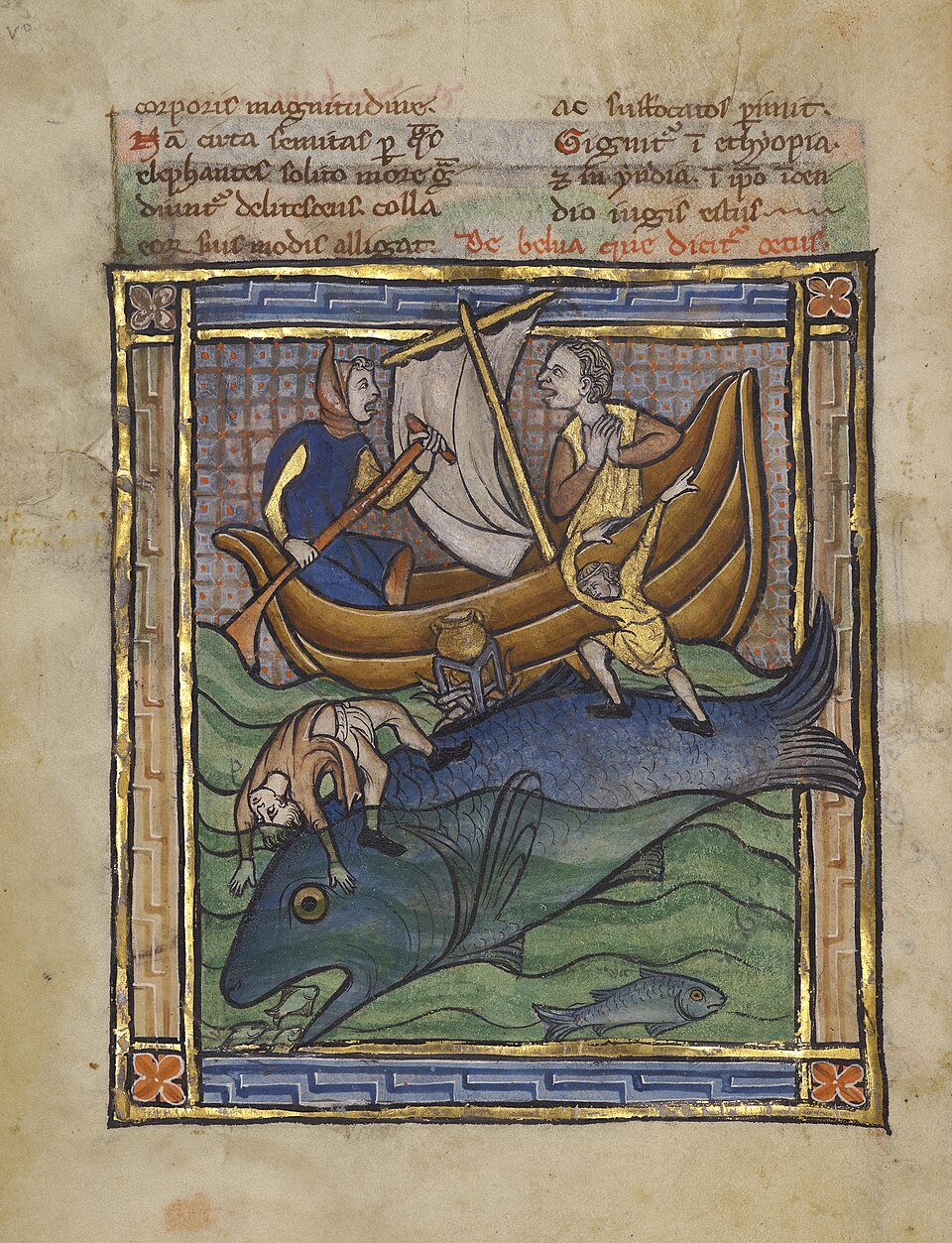
The aspidochelone appears in the Physiologus and later medieval bestiaries. Its false-island story has a striking practical detail: sailors land on what they think is rock, light a cooking fire, and the creature dives. A second motif gives the whale a sweet smell that draws small fish into its mouth. The animal is portrayed variously as a whale, great fish or shield-backed creature; the Pathfinder version is a particular modern game interpretation, not the only traditional description.
For the historical account and manuscript variants, consult the Medieval Bestiary account of the whale and the Latin second-family bestiary text. The creature’s behaviour on this page is campaign material; it is not a claim that one manuscript establishes a real animal’s habits.
Related Creatures and Sea Routes
For other dangers beneath a ship, compare the intelligent kraken and the fast-moving sea serpent. The Deep Singer Whale is another extraordinary ocean whale, but is not the aspidochelone’s drifting false island. Return to the Magical Beasts index or the full World Bestiary to explore related creatures.
For ships, routes and maritime hazards, use the Oceans guide. The Pathfinder 1e aquatic terrain and underwater combat rules help adjudicate characters caught in its dive in that edition; use the selected D&D edition’s own underwater movement and suffocation rules instead for 2024 or 2014 play.
Sources and Licensing
Original Pathfinder rules: The Pathfinder 1e stat block is from Pathfinder #27: What Lies in Dust, p. 78 (Paizo Publishing, 2009), archived at Archives of Nethys. The D&D 2024, D&D 2014 and D&D 3.5e game conversions on this page are original unofficial adaptations; they are not Paizo or Wizards of the Coast releases. Medieval lore is cited in the folklore section. The boat photograph is retained as a seafaring illustration, not a purported drawing of the monster.
D&D 2024: SRD 5.2.1 material is available under Creative Commons Attribution 4.0 via D&D Beyond. The new monster design is unofficial. Open Game Content: The original PF1e and 3.5e game mechanics are identified as Open Game Content under the OGL 1.0a, except for any Product Identity, original campaign setting lore, illustrations and trademarks. The 2024 SRD material is separately CC BY 4.0; 2014 edition mechanics are presented here as an original adaptation using applicable open mechanics.
Open Game License v1.0a and Section 15 notices
OPEN GAME LICENSE Version 1.0a
The following text is the property of Wizards of the Coast, Inc. and is Copyright 2000 Wizards of the Coast, Inc (“Wizards”). All Rights Reserved.
1. Definitions: (a) “Contributors” means the copyright and/or trademark owners who have contributed Open Game Content; (b) “Derivative Material” means copyrighted material including derivative works and translations (including into other computer languages), potation, modification, correction, addition, extension, upgrade, improvement, compilation, abridgment or other form in which an existing work may be recast, transformed or adapted; (c) “Distribute” means to reproduce, license, rent, lease, sell, broadcast, publicly display, transmit or otherwise distribute; (d) “Open Game Content” means the game mechanic and includes the methods, procedures, processes and routines to the extent such content does not embody the Product Identity and is an enhancement over the prior art and any additional content clearly identified as Open Game Content by the Contributor, and means any work covered by this License, including translations and derivative works under copyright law, but specifically excludes Product Identity; (e) “Product Identity” means product and product line names, logos and identifying marks including trade dress; artifacts; creatures characters; stories, storylines, plots, thematic elements, dialogue, incidents, language, artwork, symbols, designs, depictions, likenesses, formats, poses, concepts, themes and graphic, photographic and other visual or audio representations; names and descriptions of characters, spells, enchantments, personalities, teams, personas, likenesses and special abilities; places, locations, environments, creatures, equipment, magical or supernatural abilities or effects, logos, symbols, or graphic designs; and any other trademark or registered trademark clearly identified as Product identity by the owner of the Product Identity, and which specifically excludes the Open Game Content; (f) “Trademark” means the logos, names, mark, sign, motto, designs that are used by a Contributor to identify itself or its products or the associated products contributed to the Open Game License by the Contributor; (g) “Use”, “Used” or “Using” means to use, Distribute, copy, edit, format, modify, translate and otherwise create Derivative Material of Open Game Content; (h) “You” or “Your” means the licensee in terms of this agreement.
2. The License: This License applies to any Open Game Content that contains a notice indicating that the Open Game Content may only be Used under and in terms of this License. You must affix such a notice to any Open Game Content that you Use. No terms may be added to or subtracted from this License except as described by the License itself. No other terms or conditions may be applied to any Open Game Content distributed using this License.
3. Offer and Acceptance: By Using the Open Game Content You indicate Your acceptance of the terms of this License.
4. Grant and Consideration: In consideration for agreeing to use this License, the Contributors grant You a perpetual, worldwide, royalty-free, non-exclusive license with the exact terms of this License to Use, the Open Game Content.
5. Representation of Authority to Contribute: If You are contributing original material as Open Game Content, You represent that Your Contributions are Your original creation and/or You have sufficient rights to grant the rights conveyed by this License.
6. Notice of License Copyright: You must update the COPYRIGHT NOTICE portion of this License to include the exact text of the COPYRIGHT NOTICE of any Open Game Content You are copying, modifying or distributing, and You must add the title, the copyright date, and the copyright holder’s name to the COPYRIGHT NOTICE of any original Open Game Content you Distribute.
7. Use of Product Identity: You agree not to Use any Product Identity, including as an indication as to compatibility, except as expressly licensed in another, independent Agreement with the owner of each element of that Product Identity.
You agree not to indicate compatibility or co-adaptability with any Trademark or Registered Trademark in conjunction with a work containing Open Game Content except as expressly licensed in another, independent Agreement with the owner of such Trademark or Registered Trademark. The use of any Product Identity in Open Game Content does not constitute a challenge to the ownership of that Product Identity.
The owner of any Product Identity used in Open Game Content shall retain all rights, title and interest in and to that Product Identity.
8. Identification: If you distribute Open Game Content You must clearly indicate which portions of the work that you are distributing are Open Game Content.
9. Updating the License: Wizards or its designated Agents may publish updated versions of this License. You may use any authorized version of this License to copy, modify and distribute any Open Game Content originally distributed under any version of this License.
10. Copy of this License: You MUST include a copy of this License with every copy of the Open Game Content You Distribute.
11. Use of Contributor Credits: You may not market or advertise the Open Game Content using the name of any Contributor unless You have written permission from the Contributor to do so.
12. Inability to Comply: If it is impossible for You to comply with the terms of this License with respect to some or all of the Open Game Content due to statute, judicial order, or governmental regulation then You may not Use any Open Game Material so affected.
13. Termination: This License will terminate automatically if You fail to comply with all terms herein and fail to cure such breach within 30 days of becoming aware of the breach. All sublicenses shall survive the termination of this License.
14. Reformation: If any provision of this License is held to be unenforceable, such provision shall be reformed only to the extent necessary to make it enforceable.
15. COPYRIGHT NOTICE
Open Game License v 1.0a Copyright 2000, Wizards of the Coast, Inc.
System Reference Document. Copyright 2000, Wizards of the Coast, Inc.; Authors Jonathan Tweet, Monte Cook, Skip Williams, based on material by E. Gary Gygax and Dave Arneson.
Pathfinder Roleplaying Game Reference Document. © 2011, Paizo Publishing, LLC; Author: Paizo Publishing, LLC.
Pathfinder Roleplaying Game Core Rulebook. © 2009, Paizo Publishing, LLC; Author: Jason Bulmahn, based on material by Jonathan Tweet, Monte Cook, and Skip Williams.
Pathfinder #27: What Lies in Dust. © 2009, Paizo Publishing, LLC; Author: Michael Kortes.
Aspidochelone, original D&D 2024, D&D 2014 and D&D 3.5e adaptations. © 2026 SpiralWorlds.
END OF LICENSE
Keep this reference growing
If this page helped with your reading or game, you can support its upkeep or explore the curated books.
Explore the Bookshop — epics, classics and stories behind imagined worlds.