
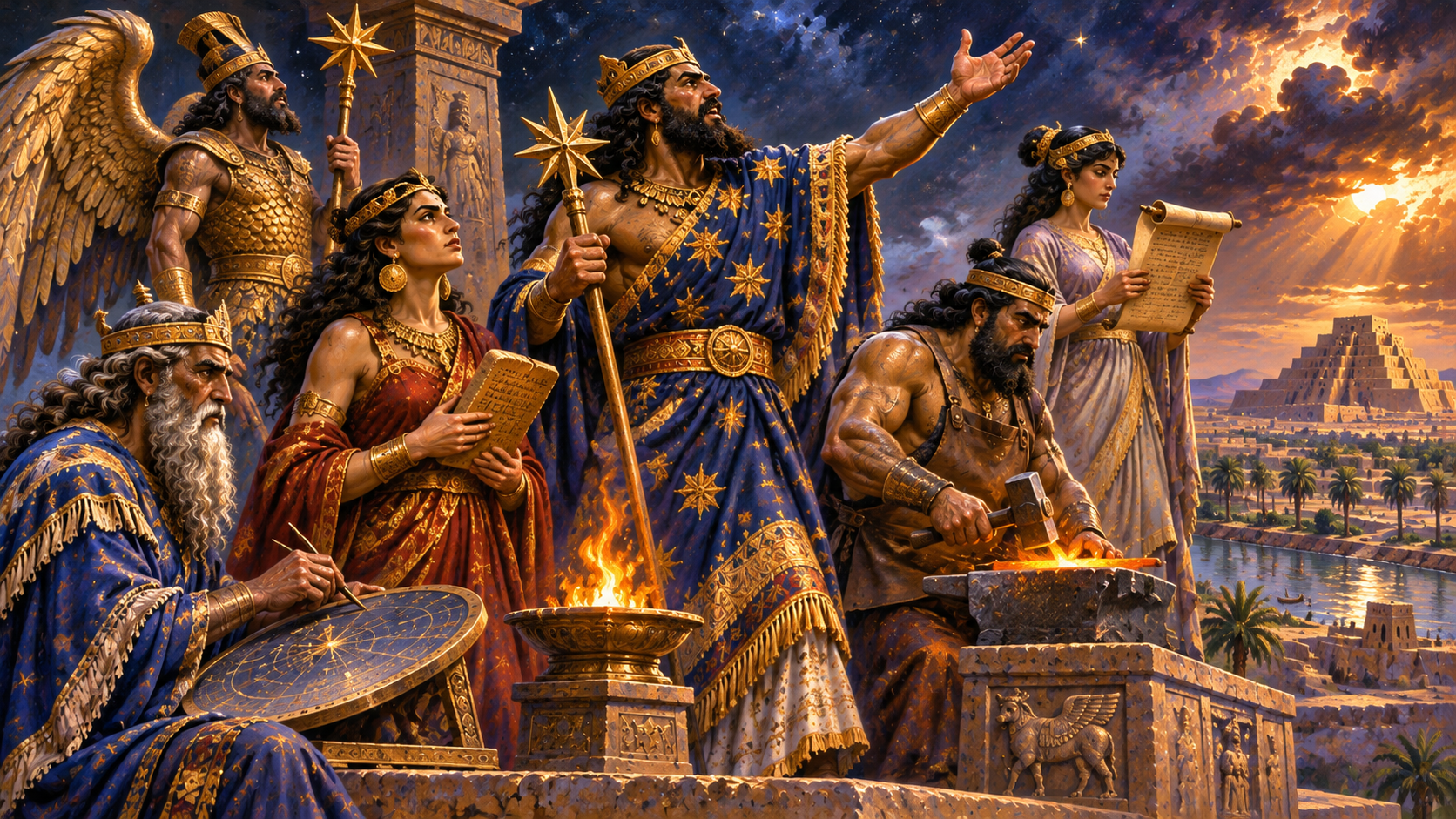
Mesopotamian Pantheon · Divine Powers of the Upper Heavens
At a Glance
| Names | Igigi, Igigu, Igigū |
|---|---|
| Nature | Assembly of divine powers; not a single deity or race of celestials |
| Sphere | Heaven, sacred service, revolt, divine authority and the burden of labour |
| Ancient adversaries | The ruling Anunnaki of the age before humankind |
| Associated deity | Marduk; each god retains its own authority |
| Divine estate | The Hall of Measured Stars |
| Worshippers | Scribes, temple servants, canal keepers, labourers and petitioners who appeal to individual gods |
| Alignment | Varies by deity and allegiance; the host has no single alignment |
| Cleric domains | Determined by the individual divine patron |
| Sign of the host | No common sacred emblem; each god is recognised by its own signs and seals |
Before the first king raised a wall, the gods dug the rivers. Under the command of the mighty Anunnaki, the Igigi laboured until their hands bled and their strength failed. Then the workbaskets burned. Their revolt shook the heavenly order—and changed the fate of mortals forever. The old dispute is not forgotten. In 1454, a clay tablet bearing the terms of divine service has returned to the light, and men are prepared to kill for what it says.
What Is Happening Right Now?
At a half-buried canal shrine outside Babylon, workers discover two copies of an ancient charter. One ends the people’s labour when a breached waterway is repaired. The other commands their descendants to serve the governor without end. Both bear the seal of a heavenly court.
Governor Bel-iddin (lawful evil human noble) orders the shorter charter burned and puts the diggers under guard. Nabû-etir (neutral good human temple scribe), who recognised the forgery, flees with the broken edge of the authentic tablet. Šamhat (chaotic good human canal forewoman) gathers the workers to free the prisoners before dawn. An Igigi Herald descends to secure the remaining evidence. It has authority to protect the tablets and witnesses, but not to execute the governor or pronounce the final judgement.
The characters arrive as the governor’s guards seal the diggings. Nabû-etir has until sunset to reach a place of sanctuary. If the party does nothing, the workers attack the guard compound at midnight, prisoners die in the fighting, and the false charter becomes law by force.
The Igigi — The Once-Burdened Gods
The Igigi are the divine host remembered for the revolt of the working gods. Their struggle against the great Anunnaki began with the making of waterways, the labour upon which the first ordered lands depended. After the rebellion, humanity took up the work the gods had refused. Every canal, field and temple granary still bears the mark of that ancient bargain.
The host does not speak with one voice. Some heavenly powers regard service as the price of cosmic order; others remember the injustice of a labour that could never end. Their alliances alter with the interests of their individual courts. Marduk stands among the powers associated with the Igigi, but the lord of Babylon does not command every god who bears the name. No single priest, messenger or mortal ruler can bind the entire host with one seal.
In their celestial aspect the Igigi hold dominion in the high courts and among the stars. Their servants travel between sanctuaries, archives and gates of judgement. The host itself is divine: the winged Igigi Heralds are created messengers in its service, not gods of the assembly.
The Anunnaki and the Broken Obligation
In the oldest account, seven great Anunnaki impose labour upon the Igigi. In the later order of heaven and the realms below, the names of the divine hosts are not used in precisely the same way. The gods remember both orders, and their rival claims endure. A petitioner seeking redress from one heavenly patron can therefore receive a very different answer from another.
The Igigi do not grant release from all duty. Their oldest law forbids an obligation without an end or a lawful means of fulfilment. That principle is fiercely contested by rulers who prefer the authority of the Anunnaki. It is the foundation of the dispute now unfolding at the canal shrine.
The Night of Burning Baskets
When the labour of the gods became unbearable, the Igigi cast down their digging tools, set fire to the workbaskets and gathered before the residence of Enlil. Fire ran along the banks of the canals; the digging ceased. The threatened divine order could neither punish every worker nor abandon the waters that sustained creation.
The high gods resolved the crisis by bringing human beings into the world to assume the burden. Thus mortal work became entwined with sacrifice, prosperity and obligation. The flood tales and the old disputes over how much the gods may demand of humanity grew from the same troubled age.
The rite of the burned basket survives in secret. A supplicant places a basket of reeds beside a sealed clay record and lights a single cord, leaving the basket intact. A flame that rises blue is accepted as a call for a hearing in the Hall of Measured Stars. A red flame marks a challenged petition. A black flame means a divine officer has already sealed the matter; the petitioner must find new evidence before the case can be heard.
Divine Powers and Rival Claims
Marduk — Lord of Babylon. His name carries immense weight in the upper courts. His priests demand careful proof and will protect a city before they protect its governor. Marduk’s favour cannot be claimed merely by invoking the Igigi.
Enlil — Keeper of the Decree. The old rebellion came to his gates. His servants defend the necessity of work, lawful hierarchy and the maintenance of the waterways. They will hear a just petition but despise disorder dressed as liberty.
Anšar — Elder of the First Heavens. The primordial power stands beyond the quarrels of mortal magistrates. An appeal to his court carries grave consequences, for an ancient judgement can unsettle the titles of gods as readily as those of kings.
The Igigi Heralds. Celestial witnesses carry sealed summons and protect records placed in their custody. Each herald serves a particular commission; a forged order can misdirect one, but a proven forgery breaks its obligation.
The Hall of Measured Stars
Above the mortal heavens stands the Hall of Measured Stars, an immense court of lapis columns, bronze gates and suspended tablets that turn slowly among constellations. Its floors reflect the courses of the Tigris and Euphrates. Every oath sworn upon its central dais leaves a line of fire in the stone until the obligation is fulfilled or lawfully dissolved.
The Gate of Seven Weights. The entrance opens for a bearer of original evidence, a sworn witness or a herald under valid commission. Armed petitioners may enter, but weapons that draw blood within the gate are held motionless until the judge releases them.
The Archive of River Names. Tablets preserved here record ancient grants and the boundaries of divine service. The first version of the canal charter lies among these records. A false copy has no weight in the archive, but stealing a genuine tablet is a crime against the court.
The Chamber of the Unfinished Task. Those who have sworn impossible service hear the sound of digging beyond its walls. A magistrate here may free an honest debtor, demand restitution from a deceiver or condemn a tyrant to repair the damage caused by his own order.
The Hall is not a refuge for the wicked merely because they know the correct rite. The gods who sit in judgement have their own alignments, rivalries and obligations. A lawful judge may enforce a harsh bargain; a merciful one may overturn it. Neither verdict is guaranteed by the wording of a prayer.
Shrines, Petitioners and Divine Favour
Worship of the Igigi is offered through individual gods rather than through a single universal priesthood. Scribes preserve petitions on clay. Canal workers leave clean water, grain and reed baskets at minor shrines. Oaths are recited before witnesses; a broken tablet is never repaired in secret, for the fracture records the history of the agreement.
Favour. A petitioner who returns stolen evidence, spares a helpless witness or fulfils a difficult duty may receive safe passage through a heavenly gate, sanctuary at an allied shrine or a truthful omen from a patron’s priest. Such gifts are bestowed by the god or its authorised servant; they are not automatic abilities belonging to every worshipper.
Disfavour. Forgery of divine seals, the enslavement of descendants under a false oath and the destruction of lawful testimony provoke the host’s scrutiny. The most common punishment is restitution. Those who refuse can be denied the protection of the court and summoned before the very powers they claim to serve.
The Two Tablets — A Ready Adventure
Opening scene: A guard strikes a canal worker beside a newly excavated shrine. She is trying to carry a clay fragment to Nabû-etir. The characters can stop the beating, follow the guard captain or protect the fragment without revealing themselves.
What the DM Knows
Bel-iddin ordered the forgery. He had the final lines of the shorter charter copied onto a new tablet, replacing a limited duty with hereditary service. He could not alter the original because its last edge was missing when the excavation began. Nabû-etir recovered that edge and recognised the different clay, firing and hand.
The heavenly seal is genuine. A corrupt temple official impressed the counterfeit tablet with a stolen seal. The Igigi Herald detects no fault in the seal itself. Only the matched fracture and the Archive of River Names establish which text carries the true terms.
The missing witness lives. Nabû-etir hides in a dry cistern beneath the old sluice. At dusk he sends a child with a reed basket tied in blue thread to find Šamhat. He will surrender the fragment only to someone who promises to protect the workers after the hearing.
Running the Adventure
- The Guarded Digging. The party secures the broken tablet edge, questions the workers or gains entry through the abandoned sluice. A captured guard knows the governor ordered all fragments taken to his house.
- The Witness at Dusk. Find Nabû-etir before the governor’s men. He identifies the exact line altered in the forged charter and names the temple officer who used the seal.
- The Heavenly Petition. Bring the authentic fragment, a living witness and the contested tablet to the Hall of Measured Stars, or confront the temple official publicly and force the evidence into the hands of an authorised herald.
- The Verdict. The court recognises that the original duty ended when the canal was restored. Bel-iddin must return wages and captives; the workers must still keep the waterway clear by agreement, not hereditary bondage.
Consequences
Evidence preserved: the guards withdraw, the prisoners are released and Šamhat becomes keeper of the restored canal. A grateful patron grants the party one audience in the Hall without the customary offering.
Governor exposed but evidence lost: Bel-iddin falls, yet rival claimants contest the canal. The workers win their freedom but must defend their new charter against another lord.
Forgery accepted: the compulsory labour begins. An Igigi Herald returns after seven nights with a summons for those who knowingly suppressed the truth. The governor gains temporary power and a dangerous enemy in heaven.
Divine Powers and Clerics
Cleric of a Heavenly Patron — D&D 2024
Divine patron: Choose an individual deity. The Igigi are an assembly, not a single creature with a Challenge Rating, and the host grants no shared class feature. Use the published Cleric class and a subclass suitable to the patron’s outlook: Life, Light, Trickery or War.
Domain spells: Use the exact Domain Spells and features of the chosen subclass. The following are thematic Cleric spell choices for divination, testimony and travel; they are not bonus prepared spells or a new subclass spell list.
| Level | Spell |
|---|---|
| 1st | Sanctuary |
| 2nd | Augury |
| 3rd | Clairvoyance |
| 4th | Divination |
| 5th | Scrying |
| 6th | True Seeing |
| 7th | Plane Shift |
| 8th | Control Weather |
| 9th | Gate |
The Two Tablets — Checks and Evidence
At the ruined shrine. A DC 15 Intelligence (Investigation) check identifies a different firing mark and clay composition on the forged tablet. A DC 15 Intelligence (History) check recognises that its final line uses a later formula of royal service. A character who compares both tablets and the recovered fragment discovers the mismatch without a check.
Find the scribe. A DC 15 Wisdom (Survival) check follows footprints through the old sluice, or a DC 15 Charisma (Persuasion) check convinces the frightened child to identify Nabû-etir’s hiding place. Failure costs an hour and brings the governor’s guards closer; it never destroys the clue.
Before the heavenly court. A DC 15 Wisdom (Insight) check exposes the temple official’s rehearsed testimony. Presenting the authentic fragment and Nabû-etir’s statement proves the forgery regardless of checks. Zone of Truth has only its published effects; a truthful claim need not be complete. For a confrontation, use an appropriately scaled guard encounter. A herald does not attack merely because the petitioners lose a check.
Rules: 2024 Cleric class and published spell descriptions.
Cleric of a Heavenly Patron — D&D 2014
Divine patron: Choose one deity whose service the character accepts. Knowledge, Light, Tempest or War can suit different patrons; these are separate published domains, not a new universal Igigi domain.
Domain spells: Prepare spells using the normal Cleric rules and gain actual Domain Spells from the selected published subclass. The following examples are thematic Cleric spells, not an additional Domain Spell feature.
| Level | Spell |
|---|---|
| 1st | Sanctuary |
| 2nd | Augury |
| 3rd | Clairvoyance |
| 4th | Divination |
| 5th | Scrying |
| 6th | True Seeing |
| 7th | Plane Shift |
| 8th | Control Weather |
| 9th | Gate |
The Two Tablets — Checks and Evidence
At the ruined shrine. A DC 15 Intelligence (Investigation) check detects new clay along the forged tablet’s final lines; a DC 15 Intelligence (History) check identifies an anachronistic royal title. Fitting the genuine fragment against the charter gives conclusive physical evidence, with no check required.
Find the scribe. A DC 15 Wisdom (Survival) check follows the sluice trail, or DC 15 Charisma (Persuasion) persuades a child to reveal Nabû-etir’s refuge. On failure, a patrol reaches the old sluice first; the characters can still intercept it or negotiate.
Before the heavenly court. DC 15 Wisdom (Insight) detects the temple official’s rehearsed account. A matching tablet fragment and sworn witness settle the question of forgery. Use ordinary guard statistics for the governor’s soldiers and scale their number to the party. No extra cleric power or lair action is granted by participation in the hearing.
Rules: 2014 Cleric class and its published divine domains.
Cleric of a Heavenly Patron — Pathfinder 1e
Alignment and domains: A cleric selects an individual deity and two domains permitted by that deity, observing the deity’s and class’s alignment restrictions. Air, Knowledge, Law, Liberation or Protection fit different patrons; a cleric does not gain all of them.
Knowledge Domain granted powers: All Knowledge skills become class skills. Lore Keeper (Sp) allows a touch attack to learn a creature’s abilities and weaknesses as a Knowledge check at 15 + Cleric level + Wisdom modifier. From 6th level, Remote Viewing (Sp) functions as clairaudience/clairvoyance for a total number of rounds per day equal to Cleric level. Use the published restrictions and action rules.
Knowledge Domain Spells
| Level | Spell |
|---|---|
| 1st | Comprehend Languages |
| 2nd | Detect Thoughts |
| 3rd | Speak with Dead |
| 4th | Divination |
| 5th | True Seeing |
| 6th | Find the Path |
| 7th | Legend Lore |
| 8th | Discern Location |
| 9th | Foresight |
The Knowledge Domain serves a patron of records and testimony; it is not bestowed by the Igigi as a whole. Other patrons grant their own published domain powers, slots and spells.
The Two Tablets — Checks and Evidence
At the ruined shrine. DC 20 Linguistics deciphers the damaged clause; detecting the deliberate forgery uses opposed Linguistics checks as normal. DC 15 Knowledge (history) places the newer royal title in its proper period. Matching the surviving fragment to the true tablet proves the replacement without a check.
Find the scribe. DC 20 Survival follows Nabû-etir’s tracks through the dry sluice, or DC 20 Diplomacy convinces the child to help. Failure alerts a patrol, but the party can still recover the witness.
Before the heavenly court. Sense Motive opposes the official’s Bluff when he lies. Presenting the genuine fragment and sworn testimony establishes the forgery even if the official succeeds on that opposed check. Resolve any combat using the appropriate published NPC and guard statistics for the party’s level.
Rules: Pathfinder 1e Knowledge Domain and Cleric class.
Cleric of a Heavenly Patron — D&D 3.5e
Alignment and domains: Choose a single deity and two of its permitted domains, observing the usual alignment restrictions. Air, Knowledge, Law or Protection can suit different divine patrons. There is no collective Igigi creature stat block or special bonus spellcasting progression.
Knowledge Domain granted power: Add all Knowledge skills to the cleric class skill list. The cleric casts divination spells at +1 caster level.
Knowledge Domain Spells
| Level | Spell |
|---|---|
| 1st | Detect Secret Doors |
| 2nd | Detect Thoughts |
| 3rd | Clairaudience/Clairvoyance |
| 4th | Divination |
| 5th | True Seeing |
| 6th | Find the Path |
| 7th | Legend Lore |
| 8th | Discern Location |
| 9th | Foresight |
Use the normal Cleric class rules for prepared domain slots, granted powers, spell components and spellcasting. Other domains use their own published 1st–9th-level lists. The host bestows no extra (Su), (Sp) or lair abilities upon its worshippers.
The Two Tablets — Checks and Evidence
At the ruined shrine. DC 20 Decipher Script recovers the damaged clause; use the published opposed Forgery checks to identify the counterfeit when both hands can be compared. DC 15 Knowledge (history) recognises the later royal title. A physical match between the broken fragment and genuine charter proves the substitution without a check.
Find the scribe. A ranger or character with the Track feat can follow the difficult sluice trail with a DC 20 Survival check. Anyone can locate the initial footprints with Search, or persuade the frightened witness to help with DC 20 Diplomacy. Failure costs time and risks meeting a patrol, not the permanent loss of the clue.
Before the heavenly court. Sense Motive opposes the official’s Bluff. The judge still accepts authentic evidence if the characters fail that check. Resolve any fighting with guards appropriate to the party’s level; an Igigi Herald acts according to its separate creature entry.
Rules: D&D 3.5e Cleric Domains and Cleric class.
Further Lore
For the powers of the Two Rivers, visit the Mesopotamian Pantheon. The courts of Marduk, Enlil and Anšar each hold a different claim on the old order. The Igigi Herald serves as a witness and guardian when a divine case enters mortal hands.
Sources and Licensing
The rebellion and divine labour draw upon the Akkadian Atraḫasis narrative and scholarship on the Igigi. Sources: ORACC, Igigi/Igigu; ORACC, Anunna; The Epic of Atraḥasis; Pierre Villard, Anunnaki and Igigi (2023). Ancient texts differ on membership and classification; Marduk is securely associated in the surviving royal tradition. The Hall of Measured Stars, the burned-basket petition rite, Bel-iddin, Nabû-etir, Šamhat, and the adventure in 1454 are original fantasy setting material, not claims about ancient history. The image is an original fantasy depiction, not an attested Mesopotamian portrait. Game rules in the edition panels refer to the published rules cited within each panel.
Keep this reference growing
If this page helped with your reading or game, you can support its upkeep or explore the curated books.
Explore the Bookshop — epics, classics and stories behind imagined worlds.