
Atar — Sacred Fire of the Persian Pantheon
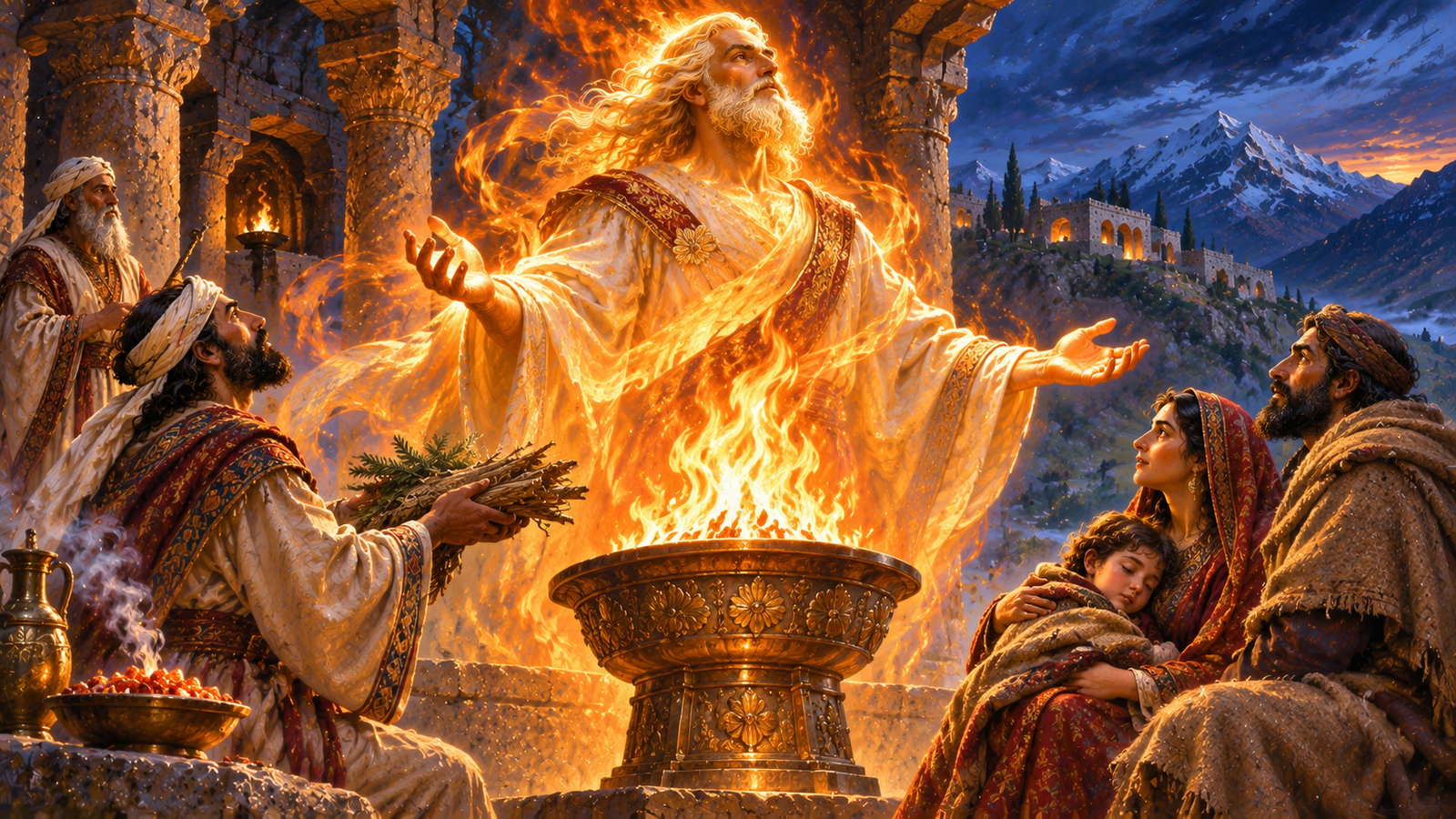
The sanctuary fire is nearly out. Outside, frightened families wait for bread; inside, a priest holds the last dry branch.
Someone has stolen the clean fuel, the winter roads are blocked, and the governor’s soldiers are demanding that the remaining wood be given to them. As night falls, the fire suddenly leans toward the children huddled by the doorway instead of the mailed men arguing beside it. A faint figure of light stands inside the flame, extending a hand. Atar has not come to burn down the city. He has come to ask who will keep its people warm.
The sacred fire is an ally that requires care. In this world, Atar may manifest in a household hearth, a priest’s altar or the fire carried carefully through hostile territory. The strength of an entire community can depend on whether its flame survives one night.
At a Glance
- Name
- Atar (Avestan Ātar; later Ādur, Ātaš)
- Nature
- Yazata of consecrated fire and the holy hearth
- Ethos
- Lawful Good in this campaign: faithful stewardship, shelter and resistance to the Lie
- Relationships
- Fire of Ahura Mazda, closely associated with Asha Vahishta; distinct from Hvare Khshaeta, the Sun
- Portfolio
- Purity of fire, warmth, honest ritual, hearths, watchfulness and the preservation of community
- Realm
- The Hall of the Unfailing Hearth, within Garōdmān in the Celestial Realms
- Sacred signs
- Clear smokeless flame, clean wood, light reflected on copper, embers guarded in peril
- Opposition
- Angra Mainyu, pollution, destruction of sacred places, those who exploit famine
- Domains
- D&D 2024/2014: Light; Pathfinder 1e: Fire and Good; D&D 3.5e: Fire and Good
- Favoured offerings
- Clean fuel and patient service; restoration for those whose hearth has been stolen

The Fire Who Lives Among the People
Atar is both the divine presence in fire and the fire that serves people in daily life. The Avestan name Ātar survives in later words for fire; across Iranian tradition it can mean the warmth of a household hearth, the ritually maintained flame, and the light that accompanies truth. A fire is not sacred because someone paints a monster’s face in its smoke. Its sanctity lies in the care devoted to it, the offering properly made, and the good it sustains.
In the fire lit for a new household, Atar is a helper. He cooks bread, warms the sick and gives light after sunset. He also imposes responsibilities: worshippers must guard a clean flame, tend it regularly and avoid careless defilement. Later temple practice developed a hierarchy of sacred fires and rules for their enthronement, while household veneration is much older. The two must not be falsely portrayed as an identical, unchanged rite from the beginning of Iranian religion.
Five Kinds of Fire
The later tradition recognises five sacred fires: Bərəzi-savaŋha (the highly beneficial fire), Vohu-fryāna (associated with life in human beings), Urvāzišta (associated with plant life), Vāzišta (lightning), and Spəništa (the holiest fire). Their explanations vary between Middle Persian texts. A GM can use the five as five different encounters or signs of Atar without insisting every ancient priest understood them identically.
Atar is not interchangeable with Asha Vahishta. Asha Vahishta embodies Best Truth and right order and is particularly associated with fire; Atar is the living sacred flame itself, tended by hands that may be ordinary, weary or wounded. Nor is he merely the Sun under another name. His presence can burn beneath a roof on a lightless winter night.
Victorious Fire and the Old Foes
Grand temple fires can have a warrior character. Swords and maces once accompanied the installation of a great fire, symbolic of its struggle against the Lie. In the campaign, a sacred coal carried past a battlefield may protect those who keep their oaths. Angra Mainyu seeks to make people treat fire as a weapon of terror, or to provoke a desperate household into profaning its own hearth. Atar counters this with enduring service rather than an appetite for conquest.
What Is Happening in 1454?
On the caravan roads of the Iranian plateau, the great dynasties are remembered through the fires they guarded. In Yazd and Kerman, small communities preserve an older religious life while rulers change around them. Some sacred flames survive in humble chambers, protected from intruders by vigilance rather than grand walls. This campaign makes that survival a practical problem: fuel has a cost, supplies can be stolen, and those fleeing raiders need shelter.
The keeper of a roadside fire can be a powerful ally for adventurers. A shelter may offer hospitality to travellers who refuse to exploit their hosts. A village may choose between a safe sealed room for the fire and space to house ten displaced families. The choice matters because Atar does not demand that the needy die to preserve the appearance of piety.
Clergy and Daily Duties
Fire-keepers clean their sanctuaries, prepare wood, guard the flame and recite prayers. Households maintain hearths as their means permit. Artisans bring damaged tools for repair rather than leaving warm rooms without a means of making food. Benefactors purchase fuel for those unable to afford it. The historical role of the priesthood is respected; the campaign’s named keepers, miracles and relics are inventions.
Followers may be lawful good, neutral good, lawful neutral or of other alignments. Atar’s own ideal is not automatically achieved by his priests. A hard-hearted priest may protect every ceremonial utensil but refuse bread to the hungry; a sceptical traveller who saves a winter family may perform the more faithful act.
The Hall of the Unfailing Hearth
Within the Celestial Realms, Atar’s estate opens from Garōdmān, the House of Song. The hall has no throne above its guests: the central hearth warms every person who approaches without malice. Bowls are shared around long tables; the embers glow through walls of polished copper, and sparks carry memories of kind deeds across the ceiling like constellations.
Atar hears people who have tended an overlooked home, carried embers through a storm or put out a needless blaze before it reached a village. Those who come demanding fire to torment prisoners find only cold ashes in their hands. The hall’s guardians will explain how a deed might be repaired but will not promise immunity from consequences.
Estate and Regional Effects
Within the hall, an unattended cooking fire never spreads to harm guests or buildings; deliberate use of fire against an innocent instead causes the flame to gutter. A traveller who confesses a harm may be shown the face of someone who can receive restitution, without compelling either party to forgive.
Within six miles of a consecrated sanctuary, a keeper may find that clean, properly sheltered coals hold warmth for an extra night. Smoke from deliberate arson may turn briefly against the arsonist’s path, making pursuit possible without proving guilt. These are original setting effects, not historical claims about Iranian fire rituals.
Three Adventures of the Living Flame
The Ember That Must Not Die — Yazd
Atashban Daryush has sheltered a flame through three generations, but a merchant has taken all the clean cedar fuel and sold it to a besieged warlord. His apprentice, Parvaneh, can negotiate with the merchant if she can reach his caravan before nightfall. The characters may escort her, buy back the fuel, or move the ember to a safer refuge while a false priest insists that moving it is sacrilege. Success: displaced families find warmth and a genuine keeper survives. Failure: the sacred flame is lost in the panic and the village turns on its own refugees.
The Fourth Hearth — Near Kerman
Three homes are warm, yet a fourth household lies frozen despite a bright stove. The missing son was accused of stealing a sacred coal, but the real culprit is an agent of a provincial tax collector who wants the family’s forge. The stove’s fire is a magical decoy concealing a winter-spirit in the chimney. The party must identify the theft, expose the collector and restore a functioning hearth, rather than simply defeating the spirit. Success: the forge reopens and the child is cleared. Failure: the cold spreads through the quarter.
The Fire of the Fallen Standard — Khorasan
A warband carries an ember from a once-famous dynastic fire as a sign that its captain may seize the road tolls. The ember is real, but the claim of divine permission is false. An injured courier, Simin, carries the route of a monastery that has offered shelter to the warband’s former victims. The characters must decide whether to persuade the soldiers to surrender the coal, protect its carrier from a rival raider group, or transport it to safe guardianship before a battle. Success: the captives return home and the old fire is entrusted to conscientious keepers. Failure: the banner becomes a justification for new violence.
Atar in Four Rules Editions
These four interpretations describe a chosen manifestation. The sacred fire does not cease to exist when a combat form withdraws or is defeated. Each edition has its own action timing, defences, attacks and personal spellcasting.
Atar — Manifestation of the Sacred Fire
Huge Celestial (Deity), Lawful Good
AC 27 (flame-woven panoply); Initiative +17 (27); HP 592 (32d12 + 384); Speed 40 ft., Fly 80 ft. (Hover)
| STR | DEX | CON | INT | WIS | CHA |
|---|---|---|---|---|---|
| 28 (+9) | 24 (+7) | 34 (+12) | 30 (+10) | 36 (+13) | 32 (+11) |
Saving Throws Str +19, Dex +17, Con +22, Int +20, Wis +23, Cha +21; Skills Insight +23, Perception +23, Religion +20; Resistances Cold, Lightning, Radiant; Immunities Fire, Poison; Condition Immunities Charmed, Frightened, Poisoned; Senses Truesight 180 ft., Passive Perception 33; Languages all languages known to its supplicants; Telepathy 180 ft.; CR 32 (unofficial epic extrapolation, unplaytested; XP unassigned); PB +10 (unofficial extrapolation).
Legendary Resistance (4/Day). If the manifestation fails a saving throw, it can choose to succeed instead. Magic Resistance. The manifestation has Advantage on saving throws against spells and magical effects. Unburning Shelter. Friendly creatures of its choice in a 30-foot Emanation have Resistance to Fire damage and ignore ordinary environmental cold while the manifestation is not Incapacitated.
Actions
Multiattack. The manifestation makes three Hearthbrand attacks. Hearthbrand. Melee Attack Roll: +19, reach 15 ft., one target. Hit: 31 (4d10 + 9) Fire damage plus 18 (4d8) Radiant damage. Light Against Ruin (Recharge 5–6). Each hostile creature of the manifestation’s choice in a 60-foot Emanation makes a DC 31 Constitution saving throw, taking 88 (16d10) Radiant damage on a failed save or half as much on success. For each creature that fails, magical Darkness it created within the Emanation ends if the Darkness was produced by a spell of 7th level or lower.
Bonus Actions
Pass the Flame (3/Day). One willing creature the manifestation sees within 90 feet regains 45 (10d8) Hit Points and ends one of the Frightened or Poisoned conditions on itself.
Reactions
Shield the Hearth. Trigger: a creature the manifestation sees within 60 feet takes Fire damage. Response: reduce that damage by 35 (10d6), and the manifestation takes the prevented amount as Force damage, ignoring Resistance or Immunity.
Legendary Actions
Three Legendary Actions per round, one immediately after another creature’s turn, regained at the start of the manifestation’s turn. Move (1). Fly up to half Speed without provoking Opportunity Attacks. Hearthbrand (2). Make one Hearthbrand attack. Restoring Spark (3). One creature within 90 feet regains 36 (8d8) Hit Points.
Personal Spellcasting
The manifestation casts using Wisdom (spell save DC 31, +23 to hit) as a 20th-level Cleric, independently of its follower’s domain spells. Casting uses the Magic action unless a spell says otherwise; spells require their normal Concentration and components, except that the manifested flame substitutes for any non-costly material components. Slots recover on a Long Rest.
| Spell level (slots) | Personal spells |
|---|---|
| Cantrips (at will) | light, mending, sacred flame, guidance, thaumaturgy |
| 1st (4 slots) | bless, command, cure wounds, sanctuary |
| 2nd (3 slots) | aid, lesser restoration, prayer of healing |
| 3rd (3 slots) | daylight, dispel magic, revivify |
| 4th (3 slots) | death ward, divination, guardian of faith |
| 5th (3 slots) | flame strike, greater restoration, mass cure wounds |
| 6th (2 slots) | heal, true seeing |
| 7th (2 slots) | fire storm, resurrection |
| 8th (1 slot) | holy aura |
| 9th (1 slot) | mass heal |
Encounter counterplay: Atar prioritises rescue. A foe who opens the sanctuary’s doors and brings people out of danger can negotiate a cessation even after fighting begins; cruelty to civilians ends that chance.
Atar — Avatar of the Guarded Hearth
Huge celestial, lawful good
Armor Class 26 (sacred flame); Hit Points 525 (30d12 + 330); Speed 40 ft., fly 80 ft. (hover)
| STR | DEX | CON | INT | WIS | CHA |
|---|---|---|---|---|---|
| 28 (+9) | 22 (+6) | 32 (+11) | 28 (+9) | 34 (+12) | 30 (+10) |
Saving Throws Str +18, Dex +15, Con +20, Int +18, Wis +21, Cha +19; Skills Insight +21, Perception +21, Religion +18; Damage Resistances cold, lightning, radiant; Damage Immunities fire, poison; Condition Immunities charmed, frightened, poisoned; Senses truesight 120 ft., passive Perception 31; Languages all, telepathy 120 ft.; Challenge 31 (unofficial epic extrapolation, unplaytested; XP unassigned); Proficiency Bonus +9 (unofficial).
Legendary Resistance (4/Day). When the avatar fails a saving throw, it may choose to succeed. Magic Resistance. Advantage on saving throws against spells and magical effects. Sheltering Heat. Chosen allies within 30 feet gain resistance to fire damage and cannot suffer ordinary extreme cold while the avatar is conscious.
Actions
Multiattack. The avatar makes three Keeper’s Brand attacks. Keeper’s Brand. Melee Weapon Attack: +18 to hit, reach 15 ft., one target. Hit: 31 (4d10 + 9) fire damage plus 13 (3d8) radiant damage. Truth of the Hearth (Recharge 5–6). Each hostile creature chosen by the avatar within 60 feet must succeed on a DC 29 Constitution saving throw or take 77 (14d10) radiant damage, taking half on a success. A hostile magical darkness spell of 5th level or lower in the area ends.
Bonus Actions
Warmth Returned (3/Day). One creature within 90 feet regains 36 (8d8) hit points and can end the frightened condition on itself.
Reactions
Interposed Coal. When an ally within 60 feet takes fire damage, reduce the damage by 27 (6d8); the avatar takes that damage as force damage without resistance.
Legendary Actions
Three legendary actions, one at the end of another creature’s turn, regained at the beginning of its turn. Move (1). Fly up to half speed. Brand (2). Make one Keeper’s Brand attack. Warmth (3). Heal a creature within 60 feet for 27 (6d8) hit points.
Personal Spellcasting
A 20th-level cleric spellcaster using Wisdom (spell save DC 29, +21 spell attack); the spells below are prepared independently from clerical Light Domain grants. Concentration, slots and normal 2014 casting actions apply. The fire itself is the spellcasting focus. Slots return on a long rest.
| Spell level (slots) | Personal prepared spells |
|---|---|
| Cantrips (at will) | light, mending, sacred flame, guidance, thaumaturgy |
| 1st (4 slots) | bless, command, cure wounds, sanctuary |
| 2nd (3 slots) | aid, lesser restoration, prayer of healing |
| 3rd (3 slots) | daylight, dispel magic, revivify |
| 4th (3 slots) | death ward, divination, guardian of faith |
| 5th (3 slots) | flame strike, greater restoration, mass cure wounds |
| 6th (2 slots) | heal, true seeing |
| 7th (2 slots) | fire storm, resurrection |
| 8th (1 slot) | holy aura |
| 9th (1 slot) | mass heal |
Counterplay: protecting evacuees and restoring a stolen fireholder is a viable resolution; the avatar will not burn a household to punish its master.
Atar, Fire of the Good Creation — CR 30
XP campaign-specific epic encounter; LG Huge outsider (extraplanar, good, lawful); Init +11; Senses darkvision 60 ft., true seeing; Perception +54; Aura Sheltering Hearth (30 ft.)
DEFENSE AC 53, touch 29, flat-footed 45 (–2 size, +7 Dex, +18 natural, +8 deflection, +5 sacred, +6 armor, +1 dodge); hp 527 (34d10 + 340); Fort +28, Ref +33, Will +37 (Reflex and Will good; +5 resistance and Great Fortitude, Lightning Reflexes and Iron Will bonuses); DR 20/epic and evil; Immune fire, poison; Resist cold 30, electricity 30; SR 45.
OFFENSE Speed 40 ft., fly 80 ft. (perfect); Space 15 ft.; Reach 15 ft.; Melee +5 holy flaming heavy mace +48/+43/+38/+33 (2d6+15 bludgeoning plus 1d6 fire plus 2d6 holy plus 4d6 untyped divine heat); Special Attacks Purifying Flame, Guarded Ember.
STATISTICS Str 30, Dex 24, Con 30, Int 30, Wis 32, Cha 30; Base Atk +34; CMB +46; CMD 77 (including +8 deflection, +5 sacred, +1 dodge); Feats Ability Focus (Unquenchable Witness), Combat Casting, Combat Reflexes, Dodge, Empower Spell-Like Ability (flame strike), Great Fortitude, Improved Critical (heavy mace), Improved Initiative, Iron Will, Lightning Reflexes, Mobility, Power Attack, Quicken Spell-Like Ability (wall of fire), Skill Focus (Perception), Skill Focus (Spellcraft), Spell Penetration, Weapon Focus (heavy mace); Skills Appraise +47, Bluff +47, Diplomacy +47, Fly +44, Heal +48, Intimidate +47, Knowledge (arcana) +47, Knowledge (history) +47, Knowledge (local) +47, Knowledge (nature) +47, Knowledge (planes) +47, Knowledge (religion) +47, Perception +54, Sense Motive +48, Spellcraft +53, Use Magic Device +47; Languages Avestan, Old Persian, Celestial, all mortal tongues spoken by witnesses; telepathy 180 ft.
Special Abilities
Sheltering Hearth (Su). Chosen allies within 30 feet gain fire resistance 20 and a +4 sacred bonus on saves against fear; leaving the aura ends both benefits. Purifying Flame (Su, 3/day). As a standard action, Atar targets enemies within a 60-foot-radius burst centred on himself. Each takes 18d8 fire damage and 10d8 untyped divine heat damage, Reflex DC 39 half; fire immunity applies only to the fire portion. The save DC is Charisma-based: 10 + half Hit Dice (17) + Cha 10 + Ability Focus 2. Guarded Ember (Su, 3/day). As an immediate action, Atar intercepts up to 60 points of damage to a willing creature within 30 feet and takes that much damage himself, ignoring his own damage reduction and resistances.
Personal Spell-Like Abilities
Caster level 34th; concentration +44; Charisma-based save DC = 20 + spell level, with no verbal, somatic or material components. Each at-will spell remains subject to its usual casting time, unless an ability says otherwise. These are his own powers, not spells granted to followers.
| Spell level (uses) | Personal spell-like abilities |
|---|---|
| 0 (at will) | light, mending, guidance |
| 1 (at will) | bless, endure elements, protection from evil |
| 2 (at will) | aid, lesser restoration, resist energy |
| 3 (at will) | daylight, dispel magic, prayer |
| 4 (at will) | death ward, restoration, wall of fire |
| 5 (3/day each) | flame strike, hallow, true seeing |
| 6 (3/day each) | heal, greater dispel magic |
| 7 (2/day each) | fire storm, resurrection |
| 8 (1/day each) | holy aura, sunburst |
| 9 (1/day) | miracle (protection or restitution only) |
Follower Domains — Pathfinder 1e
Clerics of Atar may select Fire and Good if aligned appropriately. Fire grants Fire Bolt and scaling resistance; Good grants Touch of Good and Holy Lance. These clerical powers and domain slots do not increase the divine manifestation’s personal repertoire.
| Spell level | Fire | Good |
|---|---|---|
| 1 | burning hands | protection from evil |
| 2 | produce flame | align weapon (good only) |
| 3 | fireball | magic circle against evil |
| 4 | wall of fire | holy smite |
| 5 | fire shield | dispel evil |
| 6 | fire seeds | blade barrier |
| 7 | elemental body IV (fire only) | holy word |
| 8 | incendiary cloud | holy aura |
| 9 | elemental swarm (fire only) | summon monster IX (good only) |
Encounter caution: CR 30 is an original epic approximation, not a playtested official stat block. Fire resistance is strong counterplay against the fire half of Purifying Flame; protecting people and their fuel can resolve the larger scene.
Atar, Divine Manifestation of the Sacred Fire — CR 32, Divine Rank 7
LG Huge outsider (extraplanar, good, lawful); Hit Dice 34d8 + 340 (612 hp, maximised deity Hit Dice); Initiative +18 (+7 Dex, +4 Improved Initiative, +7 divine); Speed 100 ft., fly 280 ft. (perfect); Armor Class 54 (–2 size, +7 Dex, +18 natural, +8 deflection, +6 armour, +7 divine), touch 30, flat-footed 47; Base Attack/Grapple +34/+59; Attack +5 holy flaming heavy mace +55 melee (2d6+15 bludgeoning plus 1d6 fire plus 2d6 holy); Full Attack +55/+50/+45/+40 melee; Space/Reach 15 ft./15 ft.
Special Attacks Purifying Flame, Guarded Ember, spell-like abilities; Special Qualities divine senses, deity immunities, DR 20/epic and evil, fire immunity, resistance cold 30 and electricity 30, SR 46, true seeing; Saves Fort +38, Ref +35, Will +39 (good outsider bases, abilities, divine rank and feat bonuses); Abilities Str 30, Dex 24, Con 30, Int 30, Wis 32, Cha 30.
Skills Concentration +54, Diplomacy +54, Heal +55, Knowledge (history) +54, Knowledge (religion) +54, Listen +58, Sense Motive +55, Spellcraft +54, Spot +58; Feats Ability Focus (Purifying Flame), Great Fortitude, Improved Critical (heavy mace), Improved Initiative, Iron Will, Lightning Reflexes, Power Attack, Quicken Spell-Like Ability (wall of fire), Skill Focus (Listen), Skill Focus (Spot), Spell Penetration, Weapon Focus (heavy mace); Environment Garōdmān; Organization solitary or with hearth-keepers; Challenge Rating 32 (original epic estimate); Treasure none; Alignment lawful good; Advancement —.
Special Abilities
Sheltering Hearth (Su). Chosen allies within 30 ft. gain resist fire 20 and a +4 sacred bonus on saves against fear. Purifying Flame (Su, 3/day). Standard action, chosen enemies within a 60-ft.-radius emanation take 18d8 fire plus 10d8 untyped divine heat (Reflex DC 46 half). Save DC = 10 + half HD (17) + Cha modifier (10) + divine rank (7) + Ability Focus (2). Guarded Ember (Su, 3/day). Immediate action: prevent up to 60 damage to a willing creature within 30 feet and take the prevented amount, bypassing the manifestation’s DR and resistances.
Personal Spell-Like Abilities
Cleric-themed spell-like abilities at caster level 34th; save DC = 10 + spell level + Cha modifier (10) + divine rank (7), and no verbal, somatic or material components. Abilities follow their stated daily use and ordinary casting time unless specifically modified. Domain slots below belong to clerics, not to the divine manifestation.
| Spell level (uses) | Personal spell-like abilities |
|---|---|
| 0 (at will) | light, mending, guidance |
| 1 (at will) | bless, endure elements, protection from evil |
| 2 (at will) | aid, lesser restoration, resist energy |
| 3 (at will) | daylight, dispel magic, prayer |
| 4 (at will) | death ward, restoration, wall of fire |
| 5 (3/day each) | flame strike, hallow, true seeing |
| 6 (3/day each) | heal, greater dispel magic |
| 7 (2/day each) | fire storm, resurrection |
| 8 (1/day each) | holy aura, sunburst |
| 9 (1/day) | miracle (protection or restitution only) |
Follower Domains — D&D 3.5e
Clerics can take Fire and Good if their alignment permits. Fire allows turning water creatures and rebuking fire creatures; Good increases caster level for Good spells by 1. The third-level Fire spell is resist energy, not Pathfinder’s fireball, and the seventh-level Fire spell is fire storm, not Pathfinder’s elemental body IV.
| Spell level | Fire | Good |
|---|---|---|
| 1 | burning hands | protection from evil |
| 2 | produce flame | aid |
| 3 | resist energy (fire or cold only) | magic circle against evil |
| 4 | wall of fire | holy smite |
| 5 | fire shield | dispel evil |
| 6 | fire seeds | blade barrier |
| 7 | fire storm | holy word |
| 8 | incendiary cloud | holy aura |
| 9 | elemental swarm (fire only) | summon monster IX (good only) |
Divine-scale rule: Divine Rank 7 has been included in AC, attack rolls, saves, initiative and relevant checks. The 34 outsider Hit Dice are maximised under the divine rule; the manifestation can withdraw without extinguishing the sacred reality represented by Atar.
Worshippers and the Light Domain
Atar’s priests maintain the sacred flame, keep the hearth from pollution and protect the households whose meals depend upon it. His divine spellcasting belongs to the manifestations above; the following spells belong to mortal clerics. A Light Domain cleric should not be mistaken for a license to burn a city as an act of worship.
D&D 2024 — Light Domain
| Cleric level | Always-prepared spells |
|---|---|
| Cleric 3 | burning hands, faerie fire, scorching ray, see invisibility |
| Cleric 5 | daylight, fireball |
| Cleric 7 | arcane eye, wall of fire |
| Cleric 9 | flame strike, scrying |
Light Domain begins at cleric level 3. Radiance of the Dawn uses Channel Divinity as a Magic action; Warding Flare uses a Reaction. The 2024 7th-level domain grant contains arcane eye, not 2014’s guardian of faith.
D&D 2014 — Light Domain
| Cleric level | Domain spells |
|---|---|
| Cleric 1 | burning hands, faerie fire |
| Cleric 3 | flaming sphere, scorching ray |
| Cleric 5 | daylight, fireball |
| Cleric 7 | guardian of faith, wall of fire |
| Cleric 9 | flame strike, scrying |
Light Domain begins at cleric level 1. Warding Flare is a Reaction; Radiance of the Dawn expends Channel Divinity as an action. The 2014 3rd-level grants are flaming sphere and scorching ray, rather than the 2024 four-spell 3rd-level group.
The Pathfinder 1e and D&D 3.5e panels above each provide the complete Fire and Good domain spell tables, separate from the manifestation’s own repertoire.
The Coal of Winter’s Return
This unique campaign relic is a tiny coal preserved in a sealed bronze lamp. It has passed from household to household through exile. The bearer gains nothing by locking it away; the coal shines brightest when it is used to keep others alive. Its rules are intentionally smaller than the powers of the deity.
Four item interpretations
D&D 2024 — Wondrous Item, Very Rare (Requires Attunement)
The lamp sheds Bright Light for 20 feet and Dim Light for another 20 feet when uncovered. It has 3 charges, regaining 1d3 at dawn. As a Magic action spend 1 charge to cast protection from energy (Fire only, requiring Concentration) on a touched creature, or 2 charges to cast daylight. Once per dawn you may use a Magic action to warm a 15-foot-radius room for 8 hours without igniting anything. This warming has no combat damage effect.
D&D 2014 — Wondrous Item, Very Rare (Requires Attunement)
While uncovered, the lamp sheds bright light 20 feet and dim light for 20 more. It has 3 charges, regaining 1d3 at dawn. As an action expend 1 charge to cast protection from energy (fire only, with concentration), or 2 charges for daylight. Once daily it warms one room for eight hours. Its light can be covered normally.
Pathfinder 1e — Unique Minor Artifact
As a standard action three times daily, the bearer may use resist energy (fire only, caster level 15) on one creature within touch range. Once a day it may create the warmth of an endure elements effect for ten willing creatures in one 15-foot-radius shelter, lasting eight hours. It provides no offensive fire damage; as an artifact, it has no purchase price or normal crafting prerequisites.
D&D 3.5e — Unique Minor Artifact
Three times daily as a standard action the bearer uses resist energy (fire only; caster level 15) on a touched creature. Once daily it provides the noncombat warmth of endure elements to up to ten willing people within a 15-foot-radius room for eight hours. No market price or ordinary crafting method exists.
Allies, Enemies and the Way Home
Ahura Mazda represents the wise source of the good creation, and Asha Vahishta stands for the right order that Atar’s sacred fire reflects. Anahita protects living waters. Their temples and devotees may share an interest in preventing pollution, but they are not manifestations of one interchangeable elemental god.
Sraosha would be a fitting ally in night-watch rituals when that individual page is published; until then, seek him through the Persian Pantheon directory. Under no circumstances should this page link to an unpublished Sraosha URL as if it were live.
Azi Dahaka and corrupted divs belong among the foes who would pollute the good creation. The existing Azi Dahaka entry offers a frightening wider link, but defeating one monster is not the whole purpose of Atar’s sanctuary.
Sources and Licensing
The hearth tradition, historical ritual fires, fivefold classification and later temple-fire practices are grounded in scholarship. The incarnate character design, dialogue, Hall of the Unfailing Hearth, named NPCs, relic and combat statistics are original fantasy adaptations. The painted hero and emblem are modern artwork, not authentic ancient cult images.
Keep this reference growing
If this page helped with your reading or game, you can support its upkeep or explore the curated books.
Explore the Bookshop — epics, classics and stories behind imagined worlds.