
At a Glance
| Identity | Details |
|---|---|
| Name | The Matronae |
| Tradition | Local cults of the Low Countries and Lower Rhine |
| Sacred country | Distinct local sanctuaries across the Lower Rhine and neighbouring lands |
| Divine concerns | Local community, sustenance, ancestry, belonging and the living household |
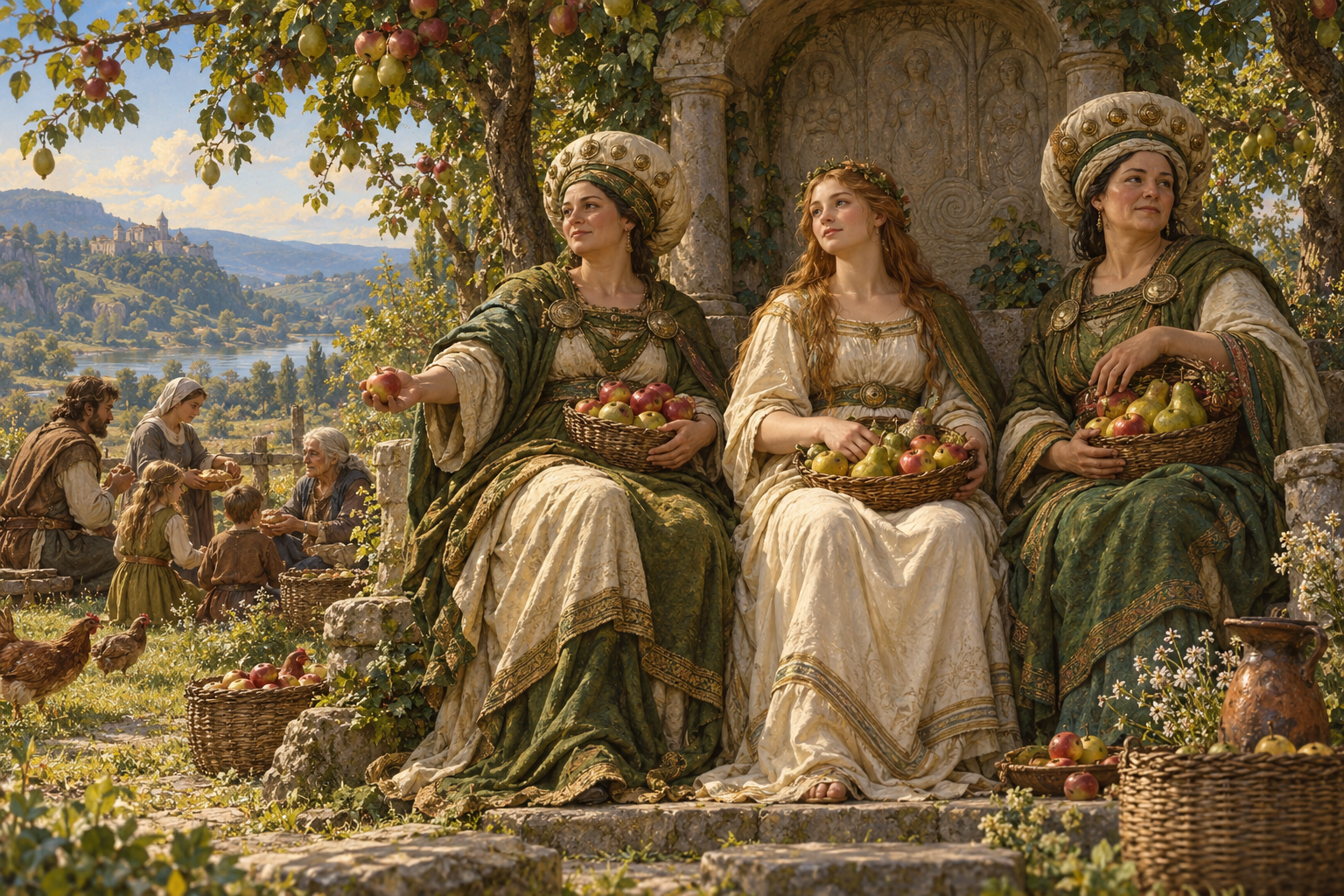
| Recognisable signs | Groups of three seated Mothers, fruit baskets and locally distinctive dress |
| Worshippers | Households, neighbours, carers and communities keeping a particular group’s name |
| Campaign alignment | Neutral Good |
| Domain paths | Healing, Plant |
Three seats stand beneath the orchard roof. Two are occupied when the neighbours arrive; the third Mother is already in the lane helping an old man carry his basket. Each community knows its own Mothers by their names, their dress and the work they expect people to do for one another.
The Matronae beyond the Low Countries: Rhineland sanctuaries honour many locally named groups of three Mothers. Aufaniae and Vacallinehae are recorded regional groups, not single interchangeable names for one universal goddess. Their worship extends into the wider Continental Germanic world, while the present entry remains their single collective reference and retains each local group’s identity.
The Matronae in the Living World
The Matronae are many local groups, not a single universal goddess wearing three faces. A shrine’s epithet matters. The Aufaniae and other named groups belong to particular communities and traditions, with connections that cannot be reduced to one royal family. A traveller asks whose Mothers are honoured before leaving a gift.
At a Lower Rhine orchard shrine, the midwife Trude keeps three clean seats beneath a timber roof. People bring fruit, remember their dead and discuss what the living need. The Mothers who meet them are distinct personalities: one practical and brisk, one quietly watchful, one willing to remember a difficult story in full. Their local names are spoken within the community rather than invented as universal ancient identities.
They protect belonging without making blood descent a test of worth. A foster child, an elderly neighbour and a stranger who stays to care for others can all become part of the household they watch. Sandraudiga’s keepers exchange seed with their shrines; Haeva’s hosts share their concern for a person who has nowhere safe to sleep.
Worship and Sacred Places
A gift of food is divided between the shrine and people who need it. Communities tend trees, visit the sick and speak the names of those who taught them a useful craft. The Mothers dislike an ancestor’s name being used to excuse cruelty. Their campaign gatherings vary by village; no single invented holy day or identical ritual is imposed across the many historically distinct cults.
Meeting The Matronae
A Mother can arrive to help with ordinary work and remain unnoticed until someone asks how she knew an ancestor’s private words. She hears disputes, but will not erase a person’s choice to leave a harmful household. A group seeking intervention must say who has been excluded and what they will do to make room. Her warning is a place setting that remains cold until the missing person is named.
Adventures
The Third Chair
Trude’s shrine has an empty third chair that no one can remember seeing occupied. An adopted child dreams of a woman trapped in the roots of the oldest tree. The party can enter the roots’ buried hall, recover a stolen local name or learn why the community stopped speaking it. Restoring the name renews the triad; forcing the child to leave repeats the harm that broke it.
Fruit from the Dead Orchard
Fruit ripens on a long-dead orchard, each piece carrying a memory of someone buried nearby. A merchant offers to buy the crop before families arrive. The party can arrange a shared remembrance, search the memories for a missing person or investigate why one tree bears only stones. Selling everything loses the memories and leaves the unresolved disappearance to haunt the next harvest.
Divine Presence and Defeat
The visible figure is a manifestation through which the divine power can act among mortals. Its defeat ends that appearance and leaves the local cult without direct intervention for thirty days; it does not kill the god or erase worshippers’ memories. Destroying a shrine can damage a community and close a meeting place, but is not a reliable way to destroy divinity.
An ordinary intervention begins with a warning, a mortal worshipper or the blessing described below. A personal appearance follows when the sanctuary or people within this deity’s care face a danger their own efforts cannot contain. Bargaining, retreat and fulfilling the god’s stated purpose remain possible during an encounter.
Divine Powers and Cleric Traditions
Campaign rules: All manifestation statistics and divine abilities below are original, unofficial and unplaytested. Challenge ratings are provisional encounter estimates, not a measure of the god’s full power. Each edition is self-contained. A creature must be within range and visible where a power requires sight; a power cannot move it into an unsafe or occupied space. Ordinary spell and condition rules apply.
The Matronae — Manifestation
Medium Celestial (Deity), Neutral Good
AC 23 (divine ward); HP 540 (40d8 + 360); Speed 30 ft.; Initiative +6 (16)
| Ability | Score | Modifier | Save |
|---|---|---|---|
| STR | 22 | +6 | +6 |
| DEX | 22 | +6 | +13 |
| CON | 28 | +9 | +16 |
| INT | 26 | +8 | +8 |
| WIS | 30 | +10 | +17 |
| CHA | 28 | +9 | +16 |
Skills Insight +17, Perception +17, Religion +15, Survival +17; Senses Truesight 60 ft., Passive Perception 27; Languages Low German, Middle Dutch, Latin; Telepathy 120 ft.
Resistances Cold, Fire, Lightning; Immunities Poison damage; Charmed, Frightened, Poisoned; Challenge 24 (provisional); Proficiency Bonus +7. Divine comprehension allows communication through Telepathy without granting a universal spoken language.
Traits
Legendary Resistance (3/Day). After failing a saving throw, the manifestation can choose to succeed instead.
Magic Resistance. Advantage on saving throws against spells and other magical effects.
A Local Mother. This sheet represents one Mother, not every Matronae cult or an entire triad. When three Mothers appear together, each has her own Hit Points, turn and resources. At the beginning of an encounter choose her aspect: Bearer adds 10 to healing she grants; Watcher adds 10 to damage she prevents; Rememberer has Advantage on Intelligence checks. Her aspect cannot change during the encounter.
Divine Strikes. The manifestation uses Wisdom for its supernatural attack and power save DC 25. Its strikes are magical. It has no spell slots; its personal repertoire consists of the powers printed here.
Actions
Multiattack. The manifestation makes three The Mother’s Hand attacks.
The Mother’s Hand. Melee Attack Roll: +17, reach 10 ft., one target. Hit: 32 (4d10 + 10) Radiant damage.
The Empty Place Is Filled (3/Day). Up to six willing creatures within 60 feet regain 45 Hit Points each and may immediately end one of the Charmed, Frightened or Poisoned conditions on themselves. Each creature can benefit from this power’s healing only once per day. Any saving throw or escape check in this power has DC 25.
Bonus Actions
A Neighbour’s Strength. One willing creature within 60 feet gains 25 Temporary Hit Points. The Mother may also end the Prone condition on that creature if it chooses.
Reactions
The Watcher’s Hand. When an ally she can see within 30 feet takes damage, she reduces that damage by 25.
Legendary Actions
Legendary Action Uses: 3. After another creature’s turn, the manifestation may expend one use for one option below. It regains all uses at the start of its turn and cannot use more than one option after the same turn.
Advance. Move up to half its Speed without provoking Opportunity Attacks. Divine Strike. Make one The Mother’s Hand attack. Grant Shelter. One willing creature within 30 feet gains 15 Temporary Hit Points. Grant Shelter can be used only once before the manifestation’s next turn.
Clerics and Domain Spells
Life Domain. This is a follower’s subclass, separate from the deity’s personal powers. Use its 2024 features and Cleric progression. The spells below are always prepared when the cleric reaches the stated level; they count as Cleric spells and do not use prepared-spell choices.
| Cleric level | Domain spells |
|---|---|
| 3 | Aid, Bless, Cure Wounds, Lesser Restoration |
| 5 | Mass Healing Word, Revivify |
| 7 | Aura of Life, Death Ward |
| 9 | Greater Restoration, Mass Cure Wounds |
Cleric rules. The holy sign can be a small votive image reflecting this local cult. The deity’s own encounter abilities are not granted to clerics.
The Matronae — Manifestation
Medium Celestial (Deity), Neutral Good
Armor Class 23 (divine ward); Hit Points 540 (40d8 + 360); Speed 30 ft.; Initiative +6
| STR | DEX | CON | INT | WIS | CHA |
|---|---|---|---|---|---|
| 22 (+6) | 22 (+6) | 28 (+9) | 26 (+8) | 30 (+10) | 28 (+9) |
Saving Throws Dex +13, Con +16, Wis +17, Cha +16
Skills Insight +17, Perception +17, Religion +15, Survival +17; Senses Truesight 60 ft., Passive Perception 27; Languages Low German, Middle Dutch, Latin; Telepathy 120 ft.
Resistances Cold, Fire, Lightning; Immunities Poison damage; Charmed, Frightened, Poisoned; Challenge 24 (provisional); Proficiency Bonus +7. Divine comprehension allows communication through Telepathy without granting a universal spoken language.
Traits
Legendary Resistance (3/Day). After failing a saving throw, the manifestation can choose to succeed instead.
Magic Resistance. Advantage on saving throws against spells and other magical effects.
A Local Mother. This sheet represents one Mother, not every Matronae cult or an entire triad. When three Mothers appear together, each has her own Hit Points, turn and resources. At the beginning of an encounter choose her aspect: Bearer adds 10 to healing she grants; Watcher adds 10 to damage she prevents; Rememberer has Advantage on Intelligence checks. Her aspect cannot change during the encounter.
Divine Strikes. The manifestation uses Wisdom for its supernatural attack and power save DC 25. Its strikes are magical. It has no spell slots; its personal repertoire consists of the powers printed here.
Actions
Multiattack. The manifestation makes three The Mother’s Hand attacks.
The Mother’s Hand. Melee Spell Attack: +17 to hit, reach 10 ft., one target. Hit: 32 (4d10 + 10) Radiant damage.
The Empty Place Is Filled (3/Day). Up to six willing creatures within 60 feet regain 45 Hit Points each and may immediately end one of the Charmed, Frightened or Poisoned conditions on themselves. Each creature can benefit from this power’s healing only once per day. Any saving throw or escape check in this power has DC 25.
Bonus Actions
A Neighbour’s Strength. One willing creature within 60 feet gains 25 Temporary Hit Points. The Mother may also end the Prone condition on that creature if it chooses.
Reactions
The Watcher’s Hand. When an ally she can see within 30 feet takes damage, she reduces that damage by 25.
Legendary Actions
The manifestation has 3 legendary actions, regaining them at the start of its turn. It may take one option at the end of another creature’s turn. Advance (1 action): Move up to half its speed without provoking opportunity attacks. Divine Strike (1 action): Make one The Mother’s Hand attack. Grant Shelter (2 actions): Up to three willing creatures within 30 feet each gain 15 temporary hit points.
Clerics and Domain Spells
Life Domain. This is a follower’s subclass, separate from the deity’s personal powers. Use its 2014 features and Cleric progression. The spells below are always prepared when the cleric reaches the stated level; they count as Cleric spells and do not use prepared-spell choices.
| Cleric level | Domain spells |
|---|---|
| 1 | Bless, Cure Wounds |
| 3 | Lesser Restoration, Spiritual Weapon |
| 5 | Beacon of Hope, Revivify |
| 7 | Death Ward, Guardian of Faith |
| 9 | Mass Cure Wounds, Raise Dead |
Cleric rules. The holy sign can be a small votive image reflecting this local cult. The deity’s own encounter abilities are not granted to clerics.
The Matronae — Manifestation
Medium outsider (extraplanar), neutral good; CR 20 (provisional original encounter)
Initiative +10; Senses darkvision 60 ft.; Perception +51
Defense
AC 41, touch 23, flat-footed 34 (+6 Dex, +18 natural, +6 deflection, +1 dodge); hp 406 (28d10+252); Saves Fort +27, Ref +17, Will +28.
DR 10/epic; immune poison; resist cold 20, electricity 20, fire 20; SR 31; fast healing 15.
Offense
Speed 30 ft.; Attack slam +35 melee (6d8+6 plus 4d8 divine force/19–20); Full attack 2 slams +35 melee (6d8+6 plus 4d8 divine force/19–20); Space/Reach 5 ft./10 ft. (supernatural reach).
The Empty Place Is Filled (Su, 3/day). Standard action. Up to six willing creatures within 60 feet each recover 45 hit points and may end one charm, fear or poison effect. The healing benefits a creature once per day. Poison already dealt as ability damage is not reversed. Save DC 34; any escape check uses the same DC. The DC is 10 + half racial Hit Dice + Wisdom modifier.
A Local Mother (Su). This sheet represents one local Mother. A triad consists of three independent creatures with separate actions and hit points. Choose one aspect at the encounter’s start: Bearer adds 10 to her healing effects; Watcher adds 10 to her damage prevention; Rememberer gains a +4 insight bonus on Intelligence-based skill checks. These are supernatural abilities.
The Watcher’s Hand (Su). Once per round as an immediate action, reduce damage to an ally within 30 feet by 25.
Divine Armament (Su). The enlarged impact, force damage and reach of the slams are inherent campaign divine abilities, not size-based natural-weapon progression. They count as epic weapons for overcoming damage reduction. These powers do not grant spell slots or additional spell-like abilities.
Statistics
Abilities Str 22, Dex 22, Con 28, Int 26, Wis 30, Cha 28; Base Attack +28; CMB +34; CMD 57.
Feats Alertness, Blind-Fight, Combat Reflexes, Dodge, Great Fortitude, Improved Initiative, Iron Will, Lightning Reflexes, Weapon Focus (slam), Skill Focus (Perception), Skill Focus (Sense Motive), Improved Critical (slam), Skill Focus (Diplomacy), Skill Focus (Knowledge [religion]) (14 racial-HD feat slots).
Skills Diplomacy +46, Knowledge (religion) +45, Perception +51, Sense Motive +51, Profession (shrine keeper) +41, Survival +41, Swim +34, Stealth +37. Listed skills have ranks equal to Hit Dice. Outsider class skills include Bluff, Craft, Knowledge (planes), Perception, Sense Motive and Stealth; the four additional racial class skills are Diplomacy, Knowledge (religion), Profession and Survival.
Languages Low German, Middle Dutch, Latin; telepathy 120 ft. Divine comprehension (Su) permits telepathic communication across language barriers. Environment Distinct local sanctuaries across the Lower Rhine and neighbouring lands; Organization local triad (three independent Mothers); Treasure offerings remain at the shrine; Advancement —; Level Adjustment —.
Clerics and Domain Spells
Domains: Healing, Plant. A cleric chooses two, subject to the edition’s normal alignment rules. These are follower grants, not additional spells known by the manifestation.
Granted powers: Healing: Rebuke Death and Healer’s Blessing; Plant: Wooden Fist and Bramble Armor. Use the level scaling and daily resources in the linked Pathfinder Cleric rules.
| Spell level | Healing | Plant |
|---|---|---|
| 1 | Cure Light Wounds | Entangle |
| 2 | Cure Moderate Wounds | Barkskin |
| 3 | Cure Serious Wounds | Plant Growth |
| 4 | Cure Critical Wounds | Command Plants |
| 5 | Breath of Life | Wall of Thorns |
| 6 | Heal | Repel Wood |
| 7 | Regenerate | Animate Plants |
| 8 | Mass Cure Critical Wounds | Control Plants |
| 9 | Mass Heal | Shambler |
The Matronae — Manifestation
Medium outsider (extraplanar), neutral good; CR 20 (provisional original encounter)
Initiative +10; Senses darkvision 60 ft.; Listen/Spot +43
Defense
AC 40, touch 22, flat-footed 34 (+6 Dex, +18 natural, +6 deflection); hp 378 (28d8+252); Saves Fort +27, Ref +24, Will +28.
DR 10/epic; immune poison; resist cold 20, electricity 20, fire 20; SR 31; fast healing 15. Dodge grants a further +1 dodge bonus to AC against one designated opponent; it is not included in the base AC.
Offense
Speed 30 ft.; Attack slam +35 melee (6d8+6 plus 4d8 divine force); Full attack 2 slams +35 melee (6d8+6 plus 4d8 divine force); Space/Reach 5 ft./10 ft. (supernatural reach).
The Empty Place Is Filled (Su, 3/day). Standard action. Up to six willing creatures within 60 feet each recover 45 hit points and may end one charm, fear or poison effect. The healing benefits a creature once per day. Poison already dealt as ability damage is not reversed. Save DC 34; any escape check uses the same DC. The DC is 10 + half racial Hit Dice + Wisdom modifier.
A Local Mother (Su). This sheet represents one local Mother. A triad consists of three independent creatures with separate actions and hit points. Choose one aspect at the encounter’s start: Bearer adds 10 to her healing effects; Watcher adds 10 to her damage prevention; Rememberer gains a +4 insight bonus on Intelligence-based skill checks. These are supernatural abilities.
The Watcher’s Hand (Su). Once per round as an immediate action, reduce damage to an ally within 30 feet by 25.
Divine Armament (Su). The enlarged impact, force damage and reach of the slams are inherent campaign divine abilities, not size-based natural-weapon progression. They count as epic weapons for overcoming damage reduction. These powers do not grant spell slots or additional spell-like abilities.
Statistics
Abilities Str 22, Dex 22, Con 28, Int 26, Wis 30, Cha 28; Base Attack +28; Grapple +34.
Feats Alertness, Blind-Fight, Combat Reflexes, Dodge, Great Fortitude, Improved Initiative, Iron Will, Lightning Reflexes, Weapon Focus (slam), Skill Focus (Sense Motive) (10 racial-HD feat slots).
Skills Diplomacy +40, Knowledge (religion) +39, Listen +43, Spot +43, Sense Motive +44, Profession (shrine keeper) +41, Survival +41, Swim +37, Hide +37. Listed skills have ranks equal to Hit Dice + 3. Other skills are untrained; unspent skill points are not included in the listed modifiers.
Languages Low German, Middle Dutch, Latin; telepathy 120 ft. Divine comprehension (Su) permits telepathic communication across language barriers. Environment Distinct local sanctuaries across the Lower Rhine and neighbouring lands; Organization local triad (three independent Mothers); Treasure offerings remain at the shrine; Advancement —; Level Adjustment —.
Clerics and Domain Spells
Domains: Healing, Plant. A cleric chooses two, subject to the edition’s normal alignment rules. These are follower grants, not additional spells known by the manifestation.
Granted powers: Healing: Cast healing spells at +1 caster level.; Plant: Rebuke or command plant creatures 3 + Charisma modifier times per day, and add Knowledge (nature) as a cleric class skill.. Use the linked 3.5e domain rules for turning and other class interactions.
| Spell level | Healing | Plant |
|---|---|---|
| 1 | Cure Light Wounds | Entangle |
| 2 | Cure Moderate Wounds | Barkskin |
| 3 | Cure Serious Wounds | Plant Growth |
| 4 | Cure Critical Wounds | Command Plants |
| 5 | Mass Cure Light Wounds | Wall of Thorns |
| 6 | Heal | Repel Wood |
| 7 | Regenerate | Animate Plants |
| 8 | Mass Cure Critical Wounds | Control Plants |
| 9 | Mass Heal | Shambler |
A Blessing to Earn
Neighbours who together rebuild a household can receive the Mothers’ blessing over the first shared meal. Each participant may once before the next dawn reroll a failed saving throw against disease or poison and accept the new result. This does not cure an existing disease or poison.
Sources and Mythic Context
Roman-period Matronae or Matres cults are represented by numerous dedications and group images, often three seated women with fruit and distinctive dress. Epithets and local affiliations vary; the Aufaniae are one important group, not a synonym for all Mothers. The orchard shrine, characters, aspects and stories here are original campaign material.
- University of Bonn — Roman Bonn and the Matronae Aufaniae
- Rijksmuseum van Oudheden — Mother Goddesses and local epithets
Explore the Low Countries Pantheon, the Gods and Pantheons directory, and the neighbouring Roman Pantheon.
Original SpiralWorlds campaign lore, artwork and rules. Historical names and objects are distinguished from campaign developments above. Rules references: Wizards of the Coast, D&D Basic Rules (2014), Free Rules / Player’s Handbook (2024), and revised D&D 3.5 System Reference Document; Paizo, Pathfinder First Edition Core Rulebook and Bestiary. Referenced names identify the relevant edition; no publisher endorsement or playtest certification is implied.
Keep this reference growing
If this page helped with your reading or game, you can support its upkeep or explore the curated books.
Explore the Bookshop — epics, classics and stories behind imagined worlds.