
Kekri — The Last Feast and the Turning Year
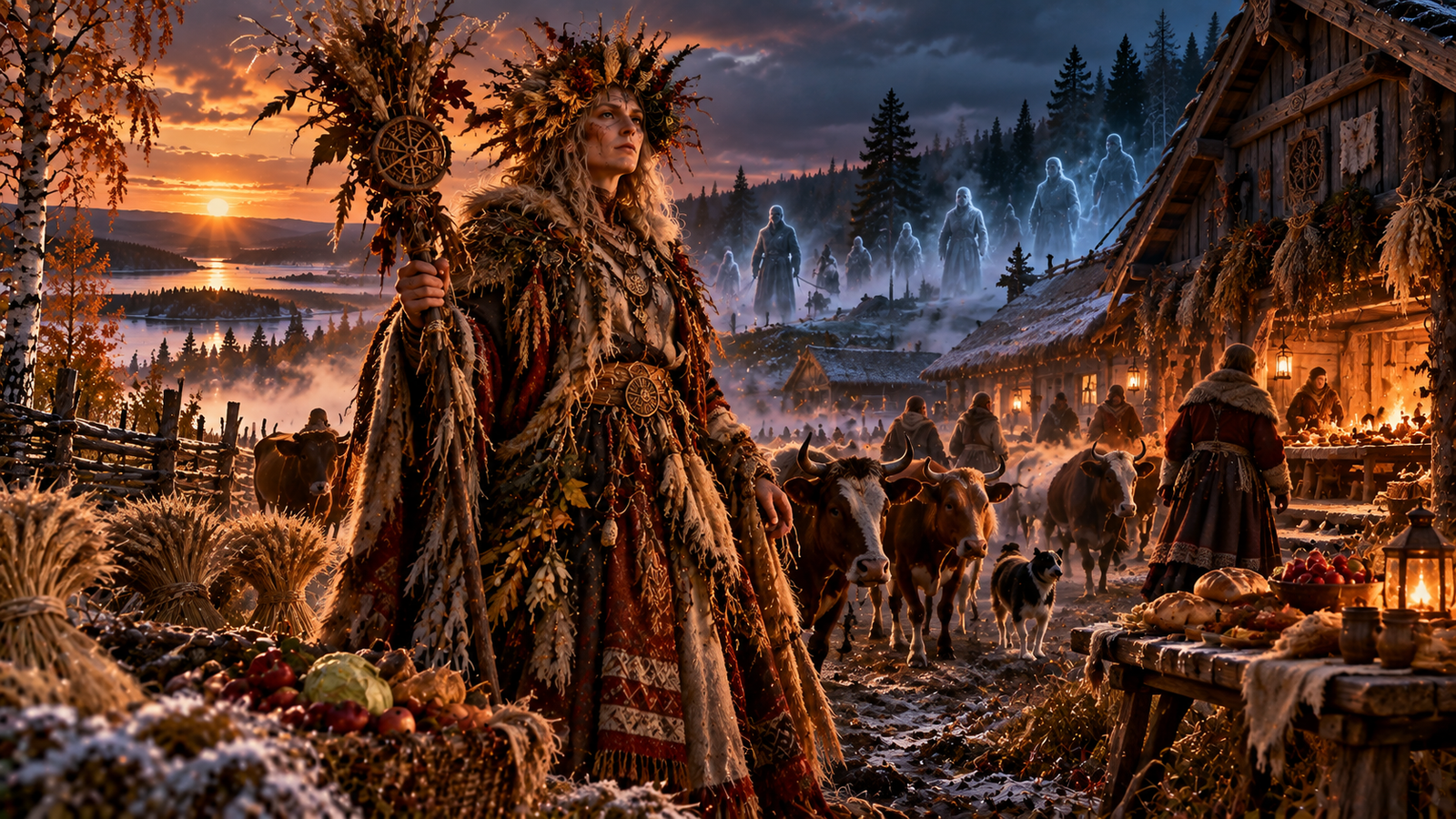
At a Glance
| Name | Kekri, Keyri, Keuri, Köyri — the old turning of the farm year |
|---|---|
| Nature | Harvest-season celebration and associated spirit of cattle growth; embodied here as a seasonal guest |
| Tradition | Finnish agricultural year, household feasts, protection of cattle, visiting guests and remembrance of ancestors |
| Alignment | Neutral Good — a campaign personification of hospitality and renewal, not a fixed historical moral description |
| Realm | The Last Granary, a threshold hall between farmsteads of Midgard and the Fey World |
| Domains | Harvest, Life, Protection and Ancestors |
| Gifts | Stores that last through winter, healthy cattle, shared food and the memory of those who have died |
| Sign | Grain sheaf between horns above a feast bowl, a campaign symbol |
| Followers | Farmers, herdswomen, household cooks, travelling labourers and communities facing a poor winter |
| Ritual season | After the final autumn work, before the new cycle of household labour begins |
| Risk | Greed, refusal of hospitality, disputes over stores and leaving the vulnerable without winter food |
| Game role | Seasonal patron, protector of harvest bargains and arbiter of the final feast |
The harvest feast is ready, but every empty chair has been set with a full plate. No servant admits doing it, and no one dares remove the bowls. The farm’s old master died before the last sheaf was cut, and his widow says he has returned to see whether the workers were paid. Before midnight the steward will announce that the farm’s winter stores have been sold to a visiting lord. If the unseen guest is truly Kekri, this will be the year the feast turns against its hosts.
Kekri is a name carried by the end of the traditional farming year and its autumn celebration. Households gathered after harvest, ate generously, remembered the dead and made sure the turn of the year would not begin in want. The name has several dialect forms, and later documentation also names Kekri as a power concerned with cattle growth. Those sources do not all agree that the festival was always a single, human-shaped god. A careful account leaves the older ambiguity intact.
In this fantasy world the season may walk into the hall as a guest. Kekri neither owns every farm nor demands that a family squander its stores on an elaborate feast. He asks that those who helped gather the harvest receive food and rest, and that households remember those who are absent. His blessings can preserve cattle through winter, but the finest blessing is often a sensible agreement between neighbours who have more than they need and those who have less.
What Is Happening Right Now?
The Unpaid Harvest Workers
A landowner has invited an entire village to his autumn banquet while refusing to pay the last month of wages to those who brought in his grain. Their places at the table remain empty, though the dishes serve themselves. His bailiff orders the food removed and claims a witch has cursed the hall. The party must locate the workers, secure their payment and discover who is using the old feast custom to settle a very modern debt.
One Cow Too Many
A herdswoman has counted every animal into the winter byre, but a black cow not listed in any account appears among them each morning. When it leaves, one neighbour’s milk runs dry; when it stays, another’s granary flourishes. The villagers begin accusing one another of theft. Kekri’s guest asks them to trace the cow’s original owner before slaughtering it at the feast. The answer lies in an old inheritance that was never divided.
The Last Candle of the Year
A widow lights a candle for a family member who did not return from the border war. The flame refuses to go out, and the soldiers of a visiting lord call it a sign of rebellion. The candle leads anyone who carries it to a field where unburied bones lie beneath the new stubble. The heroes must return the dead, protect the widow and keep the harvest feast from turning into a trial for treason.
When the Working Year Ends
The festival does not belong to a single famous hero or a single house. Its timing shifts as each household finishes its autumn work. Some begin after the grain has been brought in, some when the cattle have been prepared for the winter, and others after the last field is cleared. In the colder north the end of work can arrive suddenly. The feast marks a real threshold between what has been gathered and what must be carefully kept.
The Guests Seen and Unseen
The living share food with neighbours and labourers, while places may also be set for ancestors and the absent dead. Visitors can arrive in disguise or under masks, and a family’s generosity is remembered long after the plates are cleared. A masked stranger asking for food is not automatically the seasonal spirit; a clever thief may also know how to take advantage of custom. The best adventures use the uncertainty to reveal who truly needs protection.
The Cattle that Must Survive
The feast follows the difficult work of making stores and shelter for winter. Cattle are vital to the household’s next year, and later sources connect Kekri’s name with their growth. In this world a healthy herd is more convincing evidence of a blessing than a heap of gold. A landlord who allows the cows to starve while boasting of a grand banquet has misunderstood the duty he claims to honour.
Not a Universal Harvest King
Some later writers present Kekri as a named livestock god, while other evidence is concerned with a festival, seasonal threshold or household custom. The oldest surviving written mentions are later than the present date of this world. There is no reason to treat one modern reconstruction as an unquestioned ancient biography. The figure encountered in this campaign is a personification: he allows the old season to become an NPC, without denying the different traditions from which the name comes.
How Kekri Appears
When he chooses a face, Kekri looks like a winter traveller wearing a dark cloak that smells of grain and woodsmoke. A small bell hangs beside his belt. His hands are scarred from work, and his boots have clay from several farms on their soles. He eats little but remembers who was offered a place at the table. He may look older in the house of a generous widow and younger where the household refuses to share.
The Last Granary
The Last Granary stands at a turning of the paths between Midgard and the Fey World. It is built of weathered timber, with a tiled hearth and long tables that will seat everyone who arrives. Its doors open toward autumn fields, while a narrow window shows the first stars of winter. A household invited inside must leave its weapons by the door, not because the hall commands perfect peace but because no family can feast safely amid drawn blades.
There are no inexhaustible barrels here. The floor holds exactly what the people who shared the food were able to store, and any person who fills a sack must say whom it is intended to feed. Kekri knows the difference between careful saving and hoarding. A guest who arrives hungry is welcomed; a visitor who arrives with wagons to seize all the flour finds only a locked door.
Regional Effects
The Honest Measure. Grain weighed with the hall’s stone measures shows whether another handful has been concealed beneath the scale.
The Final Place. A chair left for a remembered dead person is undisturbed until the household speaks a truthful memory.
The Winter Byre. Animals properly sheltered during the night recover from ordinary fatigue and fear by dawn.
The Shared Bowl. A guest who willingly gives part of a meal to another finds that their own portion remains enough for a modest supper, but the effect cannot feed a city from nothing.
Divine Gifts and Spells
Domains: Harvest, Life, Protection and Ancestors. These are rules for a seasonal power in this world rather than a claim about a continuous named priesthood.
Domain Spells
| Level | Spells |
|---|---|
| 1st | Goodberry, Purify Food and Drink |
| 2nd | Augury, Lesser Restoration |
| 3rd | Plant Growth, Speak with Dead |
| 4th | Divination, Freedom of Movement |
| 5th | Greater Restoration, Hallow |
| 6th | Heroes’ Feast, Heal |
| 7th | Regenerate, Resurrection |
| 8th | Animal Shapes, Mind Blank |
| 9th | Foresight, Mass Heal |
Year’s Last Welcome. The faithful can bless a harvest feast so a small party of unexpected travellers receives a full supper without emptying the host’s own plates.
Healthy Byre. A caretaker whose animals have been properly fed and housed may receive a warning that a disease or winter storm threatens them, allowing time to act.
Game Statistics
Kekri, Guest of the Last Feast
Medium Fey, Neutral Good
AC 22 (harvest ward); Initiative +3 (13); HP 432 (32d8 + 288); Speed 30 ft.
| STR | DEX | CON | INT | WIS | CHA |
|---|---|---|---|---|---|
| 18 (+4) | 16 (+3) | 28 (+9) | 24 (+7) | 32 (+11) | 28 (+9) |
Saving Throws Str +11, Con +16, Wis +18, Cha +16; Skills Insight +18, Nature +14, Perception +18, Persuasion +16, Survival +18; Resistances Cold, Fire, Psychic; Immunities Poison; Condition Immunities Frightened, Poisoned; Senses Truesight 90 ft., Passive Perception 28; Languages Finnish, Karelian, Sylvan, telepathy 120 ft.; CR 22 (41,000 XP; PB +7)
Traits
Legendary Resistance (3/Day). If Kekri fails a saving throw, he can choose to succeed instead.
The Open Table. Willing creatures within 30 feet have Advantage on saving throws to end the Frightened condition while Kekri is conscious.
Actions
Multiattack. Kekri makes three Threshing Bell attacks.
Threshing Bell. Ranged Spell Attack Roll: +18, range 150 ft. Hit: 27 (6d8) Thunder damage plus 13 (3d8) Radiant damage.
The Turning Year (Recharge 5–6). Creatures Kekri chooses in a 40-foot-radius Sphere centred on a point he sees within 120 feet make a DC 26 Wisdom saving throw. On a failure, each takes 54 (12d8) Thunder damage and has the Prone condition. On a success, it takes half damage and is not Prone.
Welcome to the Hungry (3/Day). Up to six willing creatures within 60 feet each regain 27 (6d8) Hit Points and end the Frightened condition on themselves.
Bonus Actions
Seat at the Table. Kekri teleports up to 40 feet to a space beside an unoccupied chair or doorway he can see.
Reactions
Share the Burden. When an ally within 60 feet takes damage, Kekri reduces it by 25 and grants the ally 10 Temporary Hit Points.
Legendary Actions (3/round)
Kekri takes one Legendary Action at the end of another creature’s turn and regains all three at the start of his turn. Stride. Move half Speed without provoking Opportunity Attacks. Bell (Costs 2 Actions). Make one Threshing Bell attack. Quiet Feast (Costs 2 Actions). One willing creature within 60 feet can end the Charmed or Frightened condition on itself.
Kekri, Guest of the Last Feast
Medium fey, neutral good
Armor Class 22 (harvest ward); Hit Points 432 (32d8 + 288); Speed 30 ft.
STR 18 (+4), DEX 16 (+3), CON 28 (+9), INT 24 (+7), WIS 32 (+11), CHA 28 (+9)
Saving Throws Str +11, Con +16, Wis +18, Cha +16; Skills Insight +18, Nature +14, Perception +18, Persuasion +16, Survival +18; Damage Resistances cold, fire, psychic; Damage Immunities poison; Condition Immunities frightened, poisoned; Senses truesight 90 ft., passive Perception 28; Languages Finnish, Karelian, Sylvan, telepathy 120 ft.; Challenge 22 (41,000 XP)
Traits
Legendary Resistance (3/Day). If Kekri fails a saving throw, he may choose to succeed. The Open Table. Willing creatures within 30 feet have advantage on saving throws to end being frightened while Kekri is conscious.
Actions
Multiattack. Kekri makes three threshing bell attacks. Threshing Bell. Ranged Spell Attack: +18 to hit, range 150 ft., one target. Hit: 27 (6d8) thunder damage plus 13 (3d8) radiant damage.
The Turning Year (Recharge 5–6). Creatures he chooses in a 40-foot-radius sphere centred within 120 feet make a DC 26 Wisdom saving throw, taking 54 (12d8) thunder damage and being knocked prone on a failure, or half damage and not falling prone on a success.
Welcome to the Hungry (3/Day). Up to six willing creatures within 60 feet regain 27 (6d8) hit points each and end being frightened.
Bonus Actions
Seat at the Table. Kekri teleports 40 feet to a space next to an unoccupied chair or doorway he sees.
Reactions
Share the Burden. When an ally within 60 feet takes damage, Kekri reduces that damage by 25 and grants the ally 10 temporary hit points.
Legendary Actions
Kekri takes three legendary actions, one at the end of another creature’s turn, regaining all at the start of his turn. Stride. Move half his speed without provoking opportunity attacks. Bell (Costs 2 Actions). One threshing bell attack. Quiet Feast (Costs 2 Actions). End charm or fear on one willing creature within 60 feet.
Kekri — CR 24
XP 1,228,800; NG Medium outsider (native); Init +7; Senses darkvision 120 ft., true seeing; Perception +40
DEFENSE
AC 32, touch 18, flat-footed 29 (+3 Dex, +14 natural, +5 deflection); hp 377 (26d10 + 234); Fort +24, Ref +18, Will +26; DR 15/epic; Resist cold 20, fire 20; SR 35
OFFENSE
Speed 30 ft.; Ranged threshing bell +29 touch (6d8 sonic plus 3d8 force); Special Attacks turning year (Su), welcome to the hungry (Su); Spell-Like Abilities (CL 26th; concentration +35): at will—create food and water, detect magic, purify food and drink; 3/day—heroes’ feast, greater restoration; 1/day—heal, foresight.
STATISTICS
Str 18, Dex 16, Con 28, Int 24, Wis 32, Cha 28; Base Atk +26; CMB +30; CMD 43; Feats Combat Casting, Combat Reflexes, Dodge, Great Fortitude, Improved Initiative, Iron Will, Lightning Reflexes, Mobility, Quicken Spell-Like Ability, Skill Focus (Perception), Spell Penetration, Toughness, Weapon Focus (ray)
Skills Diplomacy +38, Knowledge (nature) +36, Perception +40, Sense Motive +40, Survival +40; Languages Finnish, Karelian, Sylvan
SPECIAL ABILITIES
Turning Year (Su). Every 1d4 rounds Kekri sends a 40-foot-radius pulse through the harvest ground, dealing 12d8 sonic damage to selected creatures (Will DC 34 half), knocking prone those that fail. This save DC is Wisdom-based.
Kekri — CR 24
Medium Outsider (Native), Neutral Good
Hit Dice 26d8+234 (351 hp); Initiative +7; Speed 30 ft.; Armor Class 32 (+3 Dex, +14 natural, +5 deflection), touch 18, flat-footed 29
Base Attack/Grapple +26/+30; Attack threshing bell +29 ranged touch (6d8 sonic plus 3d8 force); Full Attack threshing bell +29 ranged touch (6d8 sonic plus 3d8 force); Space/Reach 5 ft./5 ft.
Special Attacks turning year, welcome to the hungry, spell-like abilities; Special Qualities DR 15/epic, darkvision 120 ft., cold and fire resistance 20, SR 35; Saves Fort +24, Ref +18, Will +26; Abilities Str 18, Dex 16, Con 28, Int 24, Wis 32, Cha 28
Skills Diplomacy +38, Knowledge (nature) +36, Listen +40, Sense Motive +40, Spot +40, Survival +40; Feats Combat Casting, Dodge, Great Fortitude, Improved Initiative, Iron Will, Lightning Reflexes, Mobility, Quicken Spell-Like Ability, Toughness
Spell-Like Abilities (CL 26th): at will—create food and water, detect magic, purify food and drink; 3/day—heroes’ feast, greater restoration; 1/day—heal, foresight.
Turning Year (Su)
Every 1d4 rounds Kekri creates a 40-foot-radius pulse, dealing 12d8 sonic damage (Will DC 34 half), with creatures failing the save being knocked prone. The DC is Wisdom-based.
Adventures at the Last Feast
The Thirteenth Place
Every autumn feast in a long valley has one extra place set at its table. This year a small village has set twelve extra places, and each bowl has been emptied without a guest being seen. The priest of the nearby lord demands the villagers be punished for wasting food. The party must learn whose dead have not been properly remembered before their relatives are forced to pay a debt they cannot afford.
The Winter Contract
A cattle dealer arrives during Kekri with signed documents claiming half the village’s surviving herd. The documents are legitimate but describe a loan repaid months ago. The spirit of the feast refuses to let the animals leave. The adventurers must find the missing receipt, keep the animals alive and prevent the dealer’s guards from seizing the village children in place of the cattle.
The Masked Visitor
A stranger wearing the hide of a goat arrives at the manor, demanding food for the landless poor. The lord calls him a thief. After the stranger departs, every barrel in the cellar becomes empty, while the workers’ cupboards are full. The heroes must discover whether this is a divine judgement or a well-planned fraud and settle the dispute without condemning people who needed a meal.
People and Places
Mythic Sources and Game Credits
The Kekri tradition project describes the harvest celebration and its concern with finishing agricultural work, hospitality, ancestors and seasonal renewal. The Kekri history project discusses the old name and its earliest surviving written mention as a cattle-related power. That written mention postdates the present age of this world; it is supporting scholarship, not an in-world record available to characters. The personified guest, divine realm, emblem, domain spells, adventures and four stat blocks are campaign creations and do not assert that every local community worshipped a fixed human-shaped god. Game terms follow the relevant open-game licences, including CC BY 4.0 for SRD 5.2.1 adaptations.
Keep this reference growing
If this page helped with your reading or game, you can support its upkeep or explore the curated books.
Explore the Bookshop — epics, classics and stories behind imagined worlds.