
Welsh Marches — Castles, Lordships and Border Law
Wales · Border lordships · Castle roads · Competing jurisdictions · Old boundaries
At a Glance
| Region | The shifting English-Welsh borderlands from the Dee country south through Powys, Herefordshire, Gwent and the Wye |
|---|---|
| Political character | Powerful local lordships beneath the wider English Crown, each with its own officers, customs and armed strength |
| Key strongholds | Chepstow, White Castle, Skenfrith, Grosmont, Raglan, Caerphilly and scores of lesser castles and fortified houses |
| Best for | Jurisdiction disputes, castle intrigue, fugitives, feuds, tolls, escorts, disputed inheritances and contested land |
| Key danger | A lawful act in one lordship may be theft, trespass or treason in the next |
| Supernatural layer | Old boundary stones, river spirits, spectral hounds, fey courts and roads whose claims predate marcher law |
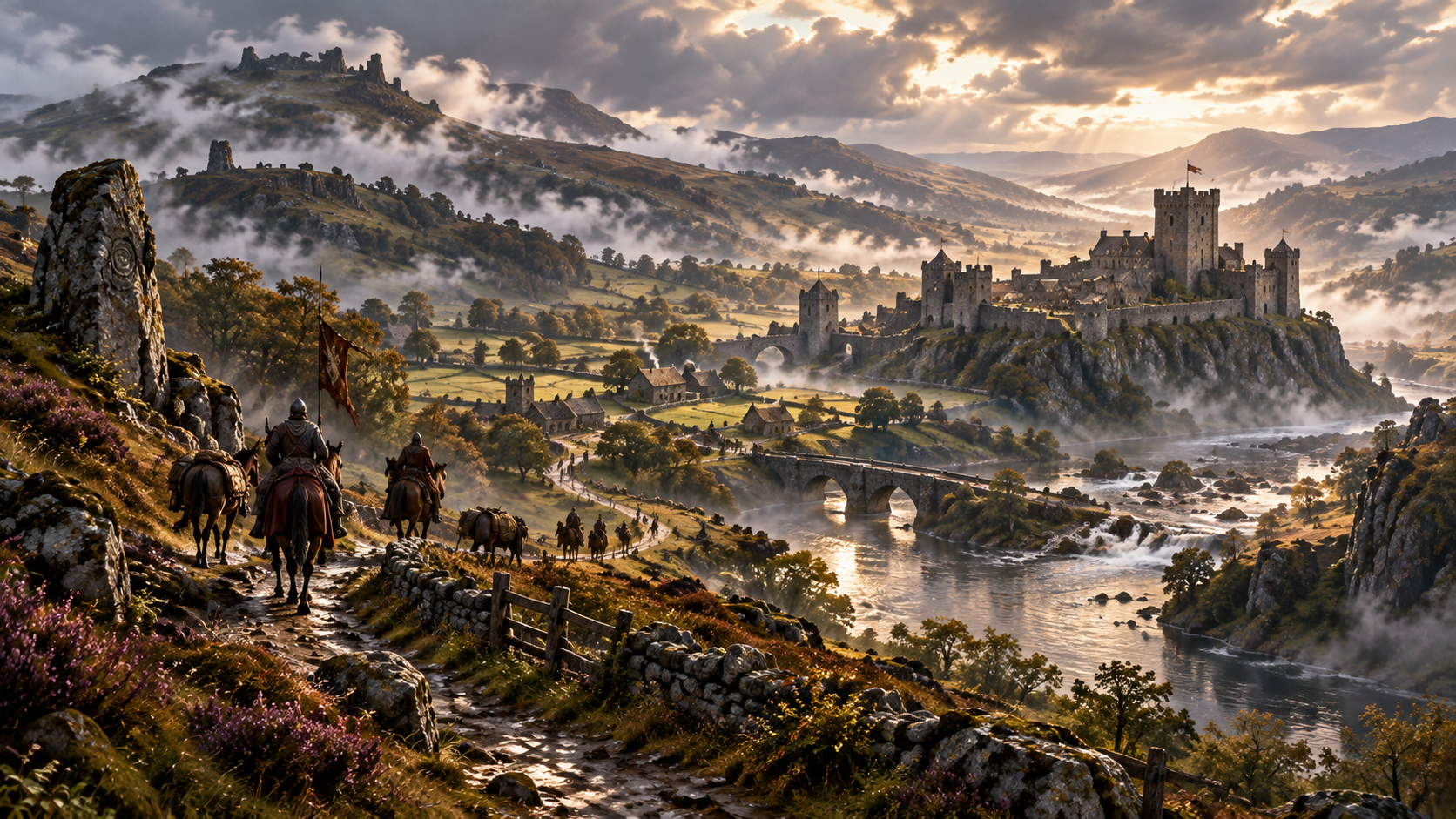
The Welsh Marches are not one border but a chain of lordships, valleys, castle districts, market towns and ancient routes where authority changes from mile to mile. A traveller can leave one court’s protection before sunset, cross a river under another lord’s toll rights and sleep on land whose oldest owners recognise neither charter.
What Is Happening Right Now?
Local lordship matters enormously. Great castles control bridges, ferries, markets, prisons and roads, while lesser households exercise power through kinship, tenancy and armed followings. There is no single marcher code that makes every dispute simple. Rights accumulated through conquest, inheritance, grant, marriage and bargain overlap until two people can produce convincing documents for the same mill, wood or toll.
The Glyndŵr rising has ended, but it remains inside living memory. Border households contain veterans, informers, dispossessed heirs and families that changed sides when survival demanded it. Confiscated estates still produce quarrels; ruined houses hide weapons and letters; old rebel routes remain useful to smugglers and fugitives.
Supernatural boundaries make the legal map even less reliable. A lord may own both banks of a stream while the ford belongs to a river power. A wood can sit wholly inside one estate yet contain a road into Annwn. An ancient stone shifted by a surveyor may change more than a field line.
Run the Marches Tonight
Three Warrants
The party arrests a wanted murderer only to be confronted by officers carrying two different warrants and a noble retinue claiming immunity. All three claims are plausible. The prisoner wants the argument to last until nightfall because the road changes jurisdiction after moonrise for reasons no mortal court records.
The Boundary Stone
A lord orders an ancient marker moved to enlarge his estate. Villagers object because it also closes a pact with the fair folk. The first surveyor disappears. The second returns at dawn speaking in the formal language of a court that has not dealt openly with mortals for generations.
The Empty Manor
A property seized after the rebellion is legally granted to a new owner. Every tenant has left overnight, livestock refuse to cross the gate and the dead former lord sits in the hall demanding the trial he was denied while alive.
Castles, Roads and Jurisdictions
Marcher castles are courts, treasuries, prisons, armouries and physical statements that a lord can make judgment stick. Chepstow dominates the Wye gateway; White Castle, Skenfrith and Grosmont control the Monmouthshire border country; Raglan is becoming one of the region’s most impressive noble residences; Caerphilly’s immense water defences guard the approaches farther west.
Between them run roads that are never politically neutral. A bridge may collect one lord’s toll, a market another lord’s dues, and a nearby wood a third household’s hunting rights. Escorts therefore carry more than weapons: seals, letters of passage, witness statements and proof of whose protection they travel under.
Fugitives exploit every seam. A thief who crosses a river can force pursuers to negotiate for permission. A noble accused in one jurisdiction may be a protected guest in another. A prisoner moved between castles can become the centre of a small war before reaching the next gate.
The Wye and the Southern Gate
The River Wye is road, boundary and obstacle at once. Barges carry timber, grain, stone and passengers while ferries and bridges concentrate tolls and gossip. Chepstow stands where the river approaches the Severn, linking the Marches to Cardiff, Bristol Channel trade and roads eastward into England.
Floods change crossings. Fog hides boats and riders. A pursuit that looks simple on a dry map can end at a swollen tributary where the only ferryman refuses coin but accepts an old name as payment.
Dungeon: The Wye Vaults of Chepstow
Chepstow’s dungeon begins inside a living great castle. Guards occupy the gates, servants work the halls, prisoners are held under authority and stores move through the wards. The lower spaces cannot be entered without affecting the household above.
The Working Undercrofts
Cellars, storerooms and service chambers press against the limestone beneath the castle. Some remain in daily use; others were sealed when walls were thickened or buildings changed purpose. Old inventories list rooms that no present steward can locate.
The Cliff Passage
Behind a blocked storage wall, worn steps descend into the rock toward the Wye. The passage once gave trusted servants access to water below the walls, but a collapse opened it into natural fissures in the limestone. River noise makes distance impossible to judge.
The Older Gate
Deep in the cliff stands a stone threshold older than the castle. It faces neither the river nor any surviving road. Crossing it during low water leads to a narrow shore beneath a different sky, where a boundary court still insists that every person passing between east and west owes a toll.
The Living Consequence
If the passage reopens, smugglers gain a route beneath the walls, prisoners gain an escape, the castle’s water security changes and an Otherworld court can demand payment from traffic on the Wye. A discovery below the fortress immediately becomes a legal and military problem above it.
Creatures of the Marches
Black Dogs
Black dogs appear on lonely roads, at fords and beside old estate boundaries. Some are omens, some guardians and some predators. The mistake is assuming that every black hound serves the same master merely because mortal witnesses describe them the same way.
Cŵn Annwn
Cŵn Annwn hunt across moor, valley and border road when Annwn opens onto the mortal world. Their passage ignores toll gates and many fortifications; a fugitive who crosses three mortal jurisdictions may still discover that the same supernatural hunt remains behind him.
Gwyllion
Gwyllion haunt the rougher western roads where the Marches rise toward Welsh uplands. Mist, steep ground and divided tracks give them everything they need to turn a short journey between castles into a night of circling the same hill.
Bendith y Mamau
Bendith y Mamau live close to farms, hidden hollows and field boundaries. They care little for a parchment grant if a household has broken an older custom. Missing livestock, exchanged children and impossible music beyond a hedgerow can turn an estate dispute into something no human judge can settle alone.
Older Borders and Otherworld Law
Arawn does not rule the Marches, but the proximity of Annwn makes his authority impossible to ignore. Roads that vanish into mist, spectral hunts and bargains made at burial mounds belong to a jurisdiction no marcher lord can overrule.
Gwyn ap Nudd brings a different form of Otherworld power: the Wild Hunt, moving boundaries and pursuit without regard for mortal privilege. When his riders cross a baron’s estate, armed men can defend the gate or stay alive; they cannot make him recognise a toll.
River and hill powers are usually more local still. A ford may have one keeper, an orchard another, a standing stone a third. These powers are strongest precisely because they are not part of one tidy pantheon or bureaucracy. They know their ground and the promises made there.
Arthur’s Eastern Roads
The south-eastern Marches lie close to Caerleon and the old roads of Gwent, where King Arthur remains part of living political memory as well as legend. Ruined Roman works, river crossings and old fortified hills draw claimants who insist that Arthurian precedent matters to present disputes.
Sir Geraint is known throughout the southern borderlands as a warrior of the Arthurian world whose honour carries weight on both sides of a quarrel. His arrival can quiet a feud for one evening or make it impossible for either side to retreat without losing face.
Border Hauntings and the Wild Hunt
The Marches remember every raid, execution and broken truce. Old roads acquire ghosts quickly here. Riders killed under safe-conduct sometimes return to the same crossing each year, refusing to let armed men pass until somebody names the lord who betrayed them.
Cŵn Annwn are feared on upland roads after dark. Their passage can carry hunters from one jurisdiction into another without crossing any mortal boundary stone, which makes them as dangerous politically as they are supernaturally.
Bendith y Mamau sometimes shelter families caught between rival lords, but their protection creates obligations no marcher court can cancel.
Historical and Mythological Context
The Marches grew from centuries of conflict and accommodation between Welsh rulers, English kings and powerful border lords. Cadw describes the region as a shifting frontier scattered with hundreds of castles and fortified residences, where local magnates exercised unusually extensive power. The later legislation that will regularise the border has not happened yet; marcher jurisdictions remain a defining fact of life.
Chepstow Castle embodies the southern March. Building began in 1067 on a limestone cliff above the Wye, and successive great lords expanded the fortress over centuries. Farther inland, White Castle, Skenfrith and Grosmont formed a linked group controlling Monmouthshire routes, while Caerphilly was raised on an immense scale in response to the power of Llywelyn ap Gruffudd.
The recent rising of Owain Glyndŵr reopened these older fault lines. Castles were repaired, attacked or held against revolt, and families throughout the border country were forced to choose, conceal or change loyalties. The war is over, but in the Marches memory is another form of evidence.
Cadw — Lords of the Border March · Cadw — Chepstow Castle · Cadw — White Castle · Cadw — Caerphilly Castle
Keep this reference growing
If this page helped with your reading or game, you can support its upkeep or explore the curated books.
Explore the Bookshop — epics, classics and stories behind imagined worlds.