
Sir Geraint the Valiant — Arthurian Knight
Sir Geraint the Valiant — Arthurian Knight
A faultlessly brave Arthurian knight whose greatest danger is not cowardice, but the moment honour curdles into pride.

- Name: Sir Geraint
- Epithet: The Valiant
- Also Known As: Geraint son of Erbin; Geraint ap Erbin
- Gender: Male
- Race: Human
- Culture: Brittonic Welsh / Arthurian Britain
- Homeland: The western Brittonic courts, Dumnonia, Cornwall, or Arthur’s Britain depending on campaign placement
- Occupation: Knight, prince, champion, noble warrior
- Allegiance: King Arthur’s court, his father Erbin’s house, Lady Enid
- Base of Operations: Arthur’s court, Erbin’s lands, and the dangerous roads of Britain
- Languages: Brittonic Welsh, courtly Common, Latin where appropriate
- Alignment: Lawful Good, with a severe prideful flaw
- Associated Figures: Lady Enid, King Arthur, Queen Guinevere, Erbin, Edeyrn son of Nudd
- Role in Play: Heroic knight, rival champion, quest patron, wounded husband, moral test of chivalry
- Recommended Weight: Major named NPC
Overview
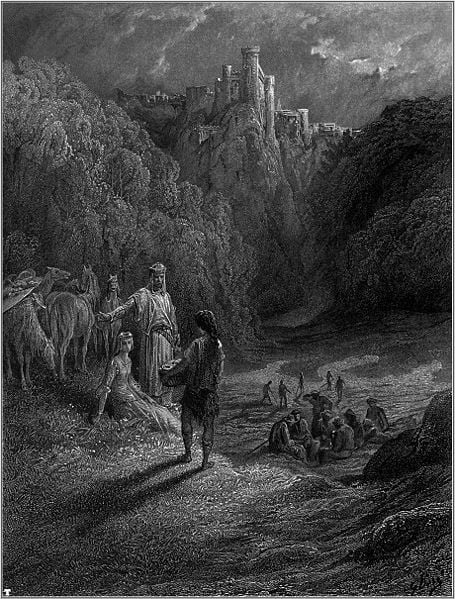
Sir Geraint the Valiant is one of Arthur’s noble knights: brave in the saddle, formidable with sword and lance, and burdened by the public weight of reputation. He is not a wandering brute or tournament peacock. He is a prince’s son and courtly champion, raised to believe that a knight’s name protects more than himself. His renown shields his wife, his household, his lord, and the people who depend on his strength.
That belief makes him admirable. It also makes him dangerous.
Geraint’s defining story is not about treachery, cowardice, or corruption. It is about a good knight who hears shame where he should hear love. After marrying Enid, he becomes vulnerable to the accusation that domestic happiness has softened him. Whether the rumour is fair matters less than what it awakens in him. Pride makes him harsh. Suspicion makes him unjust. He tests loyalty when he should trust it.
At the table, Geraint should first appear as genuinely heroic. Let him protect the weak, defeat a cruel knight, or uphold a lawful judgement when others hesitate. Only after that should his flaw emerge. His tragedy works because he is not secretly vile. He is brave, disciplined, loving, and wrong.
His best campaign use is as a knight the players can respect, oppose, rescue, rebuke, or redeem.
Appearance
Geraint is a tall, powerfully built knight in his prime, hardened by riding, hunting, tournament combat, and war. His face is controlled rather than expressive, with the stillness of a man trained to be watched in halls and on battlefields.
His arms and clothing show noble quality without foolish display: mail or early plate-and-mail depending on campaign era, a well-made surcoat, a battered shield, a war sword, a lance, riding cloak, gloves, spurs, and a horse fit for a prince’s son. He should look expensive because everything he owns is functional, maintained, and inherited through duty.
When calm, he is grave and courteous. When ashamed, he becomes quiet, rigid, and difficult to reach.
Character
Geraint is brave, loyal, restrained, and deeply conscious of rank. He does not enjoy cruelty. He does not seek needless war. He is capable of mercy, public apology, and noble generosity.
His flaw is that he confuses honour with control.
If praised, he accepts it stiffly. If insulted, he remembers. If loved, he is grateful but uneasy. If corrected by someone beneath him in status, especially in public, his pride can overrule his judgement.
This is what makes Enid so important. She is not merely the wife in the story. She is the person whose loyalty exposes the limits of his virtue. Geraint can face ambushes, hostile knights, and death. What he struggles to face is the possibility that Enid sees more clearly than he does.
What He Wants
Geraint wants to prove that love has not made him lesser.
More deeply, he wants to be worthy of Enid without feeling diminished by needing her.
What He Fears
Geraint fears becoming a song of mockery: the knight who abandoned arms for comfort, the husband ruled by his household, the prince who forgot duty after marriage.
His deepest fear is not that Enid is disloyal. It is that Enid may be right.
Allies
Lady Enid: His wife and the emotional centre of his story. Enid should be played as perceptive, loyal, frightened when she has reason to be, and morally braver than courtly silence allows.
King Arthur: Geraint’s sovereign and the courtly standard by which his conduct is measured.
Queen Guinevere: A strong patron for Enid and a useful courtly judge of behaviour, reputation, and truth.
Erbin: Geraint’s father, useful for succession disputes, dynastic pressure, and the burden of noble inheritance.
Enemies
Edeyrn son of Nudd: A proud knight associated with insult, humiliation, and the sparrow-hawk tournament tradition. He makes an excellent early rival or defeated enemy.
Robber-Knights: Violent men who rule stretches of road through fear, tolls, abduction, and false hospitality.
Court Slanderers: Nobles who know Geraint can be moved by reputation and use rumour as a weapon.
False Counsellors: Men who praise his severity because it flatters him and isolates Enid.
His Own Pride: The enemy that cannot be killed by lance or sword.
Enid in Play
Enid should never be treated as passive scenery. She is the moral witness of the story and often the first person to recognise danger.
Use her as the person who sees what others miss: armed men in the trees, false courtesy from a host, the insult hidden inside courtly praise, or the moment Geraint’s command has become unjust. Her problem is not weakness. Her problem is that love, rank, fear, and obedience all pull against truth.
A good Enid scene gives her agency without making her reckless. She may warn the party quietly, choose to break silence, refuse to abandon Geraint, or ask the characters to save him without humiliating him. She can be frightened and brave at the same time.
The party should not simply “rescue Enid from Geraint.” That flattens the story. The stronger version is harder: Enid loves him, sees his fault, suffers from it, and may still want him restored rather than destroyed.
How to Use Geraint in a Campaign
Geraint works best when the players are not sure whether to admire him, challenge him, or save him.
He should do good before he does harm. Show his courage first. Let the party see why Arthur’s court values him. Then reveal the harder truth: under shame, he can become severe, distrustful, and dangerously committed to proving himself.
The key is not to make him a villain. The key is to make his flaw active enough that the party must respond.
A strong Geraint scene should ask one of these questions:
- Do the characters obey honour when honour is being misused?
- Can they correct a good man without humiliating him?
- Can Enid be protected without stripping her of agency?
- Can Geraint be restored without pretending he did nothing wrong?
Sir Geraint the Valiant D&D 5.5e / 2024
Sir Geraint the Valiant Pathfinder 1e
Sir Geraint the Valiant D&D 5.5e / 2024

Medium Humanoid, Lawful Good
Armor Class 18
Hit Points 136
Speed 30 ft.
Challenge 8
Proficiency Bonus +3
| STR | DEX | CON | INT | WIS | CHA |
|---|---|---|---|---|---|
| 19 (+4) | 14 (+2) | 17 (+3) | 12 (+1) | 15 (+2) | 17 (+3) |
Saving Throws Str +7, Con +6, Wis +5, Cha +6
Skills Animal Handling +5, Athletics +7, History +4, Insight +5, Intimidation +6, Persuasion +6
Senses passive Perception 12
Languages Brittonic Welsh, courtly Common, Latin
Traits
Arthurian Knight. Geraint has advantage on saving throws against being frightened while defending a sworn charge, noble guest, household member, or person under his protection.
Mounted Mastery. While mounted, Geraint has advantage on checks and saving throws made to avoid being shoved, knocked prone, or dismounted.
Honour Under Fire. Once per turn, when Geraint hits a creature that has damaged an ally, helpless creature, guest, or sworn charge since the end of his last turn, he deals an extra 7 (2d6) weapon damage.
Pride Before Counsel. If Geraint is publicly accused of cowardice, dishonour, or neglect of knightly duty, he must succeed on a DC 15 Wisdom saving throw or pursue immediate redress through challenge, pursuit, formal accusation, or withdrawal from counsel. This does not force obviously suicidal action. A trusted ally who speaks plainly may use an action to make a DC 16 Charisma (Persuasion) or Wisdom (Insight) check, allowing him to repeat the saving throw.
Actions
Multiattack. Geraint makes two melee attacks with his longsword, or one Longsword attack and one Shield Bash. He cannot use Mounted Lance Charge as part of Multiattack.
Longsword. Melee Weapon Attack: +7 to hit, reach 5 ft., one target. Hit: 9 (1d10 + 4) slashing damage if used with two hands, or 8 (1d8 + 4) slashing damage if used one-handed.
Shield Bash. Melee Weapon Attack: +7 to hit, reach 5 ft., one target. Hit: 7 (1d6 + 4) bludgeoning damage, and the target must succeed on a DC 15 Strength saving throw or fall prone.
Mounted Lance Charge. Melee Weapon Attack: +7 to hit, reach 10 ft., one target. Geraint must be mounted, and his mount must move at least 20 feet straight toward the target before the attack. Hit: 22 (4d8 + 4) piercing damage. If the target is Large or smaller, it must succeed on a DC 15 Strength saving throw or be knocked prone.
Commanding Rebuke. Geraint targets one creature he can see within 60 feet that can hear him. The target must succeed on a DC 14 Wisdom saving throw or have disadvantage on the next attack roll it makes before the end of its next turn. If the target has attacked a helpless creature, broken sworn hospitality, or struck from ambush, it also takes 7 (2d6) psychic damage.
Bonus Actions
Knight’s Challenge. Geraint marks one creature he can see within 30 feet until the end of his next turn. The first time the marked creature attacks a target other than Geraint, Geraint may move up to half his speed toward that creature as a reaction.
Second Wind. Geraint regains 18 hit points. Once used, he cannot use this feature again until he finishes a short or long rest.
Reactions
Parry. Geraint adds 3 to his AC against one melee attack that would hit him. He must see the attacker and be wielding a melee weapon.
Defend the Worthy. When a creature within 5 feet of Geraint is hit by an attack, Geraint can impose disadvantage on the attack roll. If the attack still hits, Geraint may take half the damage instead.
Equipment
- Fine mail or early plate-and-mail harness
- Noble surcoat
- Longsword
- Lance
- Shield bearing his arms
- Dagger
- Warhorse with knightly tack
- Signet
- Court token
- A personal favour from Enid
Sir Geraint the Valiant Pathfinder 1e

CR 8
XP 4,800
Male human fighter 6 / cavalier 3
LG Medium humanoid
Init +2; Senses Perception +9
Defence
AC 23, touch 12, flat-footed 21
hp 94
Fort +11, Ref +5, Will +7
Defensive Abilities bravery +2, armour training 1
Offence
Speed 20 ft. in armour; 30 ft. unarmoured
Melee +1 longsword +16/+11 (1d8+7/19–20)
Shield Bash heavy steel shield +14 (1d4+4)
Mounted Charge +1 lance +18 (1d8+8/x3), triple damage on a mounted charge with Spirited Charge. This is a charge attack, not a full-attack routine.
Special Attacks challenge 1/day, weapon training, tactician
Statistics
Str 19, Dex 14, Con 16, Int 12, Wis 14, Cha 16
Base Atk +9; CMB +13; CMD 25
Feats Mounted Combat, Ride-By Attack, Spirited Charge, Power Attack, Weapon Focus (longsword), Weapon Specialization (longsword), Shield Focus, Iron Will
Skills Diplomacy +13, Handle Animal +13, Intimidate +13, Knowledge (nobility) +10, Perception +9, Ride +15, Sense Motive +13
Languages Brittonic Welsh, courtly Common, Latin
SQ armour training, mounted bond, noble bearing
Gear
+1 longsword, +1 lance, masterwork heavy steel shield, fine mail or early plate-and-mail equivalent, noble clothing, warhorse, signet, courtly favour, 200 gp in portable noble wealth and gifts.
Running Geraint at the Table
Voice and Manner
Geraint speaks plainly, formally, and without theatrical cruelty. He does not sneer. He judges.
Use short, controlled lines:
- “That cannot stand.”
- “A knight’s name is not his alone.”
- “Speak plainly. I have no patience for decorated cowardice.”
- “If I have wronged her, then my victories are ash.”
- “Do not praise me for what honour already required.”
Combat Behaviour
Geraint fights like a disciplined mounted knight. He opens with the lance when terrain permits.
Once the charge breaks, he shifts to sword and shield. He controls space, protects allies, and challenges the most dishonourable enemy rather than the weakest one.
Against player characters, he should usually fight to first blood, surrender, disarmament, or public judgement unless the campaign has already turned deadly. Geraint is a knight of romance, not a random murder encounter.
Moral Pressure
Geraint should create uncomfortable choices, not simple villainy.
He may be right about danger but wrong about Enid.
He may seek justice but demand it harshly.
He may love his wife and still wound her through mistrust.
He may need rescue from enemies and correction from friends.
Treasure and Rewards
Geraint does not pay like a merchant. His rewards are public, symbolic, and socially powerful.
Possible rewards include:
- A warhorse from his own stable: A practical knightly gift with real campaign value.
- A court introduction: Access to Arthur, Guinevere, Erbin’s household, or a western Brittonic court.
- A public gift of honour: A shield, cloak, sword-belt, or spur-set given before witnesses.
- Protection under his name: Safe lodging, escort, or passage through allied lands.
- A sworn declaration: A formal statement clearing the party of slander, false accusation, or disputed conduct.
- Tournament sponsorship: Entry into a noble contest under Geraint’s reputation.
- Enid’s favour: Advantage on one future social appeal involving loyalty, marriage, warning, or truth.
Adventure Hooks
1. The Shield on the Silent Road
Geraint’s shield is found split beside a forest road. His horse is gone, his blood marks the stones, and Enid is nearby, exhausted and forbidden by his command to explain unless directly questioned by him. The party must decide whether to honour a cruel instruction or break it before Geraint vanishes into robber-knight country.
2. Enid’s Warning
The party travels near Geraint and Enid when ambushers gather in the trees. Enid sees the danger first, but Geraint has ordered her silence. If she speaks, she risks his anger. If she obeys, men may die. The party must act quickly while the moral failure of the command becomes impossible to ignore.
3. The Sparrow-Hawk Tournament
A local lord holds a brutal tournament where the victor claims the sparrow-hawk and the right to shame lesser houses. Geraint intends to enter, but the contest is rigged by oath, hostage, and hidden debt. The party can compete, investigate, protect Enid, or expose why the same champion has never truly lost.
Source and Literary Context
Sir Geraint belongs to the Welsh Arthurian romance tradition, especially Geraint and Enid, where his marriage, wounded pride, and knightly reputation become the centre of the story. For a public-domain English presentation of the tale, see Geraint and Enid. For brief literary background on Geraint’s relationship to Chrétien de Troyes’ Erec and Enide, see Britannica’s article on Sir Geraint.
Keep this reference growing
If this page helped with your reading or game, you can support its upkeep or explore the curated books.
Explore the Bookshop — epics, classics and stories behind imagined worlds.