
Starstone – Long-Lasting Alchemical Light Source
Starstone – Long-Lasting Alchemical Light Source
A compact alchemical light-stone that burns for three days after a touch of flame.
Overview
A Starstone is a small alchemical light source made for long watches, deep roads, siege tunnels, mines, tombs, and expeditions where ordinary fuel may run out. It is not as bright as a sunrod, but it lasts far longer.
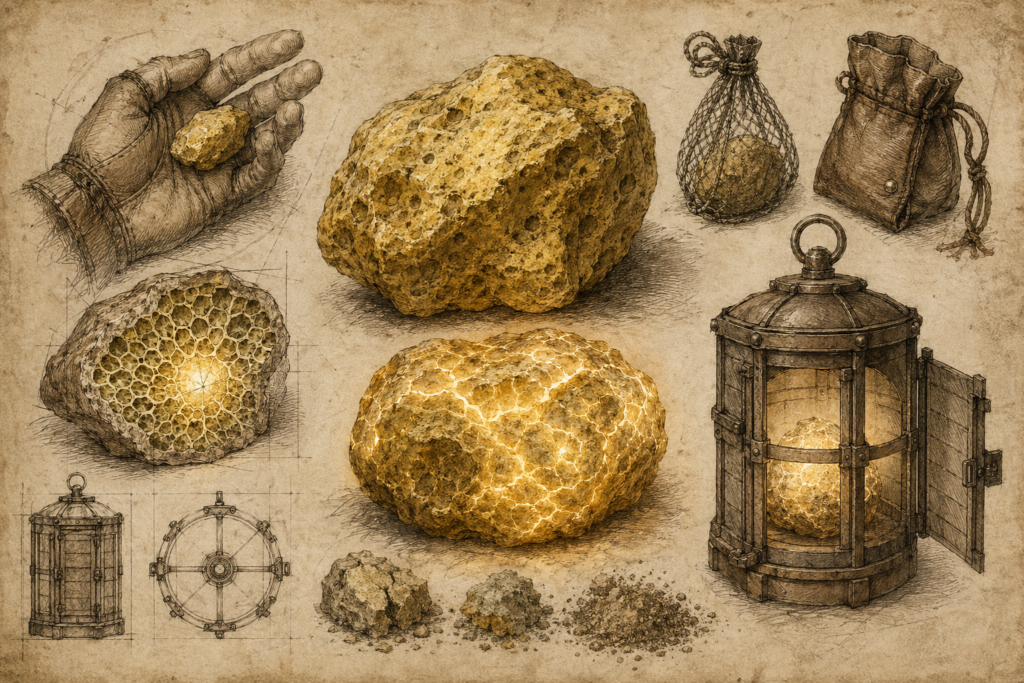
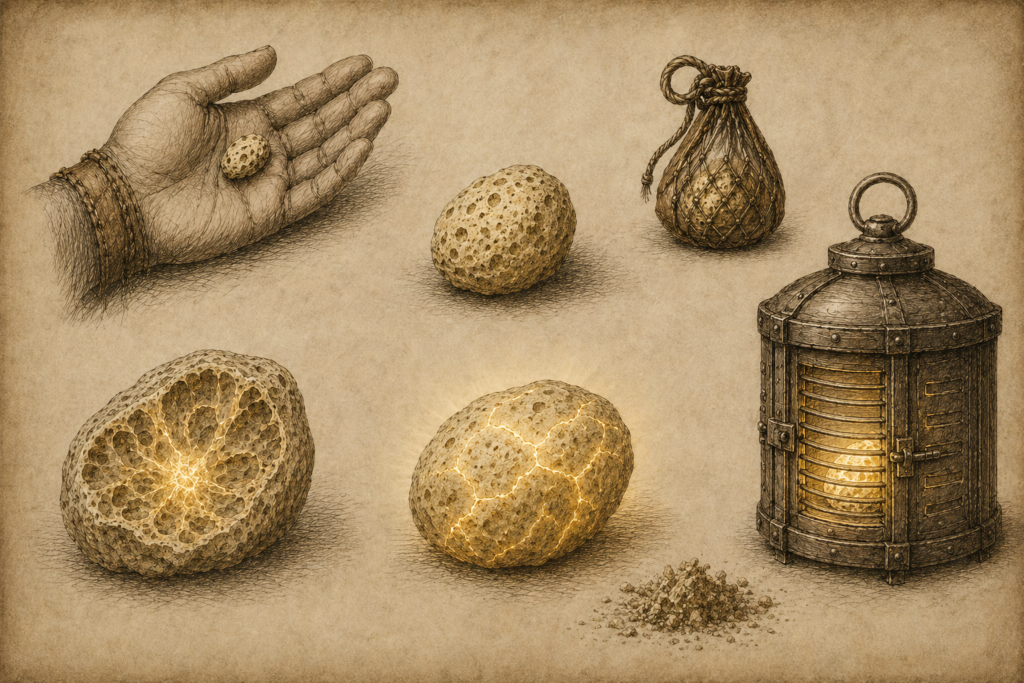
At first glance, a Starstone resembles a rough lump of pale gold about half the size of a man’s fist. The resemblance is misleading. It is much lighter than gold, somewhat lighter than common stone, and faintly porous beneath its metallic yellow surface.
When exposed to flame, the Starstone’s prepared alchemical body activates. Existing mineral lines brighten beneath the surface and release a clean, steady radiance. The light does not smoke, flicker, drip wax, consume oil, or need tending. Once lit, however, the stone cannot normally be extinguished. It glows until its alchemical fuel is spent, then collapses into dull grey-yellow dust.
A Starstone is best understood as endurance light. It is not the cheapest way to see in the dark, and it is not the strongest. Its value lies in lasting through the night, the next day, and the night after that.
Physical Description
A Starstone is a rough, gold-coloured alchemical stone weighing about 1 pound. Most are half the size of a clenched fist, though individual examples vary slightly in shape. It is much lighter than gold and somewhat lighter than a common stone of similar size, though the finished item is still listed at 1 pound for game purposes.
Inactive Starstones are usually wrapped in cloth, packed in leather pouches, or kept in fitted boxes to protect them from breakage, damp, soot, and careless handling around open flame. Their surface may show tiny mineral veins, sealed lines, or faint amber flecks.
Once activated, the stone glows from within. Existing veins and mineral lines brighten beneath the surface, producing a clear golden-white light rather than the red flicker of fire. When exhausted, the Starstone becomes brittle and crumbles into powder.
Edition Tabs
Starstone 5.5e / 2024
Starstone, Pathfinder 1e / 3.5e
Starstone 3.0
Starstone 5.5e / 2024
Adventuring Gear, Alchemical Item
Cost: 15 gp
Weight: 1 lb.
Activation: Expose to flame
Duration: 72 hours
Light: Bright light in a 20-foot radius and dim light for an additional 20 feet
A Starstone is activated when exposed to flame, such as a torch, candle, lantern, campfire, burning oil, or similar source. Brief contact with an open flame is enough; ordinary heat, sunlight, sparks, and warm metal do not activate it unless the GM decides the source is equivalent to flame.
Once activated, it sheds bright light in a 20-foot radius and dim light for an additional 20 feet. The Starstone continues to glow for 72 hours. This duration cannot normally be paused, suppressed, or reset. At the end of the duration, the Starstone crumbles into inert dust.
A Starstone gives off light but not useful heat. It cannot ignite objects, cook food, burn webs, serve as a torch for fire damage, or count as sunlight unless a specific rule says otherwise.
Practical Adjudication
A covered Starstone has its light blocked by the covering object, such as a pouch, cloak, box, shuttered lantern, or shield. Covering the stone does not stop its duration from expiring.
If a Starstone is broken before its duration ends, it stops functioning. Its fragments may glow briefly, but they do not explode, burn creatures, or create a damaging burst unless a specific adventure feature says otherwise.
Starstone, Pathfinder 1e / 3.5e

Adventuring Gear, Alchemical Item
Cost: 15 gp
Weight: 1 lb.
Activation: Expose to flame
Duration: 72 hours
Light: Bright illumination in a 20-foot radius and shadowy illumination for an additional 20 feet
A Starstone is activated when exposed to flame, such as a torch, candle, lantern, campfire, burning oil, or similar source. Brief contact with an open flame is enough; ordinary heat, sunlight, sparks, and warm metal do not activate it unless the GM decides the source is equivalent to flame.
Once activated, it provides bright illumination in a 20-foot radius and shadowy illumination for an additional 20 feet. The Starstone continues to glow for 72 hours. Once activated, it cannot normally be turned off. When its alchemical fuel is exhausted, it crumbles into dust.
A Starstone produces light, not meaningful heat. It cannot be used to ignite objects, cook food, burn obstacles, or replace a torch for effects that specifically require flame.
Starstone 3.0
Ultimate Equipment Guide II
Author Greg Lynch, J. C. Alvarez
Publisher Mongoose Publishing
Publish date 2005
Smaller and longer-lasting that a sunrod, though not quite as bright, a starstone is a rock, about half the size of a man’s fist, which seems at first glance to be a chunk of solid gold. Though it shares the same colour as gold, the resemblance ends there. A starstone is much lighter than the precious metal it resembles, weighing even less than an average rock of its size.
The most important element of a starstone, of course, is not its appearance, but its function. When exposed to flame, the latent alchemy of the starstone is activated, causing it to burst forth with a bright, clear light. The starstone provides full illumination out to 20 feet, and shadowy illumination for an additional 20 feet beyond that. The starstone will give off a steady light for a full 72 hours before it exhausts its alchemical fuel and crumbles into dust.
The item has not yet managed to supplant the popularity of the traditional sunrod, and perhaps never will. Though its long duration is commendable, the reduced brightness of its light, coupled with its greater cost, may well doom the starstone to remain forever in the shadow of the sunrod.
Starstone: 15 gp; 1lb.
How Starstone Is Used
Adventurers use Starstones when they need reliable light for a long time and do not want to manage fuel.
A Starstone can be carried in hand, placed in a bowl, tied inside a mesh pouch, hung from a pole, lowered into a shaft, or set inside an empty shuttered lantern frame to control the glow. It is useful in mines, caves, sealed tombs, old sewers, siege tunnels, long watches, and expeditions where torches and oil may run short.
Its weakness is visibility. A glowing Starstone can reveal the party’s position in darkness, especially in ruins, forests, tunnels, and battlefield trenches. Careful users keep a cover, shutter, pouch, or wrapping close at hand.
Failure, Risk, and Misuse
The Starstone’s main risk is waste.
Once activated, it burns through its full duration whether the party needs the light or not. A careless adventurer who tests one in daylight has spent 15 gp for nothing. A group that lights several at once may feel well-prepared for a night and then find itself without reserve light deeper underground.
The second risk is exposure. A Starstone makes stealth harder when light itself is the problem. It may reveal a camp, mark a tunnel route for pursuers, or show enemies exactly where a scout is standing.
The item should not be allowed to do things outside its role. It is a light source, not a fire source, holy radiance, sunlight substitute, alchemical bomb, or free magical beacon.
Value in the World
The Starstone has not replaced the sunrod because it is more expensive and less bright. It survives because it solves a different problem.
A sunrod is better for immediate, forceful illumination. A Starstone is better for endurance. It is the item bought by cautious delvers, military engineers, caravan masters, miners, tomb-breakers, night sentries, and wealthy expeditions that expect to remain underground longer than planned.
In settled markets, Starstones are specialist goods rather than common household lighting. Most ordinary people still rely on cheaper lamps, candles, rushlights, fire, and daylight. A Starstone is what someone buys when darkness is expected to become dangerous.
Trade, Craft, and Common Forms
Starstones are not usually sold in many “types.” The stone itself does the work. What changes is how it is carried, protected, and controlled once lit.
Most are sold wrapped in waxed cloth or packed in a small leather pouch. Better examples come with a fitted tin, bronze, or iron cage that lets the bearer hang the stone from a belt, pack, hook, pole, or tunnel nail. Military and mining suppliers may sell Starstones with shuttered frames, allowing the light to be covered quickly without touching the stone itself.
Counterfeit or badly made Starstones may activate unevenly, glow dimly, crumble early, or leave irritating yellow dust when spent. Reputable alchemists mark the pouch, seal, or cage with a maker’s stamp because a failed Starstone in a mine, tomb, or siege tunnel can be more than an inconvenience.
A Starstone does not need multiple mechanical variants. Its useful differences are practical: protected, hanging, shuttered, reliable, or badly made.
Using Starstone in Your Game
Use a Starstone when light should create decisions.
It works well when the party must choose whether to activate a costly resource now or save it for later. It is useful when characters need to mark a route, illuminate a worksite, keep a watch lit, or continue travelling after ordinary fuel is gone.
It also makes good environmental storytelling. A glowing Starstone beside a dead explorer tells the party that someone passed through recently. Spent Starstone dust in wall niches may show how an old tomb was explored, guarded, or robbed. A fortress rationing Starstones during a siege tells players that supplies are failing.
Adventure and Worldbuilding Hooks
- The Three-Day Light: A Starstone is found burning beside a corpse in an underground passage. Since the stone cannot glow for more than 72 hours, the death is recent, and whatever killed the bearer may still be close.
- The False Gold Shipment: A caravan believed to be carrying gold is found abandoned. The “gold” is actually a crate of Starstones, suggesting the cargo was meant for a mine, siege tunnel, hidden road, or night assault.
- The Last Lit Stone: A besieged fortress has relied on Starstones to guard its tunnels. The final stones begin crumbling into dust on the same night enemy miners break through beneath the walls.
Historical Context
Starstone is a fantasy alchemical item, not a direct historical object. Its value comes from the real difficulty of pre-modern lighting. Candles, rushlights, oil lamps, torches, and hearth-fire all required fuel, tending, storage, and care. Clean, steady, long-lasting light would be valuable in enclosed spaces, night work, travel, study, mining, and military use.
For a useful medieval comparison, see Cotswold Archaeology’s object page for a medieval oil lamp from Bristol. The lamp probably dates to the mid-13th century, shows traces of burning, and likely used animal fat with a wick. The page also notes that ceramic lamps are uncommon finds from Bristol, suggesting that tallow candles and rushlights were more widespread.
That comparison gives the Starstone a clear place in a fantasy equipment list. It is not just “a glowing rock.” It is a premium alchemical answer to a real medieval problem: how to provide steady light without constant fuel, smoke, open flame, or careful tending.
Keep this reference growing
If this page helped with your reading or game, you can support its upkeep or explore the curated books.
Explore the Bookshop — epics, classics and stories behind imagined worlds.