
Dog Sled — The Northern Winter Road
At a Glance
- Type
- Light sled with runners and a trained dog team
- Crew
- One driver, with room for supplies or a light passenger if the team can haul them
- Power
- Several trained dogs, harnessed to a shared line
- Best Ground
- Hard snow, frozen lakes and maintained winter trails
- Hazards
- Thin ice, exhaustion, blizzards, hidden crevasses and injured dogs
- Required Supplies
- Food for dogs and travellers, rope, spare bindings and winter shelter
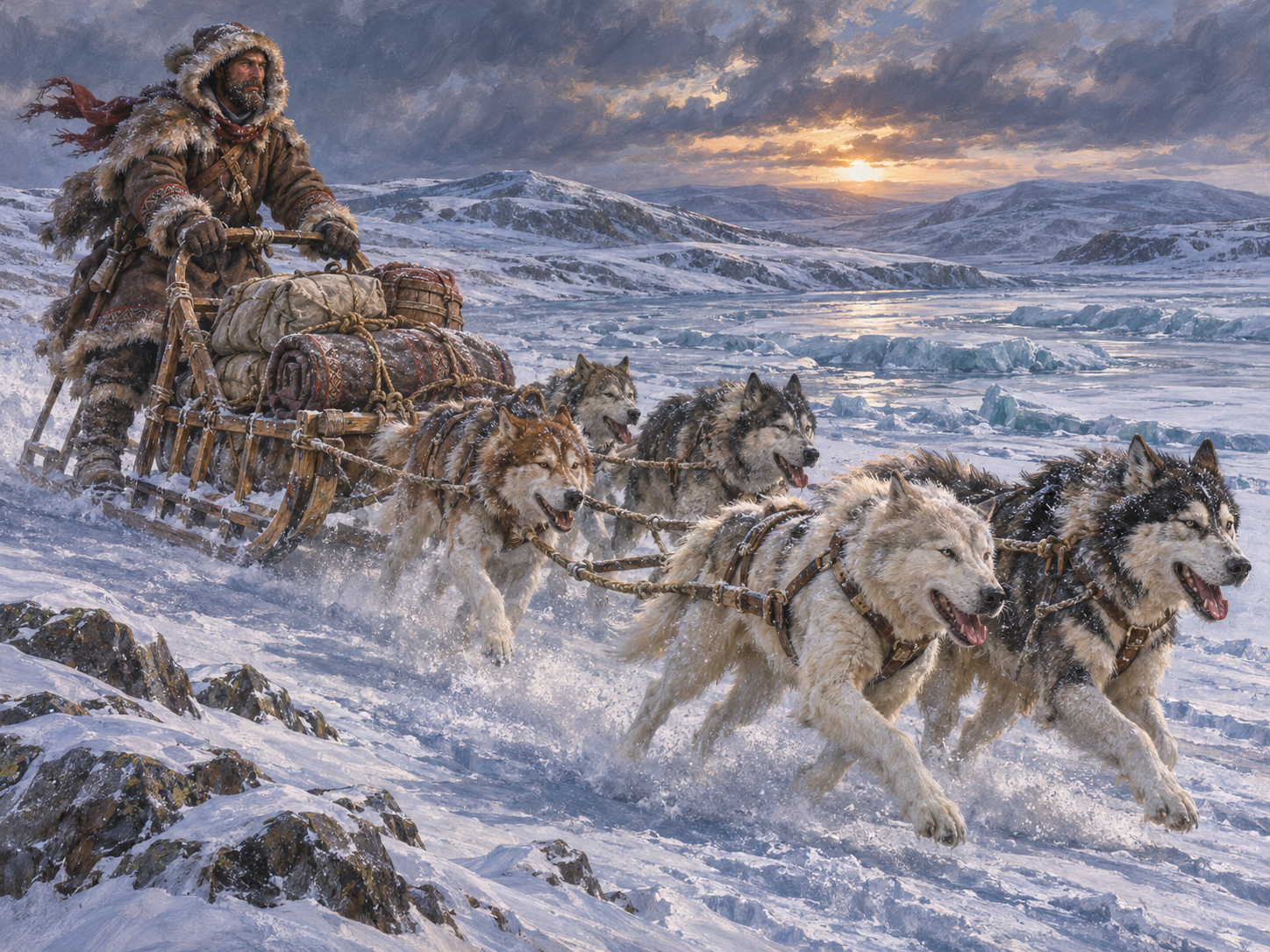
Across the winter flats, a string of dogs races toward a pale line of hills. The guide has wrapped the supplies in oilcloth, lashed every bundle to the runners and left enough space to stand when the trail falls away. Behind the party, the wind has already buried their tracks. Ahead, the river should still be frozen — but no one has checked it since the thaw began.
Dog sleds carry people and freight where wheels cannot go and where even a horse may struggle on hard snow. The animals are neither machines nor expendable tools: they must be trained, fed, rested and protected. A skilled driver knows when to help by running beside the sled, when to stop, and when the trail is unsafe.
Construction and the Team
A narrow timber bed rides on two long runners joined by flexible lashings. The dogs pull through traces attached to a central line. The driver balances on the rear runners, guiding the team with voice commands and weight shifts. The frame is light enough to haul through powder or repair at a winter camp, but it is not suited to bare rocky roads.
Dogs and load. A team can move only as much as its combined strength, condition and footing allow. The weight of the sled, passenger and supplies all counts. A packed cargo of tents, food or firewood makes uphill work exhausting and turning more difficult.
Repairs. Damaged runners can be lashed or fitted with replacement wood. Broken traces are an immediate emergency: a loose team may run into danger while the sled remains behind. The driver carries spare cordage and knows how to secure the dogs at night.
Winter Roads
When deep winter freezes marsh and river, new routes open between settlements. The same crossing becomes a trap as the ice begins to fracture. Guides probe suspicious snow, mark dangerous banks and wait out blizzards rather than outrun them.
Encounters. A frightened lead dog may smell a predator long before anyone sees it. A sudden drop can overturn the sled; a rope caught under a runner may halt the team at the edge of a crevasse. An armed pursuer on snowshoes might follow slowly but persistently long after horses must turn back.
Adventure — The Silent Crossing. An urgent message must reach a watchtower beyond a frozen estuary. At the halfway mark, the lead dog stops and refuses to advance. Beneath the clear ice, dozens of dark shapes move against the current. The tower’s signal fire is already burning, though it has not sent a reply in three nights.
Dog Sled — Vehicle Rules
Dog Sled — D&D 2024
| Equipment | Cost | Weight |
|---|---|---|
| Sled (base land vehicle) | 20 GP | 300 lb. |
The Basic Rules publish a sled, not a separate dog-team vehicle. Dogs are purchased and maintained separately.
Pulling and carrying. An animal drawing a sled can pull up to five times its carrying capacity, including sled, driver and cargo. Add the pulling capacities of all dogs in the team. The equipment’s own 300 lb. must be included before calculating additional freight.
Movement. Use the animals’ speed and the applicable travel pace; reduce progress for steep slopes, deep drifts and fatigue. A trained team following a safe packed trail does not need a check merely to keep going.
Ice hazards. A weak river crossing, exposed crevasse or sudden turn may require a relevant ability check. Resolve damage to runners and harness with object rules; the basic item has no official combat AC, HP or ramming attack.
Source: D&D 2024 Basic Rules — Equipment.
Dog Sled — D&D 2014
| Equipment | Cost | Weight |
|---|---|---|
| Sled (drawn land vehicle) | 20 gp | 300 lb. |
The published sled is a general drawn vehicle; the team is additional.
Load. An animal pulling a vehicle can draw weight up to five times its carrying capacity; include vehicle weight, load and any occupants. Add the team’s individual pulling limits together. If the animals cannot haul the total mass, the driver must reduce the cargo or secure more pullers.
Driving. Travel on a sound trail needs no check. If the team panics, the sled begins to overturn or the ice breaks, the DM may call for a relevant ability check, applying suitable training or circumstances. Handle cold exposure and exhaustion using the 2014 travel rules.
Damage. Resolve destroyed traces, broken runners and cargo loss through the edition’s object rules and environmental hazards; no Pathfinder vehicle manoeuvre values apply.
Source: D&D 2014 Basic Rules — Equipment.
Dog Sled — Pathfinder 1e
| Equipment | Cost | Weight |
|---|---|---|
| Dog Sled (Adventurer’s Armory) | 20 gp | 300 lb. |
This is a published equipment purchase, not an Ultimate Combat vehicle stat block. No automatic AC, CMB, CMD or ramming is assigned.
Team and load. Add the hauling capabilities of the trained dogs. Check load and terrain before setting a travel pace; a weak or injured dog can reduce the team’s available capacity. The sled itself is not a creature and cannot move without its team.
Handling and weather. Apply the appropriate animal-handling and skill rules when a dog bolts, a runner catches or the team must turn on unsafe ice. Use Pathfinder’s cold, weather and overland movement rules. Adventurer’s Armory does not give this equipment entry the AC, CMB, CMD and ramming profile of an Ultimate Combat chariot.
Source: Pathfinder Player Companion: Adventurer’s Armory (Paizo, 2010), Mounts, Pets and Related Gear; see also Pathfinder Core Rulebook — Additional Rules.
Dog Sled — D&D 3.5e
| Equipment | Cost | Weight |
|---|---|---|
| Sled (core transport) | 20 gp | 300 lb. |
The core SRD lists the general sled, not a distinct dog-sled combat vehicle.
Movement. Determine the team’s hauling capability and apply overland pace, terrain and weather effects. When snow is suitable for runners the sled travels with the animals; bare rocky ground makes hauling difficult or impossible.
Hazards. Handle Animal checks may apply when the team is frightened or directed through a difficult manoeuvre. Use the edition’s rules for cold and ice, along with ordinary object damage for the sled and its bindings.
Source: D&D 3.5e SRD — Transport and 3.5e SRD — Wilderness.
Other Winter Transport
Compare the Sled and Sleigh and Waggon Sled, or return to the Vehicles catalogue.
Sources and Attribution
Dog-sled equipment and its Pathfinder description are drawn from Pathfinder Player Companion: Adventurer’s Armory (Paizo, 2010). Other rules references appear in their respective panels. The setting material, encounter and practical travel guidance are new writing.
Keep this reference growing
If this page helped with your reading or game, you can support its upkeep or explore the curated books.
Explore the Bookshop — epics, classics and stories behind imagined worlds.