
Iron Mole — The Subterranean Prospector
At a Glance
- Kind
- Unique experimental subterranean prospector
- Inventor
- Abner Perry
- Financier and expedition companion
- David Innes
- Length
- 100 feet; articulated steel hull
- Propulsion
- Experimental generator and revolving drilling head
- Home
- Pellucidar, Hollow Earth
- Purpose
- Exploration, geological observation and rare passages between the inner and outer worlds
- Availability
- Unique; no ordinary market price
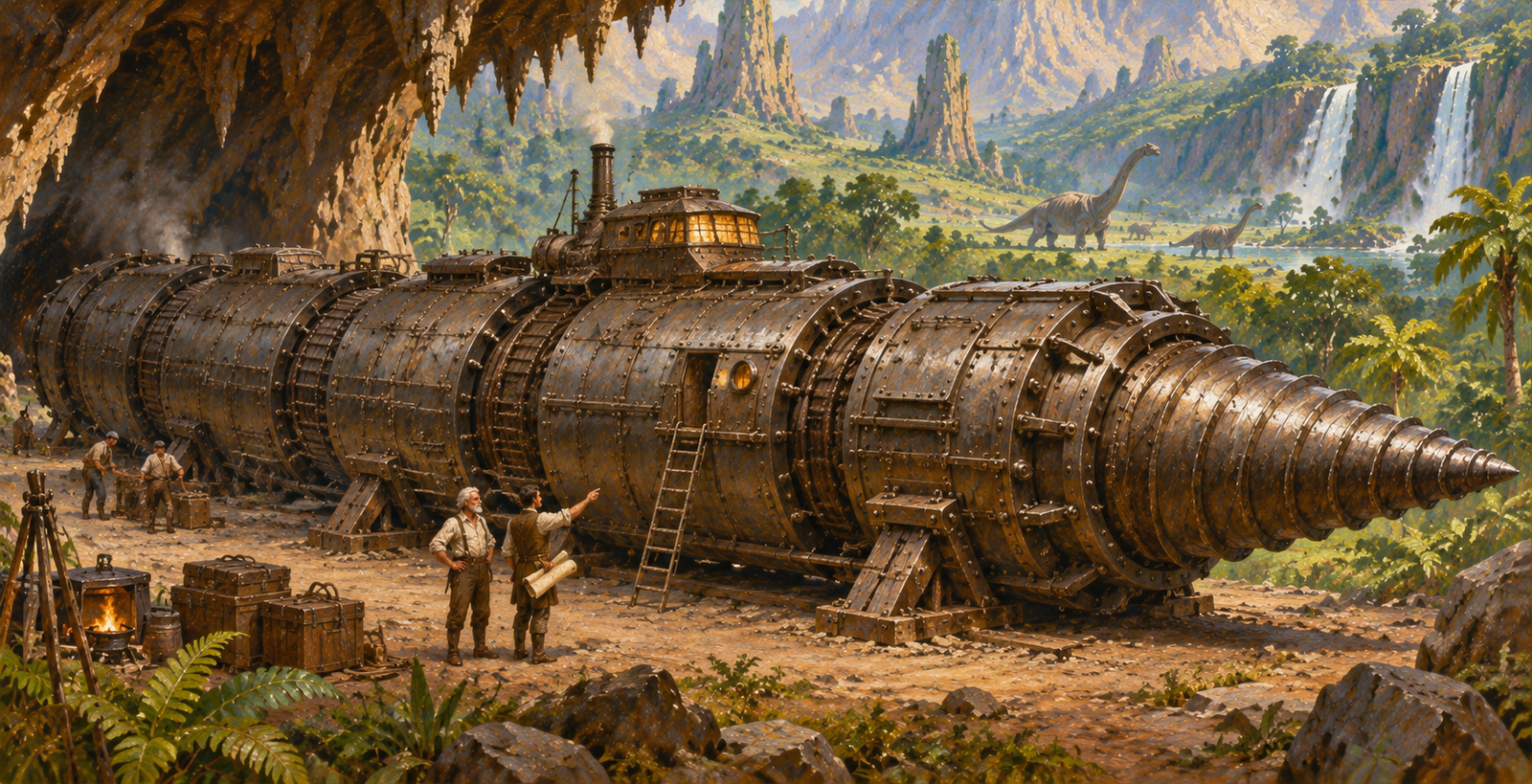
The giant steel cylinder rests on a cradle of heavy timbers. Its articulated sections bear the scars of their long descent; at the forward end, the great drill catches the light. Perry listens to the sound of the generator while David examines a chart of the surrounding strata. Their machine can reach places no road leads to, but the route home is far from certain.
The Iron Mole is the life’s work of Abner Perry, a mechanical prospector financed by David Innes. Its first voyage reveals Pellucidar. It is an exceptional invention, not proof that ordinary workshops can reproduce its capabilities. The current expedition depends on rare parts, skilled maintenance and the continued cooperation of the inhabitants of the Inner World.
Hull, Drive and Cabin
The elongated steel shell has flexible joints permitting changes of direction through rock. A powerful revolving head cuts a passage ahead of the vehicle. The enclosed cabin holds controls, supplies and instruments for recording travel and examining the surrounding materials. A separate atmosphere apparatus supplies breathable air while the vessel is sealed underground.
Steering is the machine’s greatest vulnerability: the crew cannot simply turn the hull at will when surrounding rock resists the nose. A lost course can leave the travellers far from their intended destination. The Iron Mole is a prospector, not a reusable tunnel-building service; displaced material and unstable strata may close its passage.
Voyages and Maintenance
Before a descent, Perry needs a suitable launch site, a surveyed entry direction, sufficient provisions and working atmosphere equipment. The crew prepares an external cradle for repositioning the machine at the end of a voyage. It cannot simply drive across a valley like a wagon. The vehicle’s immense size also makes shelter, recovery and maintenance difficult.
In 1454, the machine represents a possible connection between the Inner World and the surface. The exceptional geology of Hollow Earth creates routes whose existence cannot be assumed elsewhere. A passage must be explored and established before its use can become reliable. No invention removes the need for local guides, permissions and political relationships.
Iron Mole — Vehicle Rules
D&D 2024
Iron Mole — Subterranean Vehicle
Unique campaign vehicle (original equipment profile).
| Size | Gargantuan object; 100 ft. long, 15 ft. wide |
|---|---|
| Crew | 2 trained operators |
| Passengers | 2 |
| Cargo | 1 ton after stores and crew |
| AC | 19 |
| HP | 600 |
| Damage Threshold | 20 |
| Speed | 8 mph in suitable strata; 4 mph in resistant rock; tactical movement 70 ft. or 35 ft. per round, respectively |
| Surface movement | None under its own power |
| Air reserve | 96 person-hours when fully charged |
| Cost | Unique; not sold |
Operation
One operator uses an action to drive or stop the vehicle; the second monitors its systems. Without a driver it stops boring at the end of its next turn. Sharp course corrections, fractured strata and unexpected obstructions require a DC 15 Intelligence check using smith’s or tinker’s tools if proficient. For an exceptional hazard the DC is 20. On a failure the craft stops and loses an hour of travel; the DM describes an identifiable problem before another attempt.
Systems and Damage
The hull, engine and atmosphere apparatus are enclosed. The hull has immunity to poison and psychic damage. At 300 HP or fewer, its speed is halved; at 0 HP it stops and cannot maintain a sealed cabin. Crew and passengers are not automatically injured when the vehicle takes damage. If the DM establishes that a breach opens into dangerous terrain, resolve the actual hazard using the normal rules. At zero hull HP the occupants must seek breathable air; apply the normal suffocation rules only if breathable air is unavailable.
Each occupied hour consumes one person-hour of air per occupant; a full reserve lasts 48 hours with two people or 24 hours with four. At zero reserve the cabin no longer supplies breathable air. A secure source of breathable air can replenish it during a maintenance stop. A trained mechanic with suitable tools and spare parts can restore 20 HP per day of workshop repairs; restoring a destroyed drive or atmosphere apparatus requires specialist work, not a spell that repairs small objects.
Limits
The drill is designed for excavating rock, not targeting creatures in combat. The craft does not leave a guaranteed traversable tunnel, pass through force barriers, or function as an amphibious or ordinary land vehicle. Preparing a new entry angle requires a secure work site, lifting equipment and a crew. Crew and occupants cannot attack out of a sealed hull.
Framework: D&D 2024 equipment and object rules; all vehicle values and special procedures above are original.
D&D 2014
Iron Mole — Subterranean Vehicle
Unique campaign vehicle (original equipment profile).
| Size | Gargantuan object; 100 ft. long, 15 ft. wide |
|---|---|
| Crew | 2 trained operators |
| Passengers | 2 |
| Cargo | 1 ton after stores and crew |
| AC | 19 |
| HP | 600 |
| Damage Threshold | 20 |
| Speed | 8 mph in suitable strata; 4 mph in resistant rock; tactical movement 70 ft. or 35 ft. per round, respectively |
| Surface movement | None under its own power |
| Air reserve | 96 person-hours when fully charged |
| Cost | Unique; not sold |
Operation
One operator uses an action to drive or stop the vehicle; the second monitors its systems. Without a driver it stops boring at the end of its next turn. Sharp course corrections, fractured strata and unexpected obstructions require a DC 15 Intelligence check using smith’s or tinker’s tools if proficient. For an exceptional hazard the DC is 20. On a failure the craft stops and loses an hour of travel; the DM describes an identifiable problem before another attempt.
Systems and Damage
The hull, engine and atmosphere apparatus are enclosed. The hull has immunity to poison and psychic damage. At 300 HP or fewer, its speed is halved; at 0 HP it stops and cannot maintain a sealed cabin. Crew and passengers are not automatically injured when the vehicle takes damage. If the DM establishes that a breach opens into dangerous terrain, resolve the actual hazard using the normal rules. At zero hull HP the occupants must seek breathable air; apply the normal suffocation rules only if breathable air is unavailable.
Each occupied hour consumes one person-hour of air per occupant; a full reserve lasts 48 hours with two people or 24 hours with four. At zero reserve the cabin no longer supplies breathable air. A secure source of breathable air can replenish it during a maintenance stop. A trained mechanic with suitable tools and spare parts can restore 20 HP per day of workshop repairs; restoring a destroyed drive or atmosphere apparatus requires specialist work, not a spell that repairs small objects.
Limits
The drill is designed for excavating rock, not targeting creatures in combat. The craft does not leave a guaranteed traversable tunnel, pass through force barriers, or function as an amphibious or ordinary land vehicle. Preparing a new entry angle requires a secure work site, lifting equipment and a crew. Crew and occupants cannot attack out of a sealed hull.
Framework: D&D 2014 Dungeon Master’s Guide, chapter 8, objects and hazards; all vehicle values and special procedures above are original.
Pathfinder 1e
Iron Mole — Colossal land vehicle (subterranean)
Squares 60 (100 ft. by 15 ft.); Cost unique.
Defense
AC 2; Hardness 10; hp 800 (broken 399); Base Save +0.
Offense
Maximum Speed 70 ft. (35 ft. through resistant rock); Acceleration 35 ft.; CMB +8; CMD 18; Ramming Damage 8d8 (accidental collision with an obstruction, not a drill attack).
Description
Propulsion mechanical generator (unique); Driving Check Knowledge (engineering) or Profession (engineer); Forward Facing drill end; Driving Device steering apparatus; Driving Space forward cabin (four squares); Crew 2; Decks 1; Capacity 2 passengers and 1 ton of cargo; Weapons none; Air reserve 96 person-hours.
Use Ultimate Combat vehicle driving actions, checks, driver modifiers, collision and broken-condition rules. For passage through resistant rock, use the reduced maximum speed above; difficult steering requires a DC 15 driving check, or DC 20 for severe obstacles. Failure stops boring and costs an hour outside combat. A sealed cabin provides full cover to the occupants, who cannot attack out of it. The drill does not perform vehicular overruns against creatures as an intentional attack.
Each occupant consumes one person-hour of air per hour. With no reserve and no breathable air, apply suffocation. A secure breathable location allows recharging. Workshop repairs with Craft (mechanical) DC 20 and suitable supplies restore 20 HP per day on success; a destroyed generator or air system needs specialist restoration. A ruined hull ends boring and its ability to maintain a sealed cabin. A crew cannot use the machine for ordinary surface travel, nor assume its passage creates a usable tunnel.
Rules framework: Pathfinder Ultimate Combat — Vehicles. This is an original vehicle profile, not an official published vehicle.
D&D 3.5e
Iron Mole — Unique Subterranean Vehicle
| Size | 100 ft. long, 15 ft. wide |
|---|---|
| Crew | 2 |
| Passengers | 2 |
| Cargo | 1 ton |
| Movement | 70 ft. per round in suitable strata; 35 ft. through resistant rock; 8 or 4 mph on long journeys |
| Surface movement | None |
| Air reserve | 96 person-hours |
| Cost | Unique; unavailable for ordinary purchase |
Handling
A driver spends a standard action each round to operate or stop the machine. A second operator monitors the generator and cabin. Use Knowledge (architecture and engineering) or Profession (engineer) DC 15 to handle an abrupt change in strata or course, DC 20 in severe conditions. Failure stops the craft and costs an hour of travel outside combat. Repositioning on the surface needs external machinery and labour.
Object Components
Use the object rules for attacks and damage. Each accessible steel hull section has hardness 10 and 120 hp; the drill head has hardness 10 and 180 hp; the enclosed generator has hardness 10 and 80 hp; the steering mechanism has hardness 10 and 60 hp; the atmosphere apparatus has hardness 5 and 60 hp. These are bespoke object values. An enclosed component has total cover until exposed. Determine the object AC by the normal size and immobility rules. A hull section reduced to zero exposes the interior; destruction of the drill, generator or steering stops controlled boring. Loss of the atmosphere apparatus ends air production. Apply normal suffocation only when breathable air is unavailable.
One occupant uses one person-hour of air each hour. At full reserve two operators can remain sealed for 48 hours; four occupants for 24 hours. Replenish in a safe breathable location. A trained engineer can restore 20 hp to one damaged component per day with a successful DC 20 Craft (mechanical) check and suitable parts; ruined components require rebuilding. The drill is not a weapon and does not guarantee a usable tunnel.
Rules framework: D&D 3.5e SRD — Objects. Original vehicle and component specifications.
Adventure Hooks
The lost direction. Instruments disagree during a descent. The crew must decide whether to halt at an accessible cavern or attempt a new route with dwindling reserves.
The disputed workshop. A rare component is available only from a community unwilling to surrender its own supplies. The expedition needs a fair exchange and a safe way to transport the replacement.
The sealed landing. A previous exit is inaccessible after a collapse. Nearby inhabitants know another way to reach open air, but they want assurances that the vehicle will not destroy their homes or expose them to hostile visitors.
Connected People and Places
Abner Perry · David Innes · Pellucidar · At the Earth’s Core (1976) · Vehicles catalogue
Sources and Licensing
Literary inspiration: Edgar Rice Burroughs, At the Earth’s Core (1914), chapter I and subsequent voyages. The hundred-foot articulated hull, drill, generator, atmosphere apparatus and steering difficulty come from the novel. Width, capacities, speeds, repair rules, other game values and the 1454 situation are original campaign adaptations. The 1976 film uses a different visual design. The hero is an original illustration; its external fittings are an artistic interpretation.
Rules references: D&D SRD 5.1 and 5.2.1, Wizards of the Coast LLC, CC BY 4.0; Pathfinder Roleplaying Game Ultimate Combat © 2011 Paizo Publishing, LLC; D&D 3.5e SRD object rules. All bespoke vehicle statistics and adventures are original.
Keep this reference growing
If this page helped with your reading or game, you can support its upkeep or explore the curated books.
Explore the Bookshop — epics, classics and stories behind imagined worlds.