
The Last Universe
The Last Universe
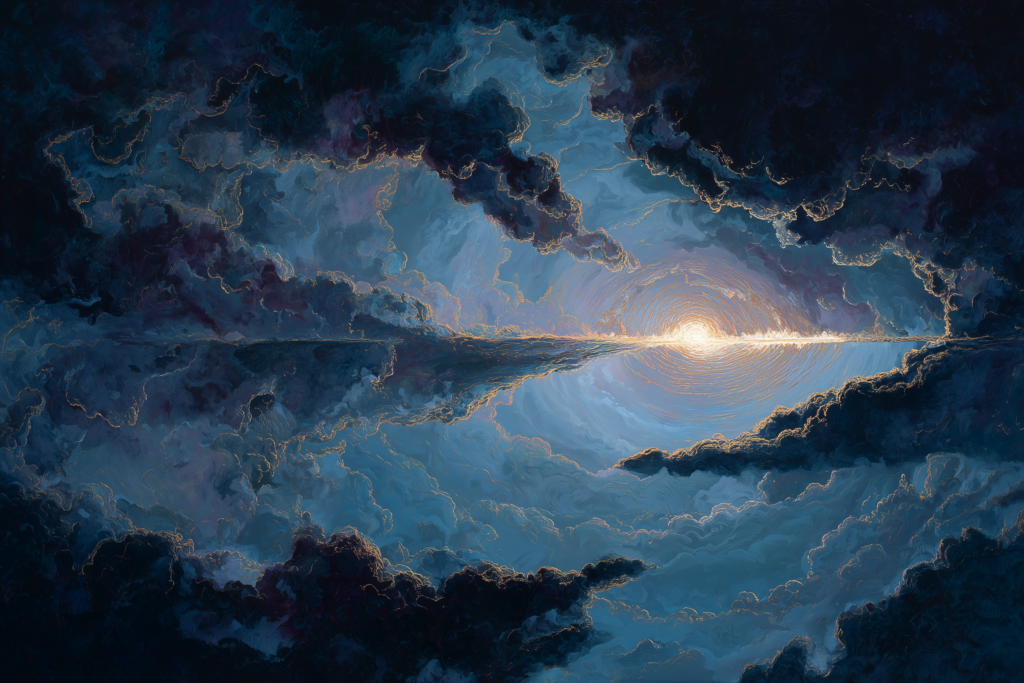
Before the present cosmos, another universe lived out its full span.
Its beginning is lost. Its stars, worlds, powers and planes belonged to an order that ended before measurable time began in the present universe.
The Powers of the Lost Creation
As that universe matured, consciousness awakened within it. Great powers arose as embodiments of its principles, environments and living forces. Some became gods. Others became architects, guardians, destroyers or keepers of laws that no longer exist.
They kindled stars, shaped worlds and cultivated realms of life, beauty, harmony and order. They created vast guardians and living wonders whose forms survive only in broken memories and uncertain echoes.
Nihros
Among these ancient powers was Nihros, Goddess of Chaos, Destruction and the Void.
Nihros embodied the power by which formed things could be broken, exhausted and returned to possibility. She was the storm before rebuilding, the silence after collapse and the darkness from which new forms might eventually emerge.
At first, the other powers accepted her place within creation. Worlds required change. Life required death. Structures that could never end would eventually become prisons.
Nihros brought endings.
Over immeasurable ages, however, her purpose changed. She ceased to destroy so that something new might follow. She came to desire permanent stillness: not the conclusion of one cycle, but the erasure of every possible cycle.
Where she passed, stars collapsed before their appointed endings. Planes lost the principles that held them together. Entire histories vanished so completely that even their absence could no longer be remembered.
The Final War
Nihros rose against the remaining powers of the Last Universe.
The war that followed consumed what remained of creation. Galaxies failed. Boundaries ruptured. Ancient peoples and beings whose names cannot survive translation fought to preserve a universe already approaching its natural end.
The gods could not destroy Nihros. Every weapon used against her became another act of destruction, and every ruined realm brought the Last Universe closer to the stillness she desired.
The surviving divine powers therefore united in one final act.
They bound Nihros beyond the remaining structure of their universe, constructing her prison from their own identities, powers and laws. Each became part of the seal: a boundary, prohibition, name, rune or consequence that prevented her from completing the erasure she had begun.
The seal held, but the gods did not survive it.
One by one, they vanished into their final work. Their realms darkened. Their voices became silent. Their names endured only where some fragment of memory refused to disappear.
The stars followed.
The Final Celebration
When only one sun remained, the final peoples and surviving intelligences gathered beneath its failing light. Some arrived in physical form. Others endured only as spirits, preserved thoughts, memories or disembodied wills.
Together, they held the Final Celebration.
They did not celebrate destruction. They honoured everything that had existed: every world raised from darkness, every life lived beneath the stars, every struggle against oblivion and every act of creation that Nihros had failed to erase.
They watched the final sun diminish.
Within its failing heart, they saw a flicker.
It was not yet fire, matter, energy, thought or divine life. It was a single unformed possibility: the capacity for something to exist after everything known had ended.
The final witnesses understood that they would not command what followed. They could neither design the next creation nor decide what forms would arise within it. They could only recognise that absolute nothingness had not won.
The Last Light
The last star sighed into darkness.
The universe did not scream.
It closed its eyes.
In the silence, necessity endured. Later traditions would give that enduring truth the name Ananke: whatever begins may end, whatever ends leaves consequences, and even the death of a universe cannot guarantee the destruction of all possibility.
The gods of the Last Universe were gone.
Its stars were dead.
Its laws had ceased to operate.
But not everything ended.
What Endured
Nihros remained within her seal. Impossible memories persisted without minds to contain them. Other remnants endured in forms that could no longer be described as living, dead, material or divine.
Beyond the ruins of the Last Universe, they persisted in the darkness between creations, where distance, duration, identity and cause no longer held dependable meaning.
The flicker within the final star was not the next universe itself.
It was the possibility of a beginning.
From possibility would come distinction.
From distinction would come opposition.
From opposition would come consequence.
But first, between the death of one creation and the awakening of another, there was only the Void Between Universes.
What Survives Into Play
The Last Universe is not merely an unreachable prologue. Its importance in a campaign lies in the things that escaped complete erasure. A surviving remnant should feel older than the laws of the present cosmos and dangerous precisely because later magic was never designed to contain it.
- Fragments of the seal: a rune, prohibition, divine name or impossible law used to bind Nihros may survive inside a later relic, ward or cosmic covenant.
- Memories without owners: visions, dreams or records may preserve events from a creation whose stars, gods and physical laws no longer exist.
- Impossible survivors: something encountered in the present cosmos may carry a purpose, wound or identity inherited from the dead universe without fully belonging to this one.
At the table: the useful question is rarely whether characters can travel back to the Last Universe. It is what fragment of that dead creation has entered their world, who recognises it, and what happens if the old seal around Nihros is weakened.
← SpiralWorlds Timeline · Next · The Void Between Universes →
Keep this reference growing
If this page helped with your reading or game, you can support its upkeep or explore the curated books.
Explore the Bookshop — epics, classics and stories behind imagined worlds.