
SpiralWorlds Magic · Planar Calling and Supernatural Service
Greater Planar Binding
Bind one formidable planar being—or, under legacy rules, call and bargain with as many as three creatures of one kind. The ritual’s greatest danger often begins after the magic succeeds.
I · Spell Overview
Powerful service under dangerous terms
Greater Planar Binding means different things in the modern and legacy rules. D&D 5.5e / 2024 has no separate spell by that name: it is the ordinary Planar Binding spell cast with an 8th-level slot, binding one eligible creature for 180 days. Pathfinder 1e and D&D 3.5e retain a separate calling spell that can bring one creature of up to 18 Hit Dice, or as many as three creatures of the same kind whose total Hit Dice do not exceed 18.
Modern binding
The creature must already be present and remain within 60 feet throughout the one-hour casting. A failed Charisma save binds it to service for 180 days.
Legacy calling
The spell transports the actual creature from another plane into an inward-facing circle. Arrival, containment, escape and negotiation are separate stages.
Service is not friendship
A hostile modern target obeys while twisting commands toward its own ends. A legacy target must be persuaded individually and may seek revenge after release.
Do not mix the procedures
Hit Dice limits, Will saves, Spell Resistance, opposed Charisma bargains and calling diagrams belong to Pathfinder 1e and D&D 3.5e. The 2024 spell instead uses creature types, a Charisma save, an ongoing duration and modern Dispel Magic rules.
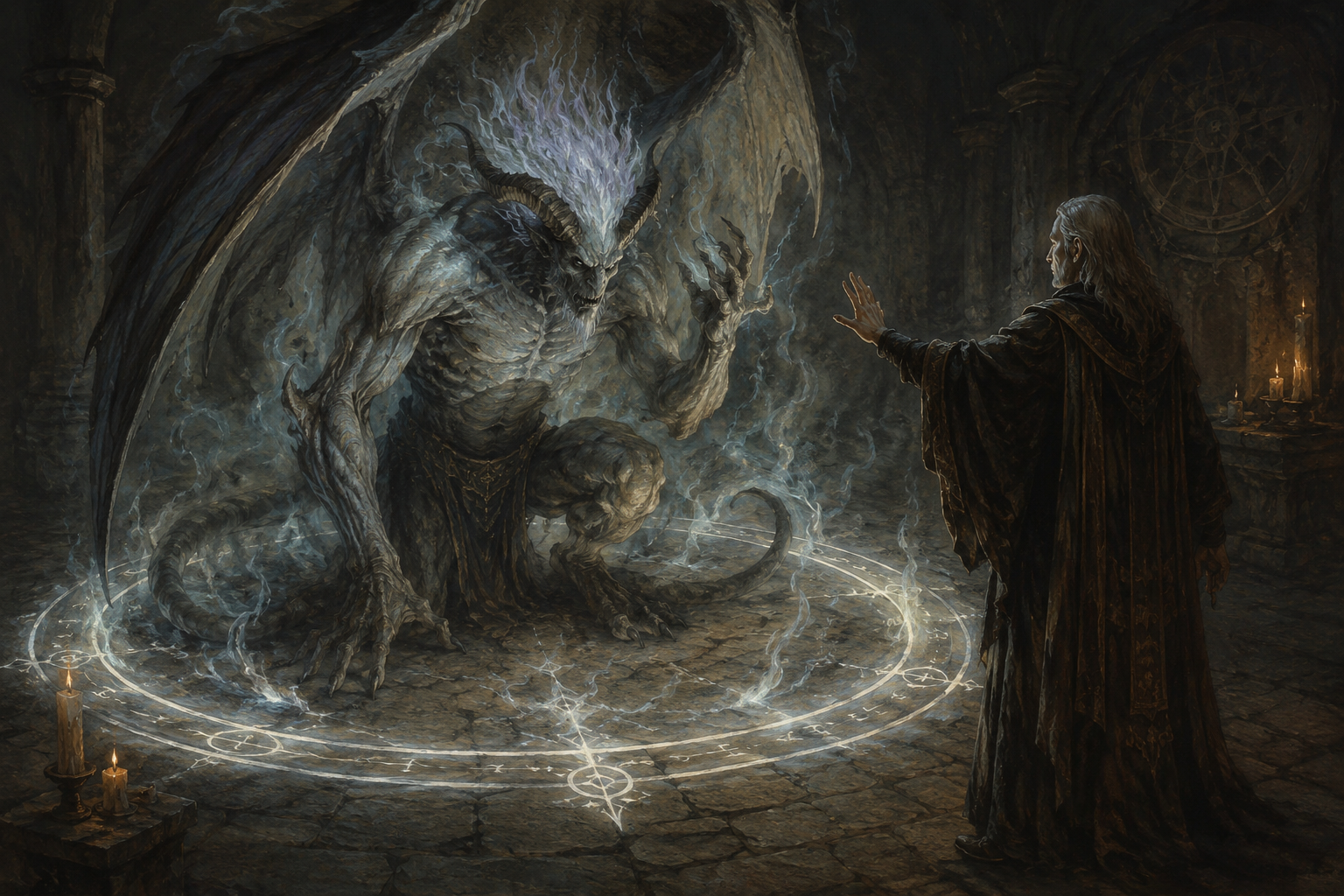
II · At the Table
Quick Rules Reference
Resolve the ritual in this order, then use only the matching edition panel immediately below.
Choose the edition
Modern rules bind a present creature. Legacy rules call an actual creature from another plane.
Secure the target
Use an inward-facing Magic Circle or another legal confinement method.
Complete the casting
D&D 2024 requires one hour and Concentration during casting. The legacy versions require ten minutes.
Resolve resistance
Use a Charisma save in 2024 or a Will save in the legacy editions. Do not substitute one for the other.
Resolve service
Modern service follows a failed save. Legacy service requires a separate opposed Charisma negotiation.
Track separate spells
The circle, binding, summoning effect and Dimensional Anchor remain distinct effects.
Check escape and dispelling
Modern binding can be dispelled. An instantaneous legacy calling cannot, although its ongoing trap can end.
Record the aftermath
Note the exact command, duration, payment, witnesses, broken wards and any reason the creature has to retaliate.
III · Edition-Separated Rules
Greater Planar Binding Mechanics
Use one panel only. The terminology, saves, creature limits, duration and counterplay are not interchangeable.
D&D 5.5e / 2024 rules
Planar Binding cast with an 8th-level spell slot
Rules status: Greater Planar Binding is a useful page title and legacy name, but the official 2024 rules use the 5th-level Planar Binding spell with an 8th-level slot. The higher slot changes its duration to 180 days.
Resolution procedure
- Place an eligible creature within 60 feet. The spell does not summon it. The creature must be a Celestial, Elemental, Fey or Fiend. Undead are not eligible.
- Keep the creature within range for the full hour. An inverted Magic Circle is the usual way to confine a hostile or summoned creature throughout the casting.
- Maintain the longer casting. A spell with a casting time of one minute or longer requires the Magic action on each turn and Concentration throughout the casting. If Concentration breaks, the casting fails, the spell slot is not expended and the caster must start again.
- Resolve the Charisma saving throw at completion. On a success, the creature is not bound. On a failure, it serves for 180 days.
- Extend the originating spell when applicable. If another spell summoned or created the creature, that spell’s duration extends to match the binding.
- Issue commands. The creature follows them to the best of its ability. A Hostile creature actively seeks interpretations that advance its own objectives.
- Resolve completion. If it finishes a command before the binding ends, it travels to report when on the same plane. If it is on another plane, it returns to the binding location and remains there until the spell ends.
Concentration conflict
The one-hour casting itself requires Concentration. A caster generally cannot maintain a different Concentration summoning spell at the same time. Use another caster, a non-Concentration means of bringing the creature or another legal arrangement.
Circle timing
A 3rd-level Magic Circle lasts one hour, exactly matching the binding’s casting time. Casting the circle with a 4th-level slot gives it a two-hour duration and avoids relying on effects ending at the same moment.
Commands, communication and truth
- The spell grants service, not friendship, the Charmed condition, telepathy or a shared language.
- Use a language, telepathic method or interpreter the creature understands if precise orders matter.
- The spell does not make statements truthful. A command to answer questions does not reveal what the creature does not know or prevent evasive phrasing.
- The modern spell does not use an opposed Charisma bargain or the legacy reasonable-demand procedure.
Dispel Magic and separate effects
The completed binding is an ongoing 8th-level spell. An 8th-level or higher Dispel Magic ends it automatically. A lower-level casting requires a spellcasting ability check against DC 18. Dispel Magic may target a creature, object or magical effect; resolve every ongoing spell affecting that chosen target according to the spell’s rules. The surrounding Magic Circle remains a separate magical effect.
After the circle ends
Once the creature has failed its save and the binding is complete, the circle is no longer required to maintain the binding. Ending or dispelling the circle does not itself end Planar Binding.
Optional SpiralWorlds conversion: Dimensional Anchor is presented on SpiralWorlds as an independent 2024-compatible conversion rather than a core 2024 spell. Apply that page’s wording only when the campaign uses it.
Pathfinder 1e rules
Planar Binding, Greater
This is a separate legacy calling spell. It transports the actual creature or creatures into a prepared trap; containment and service are not automatic merely because the initial call succeeds.
When the called creature has the air, chaotic, earth, evil, fire, good, lawful or water quality, the spell gains the corresponding descriptor for that casting.
Calling procedure
- Prepare an alignment-appropriate inward-facing magic circle. The linked Magic Circle Against Evil procedure contains a nongood called creature; another alignment version may be required for a different target. State the kind of elemental or outsider to be called. Calling a particular individual requires that creature’s proper name.
- Begin the ten-minute binding. Begin casting Planar Binding during the round after completing the inward circle. The calling completes after its normal ten-minute casting time.
- Resolve each Will save. Success prevents that creature from being called. Spell Resistance does not prevent the initial calling.
- Place each failed target in the trap. When several creatures are called, they must be of the same kind, their total Hit Dice cannot exceed 18, and no two can be more than 30 feet apart when they appear.
- Resolve escape attempts separately. Once per day, each prisoner can try Spell Resistance against the caster-level check, dimensional travel and a Charisma check against DC 15 + half the caster level + the caster’s Charisma modifier.
- Negotiate separately. Describe the service and any reward, then make an opposed Charisma check against each creature. The caster’s check receives a +0 to +6 modifier based on the service and reward.
- Release after service. A creature that completes the agreed service can report completion and immediately return whence it came. It may remember the coercion and seek revenge.
Escape DC
DC 15 + half the caster level + the caster’s Charisma modifier. A successful reinforced calling diagram increases this Charisma escape DC by 5.
Natural 1
If the caster rolls a natural 1 on the opposed Charisma check, the creature breaks free and can escape or attack. This is not merely an automatic negotiation failure.
Ordinary trap and reinforced diagram
| Feature | Ordinary inward circle | Successful calling diagram |
|---|---|---|
| Preparation | Cast the ordinary powdered-silver circle using its normal procedure. | Draw for 10 minutes and make a secret DC 20 Spellcraft check. Take 10 when unpressured, or take 20 by spending 3 hours 20 minutes. |
| Spell Resistance | The creature can test the trap once per day. | The creature cannot use Spell Resistance against the circle. |
| Attacks and abilities | Ranged attacks, spells and magical abilities can cross. | None of the prisoner’s attacks or abilities can cross. |
| Dimensional escape | Possible unless Dimensional Anchor prevents it. | The anchor may be placed on the diagram during the round before the calling spell begins. |
| Charisma escape | Normal binding DC. | Binding escape DC increases by 5. |
| Fragility | Breaking the silver boundary ends the trap. | Any outside disturbance of the diagram releases the prisoner. |
An inward circle can contain a called creature for no more than 24 hours per caster level. The creature must fit within the trap; if it is too large, the specialised inward containment does not hold it. The prisoner cannot directly or indirectly disturb its own silver boundary, but another creature can break or contaminate the circle.
Refusal, new offers and open-ended service
- A creature that wins the opposed Charisma check refuses the offer but is not automatically dismissed.
- New offers, rewards or repeated terms can be attempted every 24 hours.
- Impossible or unreasonable demands are never accepted.
- An open-ended task the creature cannot complete through its own actions lasts no longer than 1 day per caster level and grants an immediate new chance to break free.
- A clever creature can subvert poorly worded instructions.
Calling, death and Dispel Magic
A calling spell transports the actual creature. If killed, it truly dies rather than disappearing and reforming as a summoned creature would. Because the call is instantaneous, Dispel Magic cannot reverse the completed calling. It can still end the ongoing Magic Circle or Dimensional Anchor, removing containment without sending the creature home.
D&D 3.5e rules
Planar Binding, Greater
The D&D 3.5e spell uses the original legacy calling structure: an inward-facing circle, a Will save against arrival, daily escape methods and an opposed Charisma negotiation for service.
When the called creature has the air, chaotic, earth, evil, fire, good, lawful or water quality, the spell gains the corresponding descriptor for that casting.
Resolution procedure
- Prepare the trap. Focus an alignment-appropriate magic circle inward. The linked Magic Circle Against Evil procedure contains a nongood called creature; another alignment version may be required for a different target. State the kind of elemental or outsider, and use a proper name to call a specific individual.
- Begin the ten-minute casting. Begin casting Planar Binding during the round after completing the inward circle. The calling completes after its normal ten-minute casting time.
- Resolve each Will save. A success resists the call. Spell Resistance does not stop the initial transport.
- Resolve each prisoner independently. Every called creature makes its own escape attempts and must be persuaded separately.
- Check daily escape routes. Each creature may test Spell Resistance against the caster-level check, attempt dimensional travel and make the Charisma escape check once per day.
- Negotiate service. Oppose the caster’s Charisma check against the creature’s Charisma check, applying the +0 to +6 service-and-reward modifier.
- Complete and return. After the agreed service, the creature can report completion and return to its home plane. Future retaliation remains possible.
Multiple calling
All called creatures must be of the same kind, their combined Hit Dice cannot exceed 18, and no two can be more than 30 feet apart when they appear. A successful save by one creature does not cancel the successful calls of the others.
Escape, bargaining and the diagram
- Charisma escape DC: 15 + half the caster level + the caster’s Charisma modifier.
- Daily attempts: Spell Resistance, dimensional travel and the Charisma escape check can each be attempted once per day.
- Dimensional Anchor: prevents dimensional escape when successfully applied under the circle or diagram procedure.
- Calling diagram: takes 10 minutes and a secret DC 20 Spellcraft check. The caster can take 10 when unpressured or take 20 by spending 3 hours 20 minutes. A successful diagram blocks the prisoner’s attacks and abilities from crossing, prevents Spell Resistance from defeating the circle and raises the Charisma escape DC by 5, but any outside disturbance releases the prisoner.
- Negotiation: impossible or unreasonable demands are never accepted. Refused offers can be renewed after 24 hours.
- Natural 1: releases the creature immediately, allowing it to flee or attack.
- Open-ended task: maximum 1 day per caster level when the creature cannot complete the task through its own actions, with an immediate chance to break free.
The inward circle contains the creature for no more than 24 hours per caster level. A creature too large to fit is not held by the specialised inward trap. The prisoner cannot disturb its own boundary directly or indirectly, but an outside creature can break the line or disturb a diagram.
Calling is not summoning
The called creature is physically transported from another plane. It actually dies if killed, and the instantaneous calling cannot be dispelled. A summoned creature instead disappears when its summoning effect ends or when it is defeated. Keep that distinction intact when adjudicating death, treasure, resurrection and planar retaliation.
Dispel Magic
A targeted Dispel Magic can end the ongoing Magic Circle or Dimensional Anchor through the D&D 3.5e caster-level procedure. It cannot undo the completed instantaneous calling. If the trap ends, the called creature remains present and free.
IV · Rules Comparison
Edition Differences at a Glance
| Rule element | D&D 5.5e / 2024 | Pathfinder 1e | D&D 3.5e |
|---|---|---|---|
| Official form | Planar Binding cast with an 8th-level slot. | Separate Greater Planar Binding spell. | Separate Greater Planar Binding spell. |
| School | Abjuration. | Conjuration (Calling). | Conjuration (Calling). |
| Creature already present? | Yes. | No; the spell calls it from another plane. | No; the spell calls it from another plane. |
| Eligible creatures | Celestial, Elemental, Fey or Fiend. | Elementals or outsiders. | Elementals or outsiders. |
| Number of targets | One. | One, or up to three of the same kind. | One, or up to three of the same kind. |
| Power limit | No Hit Dice or Challenge Rating limit. | 18 Hit Dice total. | 18 Hit Dice total. |
| Initial defence | Charisma save at completion. | Will save against being called. | Will save against being called. |
| Spell Resistance | Not used. | Does not stop arrival; may later defeat an ordinary trap. | Does not stop arrival; may later defeat an ordinary trap. |
| Service model | Magical service after a failed save. | Opposed Charisma bargain after containment. | Opposed Charisma bargain after containment. |
| Binding duration | 180 days with an 8th-level slot. | Service-based; the calling itself is instantaneous. | Service-based; the calling itself is instantaneous. |
| Can Dispel Magic end it? | Yes. DC 18 with a lower slot; automatic with an 8th-level or higher slot. | It cannot reverse the call, but it can end the circle or anchor. | It cannot reverse the call, but it can end the circle or anchor. |
| Death risk | Depends on the effect that brought or created the creature. | A called creature actually dies if killed. | A called creature actually dies if killed. |
V · Adjudication
Rules Clarifications and Edge Cases
Most disputes arise from importing a rule from another edition, treating a circle as a perfect wall or assuming magical obedience also creates loyalty and honesty.
Is Greater Planar Binding a separate spell in D&D 2024?
No. Use Planar Binding with an 8th-level spell slot. The result lasts 180 days.
Does the 2024 spell summon the creature?
No. The target must already be within 60 feet and remain in range throughout the full casting. Magic Circle confines; it does not summon.
Can the modern spell bind an Undead creature?
No. The eligible types are Celestial, Elemental, Fey and Fiend. Magic Circle can affect Undead, but that does not make Undead a legal Planar Binding target.
Can one 2024 caster maintain a summoning spell and cast the binding?
Usually not when both require Concentration. The one-hour casting of Planar Binding requires Concentration under the longer-casting rule. Another caster or a non-Concentration method is normally required.
Does the completed 2024 binding require Concentration?
No. Concentration is required while casting because the casting time is one hour. The completed 180-day binding has no Concentration requirement.
Does the 2024 binding impose the Charmed condition?
No. It imposes the service described by the spell. Features interacting specifically with Charmed do not automatically apply.
Does an inward circle block every attack?
No. In 2024, the selected creature has Disadvantage on attack rolls against protected targets, but the circle does not automatically block saving-throw effects, areas or every ranged ability. In the legacy editions, ordinary circles allow ranged attacks, spells and magical abilities to cross; a successful reinforced diagram is much stricter.
What happens when only some legacy creatures fail their Will saves?
Resolve each creature independently. Successful calls remain valid even if another intended target resists. Each arriving creature then makes its own escape attempts and requires its own bargain.
Can the legacy spell force an impossible or suicidal service?
Impossible or unreasonable demands are never accepted. The service-and-reward terms affect the opposed Charisma check, and the GM decides the appropriate modifier.
Does a legacy creature vanish if the circle is dispelled?
No. The calling is instantaneous. Ending the circle removes containment; it does not return the creature to its home plane.
Does Planar Binding compel truthful answers?
No edition presented here explicitly creates perfect truthfulness. A commanded or bargained creature can answer within the limits of its knowledge and may exploit ambiguity unless another effect requires truthful speech.
Can a creature seek revenge afterward?
Yes. The legacy text expressly warns of later revenge, and a hostile modern creature retains its own goals while bound. The spell governs service, not memory, forgiveness or future allegiance.
VI · Ritual Planning
Preparing the Binding
A greater binding should feel like a prepared operation rather than a casual spell selection. Its risks involve range, time, concentration, escape routes, communication and the creature’s motives.
Research the target
Know its creature type, movement modes, teleportation, resistances, languages, goals and likely response to coercion. Legacy casters also need the correct kind or proper name.
Build the chamber
Use distance, cover, controlled entrances and guards as well as magic. A circle controls specified crossings; it is not automatically an impregnable bunker.
Plan the arrival
Modern casters must already have a legal target present. Legacy casters must ensure the trap is within range and large enough for every called creature.
Close escape routes
Account for ordinary movement, magical travel, external saboteurs and dispelling. In legacy play, Dimensional Anchor and a correct diagram materially improve containment.
Prepare communication
Secure a shared language, telepathy or an interpreter. Write the essential objective, limits and reporting terms before the ritual begins.
Prepare the exit
Decide how the creature will be dismissed, returned, released or confronted if the binding fails. Do not improvise that decision after a hostile prisoner escapes.
Pre-casting checklist
- Correct edition and spell statistics confirmed.
- Legal target type or legacy creature category confirmed.
- Circle orientation and duration confirmed.
- Casting range and creature size measured.
- Concentration responsibilities assigned.
- Teleportation and planar escape assessed.
- Command or proposed service written in advance.
- Legacy reward and negotiation modifier discussed with the GM.
- Dispel protection, guards and emergency response positioned.
- Exact start time, end time and separate spell durations recorded.
VII · Strategic Uses
Best Uses
Long-term guardian
Protect a vault, crossing, fortress or ritual site. State who may enter, what counts as a threat and what collateral damage is forbidden.
Planar guide
Use native knowledge of hazards, customs and routes. Binding does not grant omniscience, so choose a creature with relevant experience.
Messenger or courier
Deliver an object or message through hostile territory. Define the recipient, proof of delivery and what happens if the route becomes impossible.
Specialist support
Secure healing, translation, reconnaissance, construction, weather control or another capability the party cannot reliably provide.
Expedition companion
Bring a creature whose movement and resistances match the destination. Establish tactical authority and retreat conditions before danger begins.
Coordinated legacy group
Pathfinder 1e and D&D 3.5e can call as many as three creatures of one kind within the 18-HD total, useful for matched scouts, messengers or specialists—but each one requires a separate save, escape procedure and bargain.
Information is not automatically reliable
A bound creature can be ordered or bargained with to investigate or report, but the spell does not make it all-knowing and does not independently enforce truth. Verify high-stakes information through another source.
VIII · Command Craft
Tactics and Command Wording
Effective wording defines an objective without creating needless loopholes. The aim is not an endless legal document; it is a clear order that identifies success, authority, limits and reporting.
Include
- The primary objective.
- Who can issue or revise instructions.
- Where and when the service applies.
- Prohibited targets and collateral damage.
- Conditions for retreat or suspension.
- How completion must be reported.
Avoid
- Undefined words such as enemy, safe or soon.
- Contradictory priorities.
- Tasks the creature cannot complete itself.
- Orders that depend on knowledge it does not possess.
- Assuming silence, loyalty or truthfulness.
- Leaving release and reporting unaddressed.
Example modern command
“Guard the western archive until sunrise on the final day of this binding. Prevent any creature other than the six named custodians from entering by the two marked doors. Use no lethal force unless a creature attacks a custodian or attempts to destroy the archive. Obey tactical instructions from the bearer of this seal, and report any breach to me at this chamber.”
This wording establishes place, duration, authorised entrants, escalation, delegated authority and reporting. It still leaves room for adjudication and does not create abilities the creature lacks.
Legacy negotiation
In Pathfinder 1e and D&D 3.5e, a clear request is only the beginning. The caster still makes a separate opposed Charisma check for every called creature. Reward, danger, duration and compatibility with the creature’s nature inform the +0 to +6 modifier. A fair, limited and well-paid service is easier to secure than an indefinite or self-destructive demand.
IX · Counterplay
Countermeasures and Failure States
| Failure or counter | D&D 2024 result | Legacy result |
|---|---|---|
| Target leaves legal range during casting | The one-hour casting cannot complete against that target. | The prepared trap and calling range govern arrival; use the legacy procedure. |
| Caster loses Concentration during casting | The spell fails, the slot is not spent and the casting must restart. | Do not import the modern longer-casting Concentration rule. |
| Target succeeds on initial save | It is not bound. | That creature is not called. |
| Circle expires or is broken before completion | The creature may escape before the binding is complete. | The prisoner is released from the trap but remains on the plane. |
| Dimensional escape | Resolve the active confinement effect. Optional Dimensional Anchor may prevent travel. | An ordinary circle can be bypassed unless Dimensional Anchor or a correct diagram prevents it. |
| Spell Resistance | Not used. | Does not prevent arrival but may defeat an ordinary circle once per day. |
| Dispel Magic after success | Can end the ongoing 8th-level binding. | Cannot reverse the instantaneous call; it may remove the circle or anchor. |
| Natural 1 on negotiation | No corresponding rule. | The creature breaks free and may flee or attack. |
| External saboteur | May dispel a ward, open a route or disrupt the hour-long casting. | Can break or disturb the circle or diagram and release the prisoner. |
| Poorly worded service | A Hostile creature twists commands toward its own objectives. | A clever creature subverts the bargain’s wording. |
The worst failure is often a successful release
A called legacy creature remains physically present when the trap fails. A modern creature released by Dispel Magic is no longer compelled but may still be standing beside the caster. Every binding chamber needs a plan for that moment.
X · Game Master Guidance
Running Greater Planar Binding
Make the creature a character
Give it motives, loyalties, fears and limits. Binding constrains conduct; it does not erase identity.
Adjudicate wording fairly
Reward clear planning without turning every sentence into a trap. Hostile interpretation should follow the creature’s aims, not arbitrary wordplay.
Preserve the spell’s cost
The 2024 jewel is consumed. Legacy play requires preparation, containment and negotiation. Do not silently waive those pressures.
Respect separate effects
Track the circle, anchor, summoning or creation spell and binding independently. Countering one does not automatically erase all the others.
Let powerful service matter
An 8th-level binding should change strategy, logistics and politics. It should not be reduced to an invisible bonus with no narrative presence.
Let consequences survive
Witnesses, planar allies, rivals and the creature itself can remember what happened after the mechanical effect ends.
Balancing without nullifying
Do not make every target immune, every command fail or every ritual interrupted merely to protect the adventure. Let the spell succeed on its own terms and make the world respond: enemies investigate the ritual chamber, allies question coercive methods, an extraplanar court demands restitution, or the bound creature fulfils the command in a way that advances its long-term agenda.
XI · Setting Impact
Worldbuilding Consequences
Regulated ritual chambers
Cities that tolerate planar binding license specialised chambers, inspect circles and punish rituals conducted near crowded districts.
Jewel consumption
Modern bindings consume jewels worth at least 1,000 GP, creating demand for certified stones, guarded supply lines and counterfeit detection.
Proper names as secrets
Legacy proper names become guarded intelligence, traded by scholars, spies and planar negotiators rather than ordinary catalogue entries.
Planar diplomacy
Repeated coercion can provoke reprisals, sanctions, retaliatory summonings or demands from powers that consider the creature a citizen, servant or sacred being.
Anti-binding architecture
Important strongholds use teleportation wards, protected thresholds, redundant dispellers and designs that deny a caster an uninterrupted hour.
Professional intermediaries
Planar advocates, translators, circle-makers and contract witnesses may turn coercive binding into negotiated service—or conceal abuses behind formal procedure.
Campaign-scale duration
A 180-day modern binding is long enough to alter a war, expedition, succession crisis or trade route. Record its end date. The approaching expiration should become a real strategic deadline rather than background bookkeeping.
XII · Adventure Design
Adventure Hooks
The Last Day of Service
A bound guardian’s 180 days end during a siege. The party must decide whether to renew the binding, negotiate a true alliance or face the creature’s accumulated anger.
Three of One Kind
A legacy ritual calls three creatures, but only two accept service. The third remains inside the circle, testing the boundary while its companions begin their mission.
The Broken Diagram
A single thread lies across a reinforced diagram. Was it an accident, sabotage or a deliberate signal from someone inside the ritual team?
The Proper Name Auction
Several factions bid for the proper name of a powerful outsider. The name may enable a binding, expose a fraud or begin a planar feud.
The Dispelled Oath
An enemy quietly ends a modern binding while the creature is deep inside a royal palace. The freed being must choose between revenge, escape and completing a promise it was never magically required to honour.
The Creature That Returned
Years after completing a legacy service, the called creature returns with witnesses and evidence of what the caster’s command cost on another plane.
XIII · Historical and Occult Development
Circles, Names and Ritual Authority
Greater Planar Binding is a modern fantasy-game construction rather than a historical ritual. Its visual and narrative language nevertheless draws from long traditions of ceremonial magic: prepared spaces, inscribed figures, specialised names, timed operations and the belief that correct words can establish authority over an unseen being.
Surviving manuscript catalogues show that European collections preserved magical experiments, invocations, seals and diagrammatic material across several centuries. The British Library’s Sloane MS 3846 contains magical texts and experiments dated from the fourteenth to the seventeenth centuries, including invocations and material concerning magical images and seals. Sloane MS 3191 is catalogued as John Dee’s surviving book of ceremonial-magic notes from 1584–1585.
Printed and theatrical images later made the circle-and-conjurer scene immediately recognisable. The Faust tradition places ambition, command and dangerous service at the centre of the drama: the practitioner seeks knowledge or power, but the relationship with the supernatural servant carries a price. A British Museum portfolio associated with Goethe’s Faust preserves nineteenth-century visual interpretations of Faust and Mephistopheles.
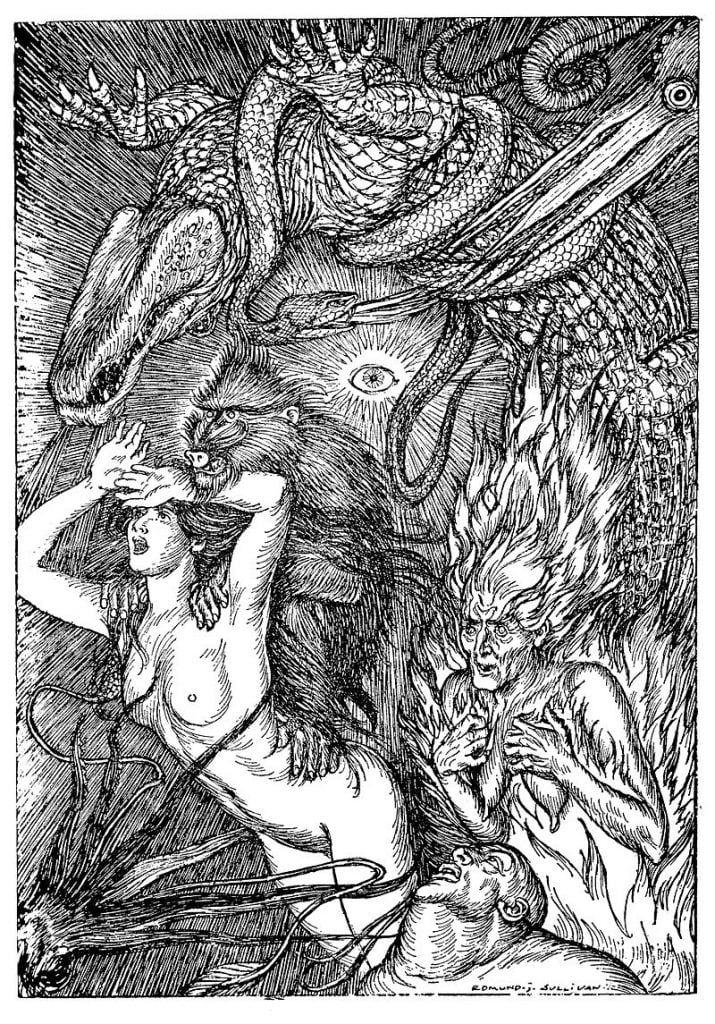
From ritual boundary to game procedure
Roleplaying rules convert broad cultural motifs into explicit steps: draw or cast a boundary, identify a legal target, resolve resistance, negotiate or command service, and define how the effect ends. The result is gameable structure rather than a claim that historical practitioners used these rules.
XIV · Mythological Parallels
Holding the Otherworld Long Enough to Gain an Answer
Proteus and compelled knowledge
In Greek tradition, Proteus is a prophetic sea-god who changes shape to escape capture. Those able to hold him through his transformations can obtain an answer. The parallel lies in containment, resistance and knowledge gained from an unwilling supernatural being, not in a direct origin for the spell.
The power of the proper name
Many ritual and mythic traditions treat names as more than labels: a precise name identifies the being addressed and establishes a special relationship of knowledge or authority. Legacy Planar Binding turns that motif into a concrete rule for calling a specific individual.
Faust and dangerous service
Faust stories frame supernatural service as a bargain whose apparent benefit conceals moral, legal or personal consequences. Greater Planar Binding reverses or complicates that bargain by allowing the mortal caster to become the coercive party.
These are thematic parallels rather than claims of direct descent. The spell combines widespread story patterns—capturing a shape-changing revealer, naming an otherworldly being, drawing a protected boundary and bargaining for dangerous aid—into a rules system designed for play.
XVI · Verification
Sources and Licensing
The mechanics were checked edition by edition. External links open in a new tab; internal mechanics links point only to confirmed SpiralWorlds pages.
- System Reference Document 5.2.1 — Planar Binding, longer casting times and D&D 2024 spell rules.
- Archives of Nethys: Planar Binding — Pathfinder 1e lesser, standard and greater versions.
- d20 SRD: Planar Binding, Greater — D&D 3.5e greater spell.
- d20 SRD: Planar Binding, Lesser — inherited D&D 3.5e calling and negotiation procedure.
- d20 SRD: Spell Descriptions — calling and summoning distinctions.
- British Library: Sloane MS 3846 — catalogue record for magical treatises and experiments.
- British Library: Sloane MS 3191 — John Dee’s ceremonial-magic notes.
- British Museum: Faust portfolio — nineteenth-century Faust and Mephistopheles imagery.
- British Museum: Proteus — mythological reference.
- Wikimedia Commons: Edmund J. Sullivan illustration — public-domain historical artwork retained from the original page.
Licensing notice
This work includes material from the System Reference Document 5.2.1 (“SRD 5.2.1”) by Wizards of the Coast LLC, available through D&D Beyond’s System Reference Document page. The SRD 5.2.1 is licensed under the Creative Commons Attribution 4.0 International License.
Legacy Pathfinder 1e and D&D 3.5e rules material is Open Game Content used under the Open Game License v1.0a. Original explanations, comparisons, setting material, adventure content and the primary spell illustration are SpiralWorlds editorial material.
Keep this reference growing
If this page helped with your reading or game, you can support its upkeep or explore the curated books.
Explore the Bookshop — epics, classics and stories behind imagined worlds.