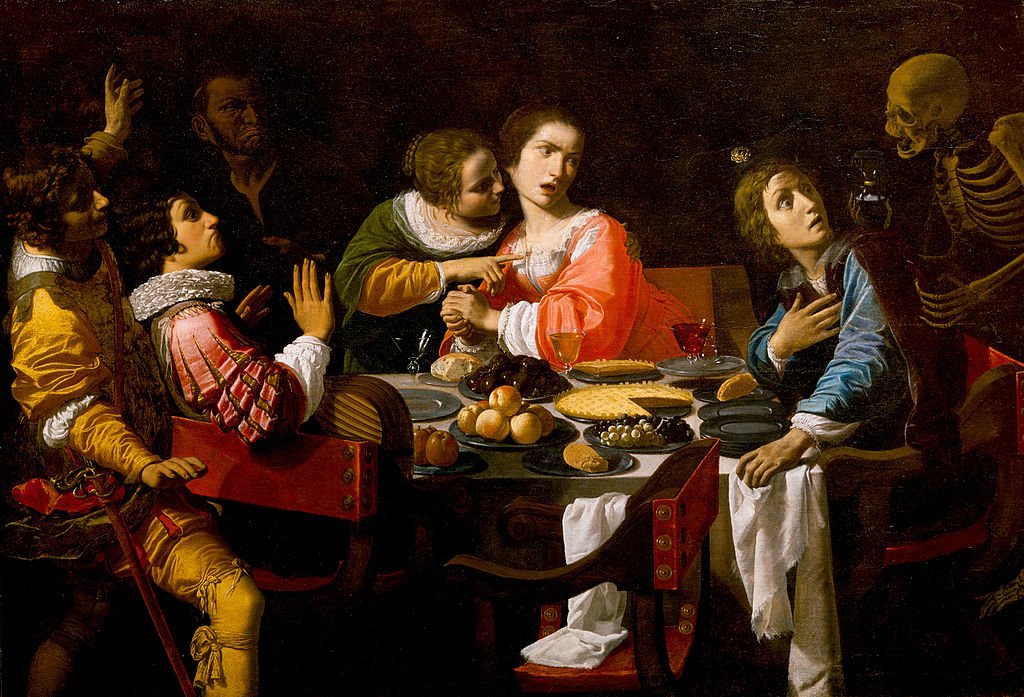
The Fear Spell turns courage into immediate flight. Weapons fall, defenders abandon their positions and a disciplined formation can dissolve into retreat before a blade is drawn.
It is most dangerous where holding ground matters: gateways, bridges, breaches, stairways, barricades and crowded battle lines.
Giovanni Martinelli, Death Comes to the Banquet Table, c. 1630–1640, New Orleans Museum of Art.
Each creature in the 30-foot Cone makes a Wisdom saving throw. On a failed save, the creature drops whatever it is holding and gains the
Frightened
condition for the duration.
On each of its turns while affected, the creature takes the Dash action and moves away from the caster by the safest available route unless there is nowhere it can move.
If the creature ends its turn somewhere it does not have line of sight to the caster, it makes another Wisdom saving throw. A successful save ends the spell on that creature.
Material ComponentEither the heart of a hen or a white feather
Range30 ft.
AreaCone-shaped burst
Duration1 round/level or 1 round; see text
Saving ThrowWill partial
Spell ResistanceYes
An invisible cone of terror causes each living creature in the area to become
Panicked
unless it succeeds on a Will save.
A creature that fails remains panicked for 1 round per caster level. If cornered, it begins
Cowering.
A creature that succeeds on its Will save is instead
Shaken
for 1 round.
Using Fear in Play
This magic is strongest when movement matters more than raw damage. A well-placed cone can empty a doorway, break defenders away from a barricade, scatter creatures guarding an objective or create space for wounded allies to escape.
Narrow terrain makes forced retreat particularly valuable. Bridges, stairs, alleys, gatehouses and dungeon corridors limit the routes available to affected creatures and make their movement easier to exploit.
The area is not selective, so positioning matters when allies and enemies occupy the same line of attack.
Fear Spell Rulings
Does leaving the cone end the 5.5e spell?
No. The cone determines which creatures make the initial saving throw. Once affected, a creature does not escape simply by moving beyond 30 feet.
Does breaking line of sight end it immediately?
No. An affected creature makes another Wisdom saving throw when it ends its turn somewhere it cannot see the caster. A successful save ends the effect on that creature.
What happens if there is nowhere to flee?
In D&D 5.5e, the creature is not required to Dash away when there is nowhere it can move. It remains Frightened until the effect ends.
In Pathfinder 1e and D&D 3.5e, a panicked creature that is cornered cowers.
What happens on a successful Pathfinder or 3.5e save?
The creature is shaken for 1 round. Success reduces the effect rather than avoiding it completely.
Can undead be affected?
The D&D 5.5e version affects creatures generally. An Undead creature can therefore be affected unless its statistics or another rule protect it from the Frightened condition.
Pathfinder 1e and D&D 3.5e expressly affect living creatures.
Fear Magic in 1454
On a fifteenth-century battlefield, courage is often collective. Soldiers hold because the line holds with them. Supernatural terror attacks that strength directly.
A caster near a breached wall can send defenders away from the opening. Used before mounted troops arrive, the spell can disrupt a spear line before impact. In a street fight it can clear a barricade or gate; aboard a ship it can drive defenders away from a ladder or contested section of deck.
Mercenary captains therefore have good reason to fear hostile spellcasters even when those casters possess little destructive magic. A formation that suffers few casualties but loses cohesion can still lose the field.
Learned natural philosophers debate whether this magic creates terror, exposes an existing instinct or forces the body to behave as though flight were the only rational choice. Soldiers generally prefer the simpler description: men who were standing suddenly run.
Hellenic tradition gives battlefield terror its own personalities. Phobos embodies panic and rout, while Deimos embodies dread and terror. Both accompany Ares into battle, making them natural mythical counterparts to magic that turns an ordered formation into flight.
Giovanni Martinelli’s Death Comes to the Banquet Table dates from c. 1630–1640, well after SpiralWorlds’ 1454 present, but captures the same instant of sudden terror: a secure gathering shattered by an impossible intrusion.
D&D 5.5e mechanics use material from System Reference Document 5.2.1 by Wizards of the Coast LLC, licensed under the Creative Commons Attribution 4.0 International License.
Pathfinder First Edition and D&D 3.5e rules material is Open Game Content used under the Open Game License v1.0a.