
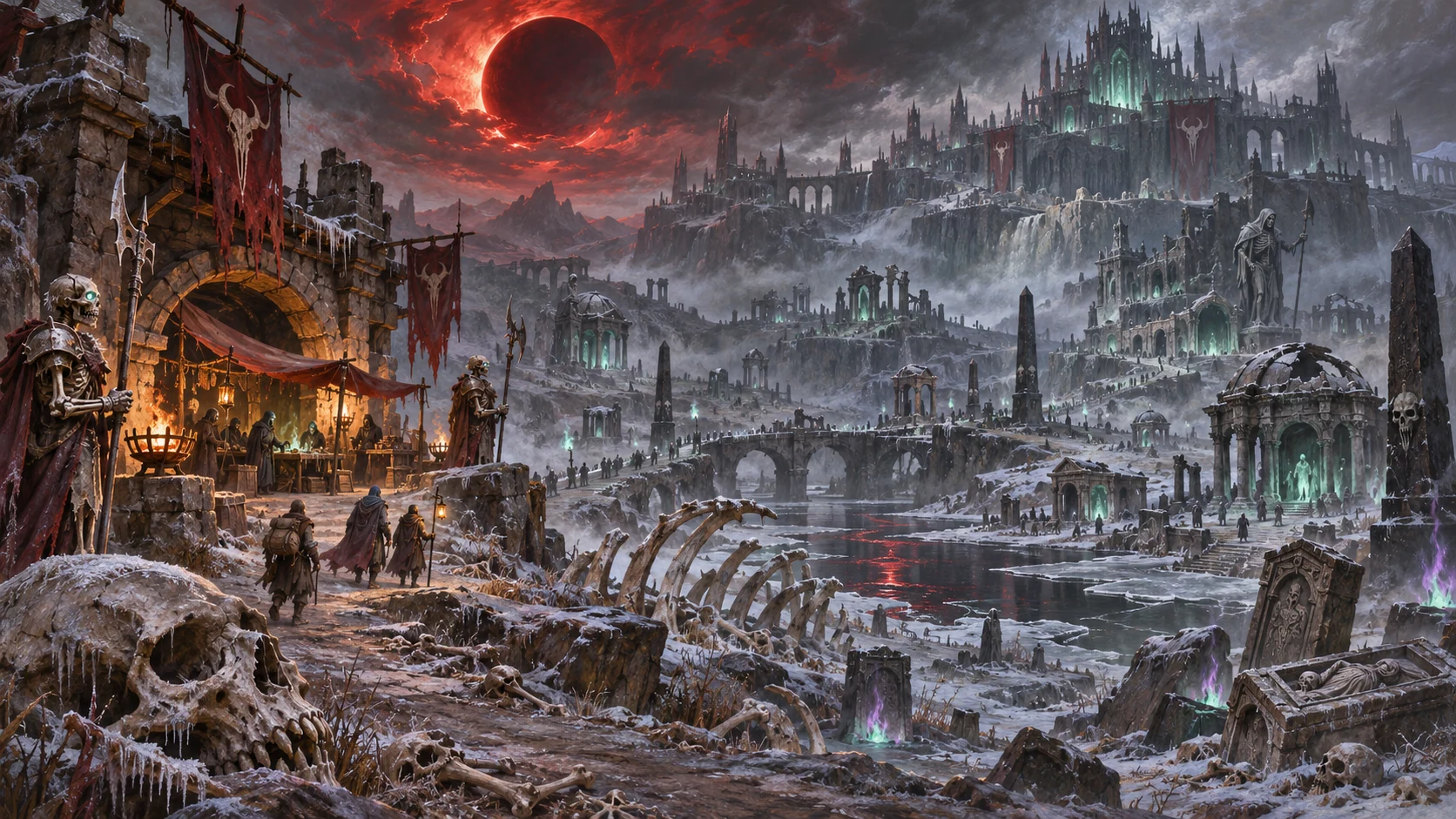
At a Glance
- Realm
- Thanatos, Layer 113 of the Abyss
- Dominant power
- Orcus, demon lord of undeath
- Nature
- Chaotic evil death-realm; a domain of corpse politics and stolen rest
- Inhabitants
- Undead, necromantic servants, demon officers, captives and scavengers
- Entry
- A known planar gate or difficult attuned approach; a graveyard does not automatically connect
- Escape
- Recover the independent exit key and return by a confirmed route
- Distinct from
- the Negative Energy Plane
The roads of Thanatos are lined with the unburied, but a living visitor can still find someone worth bringing home.
A bell tolls across a ruined necropolis. The sound does not call the dead to prayer: it tells the overseers whose corpses have been counted and which refuse to stay still. Thanatos has battlefields, roads, prisons, cold settlements and servants who fear their masters. It is not simply an endless empty graveyard.
What Is Happening Right Now?
The descendants of a mortal family learn that their ancestor’s grave was emptied after a demonic bargain long forgotten. A reliquary containing the ancestor’s name has surfaced in a necromancer’s convoy bound for Thanatos. A living witness claims the captive spirit has not consented to service. The family asks for the reliquary before a rite fixes the ancestor in a new undead body.
A lesser death-priest wants the rite to succeed so that Orcus will notice him. Another keeper fears the prisoner may expose years of falsified records. Both offer bargains; neither can promise unrestricted audience with the demon lord.
Crossing, Navigation and Return
A family on Midgard can begin by following the Abyss guide to an established, guarded Abyssal junction; its original earthly key is left with a trusted watcher. The gate-plain of Pazunia can serve as a staging point but does not provide a shortcut into Thanatos. The mortuary seal described below opens the next, specific route to Thanatos. A name in a death-ledger cannot itself open a road from Earth.
Departure: A surviving route ledger identifies a specific gate on a remote Abyssal approach. Before travelling, obtain the matching mortuary seal, an independently witnessed account of the ancestor and a way to protect living bodies from disease and cold. A funeral rite alone does not open a universal passage to Thanatos. A Gate or Plane Shift must be prepared with its own destination and return conditions.
Entry: The sealed gate opens near the Bone Road, a causeway connecting two ruined watchtowers. The road leads to the Counting House. A neutral-feeling shelter beneath the north tower can support a brief rest if watched, but cannot guarantee safety.
Return: The seal must remain intact; the gatekeeper opens the same arch only while the ledger lists a living bearer. If the name is removed from the ledger, the party can recover the stolen page, recruit another recognised bearer or discover a separate researched exit. The characters must return the reliquary to its legitimate guardians without allowing a second binding.
Places of the Layer
The Bone Road
A raised route across fields of broken armour and uncovered graves. Fallen markers indicate patrol changes and pits where fresh undead have been raised.
The Counting House
A fortress archive where clerks record identities, debts and bodies. Every page is a target of rival claimants; the registers are powerful because officers use them, not because every entry is metaphysically binding.
The Cold Lantern Refuge
A hidden room maintained by deserters and escaped captives. Its lantern burns blue only while somebody tends it. It offers an opportunity for sleep and testimony, not immunity to detection.
The Bellfield
Rows of iron bells announce forced muster. A bell cracked by sabotage disrupts a nearby patrol long enough to move prisoners; the consequence is heightened suspicion elsewhere.
Rulers, Residents and Bargains
Orcus treats undeath as dominion and a weapon against life, but his servants have competing priorities. Some seek souls, some seek relics, and some hoard knowledge that could keep them alive if their lord falls. An escaped attendant knows the timetable of the rite; a mortal grave-keeper can recognise the true name on the reliquary. Talon of Spite is a relevant path of Orcus-related necromantic influence, not proof that every undead on the plane obeys its order.
The party can protect a captive spirit without declaring all undead minds identical. An intelligent undead witness might despise the necromancer and still threaten innocent travellers.
Dangers, Warnings and Counterplay
Dead-ash: Grey powder drifts against the wind before living breath becomes painfully cold. Masks, warded clothing and retreat through the north tower reduce exposure. Bone sink: A road marker turns sideways before the path collapses into a tomb shaft; a tested pole and tied rope prevent a fall. False resurrection: A ritual voice offers a perfect return of the ancestor, but the reliquary begins reciting names unknown to the family. Comparing it with an independent witness exposes the imposture.
Adventure Choices and Consequences
Recover the name: Steal the correct page from the Counting House, return it to the family and close the rite before the bell calls its final watch.
Free the attendants: Saving prisoners delays the escape but creates witnesses who can testify to how the necromancer traded mortal remains.
After returning: One servant still has a duplicate ledger. The family must decide whether to publicise the old bargain and risk destroying the ancestor’s reputation, or conceal it and leave the necromancer’s human accomplices untouched.
Game Statistics
The hazards below govern the immediate route and its dangers. A defensible shelter and a known return passage may matter more than winning a battle.
D&D 2024
Dead-ash: DC 16 Constitution saving throw or 2d6 Necrotic damage and speed reduced by 10 feet until the end of the next turn; shelter prevents exposure. Bone sink: DC 16 Dexterity save or fall 20 feet into a prepared tomb, suffering normal falling damage. Navigation: DC 17 Wisdom (Survival) with an accurate ledger. Warded refuge supports a Long Rest if guarded; no involuntary alignment change.
D&D 2014
Dead-ash: DC 16 Constitution saving throw or 2d6 necrotic damage and speed reduced by 10 feet for 1 round. Bone sink: DC 16 Dexterity saving throw or fall 20 feet; normal falling damage applies. Navigation: DC 17 Wisdom (Survival). A credible route ledger grants advantage on the check; a hidden shelter permits guarded rest.
Pathfinder 1e
Dead-ash: Fortitude DC 18 or 2d6 negative energy damage and fatigued for 1 round; masks and cover prevent exposure. Bone sink: Reflex DC 17 or fall 20 feet, taking normal falling damage. Navigation: Survival or Knowledge (planes) DC 22 with a valid ledger granting +2 circumstance bonus.
D&D 3.5e
Dead-ash: Fortitude DC 18 or 2d6 negative energy damage and fatigued for 1 round. Bone sink: Reflex DC 17 or fall 20 feet, taking normal falling damage. Navigation: Survival or Knowledge (the planes) DC 22; a witnessed route ledger grants +2 circumstance bonus. Warded protection is regional, not universal.
History, Sources and Onward Routes
The Abyss catalogue places the realm of Orcus at layer 113. The broader Undead Bestiary provides encounter options. Thanatos is not identified with the Negative Energy Plane. The route, relic dispute, four places and mechanics are original campaign material.
Keep this reference growing
If this page helped with your reading or game, you can support its upkeep or explore the curated books.
Explore the Bookshop — epics, classics and stories behind imagined worlds.