
Sir Lamorak de Gales is one of the fiercest knights of Arthur’s court: son of King Pellinore, scion of a blood-feud, lover of Queen Morgause of Orkney, and the warrior whose fate proves that Camelot’s deepest wounds are made from within.
- Name: Sir Lamorak de Gales
- Aliases: Lamorak of Gales, Lamorak de Galis, Lamorak the Valiant, the Gales Lion
- Kind: Human knight
- Role: Round Table champion, tournament terror, feud-bearer, doomed lover, courtly pressure point
- Homeland: Gales / Welsh Arthurian tradition
- Affiliation: King Arthur’s court, the Round Table, the House of Pellinore
- Family: Son of King Pellinore; brother or close kinsman to Aglovale, Percival, Tor, Drian, and Dindrane depending on the tradition used
- Allies: King Arthur, Sir Lancelot, Sir Tristram, Sir Palamedes, Sir Dinadan, Sir Gareth when honour outweighs blood
- Enemies: Sir Gawain, Sir Agravain, Sir Gaheris, Sir Mordred, and the hard Orkney faction
- Significant Bond: Queen Morgause of Orkney
- Languages: English, French, Welsh
- Alignment: Neutral Good
- Threat Level: Elite heroic knight; deadly in single combat, mounted charge, tournament melee, and prolonged battle
Sir Lamorak de Gales is not a decorative courtly knight. He is one of the great blades of the Round Table: proud, powerful, direct, and almost impossible to exhaust once battle begins. His name carries the weight of the Pellinore line, a family bound to strange quests, old kingship, sacred beasts, and violent feud.
Lamorak’s tragedy is not that he lacks honour. His tragedy is that he has too much faith in honour among men who no longer feel bound by it.
His father, King Pellinore, stands at the root of a blood-feud with the house of Orkney. The sons of King Lot do not look at Lamorak and see only a rival knight. They see their father’s death, their mother’s scandal, and the humiliation of a man they cannot easily defeat in open combat. Lamorak’s relationship with Queen Morgause turns old hatred into immediate danger. What begins as family grievance becomes courtly fracture, then conspiracy, then murder.
In the campaign, Lamorak is one of the clearest signs that Camelot is still glorious but no longer whole.
Appearance
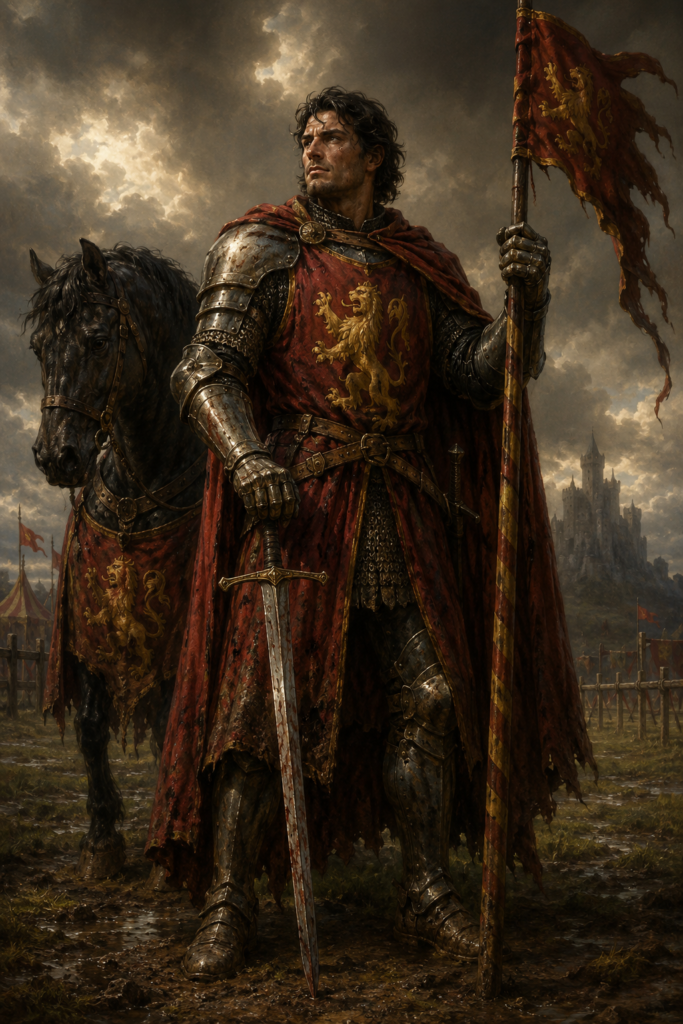
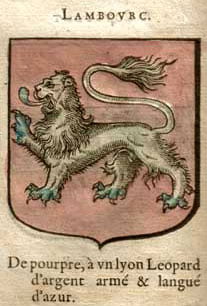
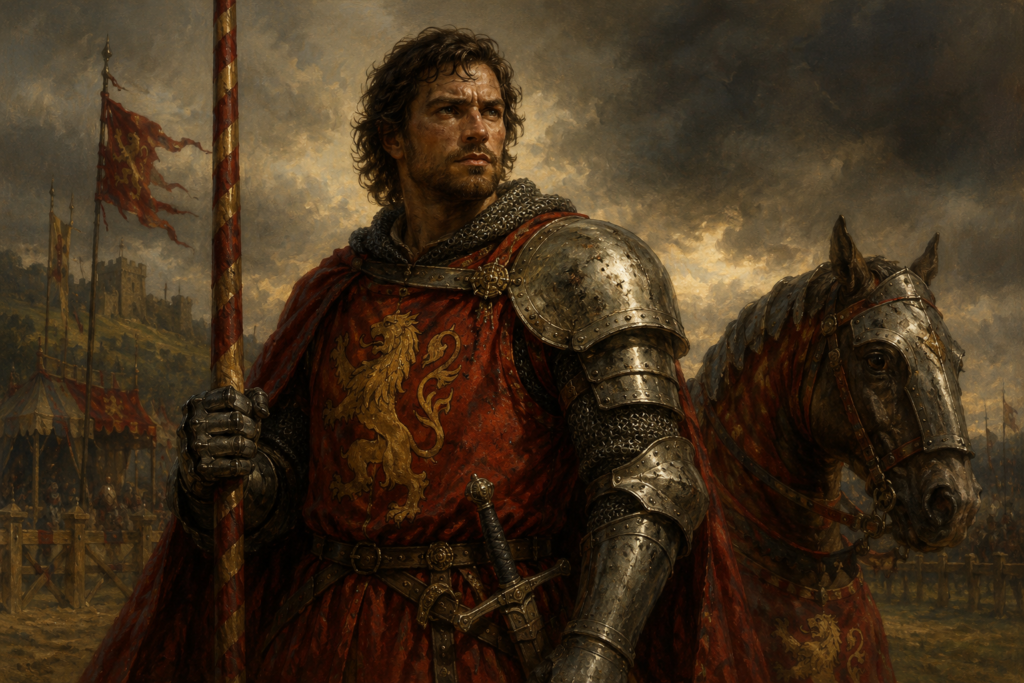
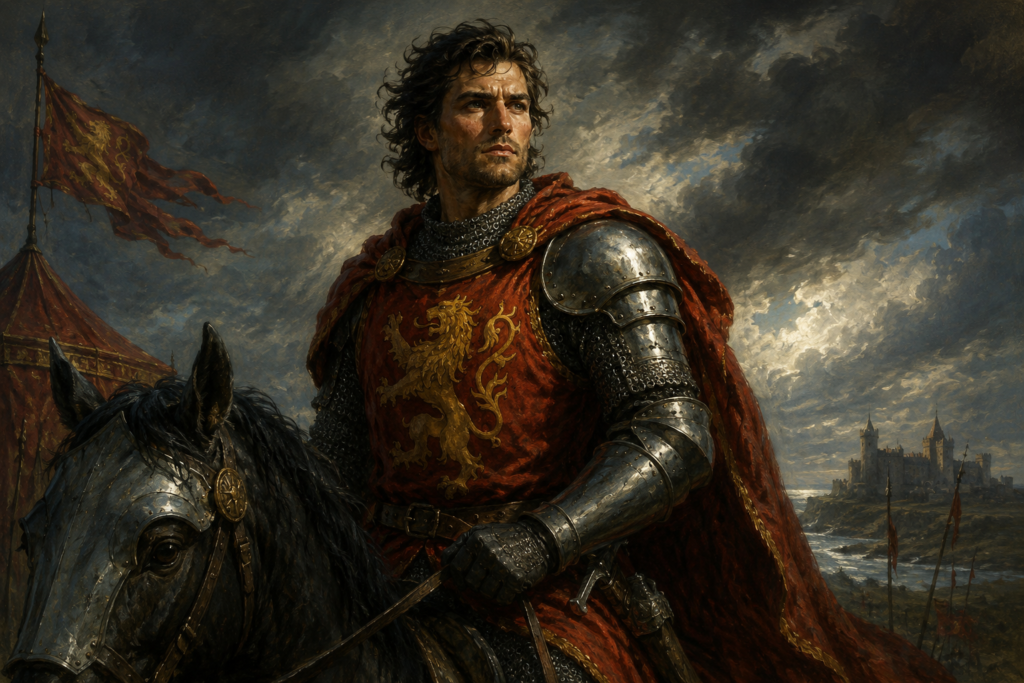
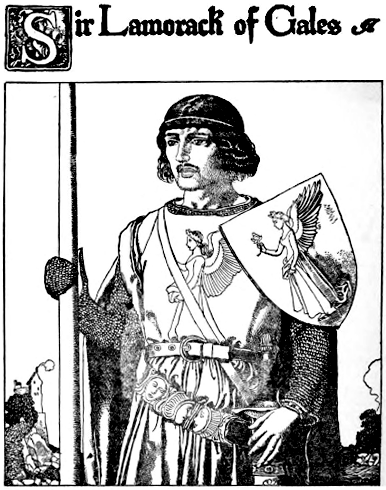
Lamorak is tall, broad-shouldered, and built for long violence rather than courtly display. His armour is costly but hard-used, with dents and scratches left visible where other knights would have had them polished away. His surcoat bears the colours of Gales and a lion, stag, or red-gold beast depending on the heraldry used in the campaign.
His face is handsome in a hard, weathered way. He has the watchful eyes of a man who expects a challenge from every gate, tent, hall, and forest road. At court he can stand calmly among princes, queens, envoys, and heralds, but in the lists he becomes something more dangerous: direct, relentless, and terribly difficult to tire.
His hands are usually scarred. His voice is controlled until insult becomes open challenge. He is not a peacock knight. He is a warhorse of a man dressed in noble steel.
Personality
Lamorak is honourable, passionate, proud, and dangerously unwilling to hide from consequences. He is not foolish, but he carries the fatal knightly belief that courage can carry a man through any trap.
He dislikes court politics, but he understands enough of them to despise them. He prefers open challenge to whispering halls, public combat to secret murder, and a hard truth to a safe lie. This makes him admirable. It also makes him vulnerable.
Lamorak loves deeply, fights honestly, and underestimates the willingness of others to behave dishonourably. When wronged, he does not scheme. He rides toward the wrong and expects the matter to be settled by courage, witness, and steel.
Role in the Campaign
Use Lamorak as Camelot’s visible fracture.
He can appear as a tournament champion, a protector on a dangerous road, a rival whose prowess forces the party to earn respect, or a doomed ally whose enemies are already gathering. He is useful whenever the campaign needs to show that the Round Table’s greatest threat is not an outside monster but the honour-feud inside its own heroic class.
Lamorak should not be written as a generic holy knight. His sacred obligations are knightly, familial, and oath-bound: loyalty to Arthur, defence of his own name, the burden of his father’s blood, and the demand that a knight meet danger openly.
He belongs in living courtly play. He is present, active, dangerous, and still capable of changing events unless the scenario deliberately places the story after his death.
Relationships
- King Arthur: Arthur values Lamorak because he knows what kind of knight Camelot loses if the feud consumes him. Lamorak is not merely useful in battle; he is one of the proofs that the Round Table can still gather the greatest warriors in the world.
- Arthur’s tragedy is that kingship does not always let him stop private blood from becoming public ruin. He can command truces, arrange reconciliations, and forbid violence inside his court. He cannot easily command men to forget their fathers, mothers, brothers, and shame.
- Sir Lancelot: Lancelot recognises Lamorak as one of the few knights whose prowess belongs in the highest company. Their relationship is respectful rather than easy. Each sees the other’s greatness, and each understands how dangerous courtly love becomes when honour and desire are forced to share the same hall.
- Lancelot is one of the knights most likely to warn Arthur that Lamorak is in danger. He also knows that warning is not the same as salvation.
- Sir Tristram: Tristram respects Lamorak as a peer in arms. Their stories echo one another: great knights, dangerous love, and enemies who use scandal as a weapon. Tristram’s grief for Lamorak should feel like one doomed champion recognising another.
- If Tristram is present in the campaign, he should not treat Lamorak as a minor knight. Lamorak is one of the few men whose death can make Tristram speak with open contempt for treachery.
- Sir Palamedes: Palamedes understands Lamorak’s martial stature. Their bond is forged through rivalry, admiration, and shared knowledge of how quickly noble courts become killing grounds.
- Palamedes is not sentimental, but he knows the difference between defeat and murder. He can become one of Lamorak’s most credible defenders when other knights hide behind blood loyalty.
- Sir Dinadan: Dinadan sees the truth behind courtly performance. He values good knights and despises treacherous ones, which places him firmly on Lamorak’s side.
- His wit can expose the Orkney brothers’ hypocrisy more sharply than any sword. He is the kind of knight who laughs at false honour until the laughter becomes accusation.
- Sir Gareth: Gareth is the exception inside the Orkney house. He is kin to Lamorak’s enemies, but he is not comfortable with their treachery.
- Use Gareth as the moral splinter in the Orkney faction: still family, still bound by blood, but unable to pretend that murder is honourable merely because his brothers call it vengeance.
- Sir Gawain: Gawain is not Lamorak’s ally. He is the central feud-enemy.
- His hatred is tangled with family vengeance, pride, shame, and the fear that Lamorak’s greatness exposes the dishonour of the Orkney brothers’ conduct. Gawain is still capable of grandeur elsewhere, but around Lamorak his judgement curdles. He becomes a great knight acting beneath himself, and that is what makes the feud dangerous.
- Sir Agravain, Sir Gaheris, and Sir Mordred: Agravain is spite and calculation. Gaheris is the blade of family shame. Mordred is the one most willing to turn feud into murder.
- Together they make Lamorak’s danger political rather than merely martial. He can defeat knights, but he cannot parry conspiracy forever.
- Queen Morgause of Orkney: Morgause is Queen of Orkney and mother of several of Lamorak’s enemies. She is not Lamorak’s aunt.
- Her relationship with Lamorak turns inherited blood-feud into immediate scandal. Their bond should be written as adult, dangerous, political, and fatal. It is not a decorative romance. It is the spark that shows how brittle Camelot’s peace has become.
Currently in the World
Lamorak rides between Camelot, the tournament roads, forest crossings, and noble houses where Arthur’s peace is still more promise than fact. He is welcomed by those who admire strength and feared by those who know the Orkney feud is no longer safely buried in the past.
He is often seen at the edge of the court rather than its centre: in the practice yard after sunset, in the stables before dawn, or alone beside his warhorse while other knights feast inside. He does not lack friends, but the weight around him makes easy company difficult.
Rumours follow him. Some say he has fought thirty knights and remained standing. Some say he is too proud to ask Arthur for protection. Some say Morgause’s name should never be spoken where the Orkney brothers can hear it. All agree on one thing: if Lamorak dies, he will not die because one better knight defeated him fairly.
Quick Rules Reference
- Human Round Table champion.
- Elite heroic NPC, suitable as ally, rival, patron, tournament opponent, or doomed courtly pressure point.
- Strongest in mounted combat, declared single combat, and sustained melee.
- Dangerous when surrounded; he is built to survive unfair odds.
- Gawain, Agravain, Gaheris, and Mordred are enemies, not allies.
- Gareth may be a conflicted ally, witness, or conscience within the Orkney faction.
- Lamorak is present and active unless the scenario deliberately takes place after his murder.
- His tragedy should come from treachery and feud, not from weakness.
Mechanics Tabs
The rules below are mechanics compatible for different game editions.
Sir Lamorak de Gales 5.5e
Sir Lamorak de Gales, Pathfinder 1e / 3.5e
Sir Lamorak de Gales 5.5e-Compatible Rules
Medium Human, Neutral Good
Armor Class 20
Initiative +8
Hit Points 225
Speed 30 ft.
Proficiency Bonus +5
| STR | DEX | CON | INT | WIS | CHA |
|---|---|---|---|---|---|
| 22 (+6) | 16 (+3) | 20 (+5) | 13 (+1) | 16 (+3) | 18 (+4) |
Saving Throws Str +11, Dex +8, Con +10, Wis +8, Cha +9
Skills Animal Handling +8, Athletics +16, History +6, Insight +8, Intimidation +9, Perception +8, Persuasion +9
Senses passive Perception 18
Languages English, French, Welsh
Challenge 16
Traits
Gales Lion. Lamorak has advantage on saving throws against being charmed or frightened.
Knight of Terrible Endurance. If Lamorak starts his turn with at least 1 hit point and is not incapacitated, he gains 10 temporary hit points. These temporary hit points do not stack.
Tournament Terror. Lamorak has advantage on attack rolls made as part of a formal duel, joust, tournament, or declared single combat unless his opponent has broken the rules of the contest.
No Treacherous Blow Goes Unanswered. When a creature hits Lamorak with an attack while another hostile creature is within 5 feet of him, Lamorak can mark the attacker until the end of his next turn. The next time Lamorak hits the marked creature, the attack deals an extra 13 damage.
Stand Against the Ring. Lamorak has advantage on Strength and Dexterity saving throws while two or more hostile creatures are within 5 feet of him. Opportunity attacks against Lamorak have disadvantage while he is moving toward a creature that damaged him since the end of his last turn.
Actions
Multiattack. Lamorak makes three longsword attacks.
Longsword. Melee Weapon Attack: +11 to hit, reach 5 ft., one target. Hit: 15 slashing damage.
Mounted Lance Charge. Lamorak must be mounted and must move at least 20 feet straight toward one target before making this attack. Melee Weapon Attack: +11 to hit, reach 10 ft., one target. Hit: 50 piercing damage. The target must succeed on a DC 19 Strength saving throw or be knocked prone. A mounted target that fails this save is unhorsed. This action is not part of Multiattack.
Break the Circle. Lamorak makes one longsword attack against each hostile creature of his choice within 5 feet of him. He can move up to half his speed before or after these attacks without provoking opportunity attacks from creatures he hits with this action.
Lion of Gales Challenge. Lamorak chooses one creature he can see within 60 feet. Until the end of Lamorak’s next turn, Lamorak has advantage on attack rolls against that creature, and the creature has disadvantage on attack rolls against creatures other than Lamorak. This effect ends early if Lamorak attacks a different creature.
Lion’s Stroke Recharge 5–6. Lamorak makes one longsword attack. On a hit, the target takes an extra 27 damage and must succeed on a DC 19 Constitution saving throw or be stunned until the start of Lamorak’s next turn. A creature that succeeds on the save is not stunned but cannot take reactions until the start of its next turn.
Bonus Actions
Press the Honour. Lamorak moves up to 15 feet toward a hostile creature he can see. This movement does not provoke opportunity attacks from the chosen creature.
Rally the Worthy. One ally within 30 feet who can see or hear Lamorak gains 15 temporary hit points and can immediately end the frightened condition on itself.
Reactions
Parry. Lamorak adds 4 to his AC against one melee attack that would hit him. To do so, he must see the attacker and be wielding a melee weapon.
Riposte. When a creature misses Lamorak with a melee attack, Lamorak makes one longsword attack against that creature.
Unfair Odds. When two or more hostile creatures are within 5 feet of Lamorak and one of them hits him with a melee attack, Lamorak can make one longsword attack against a different hostile creature within 5 feet.
Legendary Actions
Lamorak can take 3 legendary actions, choosing from the options below. He can take only one legendary action at a time and only at the end of another creature’s turn. Lamorak regains spent legendary actions at the start of his turn.
Move. Lamorak moves up to half his speed without provoking opportunity attacks.
Attack. Lamorak makes one longsword attack.
Mounted Turn. If mounted, Lamorak directs his mount to move up to half its speed. This movement does not provoke opportunity attacks from one creature Lamorak can see.
Driving Stroke Costs 2 Actions. Lamorak makes one longsword attack. On a hit, the target must succeed on a DC 19 Strength saving throw or be pushed 10 feet and knocked prone.
Defy the Ring Costs 3 Actions. Lamorak uses Break the Circle.
Mount
Lamorak normally rides a trained destrier suitable for tournaments, battlefield charges, and long road travel. Use the standard warhorse or destrier rules for the edition being played unless the mount becomes important to the scene. The horse is part of his knightly equipment and visual identity, not a separate named creature by default.
Equipment
Plate armour, shield, masterwork longsword, lance, knightly dagger, knightly spurs, signet of the Pellinore line, tournament helm, warhorse, and a court cloak of Gales.
His gear may be finely made, but it does not need to be overtly magical. Lamorak’s danger comes from strength, endurance, mounted discipline, and heroic prowess rather than from enchanted equipment.
Sir Lamorak de Gales, Pathfinder 1e / 3.5e-Compatible Rules
Male human fighter 10 / cavalier 6, NG
CR 16
Init +7
Senses Perception +21
Defence
AC 32, touch 14, flat-footed 29
hp 218
Fort +18, Ref +12, Will +13
Defensive Abilities bravery, armour training, indomitable honour, mounted discipline
Fear Resistance +4 morale bonus on saves against fear while mounted or while engaged in a declared duel
Offence
Speed 30 ft.
Melee masterwork longsword +28/+23/+18/+13
Mounted Charge lance +29; applies normal mounted charge multipliers when Lamorak charges while mounted
Special Attacks challenge, banner, devastating charge, weapon training, lion’s stroke, break the circle
| STR | DEX | CON | INT | WIS | CHA |
| 24 (+7) | 16 (+3) | 20 (+5) | 13 (+1) | 16 (+3) | 18 (+4) |
Special Rules
Challenge of Gales. Once per encounter, Lamorak may challenge a single visible foe. Against that foe he gains a +4 morale bonus on melee damage rolls and a +2 bonus on Will saves. The challenged foe takes a -2 penalty on attacks against Lamorak’s allies while Lamorak threatens it.
Lion’s Stroke. When Lamorak confirms a critical hit with a longsword, the target must succeed at a Fortitude save or be staggered for 1 round. The save DC is Strength-based.
Break the Circle. When Lamorak is threatened by three or more enemies, he gains a +2 dodge bonus to AC and may make one additional attack of opportunity each round without spending an attack of opportunity.
Devastating Mounted Charge. When Lamorak charges while mounted and strikes with a lance, apply normal mounted charge multipliers. If using Pathfinder feats, he should have Mounted Combat, Ride-By Attack, and Spirited Charge. The lance is his charge weapon, not his repeated full-attack routine.
Indomitable Honour. Lamorak gains a +4 bonus on saving throws against charm, compulsion, and effects that would force him to surrender, flee, or betray a sworn companion.
No Treacherous Blow Goes Unanswered. If Lamorak is struck by a flanking enemy or by an attacker benefiting from invisibility, concealment, or surprise, he gains a +2 morale bonus on attack and damage rolls against that enemy until the end of his next turn.
Feats
Mounted Combat, Ride-By Attack, Spirited Charge, Power Attack, Weapon Focus, Weapon Specialisation, Greater Weapon Focus, Improved Critical, Combat Reflexes, Step Up, Iron Will, Toughness, Dazzling Display.
Skills
Climb +24, Handle Animal +23, Intimidate +23, Knowledge nobility +13, Perception +21, Ride +25, Sense Motive +21, Survival +17.
Mount
Lamorak normally rides a trained destrier suitable for jousts, battlefield charges, and hard road travel. Use the standard warhorse or destrier rules for the edition being played unless the mount becomes a specific encounter focus.
Gear
Full plate, heavy steel shield, masterwork longsword, lance, knightly dagger, noble clothing, warhorse, court signet, tournament harness, and travel cloak.
Roleplaying Lamorak
Lamorak speaks plainly, but not crudely. He has courtly manners and knows how to address kings, queens, heralds, ladies, squires, and enemies. What he lacks is patience for evasive half-truths.
He is slow to insult and quick to answer insult once given. He respects courage in commoners, squires, and strange wanderers as readily as in noble knights. He despises cowardice most when it dresses itself as family duty or courtly necessity.
Use these cues at the table:
- He does not ask whether danger is safe; he asks whether it is honourable.
- He watches exits and horse-lines even during feasts.
- He lowers his voice when Morgause is mentioned.
- He does not speak Gawain’s name lightly.
- He trusts Arthur’s dream more than Arthur’s court.
- He expects enemies to face him openly, which is his great weakness.
Using Lamorak in Your Game
Use Lamorak when the party needs to see the Round Table at its most glorious and most fragile.
He can be a patron for martial characters, a rival in a tournament, a witness to a courtly crime, a protector on a road haunted by feud, or the target of an assassination plot. If the characters save him from one ambush, the feud does not end; it changes shape. The Orkney brothers become more careful, court politics tighten, and Arthur is forced to act before private hatred becomes open fracture.
Lamorak should create difficult choices. Protecting him may mean offending Gawain. Helping Morgause may mean entering a scandal. Revealing the truth may damage Camelot. Doing nothing may allow one of the greatest knights in the world to be murdered by men who could not defeat him fairly.
Adventure Hooks
The Tournament at Lonazep
A great tournament gathers the strongest knights of Britain and beyond. Lamorak dominates the field, but the party notices that several Orkney retainers are not watching the lists. They are studying exits, horse-lines, servants’ paths, and wooded approaches. The tournament is not the danger. The ride after victory is.
The Queen’s Message
A sealed message from Queen Morgause is intercepted before it reaches Lamorak. The party must decide whether to deliver it, destroy it, show it to Arthur, or use it to expose the trap forming around both lovers. Every choice creates an enemy.
The Four Against One
Lamorak’s horse is found wounded near a forest road, and the signs show several armoured riders converging on one man. The party can reach the fight before the killing stroke, but saving Lamorak means openly opposing Gawain, Agravain, Gaheris, and Mordred. The question is not whether Lamorak deserves help. The question is what Camelot becomes after the party gives it.
Mythic and Historic Context
Sir Lamorak de Gales belongs to the later medieval Arthurian romance tradition of the Matter of Britain. He is especially associated with the Prose Tristan tradition and with Sir Thomas Malory’s Le Morte d’Arthur, where he becomes one of the great martial knights of Arthur’s world.
Lamorak’s importance is not simply that he is strong. He stands at the collision point between prowess, kinship, adultery, vengeance, and courtly honour. He is a son of King Pellinore, and his family’s feud with the Orkney house places him inside one of the most dangerous private conflicts in Arthur’s court. In Malory, his bond with the Queen of Orkney intensifies that feud until private shame becomes public violence.
The relationship with Morgause should be handled carefully in the campaign. She is Queen of Orkney and mother of several of Lamorak’s enemies, not Lamorak’s aunt. Their affair is not a decorative romance subplot; it is the political spark that exposes how brittle Camelot’s peace has become. The killing of Morgause by Gaheris, and the later ambush of Lamorak by Gawain, Agravain, Gaheris, and Mordred, show the Orkney feud moving from family grievance into murder.
Malory’s treatment gives Lamorak unusually high martial status. He is praised by other major knights, associated with great tournaments, and remembered as a warrior whose death comes through treachery and numbers rather than fair defeat. This is why the campaign version treats him as an elite Round Table champion rather than as a minor doomed lover.
The campaign version keeps the source shape but places Lamorak inside a living Arthurian world. He is not introduced as a dead legend, saint, ghost, or moral anecdote. He is a present-tense knight whose choices can still matter unless the scenario deliberately takes place after his murder. His fate should remain playable: the party may witness the feud, delay the ambush, expose the conspiracy, save him, or make his death politically impossible.
Lamorak’s strongest use is as Camelot’s warning sign. He shows that the Round Table’s collapse does not begin with one final battle. It begins with honoured men deciding that treachery is acceptable when family hatred demands it.
Useful external starting points include the public-domain text of Malory’s Le Morte d’Arthur, the general overview of Sir Lamorak, and background on the wider Tristan romance tradition that shaped much of Lamorak’s literary setting.
Keep this reference growing
If this page helped with your reading or game, you can support its upkeep or explore the curated books.
Explore the Bookshop — epics, classics and stories behind imagined worlds.