
Negative Energy Plane — The Void of Entropy and Unlife
A lightless Inner Plane where life leaks away, matter forgets its shape, and death-force gathers before it is stolen into undeath.
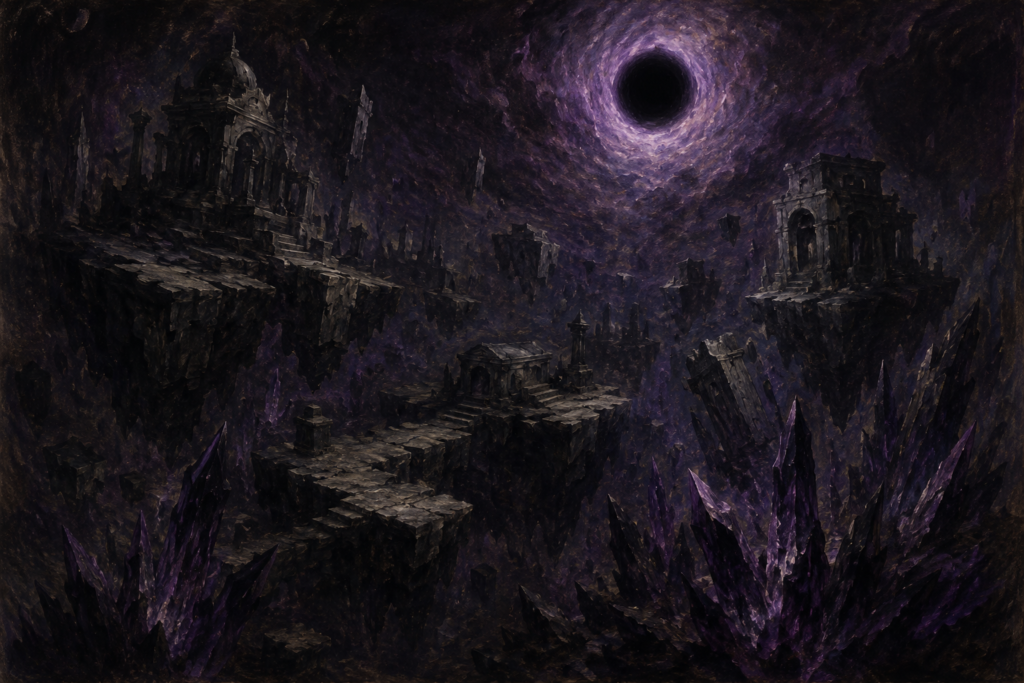
- Plane Type: Inner Plane; Energy Plane
- Moral Gravity: Neutral by nature; often exploited by evil powers
- Common Names: The Void, the Negative Energy Plane, the Black Intake, the Entropic Deep, the Plane of Unmaking
- Primary Function: Entropy, dissolution, negative energy, death-force, unmaking, and the cosmic counterweight to creation
- Usual Arrival Point: The Near Dark, dead-world debris fields, failed necromantic gates, black-star thresholds, entropy-crystal outskirts, or warded planar anchors
- True Native People: Sceaduinar and entropy-crystal entities
- Common Intruders: Incorporeal undead, nightshades, liches, necromancers, void cultists, soul-thieves, planar scholars, and heavily warded expeditions
The Negative Energy Plane is the Inner Plane of entropy. Travellers call it the Void because there is almost nothing else to call it.
It is not Hell, not an underworld, not a punishment realm, and not a kingdom of the dead. It is the cosmic pressure that ends things. Flame gutters here. Breath becomes meaningless. Flesh chills before it freezes. Blood slows, thought thins, and the body begins to forget why it should continue.
A traveller who arrives without protection does not face a battlefield, a court, or a moral judgement. They face an environment that calmly removes them.
The plane is not evil in the way a murderer is evil. It does not hate. It does not scheme. It does not punish. It consumes because consumption is what it is.
Necromancers mistake usefulness for welcome. Undead draw strength from the plane’s black current, and many forms of unlife endure here more easily than living creatures do. But the plane is not theirs. The Void is older than necromancy, colder than malice, and far less personal. Undeath is one use of negative energy. It is not the whole truth of it.
At its deepest, the plane becomes a lightless interior where matter crystallises into impossible structures of black, violet, and dead-silver entropy. From those crystalline failures of creation come the sceaduinar: native beings of living negative energy who hate both life and unlife.
Cosmological Role
The Negative Energy Plane is the intake of the Inner Planes.
The Positive Energy Plane pours force into possibility. The Elemental Planes give matter its forms. The Material Plane lets those forces become lives, bodies, fires, seas, mountains, cities, forests, wounds, graves, and empires. The Negative Energy Plane receives the end of those processes.
It is not merely destruction. It is the clearing pressure that makes permanence impossible.
Without the Void, creation would choke on itself. Nothing would decay. Nothing would release. Nothing would end cleanly. Every wound, body, spell, empire, forest, promise, and star would remain in some swollen, unfinished state.
That does not make the plane safe. It only makes it necessary.
The Void is the plane of entropy, not the plane of evil. Evil powers use it because it is useful. Necromancers use it because it animates corpses and drains the living. Nightshades use it because it nourishes their war against life. Liches study it because it promises endurance without life.
But the plane itself offers no throne, no mercy, no allegiance, and no reward.
Death, Undeath, and Negation
Death is a passage. Undeath is an interruption. Negation is the Void.
These three are often confused by mortals, and that mistake kills many travellers.
Death belongs to the cycle of souls, bodies, memory, burial, judgement, mourning, and return. Death gods, psychopomps, ancestral powers, underworld judges, funeral spirits, and sacred laws all care about what happens after a life ends.
Undeath is a refusal, wound, theft, curse, accident, punishment, spell, hunger, or unfinished claim. Some undead remember. Some are enslaved. Some are only animated matter. Some are persons in law or custom. Many are hazards. Undeath uses negative energy, but it is not the same thing as the Void.
Negation is older and colder. It does not care whether a body was loved. It does not know whether a soul deserves judgement. It does not recognise rank, beauty, bloodline, guilt, innocence, empire, debt, oath, or prayer. It reduces. It empties. It unbinds.
The Negative Energy Plane is not where the dead should go. It is what waits when protection fails.
Known Regions
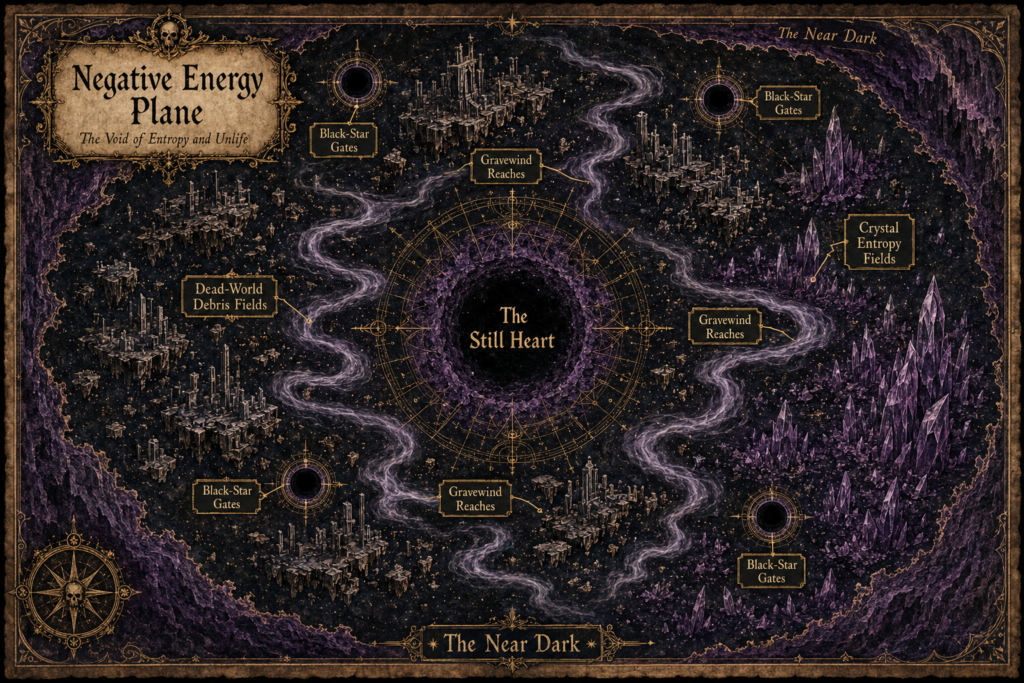
The Negative Energy Plane does not have countries in the ordinary sense. It has depths, currents, pressure zones, wounds, debris, and rare stable formations. Maps are useful only near anchors. Farther in, direction becomes subjective and distance becomes a negotiation with survival magic.
The Near Dark
The Near Dark is the least lethal border of the plane. It is still deadly, but prepared expeditions can survive here using death wards, planar vessels, soul-tethers, necrotic insulation, divine protection, or carefully made anchors.
Here, the darkness has texture. Travellers may see floating corpse-stone, broken doors from dead demiplanes, shattered spell-engines, fragments of tomb architecture, dead stars seen impossibly close, or black dust moving in slow rivers without wind.
Most mortal expeditions never go beyond the Near Dark.
The Gravewind Reaches
The Gravewind Reaches are vast moving currents of negative energy. They do not blow like air. They pull like thirst.
Travellers caught in a gravewind feel memories loosen first: names, faces, songs, the reason for coming. Then the body follows. Wounds reopen. Old scars ache. Healed bones remember breaking. Magic grows cold in the hand.
Gravewinds carry incorporeal undead, broken souls, failed ritual fragments, and messages never delivered from the dying.
The Dead-World Debris Fields
Not every fragment in the Void comes from the plane itself. Some are pieces of failed worlds, shattered demiplanes, collapsed tomb-realms, broken moonlets, destroyed sanctums, and magical fortresses dragged through death-gates.
These debris fields are among the most useful places to run adventures on the plane. They provide surfaces, rooms, doors, broken wards, treasure, corpses, trapped undead, old machines, and reasons to explore.
A dead-world fragment may hold a single street from a vanished city, a palace corridor with no palace, a field of black wheat, a ship frozen in air, or a cathedral-sized engine built to keep one dead king from being forgotten.
The Crystal Entropy Fields
In the deeper Void, negative energy sometimes condenses into crystalline growths. These formations resemble black snowflakes, violet glass antlers, frozen lightning, or great angular reefs grown from the idea of ending.
The fields are beautiful from a distance and lethal up close. They drain warmth, sound, colour, and spell-force. Living creatures see their reflections aged, dead, unborn, or erased. Undead hear the crystals singing promises of final destruction.
The sceaduinar are born from these formations.
Around a new birth-field, the plane may become more stable. This stability attracts necromancers, undead hunters, planar miners, lich-agents, and scholars who do not understand that the crystals are not inert treasure. They are eggs, wounds, and weapons at once.
The Black-Star Gates
Some portals between the Material Plane and the Negative Energy Plane appear near dead stars, collapsed stars, black holes, void-comets, impossible eclipses, and wounds in the night sky. Scholars call these Black-Star Gates.
A Black-Star Gate is rarely a simple doorway. It may be an event, a season, a mathematical alignment, a failed resurrection, the death of a star, the opening of a sealed tomb, or the collapse of a necromantic engine.
Material-side legends speak of undead trapped in the outer pull of such gates, circling forever in lightless accretion, unable to escape and unable to be destroyed.
The Still Heart
The Still Heart is not a place most campaigns need to visit. It is the absolute depth of the plane, where negative energy is so concentrated that distinction fails.
Light does not vanish there because there is no “there” for light to enter. Time becomes thin. Matter becomes conditional. Souls are not judged; they are endangered. Undead are not empowered so much as stripped toward the force that animates them.
Only divine intervention, unique artefacts, or campaign-ending magic should allow mortal travel into the Still Heart.
Laws of the Plane
Life Leaks Away
The Void drains living creatures because life is an unstable contradiction in its presence. Protection is not optional. It is the first rule of travel.
Light Is Swallowed
Ordinary light fails quickly. Magical light survives longer but becomes thin, colourless, and directional. Light does not illuminate the deep Void so much as mark the traveller as something that should not be there.
Healing Is Impeded
Magic that restores life struggles in the Void. Wounds may close but remain cold. Breath may return without warmth. A healing spell may work only after the caster forces a pocket of life into existence.
Necromancy Is Strengthened and Watched
Negative-energy magic is easier to shape, but that ease is dangerous. Spells that drain, animate, curse, or bind the dead may draw the attention of sceaduinar, nightshades, undead predators, or rival necromancers.
Undead Are Nourished, Not Safe
Many undead endure here better than the living. Some are strengthened. Some are repaired. Some become more lucid. None are guaranteed safety. Sceaduinar despise undead as corrupt mockeries of creation, and deeper regions can unmake even the unliving.
Matter Fails Slowly
Tools become brittle. Metal sweats black frost. Leather cracks. Ink fades. Food becomes ash. Rope loses memory of tension. Corpses preserve, then hollow.
Souls Require Protection
The Negative Energy Plane is not an afterlife, but souls can be damaged, trapped, or misdirected near its gates. Funeral gods, psychopomps, ancestor rites, and burial customs all fear uncontrolled Void breaches because they endanger the proper passage of the dead.
Divine Powers and Sacred Realms
No god owns the Negative Energy Plane.
Death gods know it. Underworld rulers guard against it. Necromantic powers bargain with it. Destroyers try to weaponise it. Funeral gods fear its breaches because the Void can damage the proper passage of souls. But the plane is not a divine court, not a judgement hall, and not a kingdom of the dead.
Anubis
Anubis is relevant to the Negative Energy Plane because he guards death’s proper passage. His priests and servants oppose grave robbery, soul theft, false resurrection, and most uncontrolled necromancy. Anubis may send omens, jackal-guides, mortuary spirits, or tomb guardians when Void breaches threaten the weighing, preservation, or lawful journey of the dead.
Use Anubis when the adventure concerns funerary law, soul judgement, violated tombs, mummification rites, or the difference between sacred death and stolen undeath.
Osiris
Osiris stands against the Void’s misuse because he represents death, resurrection, renewal, and the lawful dignity of the dead. Where the Void erases, Osiris judges, restores order, and teaches that death can be transformation rather than oblivion.
Use Osiris when the adventure concerns resurrection, grave sanctity, afterlife law, dead kings, tomb-courts, sacred agriculture after famine, or the cycle of death and renewal.
Mictlantecuhtli
Mictlantecuhtli rules an underworld, not the Void. His priests, necromancers, and death-knights may know how to open underworld gates, bargain with corpse powers, or redirect dead souls through dangerous thresholds. His connection to death, decomposition, fertility, and rebirth makes him useful for stories where decay feeds new life but ambitious cults risk confusing underworld sovereignty with cosmic negation.
Use Mictlantecuhtli when the adventure concerns underworld tribute, skull gates, death-cult bargains, necromantic agriculture, or a priesthood trying to control what should not be controlled.
Chthonic and Underworld Powers
Hades, Persephone, Hecate, Melinoë, Charon, Moros, Thanatos, Nyx, Erebus, Hel, Nidhogg, and similar powers all touch death, night, ghosts, underworld passage, doom, dreams, shadow, corpse-roads, or soul-devouring threats.
They should not be moved into the Negative Energy Plane. Their realms and functions are older, stranger, and more lawful than mere negation.
Use them when the Void interferes with proper descent, burial, oath-death, ghost passage, nightmare gates, or the boundary between underworld and nothingness.
Inhabitants
The Negative Energy Plane has fewer true inhabitants than most planes. Many creatures found here are intruders, exiles, undead survivors, summoned horrors, or things dragged in by necromancy.
The most important native people are the sceaduinar. The most dangerous undead associated with the plane are nightshades, especially nightwalkers. Other undead appear where the plane touches graves, failed rituals, dead-world fragments, underworld breaches, and necromantic engines.
Do not treat every undead creature as a natural citizen of the Void.
Sceaduinar
Sceaduinar are the most important native people of the Negative Energy Plane.
They are not generic void monsters. They are intelligent beings born from entropy-crystal formations in the deep plane. They appear as angular, dark-violet, crystalline, gargoyle-like forms with long limbs, flying shapes, and a presence that wounds living matter by proximity.
Sceaduinar hate life and unlife alike. Living creatures offend them because life carries a spark of creation. Undead offend them because undeath is a corrupt imitation of life, a stolen animation that refuses proper ending.
They may ignore outsiders unless those travellers disturb birth-fields, harvest entropy crystals, protect undead, or carry positive-energy relics. They have little society in the mortal sense, but they gather into death squads, wing-led groups, void hunters, shardsingers, and crystal-wardens when a threat requires coordinated destruction.
Use sceaduinar when the adventure should make the party question whether harvesting “resources” from the plane is actually desecration, theft, or provocation.
Nightshades and Nightwalkers
Nightshades are among the most terrible undead associated with the Negative Energy Plane. A nightwalker is a towering form of that horror: a massive life-draining entity that leads undead forces, spreads despair, and exists to extinguish life.
Some accounts place nightwalkers close to the Plane of Shadow. Others place them directly in the Negative Energy Plane. In the campaign, this is not a contradiction. Nightwalkers are best treated as Shadow-Void war-shapes: undead abominations that move through darkness, shadow breaches, negative-energy depths, and dead gates.
They are not native people in the same way sceaduinar are. They are undead engines of annihilation.
Use nightwalkers when the plane’s danger needs a commander, destroyer, siege horror, or final encounter.
Wraiths
Wraiths are common dangers in the Near Dark, gravewind currents, dead-world ruins, and failed necromantic gates. They are not usually natives. They are undead hunters sustained by negative energy, drawn to places where life is weak and shadows are deep.
A wraith is useful when the party needs a mobile, incorporeal predator that can pass through walls, stalk weakened characters, and turn an expedition clock into an encounter clock.
Shadows
Shadows gather where light has failed but memory of bodies remains. They are common around broken camps, abandoned portals, and places where travellers died without proper rites.
Shadows work well as early warning signs. If shadows begin moving independently around a warded camp, the camp is failing.
Spectres
Spectres drift through the Void’s weaker regions like torn banners of soul-hunger. They are most often found near death gates, battlefield fragments, and necromantic laboratories where souls were extracted badly.
Use spectres when the plane’s danger should feel personal and accusatory rather than merely environmental.
Ghosts
Ghosts do not belong in the Void. A ghost found here is a sign that something has gone wrong.
Perhaps a soul was stolen from its proper passage. Perhaps a tomb-gate opened into the Near Dark. Perhaps a necromancer used a ghost as an anchor. Perhaps a divine messenger failed. Perhaps the ghost is clinging to one remembered object in a dead-world debris field.
Ghosts are persons unless the campaign gives strong reason otherwise. They may need rescue, judgement, release, testimony, or protection from the plane itself.
Wights
Wights survive well in the Near Dark and in dead-world ruins because they retain bodies, hunger, and a cruel relationship with life-force. They are useful as former soldiers, tomb guardians, failed expedition members, or the remains of settlers trapped in a necromantic breach.
Wights should rarely be alone unless the scene explains why. A wight pack in the Void may be the remains of a doomed fortress, oath-bound tomb company, or necromancer’s abandoned guard.
Liches
Liches come to the Void deliberately.
They harvest entropy crystals, test phylacteries, bargain with nightshades, imprison souls, build negative-energy engines, or hide laboratories in dead-world debris fields. Some want to master the plane. None truly do.
A lich in the Void should feel prepared. It has anchors, escape routes, undead servants, decoy phylacteries, and layers of warding. The plane is not its home, but it may have made a dangerous workshop here.
Mummies, Revenants, Vampires, and Other Undead
Other undead may appear where story, ritual, or disaster brings them. Mummies may guard tomb-fragments dragged into the plane. Revenants may pursue murderers through a black-star gate. Vampires may seek necrotic renewal but quickly discover that the Void offers no blood, warmth, or courtly comfort.
Use them as visitors, victims, claimants, or hazards. Do not make every undead creature a natural citizen of the Void.
Personhood and Law
The Void has no courts that mortals can appeal to. It has no local ruler, no common law, no market, no border authority, and no native treaty structure recognised by ordinary kingdoms.
That does not mean actions here are consequence-free.
Sceaduinar are intelligent native beings. They are persons. Killing them, stealing entropy crystals from their birth-fields, or destroying their formations may create planar consequences even if no mortal court understands the crime.
Ghosts are usually persons and may have legal, familial, sacred, or political claims elsewhere. A ghost rescued from the Void may be a witness, heir, ancestor, victim, criminal, saint, oathbreaker, or sovereign.
Intelligent undead vary by place, status, custom, and threat. A lich raiding souls from a city is not the same legal problem as a revenant pursuing a murderer or a bound mummy guarding a lawful tomb.
Mindless undead are usually hazards. Destroying them is normally clearance, not murder.
The plane does not care. The worlds around it do.
Travel and Arrival
Travel to the Negative Energy Plane is rarely casual. Most arrivals happen through controlled ritual, catastrophic breach, divine mission, black-star alignment, failed resurrection, necromantic experiment, cursed tomb, or damaged planar gate.
Common Arrival Sites
- Warded Anchors: Circles, vessels, tomb-machines, or divine seals built to hold a breathable pocket of reality.
- Dead-World Fragments: Broken architecture, floating ruins, wrecked ships, shattered fortresses, and lost cities pulled into the plane.
- Entropy Crystal Fields: Dangerous but stable enough to attract scholars, miners, and hunters.
- Black-Star Thresholds: Gates linked to collapsed stars, impossible eclipses, dead moons, or cosmic void wounds.
- Necromantic Breaches: Unstable wounds created by liches, cults, failed armies, plague rites, or soul engines.
Travel Methods
Plane shift, gate magic, divine intervention, artefacts, black-star portals, necromantic engines, and rare underworld routes can all reach the Void. Ordinary teleportation inside the plane is unreliable unless anchored to a known ward, object, creature, or fixed crystal formation.
What Every Expedition Needs
A successful expedition usually needs all of the following:
- Protection from necrotic drain.
- A way to create or preserve light.
- A return anchor.
- A soul-tether or funeral safeguard.
- A plan for incorporeal attackers.
- A way to keep healing magic functioning.
- A time limit.
- A reason strong enough to justify going.
Planar Effects
The rules below are mechanics compatible for different game editions.
The Negative Energy Plane should not be run as a normal dungeon with black paint. It is an expedition hazard. The party is always spending protection, time, light, warmth, memory, or magical stability.
Use three exposure bands.
- Near Dark: Border regions, warded anchors, debris fields, survivable crystal outskirts.
- Deep Void: Gravewind reaches, unstable gates, dense negative currents, active entropy fields.
- Still Heart: Absolute depth, campaign-ending danger, divine-scale negation.
Mechanics Tabs
The rules below are mechanics compatible for different game editions.
Negative Energy Plane 5.5e
Negative Energy Plane Pathfinder 1e / 3.5e
Negative Energy Plane 5.5e-Compatible Rules
Quick Rules Reference
- The Void is hostile to living creatures.
- Living creatures need magical protection or begin taking necrotic harm.
- Healing magic is weakened unless protected by a ward, deity, artefact, or successful spellcasting check.
- Necrotic magic is empowered but attracts attention.
- Undead are strengthened in lesser regions but can still be destroyed or unmade by deeper entropy.
- Bright light becomes dim light unless specially protected.
- Resurrection and soul magic are unstable.
- Use an expedition clock.
Exposure to the Void
A living creature not protected by death ward, planar adaptation, a suitable artefact, a divine blessing, or a stable warded anchor must make a Constitution saving throw at the listed interval.
| Region | Save Interval | Save DC | Damage on Failed Save | Extra Effect |
|---|---|---|---|---|
| Near Dark | 1 hour | 14 | 10 necrotic | 1 Exhaustion |
| Deep Void | 10 minutes | 18 | 21 necrotic | 1 Exhaustion |
| Still Heart | 1 round | 22 | 45 necrotic | 1 Exhaustion and soul risk |
On a success, the creature takes half damage and suffers no Exhaustion.
A creature reduced to 0 hit points by this exposure becomes soul-endangered. If it dies before removal or protection, resurrection requires soul recovery, divine aid, or a dedicated rescue scene.
Warded Anchors
A warded anchor creates a survivable pocket up to 60 feet across. Within the anchor:
- Exposure saves are not required.
- Healing magic functions normally.
- Light behaves normally.
- Creatures can rest if no hostile force interferes.
A warded anchor has a Stability rating from 3 to 10. Each major disturbance reduces Stability by 1. Disturbances include gravewinds, nightshade attacks, failed teleportation, uncontrolled necromancy, entropy crystal harvesting, or a critical failure on a plane-related check.
At Stability 0, the anchor collapses.
Light Suppression
Nonmagical flames go out after 1 minute unless inside a warded anchor.
Magical bright light becomes dim light beyond 20 feet. Magical dim light does not extend beyond its normal radius. Spells that create sunlight work, but each casting reduces the current expedition clock by 1 segment or attracts a Void encounter.
Healing Impeded
When a spell or magical feature restores hit points to a living creature outside a warded anchor, the caster must make a DC 15 spellcasting ability check.
- On a success, the healing works normally.
- On a failure, the healing restores only half the normal hit points.
- On a natural 1, the spell also attracts attention: a shadow, wraith, sceaduinar scout, nightshade servant, or other suitable Void hazard senses the burst of life.
Death ward, heal, power word heal, and comparable high-grade magic can protect against the plane’s lesser pressure, but they do not make the party immune to every regional hazard, soul threat, or intelligent predator.
Necrotic Magic Enhanced
When a creature casts a spell that deals necrotic damage or directly manipulates undeath, it may choose to empower the spell.
If empowered, the spell deals one extra damage die of necrotic damage or imposes disadvantage on one saving throw against a necromancy effect.
Each time a creature empowers necrotic magic this way, mark one Void Attention.
At 3 Void Attention, a minor hazard arrives.
At 6 Void Attention, an intelligent undead, sceaduinar patrol, or rival expedition notices.
At 9 Void Attention, a major threat responds.
Undead in the Void
Undead have advantage on saving throws against Exhaustion caused by the plane. Undead that deal necrotic damage gain temporary hit points equal to their proficiency bonus the first time each round they damage a living creature with necrotic damage.
This benefit does not apply in the Still Heart. In the Still Heart, undead must also save against unmaking unless they are protected by legendary, artefact, or divine power.
Sceaduinar Birth-Fields
A creature that damages, mines, or magically alters an entropy crystal in a birth-field must make a DC 17 Constitution saving throw.
On a failure, it takes 18 necrotic damage and cannot regain hit points until the end of its next turn.
On a success, it takes half damage.
If three or more crystals are damaged in one scene, a sceaduinar response is likely.
Gravewind
A gravewind is a regional hazard. When it passes through the area, each creature outside a warded anchor must make a DC 16 Wisdom saving throw.
On a failure, the creature loses one prepared spell, one attuned magic item benefit, one Hit Die, or one important memory until it completes a long rest outside the Void. The player chooses unless the scene calls for a specific loss.
On a success, the creature feels the pull but suffers no mechanical loss.
A creature that fails by 5 or more also becomes frightened until the end of its next turn.
Resurrection and Soul Magic
Raise dead, revivify, resurrection, true resurrection, magic jar, soul cage, clone, and similar magic are unstable in the Void.
Outside a warded anchor, the caster must make a DC 18 spellcasting ability check. On a failure, the spell slot or use is spent and the magic fails. On a natural 1, the spell also creates a soul flare that attracts a major Void hazard.
Divine intervention, a god’s direct servant, or a purpose-built funerary rite can bypass this instability.
Expedition Clock
Use a 6-segment clock for short visits and an 8-segment clock for major expeditions.
Mark a segment when:
- The party enters a new region.
- The party casts major healing or resurrection magic outside an anchor.
- The party empowers necrotic magic.
- The party damages entropy crystals.
- The party fails a navigation check.
- A gravewind passes.
- The party takes a short rest outside a stable anchor.
- The return anchor is attacked.
When the clock fills, something goes wrong: the anchor weakens, the route shifts, a nightshade notices, a sceaduinar patrol arrives, an undead swarm gathers, or the way home begins to close.
Negative Energy Plane Pathfinder 1e / 3.5e-Compatible Rules
Quick Rules Reference
- Subjective directional gravity.
- Major negative-dominant in most regions.
- Minor negative-dominant in some stable islands and warded areas.
- Negative-energy magic is enhanced.
- Positive-energy magic is impeded.
- Undead are strengthened but not immune to all Void hazards.
- Sceaduinar and nightshades are major intelligent threats.
Planar Traits
Gravity: Subjective directional gravity. Travellers choose a direction of fall by force of will. Untrained or panicked creatures may drift, tumble, or fall toward a perceived centre of darkness.
Time: Normal in the Near Dark. Unreliable in Deep Void and Still Heart regions at the DM’s discretion.
Shape and Size: Infinite or effectively infinite. Stable locations exist as islands, debris, crystal fields, and warded anchors.
Morphic Trait: Alterable, but resistant to creation and restoration effects.
Energy Trait: Major negative-dominant in most areas. Minor negative-dominant in some inhabited or stable regions.
Magic Trait: Enhanced negative-energy magic; impeded positive-energy magic.
Negative-Dominant Regions
| Region | Trait | Effect |
|---|---|---|
| Near Dark | Minor negative-dominant | Living creatures take 1d6 negative energy damage per round unless protected. |
| Deep Void | Major negative-dominant | Living creatures must succeed at a Fortitude save each round or gain 1 negative level. |
| Still Heart | Extreme major negative-dominant | Divine, artefact, or campaign-scale protection required; ordinary survival rules are not enough. |
Suggested Fortitude DCs:
- Near Dark hazard: DC 18
- Deep Void: DC 25
- Still Heart: DC 30+
A creature whose negative levels equal its Hit Dice dies. If the body remains in the Void, it may rise as undead, be consumed by a nightshade, crystallise into entropy matter, or require soul retrieval before resurrection.
Enhanced Magic
Spells and spell-like abilities that use negative energy are enhanced.
As a simple campaign rule, such effects gain a +2 bonus to caster level checks and save DCs in the Near Dark, and a +4 bonus in the Deep Void.
Channel negative energy, inflict spells, enervation, energy drain, create undead, control undead, and similar effects benefit from this trait.
Impeded Magic
Spells and spell-like abilities that use positive energy are impeded.
To cast such a spell, the caster must succeed at a caster level check.
Near Dark DC: 15
Deep Void DC: 20
Still Heart DC: 30
Failure means the spell is lost with no effect.
Cure spells, heal, restoration, raise dead, resurrection, true resurrection, undeath to death, consecrate, and similar effects are all subject to this trait unless cast inside a warded anchor or under direct divine protection.
Removing Negative Levels
In the Void, attempts to remove negative levels suffer a –10 penalty on relevant checks or saving throws unless the target is inside a warded anchor.
A successful removal may still mark the party with Void Attention.
Entropy Crystal Fields
Breaking, mining, or reshaping entropy crystals triggers a Fortitude save.
Near Dark field DC: 18
Deep field DC: 24
Birth-field DC: 28
Failure deals 4d6 negative energy damage and imposes one negative level. Success halves the damage and avoids the negative level.
Repeated damage to a birth-field should trigger sceaduinar response.
Warded Anchors
A warded anchor functions as a temporary demiplanar shelter. It suppresses negative-dominant damage, allows positive-energy magic to function normally, stabilises subjective gravity, and permits rest.
A minor anchor lasts 1 hour per caster level.
A major anchor lasts 24 hours or until its seal is broken.
A divine or artefact anchor lasts as long as the story requires, but should be a major objective, not casual equipment.
Running the Void
The Negative Energy Plane works best as a short, high-pressure expedition rather than a casual wilderness.
Do not make the whole adventure about walking down a road. The pressure should come from failing wards, draining life, unstable gates, contested souls, necromantic engines, entropy crystals, undead predators, and choices about how far the party dares to go.
Strong Uses
Use the Void for:
- Recovering a stolen soul before resurrection fails.
- Destroying a lich’s negative-energy engine.
- Closing a black-star gate above a city.
- Rescuing a ghost from improper erasure.
- Bargaining with sceaduinar near a threatened birth-field.
- Recovering a relic from dead-world debris.
- Stopping nightshades from using a Void breach as an invasion route.
- Testing whether a death cult understands death or merely worships negation.
Weak Uses
Avoid using the Void as:
- A normal dungeon with dark walls.
- A generic undead kingdom.
- A place where every death god lives.
- A safe necromancer marketplace.
- A travel montage.
- A punishment afterlife.
- A replacement for the Plane of Shadow, underworlds, or Hell.
Table Pressure
Every scene should answer at least one of these questions:
- What protection is running out?
- What is being drained?
- What noticed the party?
- What happens if the anchor fails?
- What does the party risk by going deeper?
- Who has a legal, sacred, or personal claim on the dead involved?
- Is the party preserving death’s order or exploiting the same forces as the villain?
Encounter Pressure
Low-Level Near Dark Scenes
Use indirect threats: shadows, weak undead, failing light, cold debris, damaged anchors, voices from dead gates, trapped ghosts, and necromantic residue.
The plane itself is the main danger.
Mid-Level Expedition Scenes
Use wraiths, wights, spectres, void-touched constructs, undead patrols, minor sceaduinar groups, rival necromancers, and unstable entropy crystals.
The main question becomes whether the party can complete the task before its protections collapse.
High-Level Deep Void Scenes
Use nightwalkers, liches, major sceaduinar death squads, black-star gates, soul engines, divine servants, collapsing underworld routes, and dead-world fortresses.
The main question becomes whether victory is worth the cost of being noticed.
Best Three Adventure Hooks
1. The Dead Star Opens
A black star appears in the night sky for three consecutive nights. On the fourth night, the dead begin whispering from wells, mirrors, and polished armour. A gate is forming between the Material Plane and the Negative Energy Plane.
Anubis’s priests say the gate is stealing souls before judgement. Astronomers say it is tied to a dead star. A lich says it can be controlled. The sceaduinar say the gate must widen until the false animation of undeath is scoured away.
The party must reach the Near Dark, find the dead-world engine anchoring the gate, and decide whether to close it, redirect it, or bargain with the beings born around it.
2. The Crystal Birth-Field
A necromancer has learned that entropy crystals can stabilise phylacteries, preserve corpses, and sharpen death magic. His miners have entered a crystal birth-field and begun cutting pieces from it.
The first sceaduinar attacks destroy the undead guards. The second attacks target the living workers. The third will strike the nearby city whose noble families funded the mine.
The party must enter the Void, stop the mining, survive the sceaduinar response, and decide whether the birth-field can be repaired or must be sealed forever.
3. The Ghost Who Should Have Reached Court
A murdered diplomat cannot be resurrected because their soul has not reached any proper afterlife. Their ghost is trapped in a dead-world fragment drifting through the Near Dark, still carrying the memory of the treaty they died to protect.
Several powers want the ghost.
A death god’s servants want the soul delivered to judgement. A king wants the ghost silenced. A lich wants the treaty-memory as leverage. A nightwalker follows the scent of the rescue magic. The ghost wants to testify before the living while still remembering the truth.
The party must recover the ghost without letting the Void erase the evidence.
Treasure and Rewards
Treasure from the Negative Energy Plane should feel dangerous, rare, and morally complicated.
Entropy Crystals
Entropy crystals can be used in necromancy, anti-healing magic, death wards, soul prisons, void engines, and weapons that damage undead as well as living creatures.
Harvesting from a birth-field is never just mining. It may be theft, desecration, murder, or survival depending on context.
Dead-World Relics
Dead-world debris fields may contain artefacts from vanished cultures: sealed crowns, broken law tablets, tomb keys, void compasses, ghost-written books, black iron anchors, and engines built to resist death.
Soul-Tethers
A soul-tether is a ritual cord, charm, coin, tattoo, or divine mark that helps a soul return from the Void. It is valuable to resurrection magic, funerary orders, and necromancers alike.
Necromantic Engines
A necromantic engine may power a lich’s fortress, preserve an undead army, hold a city in false immortality, or keep a dead king speaking. Destroying one may release trapped souls. Using one may solve a crisis at terrible cost.
Mythic and Historic Context
The Negative Energy Plane is a fantasy cosmology concept, not a realm taken from one historical religion or mythic tradition. It gives shape to an idea that appears across many kinds of story: the force that drains, withers, consumes, cools, empties, and returns things toward nothing. It should not replace cultural underworlds, ancestral realms, funeral gods, psychopomps, grave guardians, or judgement halls. Death and negation are not the same thing.
Many mythic traditions imagine a place, road, river, cave, gate, or kingdom associated with the dead. These include the broad idea of the underworld, the Egyptian Duat, the Greek realm of Hades, the northern realm of Hel, and the Mexica underworld of Mictlan. These places are usually more than emptiness. They have rulers, customs, roads, guardians, trials, rivers, ancestors, punishments, honours, and laws. The Negative Energy Plane is different. It is not where the dead properly belong. It is what threatens the dead when the proper road fails.
This distinction matters in play. A funeral god, ancestral judge, underworld queen, grave guardian, or psychopomp protects passage, memory, burial, and judgement. The Void does none of these things. It does not weigh souls, honour the dead, preserve lineage, punish oathbreakers, welcome ancestors, or maintain sacred law. It removes. When the Void touches a tomb, battlefield, plague pit, royal crypt, or resurrection rite, the danger is not simply that the dead may rise. The deeper danger is that death’s proper order is being damaged.
The plane also echoes natural and philosophical ideas of dissolution. In modern language, it resembles entropy: the tendency of ordered things to break down, disperse, cool, and become unavailable for work. Its black-star gates and lightless depths can be compared in tone to black holes, collapsed stars, and the imagined heat death of the universe. These are useful metaphors for the campaign, not literal physics. The Negative Energy Plane is not a scientific location. It is a mythic image of unmaking.
Older fantasy game cosmologies often present negative energy as the opposing pressure to positive energy. Positive energy animates, heals, overflows, and creates. Negative energy drains, withers, unravels, and empowers undeath. This entry keeps that useful contrast while giving the plane a clearer campaign role. The Negative Energy Plane is not a generic undead kingdom. It is a hostile expedition environment, a planar hazard, a source of necromantic power, and a cosmic wound where life, memory, matter, and soul-protection all begin to fail.
Undeath should not be treated as the whole meaning of the plane. A vampire, lich, wraith, spectre, shadow, or nightshade may draw strength from negative energy, but each is still a particular kind of undead with its own origin, hunger, curse, oath, spell, or crime. The plane itself is colder than any of them. It nourishes many undead because they are built from its force, but it does not love them, rule them, or guarantee their safety.
The sceaduinar make this distinction visible. They are native beings of entropy and negative energy, but they hate both life and undeath. To them, living creatures carry the spark of creation, while undead creatures are stolen motion: dead matter animated in defiance of proper ending. Their presence keeps the Negative Energy Plane from becoming merely “the undead plane.” It is the plane of negation first. Undeath is only one crime mortals commit with its power.
For campaigns, the Negative Energy Plane works best when it challenges assumptions about death. A ghost trapped here may need rescue, not destruction. A death god’s servants may oppose a necromancer not because death is evil, but because the necromancer has stolen a soul from judgement. A lich may believe the Void is a tool, while a sceaduinar birth-field proves that the plane has native claims no mortal court understands. A black-star gate may threaten a city not only with undead, but with erasure: names forgotten, bodies hollowed, rites broken, and the dead denied their road.
The strongest use of the plane is contrast. Death can be sacred, lawful, feared, mourned, negotiated, transformed, or avenged. The Void is none of these. It is the silence beneath failed rites, the cold behind stolen resurrection, the black pressure under necromancy, and the place where even the dead can be lost.