
European History: 1000–1299
This chronology records Europe from 1000 to 1299. Political, religious and military events appear alongside supernatural incursions, magical persecution and the hobgoblin invasions because all of them shaped the same world.
11th Century: 1000–1099
- 1000 – Leif Eriksson, son of Erik the Red, explores the coast of North America.
- 1000 – Olaf Tryggvasson dies in the Battle of Svolder (coast of Vendland); Norway ruled by Danes.
- 1002 — Brian Boru becomes High King of Ireland after Máel Sechnaill yields the high kingship. His authority is extensive but not identical to direct rule over every Irish kingdom.
- c. 1014 — Later saga tradition credits Olaf Haraldsson with helping Æthelred recover London and bringing down London Bridge; the episode is famous but its exact historicity and date remain uncertain.
- 1010 – Viking explorer Thorfinn Karlsefni attempts to found a settlement in North America.
- 1013 — Sweyn Forkbeard invades England, receives the submission of major English regions and forces Æthelred to flee to Normandy.
- 1014 — Battle of Clontarf: Brian Boru’s forces defeat the Leinster-Dublin alliance, which includes Norse forces; Brian is killed. The battle is a major Irish political struggle rather than a simple final war between “Irish” and “Vikings.”
- Early 11th century — Norse expeditions reach Vinland and attempt short-lived settlement in North America; the exact date when sustained occupation ends is uncertain.
- 1015–1016 — Olaf Haraldsson returns to Norway, establishes his claim to the kingship and strengthens his position after the Battle of Nesjar.
- 1016 — After the death of Edmund Ironside, Cnut becomes king of all England. He later becomes king of Denmark in 1018 and king of Norway in 1028.
- 1017 — Cnut is crowned king of England in London.
- 1022 — The Orléans heresy: several clerics are condemned and burned for heresy, the first recorded execution by burning for heresy in the medieval Latin West. Later hostile accounts add sensational accusations that cannot be treated as neutral eyewitness fact.
- 1026 – Kings Anund Jakob (Sweden) and Olaf Haraldsson (Norway) attacks Denmark, but fails.
- 1028 – Canute, king of England and Denmark, conquers Norway and Olaf flees.
- 1030 – Olaf Haraldsson returns to regain Norway, but is killed at Stiklestad.
- 1035 – Canute the Great dies, Magnus, son of St Olaf, expels the Danes from Norway and regains the kingdom.
- 1042 — Edward the Confessor succeeds Harthacnut, restoring the House of Wessex to the English throne.
- 1042 – Magnus, king of Norway, becomes king of Denmark.
- 1045 – Magnus grants Harald Hardraada half of Norway, as a co-king.
- 1047 – Magnus, king of Norway & Denmark, dies; Hardraada sovereign king of Norway; Claims Denmark as well.
- 1047 – Svend Estridsson gains control of the Danish throne, but Hardraada won’t give up his claim.
- 1049 – Hardraada founds Oslo, Norway.
- 1050 – Hardraade raids Haithabu.
- 1062 – Hardraada defeats Svend Estridsson at the Battle of Nissen, but fails to gain control of Denmark.
- 1064 – Hardraada gives up Denmark and recognizes Svend Estridsson as legal heir to the throne.
- 1066 – Harold Godwinson defeats Harald Hardraada, who dies in the Battle of Stamford Bridge (Sep 25th).
- 1066 – William, Duke of Normandy, invades England and defeats Saxon king Harold in the Battle of Hastings (Oct 14th). End of Anglosaxon rule in England and start of Norman lineage
- 1072 — Norman forces led by Robert Guiscard and Roger capture Palermo during the Norman conquest of Sicily.
- 1080 – Pope Gregory VII writes a letter to King Harold of Denmark forbidding witches to be put to death upon presumption of their having caused storms, failure of crops or pestilence.
- 1085 – Danish Vikings makes a final attempt to conquer England but fails.
- 1086 The compilation of the Domesday Book, a great land and property survey commissioned by William the Conqueror to assess his new possessions. This is the first such undertaking since Roman times.
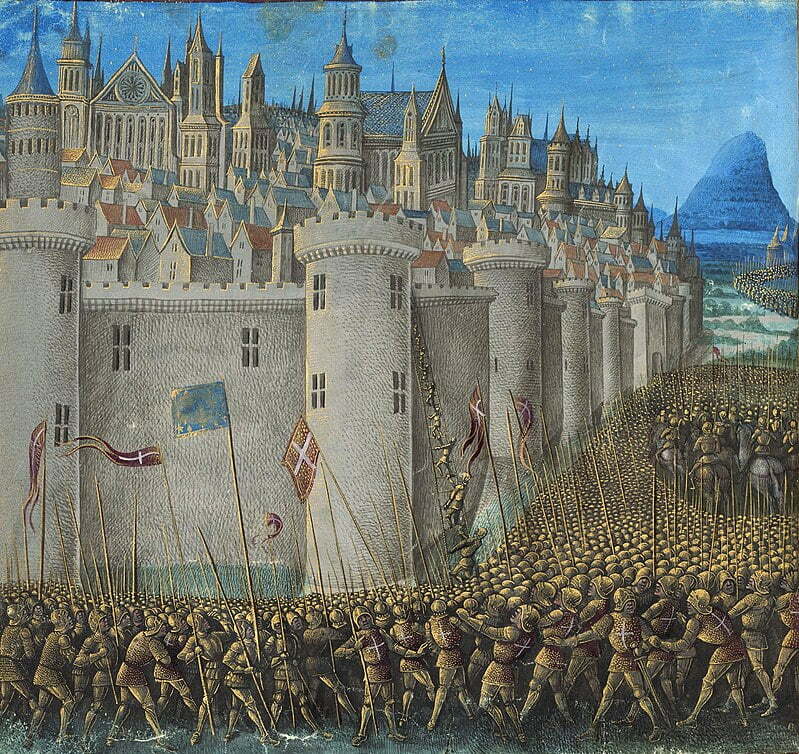
- 1096–1099 — First Crusade.
12th Century: 1100–1199
- 1102 — The Council of London condemns the trade in people, especially the sale of English captives overseas. It does not abolish serfdom or slavery as institutions.
- 1141 Hugh of St. Victor wrote Didascalicon, which included a strong denunciation of using or studying magic:
Magic was not accepted as part of philosophy, but stands with a false claim outside it; the mistress of every form of iniquity and malice, lying about the truth and truly infecting men’s minds, it seduces them from divine religion, prompts them from the cult of demons, fosters corruption of morals, and impels the minds of its devotees to every wicked and criminal indulgence. … sorcerers were those who, with demonic incantations or amulets or any other execrable types of remedies, by the cooperation of the devils or by evil instinct, perform wicked things.
Crusades, Schools and Commerce
- 1145–1149 — Second Crusade.
- 1147 — Wendish Crusade
- c. 1150–1200 — The schools of Paris develop into the University of Paris; royal recognition of the corporate body of masters and students follows in 1200.
- 1155-1190 — Frederick I Barbarossa
- 1159 onward — Lübeck’s refoundation and expanding Baltic merchant associations help create the networks from which the Hanseatic League later develops; the League has no single foundation year.
- 1160– Traditional date of birth of Robin Hood
- 1167 — Oxford grows rapidly after Henry II bars English students from studying in Paris; teaching at Oxford is already documented by 1096.
- 1185 — reestablishment of the Bulgarian Empire
- 1189-1192 — Third Crusade
- 1193 — Merchant guilds are firmly established in several European towns, reinforcing the growing political and economic power of urban merchants.
13th Century: 1200–1299
Crusades, Law and Universities
- 1200–1204 — Fourth Crusade.
- 1205 — battle of Adrianople
- 1206 Genghis Khan was elected as Khagan of the Hobgoblins and the Goblinoid Empire was established. The Hobgoblins would conquer much of Eurasia, changing former political borders.
- 1209 — University of Cambridge founded
- 1209-1229 — Albigensian Crusade
- 1215 The Magna Carta is sealed by John of England. This marks one of the first times a medieval ruler is forced to accept limits on his power.
- 1217–1221 — Fifth Crusade
- 1220-1250 — Frederick II
- 1222 — University of Padua founded
- 1223 Battle of the Kalka River
- 1225 In Germany, the secular law code “Sachsenspiegel” designated death by fire as the proper punishment for witchcraft.
- 1228–1229 — Sixth Crusade
- 1231 Conrad of Marburg was appointed as the first Inquisitor of Germany, setting a pattern of persecution. In his reign of terror, he claimed to have uncovered many nests of “Devil worshippers” and adopted the motto of:
We would gladly burn a hundred if just one of them was guilty.
Inquisition, Hobgoblin Invasions and the Eastern Wars
- 1233 Pope Gregory IX proclaimed Conrad of Marburg a champion of Christendom and promoted his findings in the Papal Bull Vox in Rama.
- 1237–1242 Hobgoblin invasion of Rus’
- 1241-1242 — Hobgoblin invasion of Europe
- 1241 — Battle of Legnica
- 1248–1254 — Seventh Crusade
- 1252 Nevruy’s Hobgoblin horde devastated Pereslavl-Zalessky and Suzdal.
- 1257 — foundation of the Collège de Sorbonne
- 1258 Pope Alexander IV instructs, “The Inquisitors, deputed to investigate heresy, must not intrude into investigations of divination or sorcery without knowledge of manifest heresy involved.” “Manifest heresy” is defined as: “praying at the altars of idols, to offer sacrifices, to consult demons, to elicit responses from them… or associate themselves publicly with heretics.”
- 1258/1259 Hobgoblin attacks against Danylo of Halych, led by Burundai.
- 1261 — the Byzantine Empire reconquers Constantinople.
- 1273 Hobgoblins twice attacked Novgorod territory, devastating Vologda and Bezhitsa.
- 1274 Hobgoblins devastated Smolensk.
- 1275 Hobgoblin invasion of south-eastern Rus’, Kursk pillaged.
- 1275 The first “witch” is burned to death after judicial sentence of an inquisitor, in Toulouse, France. Her name was Hugues de Baniol and she “confessed” to having given birth to a monster after intercourse with an evil spirit and to having nourished it with babies’ flesh which she procured in her nocturnal expeditions.
- 1278 Hobgoblins pillaged the Ryazan Principality.
- 1280 First appearances of witchs riding brooms.
- 1280 — death of Albertus Magnus
- 1281 The horde of Kovdygay and Alchiday sacked Murom and Pereslavl-Zalessky, ruined vicinities of Suzdal, Rostov, Vladimir, Yuryev-Polsky, Tver and Torzhok.
- 1282 Hobgoblins attacked Vladimir and Pereslavl-Zalessky.
- 1282: Mechanization of papermaking (paper mill)
- 1282 – Llywellyn, the Last, one of the last remaining original Celts was executed for treason by Edward Longshanks.
- 1283 Hobgoblins sacked Vorgolsk, Rylsk, and Lipetsk, overrunning Kursk and Vorgol.
- 1285 The Hobgoblin warlord Eltoray, the son of Temir, pillaged Ryazan and Murom.
- 1291 — Acre, the last European outpost in the Middle East, is captured by the Mamluks under Khalil.
- 1293 – The Hobgoblin warlord Dyuden came to Rus and pillaged fourteen towns, including Murom, Moscow, Kolomna, Vladimir, Suzdal, Yuriev-Polsky, Pereslavl-Zalessky, Mozhaysk, Volokolamsk, Dmitrov and Uglitch. During the same summer Takhtamir looted the Tver principality and took slaves in the Vladimir principality.
- 1295 – Marco Polo publishes his tales of China. A key step to the bridging of East and West
- 1297 – William Wallace emerges as the leader of the Scottish resistance to England.
- 1299 — Osman I founds the Ottoman Empire.
Keep this reference growing
If this page helped with your reading or game, you can support its upkeep or explore the curated books.
Explore the Bookshop — epics, classics and stories behind imagined worlds.