
Conjuration • Legacy Nature Summoning
Summon Nature’s Ally VII
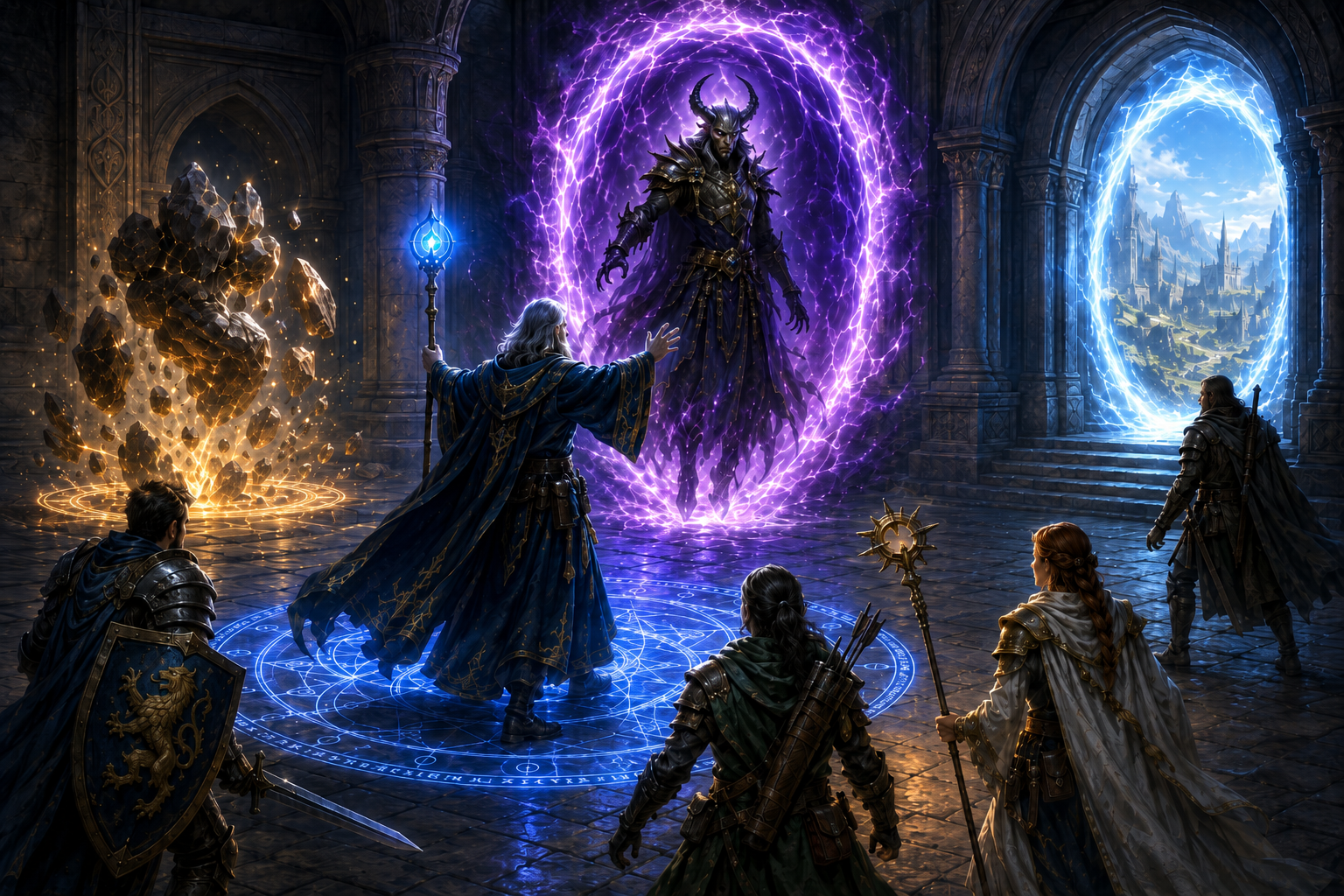
Summon Nature’s Ally VII calls one formidable natural ally or a company of lesser creatures to fight, protect or aid the caster. This is a published Pathfinder 1e and D&D 3.5e summoning progression; its Witch 7 listing on this site is preserved as a separate legacy class tradition.
Summon Nature’s Ally VII at a Glance
| 5.5e / 2024 | No spell by this exact name in SRD 5.2.1 |
|---|---|
| 5e / 2014 | No core spell by this exact name |
| Pathfinder 1e | Druid 7, Shaman 7; not automatically Pathfinder Witch 7 |
| D&D 3.5e | Druid 7; preserved legacy Witch archive: Witch 7 |
Spell Rules by Edition
Summon Nature’s Ally VII — 2024
Status: no such spell in SRD 5.2.1. Use the current edition’s own summoning spells, creature statistics and class access.
Summon Nature’s Ally VII — 2014
Status: there is no numbered Summon Nature’s Ally VII spell in the 2014 core rules. Use fifth-edition summoning magic separately.
Summon Nature’s Ally VII — Pathfinder 1e
| School | Conjuration (Summoning) [see text] |
|---|---|
| Level | Druid 7, Shaman 7 |
| Components | V, S, DF |
| Casting Time | 1 round |
| Range | Close (25 ft. + 5 ft./2 levels) |
| Effect | One or more summoned creatures |
| Duration | 1 round/level (D) |
| Saving Throw | None |
| Spell Resistance | No |
Choose one creature from the Pathfinder 7th-level Summon Nature’s Ally list, 1d3 creatures of the same kind from the 6th-level list, or 1d4+1 creatures of the same kind from a lower-level list. The creatures appear in legal spaces and act on your turn. They cannot summon or conjure other creatures, nor teleport or travel between planes.
Summon Nature’s Ally VII — D&D 3.5e
| School | Conjuration (Summoning) [see text] |
|---|---|
| Level | Druid 7; Witch 7 in the preserved legacy Witch list |
| Components | V, S, DF |
| Casting Time | 1 round |
| Range | Close (25 ft. + 5 ft./2 levels) |
| Effect | One or more creatures, no two more than 30 ft. apart |
| Duration | 1 round/level (D) |
| Saving Throw | None |
| Spell Resistance | No |
The original entry functions as Summon Nature’s Ally I, except that you may summon one 7th-level creature, 1d3 6th-level creatures of the same kind, or 1d4+1 lower-level creatures of the same kind. Summoning a creature with an air, chaotic, earth, evil, fire, good, lawful or water descriptor gives the spell that descriptor as well under the original rules.
What Changed?
The Pathfinder and D&D 3.5e versions both preserve the numbered creature ladder, but their published creature lists and class availability differ. Neither is a fifth-edition spell, and the legacy Witch 7 listing should not be mistaken for a Pathfinder or 2024 Witch spell grant.
Using Summon Nature’s Ally VII in Play
Choose between one powerful ally and several weaker creatures with complementary roles. Flying scouts, a durable blocker or multiple creatures controlling different squares can matter more than the highest damage total. Check the summoned creature’s legal environment before casting.
Counterplay and GM Rulings
- Counterspell can stop the one-round casting according to the relevant edition; Dispel Magic can end ongoing summons under its normal rules.
- Use only eligible creatures from the chosen edition’s list and all normal restrictions on placement, summoned abilities and descriptors.
- Summoned creatures cannot begin further summoning chains or use teleportation and planar travel abilities under these rules.
- Do not invent fifth-edition concentration, upcasting or Witch class eligibility for this legacy spell.
Related Magic
Summon Nature’s Ally VI · Summon Nature’s Ally VIII · Dispel Magic
Mythical Context
Greek dryads are woodland spirits, and a hamadryad can be linked to a particular tree’s life. That is a compelling way to portray a guardian called from a sacred forest: it may fight because the land it protects is threatened. See the classical account of dryads and hamadryads.
Historical Context
Pliny’s Roman description of druids revering groves and mistletoe illustrates a historical tradition in which certain trees were set apart for ritual significance. The account comes from a Roman observer, so it should be read critically. It does not establish magic that calls creatures into battle. See Pliny’s Natural History on sacred groves.
Rules Sources and Licensing
The original D&D 3.5e and Pathfinder 1e rules are Open Game Content under the Open Game License v1.0a. Original site explanations and the artwork are separate from that designation. The source archive preserves Witch 7 as a legacy variant rather than an official class entry in other editions.
Keep this reference growing
If this page helped with your reading or game, you can support its upkeep or explore the curated books.
Explore the Bookshop — epics, classics and stories behind imagined worlds.