
Necromancy • Ninth-Circle Witch Magic
Suffocation, Mass
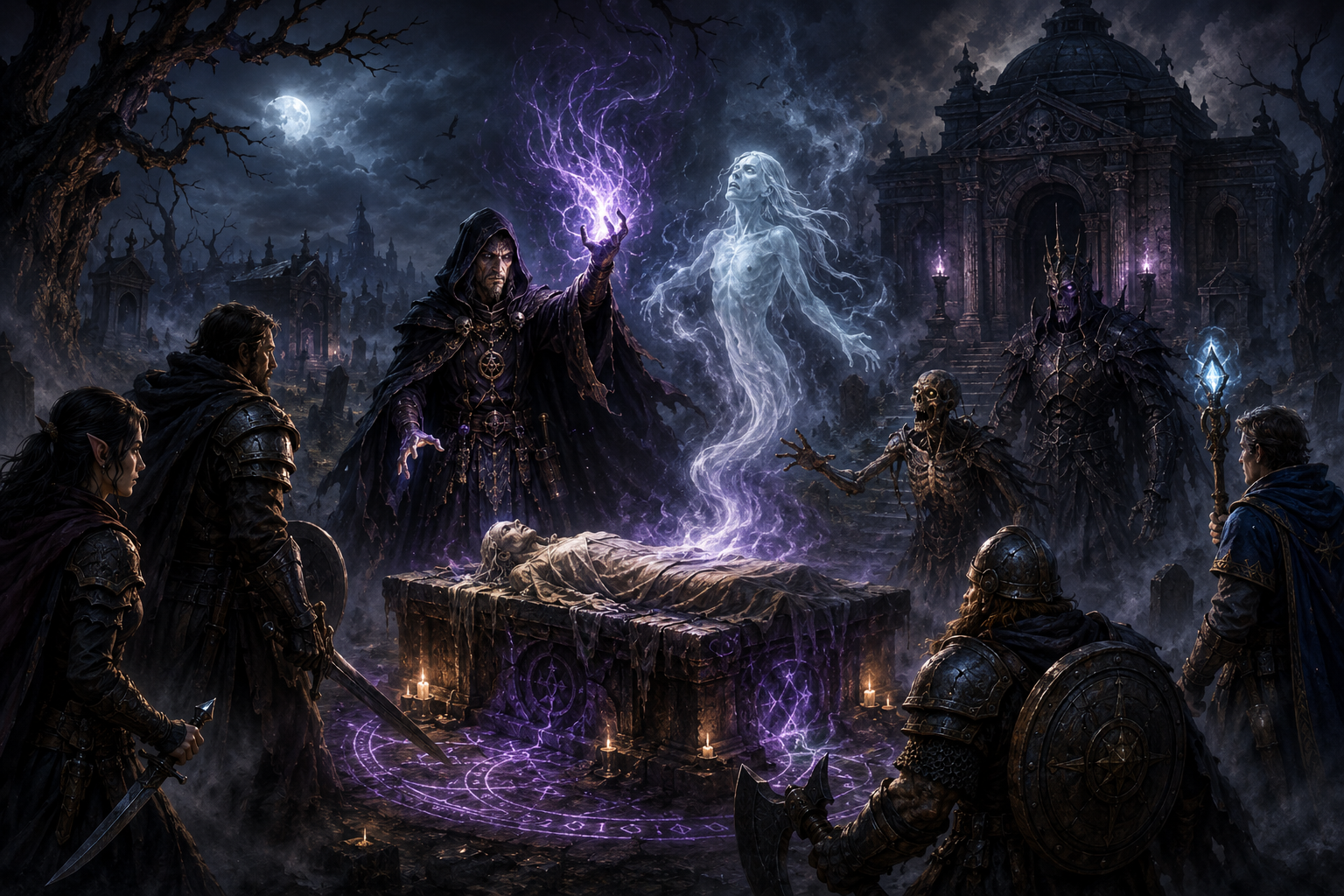
With a single whispered word, an entire company falls silent. The air leaves their lungs though the sky above remains full of wind, and battle cries become desperate gestures. Suffocation, Mass is among the most dreaded rites of a high witch: a spell that can bring even heavily armoured warriors to their knees without breaking a single shield.
Suffocation, Mass at a Glance
| Circle | Ninth |
|---|---|
| Targets | Several creatures whose bodies require air |
| Effect | Breath stolen; escalating injury until the curse is broken |
| Protection | Resisting the spell, disrupting its caster or ending its magic |
| Limit | Undead, constructs and other creatures that do not breathe are unharmed |
Spell Rules by Edition
Suffocation, Mass — D&D 2024
9th-level Necromancy (original campaign spell)
| Casting Time | Action |
|---|---|
| Range | 60 feet |
| Components | V, S, M (a glass vial containing a breath exhaled by the caster) |
| Duration | Concentration, up to 1 minute |
| Targets | Up to six breathing creatures you can see; all targets within 30 feet of one another |
| Saving Throw | Constitution |
| Spell List | Witch, Sorcerer, Wizard (campaign spell) |
You squeeze the breath from the lungs of your enemies. Each target must make a Constitution saving throw. On a failure, it takes 8d8 Necrotic damage and cannot breathe or speak until the spell ends for it. On a success it takes half damage and the effect ends for that creature. A creature that does not need to breathe is immune to the spell. Merely holding one’s breath does not protect a target.
At the end of each of its turns, an affected creature repeats the Constitution saving throw. On a failed save it takes 4d8 Necrotic damage and has the Incapacitated condition until the start of its next turn. On a successful save the spell ends for that creature. An affected creature can still move on a turn when it is not Incapacitated; the inability to speak prevents it from supplying Verbal spell components. The damage can reduce it to 0 HP and kill it under the ordinary rules, but the spell does not impose automatic death at a fixed round.
Dispel Magic and similar magic can end the ongoing effect according to their normal rules. Ending Concentration frees every remaining target. Using a Higher-Level Spell Slot: None; this spell is already 9th level.
Suffocation, Mass — D&D 2014
9th-level Necromancy (original campaign spell)
| Casting Time | 1 action |
|---|---|
| Range | 60 feet |
| Components | V, S, M (a vial filled with the caster’s breath) |
| Duration | Concentration, up to 1 minute |
| Targets | Up to six creatures you can see that need air to live, no two more than 30 feet apart |
| Saving Throw | Constitution |
| Classes | Witch, Sorcerer, Wizard (campaign spell) |
The breath is torn from each target’s lungs. Every target makes a Constitution saving throw, taking 8d8 necrotic damage on a failed save or half damage on a successful one. A target that fails also cannot breathe or speak and remains affected while you concentrate. Holding its breath provides no defence. Creatures that do not breathe are unaffected.
At the end of each of its turns, an affected creature repeats the save, ending the spell on itself with a success. On a failure it takes 4d8 necrotic damage and is incapacitated until the beginning of its next turn. The inability to speak also prevents verbal spellcasting. Loss of concentration ends the effect on all subjects, and ordinary damage and death rules determine the consequences of reducing a victim to 0 hit points. Dispel Magic can end the ongoing spell with the usual check for a 9th-level effect.
Suffocation, Mass — Pathfinder 1e
| School | Necromancy |
|---|---|
| Level | Sorcerer/Wizard 9, Witch 9 |
| Components | V, S, M: a vial holding some of the caster’s breath |
| Casting Time | 1 standard action |
| Range | Close (25 ft. + 5 ft./2 levels) |
| Targets | One living creature per two caster levels; no two farther than 30 feet apart |
| Duration | 1 round/level |
| Saving Throw | Fortitude partial |
| Spell Resistance | Yes |
Each creature makes the initial Fortitude saving throw. On success it is staggered for one round; on failure the spell extracts its breath and begins the original Suffocation progression. Affected creatures can attempt saving throws in later rounds to delay the next stage. Under the underlying spell a failed initial save leads to unconsciousness and 0 hit points on the next turn, then dying at −1 hit points, then death unless successive saves delay those steps. Merely holding one’s breath does not protect a target that failed the initial save.
Mass difference: the effect lasts one round per caster level, creating additional rounds in which the subject may be forced to attempt saves. Its multiple-target restriction must be applied as written.
Source: Pathfinder 1e Advanced Player’s Guide — Suffocation and Suffocation, Mass.
Suffocation, Mass — D&D 3.5e
Necromancy; Witch 9, Sorcerer/Wizard 9 (original campaign spell)
| Casting Time | 1 standard action |
|---|---|
| Components | V, S, M (a vial containing the caster’s exhaled breath) |
| Range | Close (25 ft. + 5 ft./2 levels) |
| Targets | One living, breathing creature per two caster levels; no two more than 30 ft. apart |
| Duration | 1 round/level |
| Saving Throw | Fortitude partial |
| Spell Resistance | Yes |
Each target that fails its initial Fortitude save immediately loses its breath. On a successful initial save it instead becomes staggered for 1 round and suffers no further effect. Spell resistance applies to each target separately. On a failed initial save, the creature begins a sequence of failed breathing: on its next turn it falls unconscious and drops to 0 hit points, one round later it falls to −1 hit point and begins dying, and one round after that it dies.
At the start of each of these subsequent rounds, the creature can make a Fortitude save to delay that round’s effect; on success, its condition does not worsen that round, though it must attempt another save in the following round. A failed save advances it one step. The spell lasts 1 round per caster level rather than ending after three rounds. A victim cannot overcome the effect merely by holding its breath. Creatures that do not breathe are immune.
A successful Dispel Magic, Break Enchantment where otherwise applicable, or equivalent magic can end the ongoing effect as allowed by the ordinary spell rules. Once the effect ends, any creature already dying or unconscious must still receive ordinary medical or magical aid; it does not automatically recover lost hit points.
Using Suffocation, Mass in Play
This is a grim escalation spell for powerful necromancers. The GM should track each target separately: initial resistance, later saving throws, the progression of any victims that fail and the total number of rounds remaining. The scene is more playable when these stages remain visible to everyone affected.
Counterplay and Rulings
- Eligible creatures: living creatures must require breathing. Use the actual target limit and spacing.
- Fortitude: an initial success only staggers the subject for one round; each subsequent failure progresses the ongoing effect.
- Magic: spell resistance may negate the initial spell effect. An appropriate counterspell can prevent its casting, and anti-necromancy or dispelling works by Pathfinder’s original rules.
- Holding breath: holding one’s breath cannot override the spell’s specific extraction of air.
The Breathless Host
A witch may use this curse when an invading army masses beneath a fortress gate. Every stricken soldier fights for breath while comrades scramble to pull the fallen clear. The spell is especially terrifying in a mine, a ship’s hold or a banquet hall, where escape routes are few. A foe that does not breathe can walk through the dying company untouched, a chilling sign that the necromancer prepared the battlefield deliberately.
Keep the fate of each victim distinct: some resist at once, others stagger and recover, and a few collapse unless friends intervene. The curse does not choke the stones, extinguish the torches or deprive unaffected bystanders of ordinary air. Its malice falls upon living lungs.
Related Magic
Mythical Context
Typhon, a monstrous force opposed by Zeus in Greek myth, is associated with terrifying winds and destructive upheaval. A spell that denies breath to an entire company can borrow that atmosphere of the air itself turning hostile. See the collected Greek accounts of Typhon.
Historical Context
Medical and magical texts from ancient Egypt included practices intended to protect the body from illness and danger. A second-century CE papyrus from Oxyrhynchus has been read as a charm against fever or for favour; it does not document causing or curing magical suffocation. See the British Museum’s Oxyrhynchus magical papyrus.
Rules Sources and Licensing
Published rules: Advanced Player’s Guide, copyright 2010 Paizo Publishing, LLC; author Jason Bulmahn. Pathfinder 1e mechanics are Open Game Content under the OGL v1.0a and their required source notice is preserved here. D&D 2024, D&D 2014 and D&D 3.5e panels contain separate original, unofficial campaign adaptations.
Keep this reference growing
If this page helped with your reading or game, you can support its upkeep or explore the curated books.
Explore the Bookshop — epics, classics and stories behind imagined worlds.