
Lullaby Spell — Song of Heavy Eyes
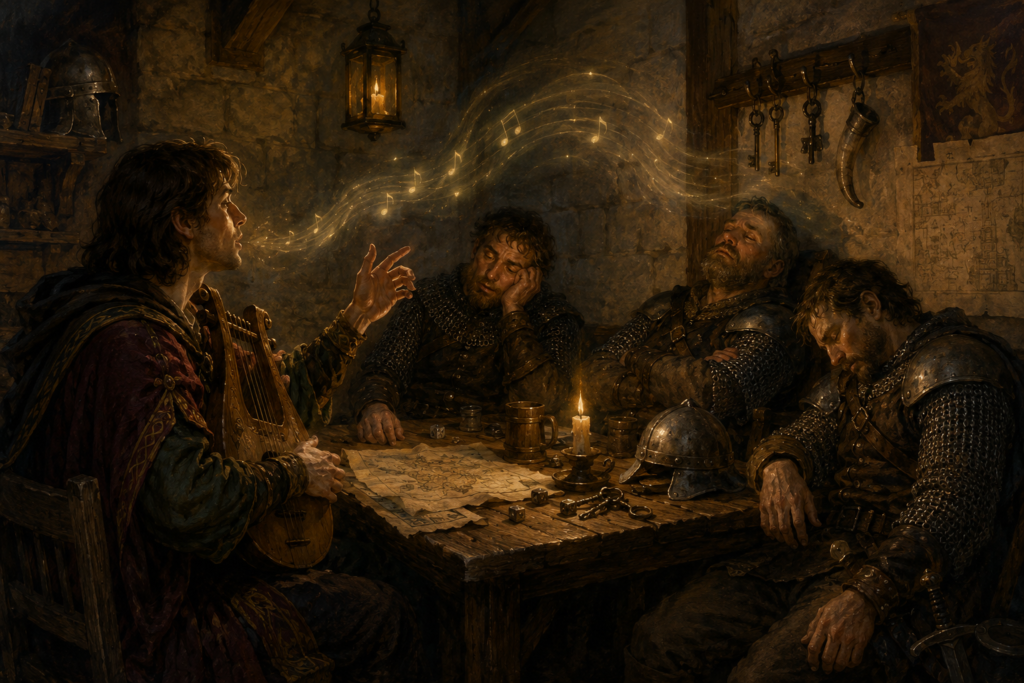
A soft bardic song makes the watchful heavy-eyed and leaves them more vulnerable to true sleep magic.
Lullaby is a legacy Bard cantrip from Pathfinder 1e and D&D 3.5e. It does not put creatures to sleep; it makes living creatures drowsy, less perceptive, and easier to affect with sleep effects. There is no direct official D&D 5e / 2014 or D&D 5.5e / 2024 Lullaby spell.
The modern spell that actually fills the sleep-magic role is Sleep, but its mechanics are entirely different. The 2024 spell uses Wisdom saves and can progress from Incapacitated to Unconscious; the 2014 spell uses a hit-point pool instead.
Quick Rules Reference
- 5.5e / 2024: no direct official Lullaby spell; use the actual 2024 Sleep rules if the goal is magical slumber.
- 5e / 2014: no direct official Lullaby spell; 2014 Sleep uses a 5d8 hit-point pool.
- Pathfinder 1e: Bard 0, 10-foot-radius burst, Will negates, Spell Resistance yes.
- D&D 3.5e: Bard 0 with the same core drowsiness procedure.
- Legacy effect: –5 Perception in PF1e; –5 Listen and Spot in 3.5e; –2 on Will saves against sleep effects.
- Duration: Concentration plus up to 1 round per caster level.
- Main limit: legacy Lullaby does not itself cause the Unconscious condition.
Rules
Lullaby by Edition
5.5e / 2024 — No Direct Official Lullaby
The 2024 Basic Rules do not contain a Lullaby cantrip. The previous homebrew drowsiness cantrip on this page has been removed.
Closest official spell: Sleep
| Level | 1st-level Enchantment |
|---|---|
| Range | 60 feet |
| Area | 5-foot-radius Sphere |
| Duration | Concentration, up to 1 minute |
| Save | Wisdom |
A failed first save gives the Incapacitated condition until the end of the target’s next turn; it then repeats the save, becoming Unconscious for the duration on a second failure. Creatures that do not sleep or are immune to Exhaustion automatically succeed.
5e / 2014 — No Direct Official Lullaby
The 2014 Basic Rules do not contain Lullaby as a cantrip.
Closest official spell: Sleep
2014 Sleep rolls 5d8 and uses that total as a pool of hit points, affecting creatures in a 20-foot-radius area in ascending order of current hit points. Affected creatures become unconscious until the spell ends, they take damage, or someone wakes them.
Undead and creatures immune to being charmed are unaffected. Higher-level slots add 2d8 to the hit-point pool per slot level above 1st.
Lullaby — Pathfinder 1e
| School | Enchantment (Compulsion) [mind-affecting] |
|---|---|
| Level | Bard 0 |
| Casting Time | 1 standard action |
| Components | V, S |
| Range | Medium (100 ft. + 10 ft./level) |
| Area | Living creatures in a 10-ft.-radius burst |
| Duration | Concentration + 1 round/level (D) |
| Saving Throw | Will negates |
| Spell Resistance | Yes |
A creature that fails its Will save becomes drowsy and inattentive, taking a –5 penalty on Perception checks and a –2 penalty on Will saves against sleep effects.
The spell lasts while the caster concentrates and then for up to 1 round per caster level afterward.
Lullaby — D&D 3.5e
| School | Enchantment (Compulsion) [Mind-Affecting] |
|---|---|
| Level | Bard 0 |
| Casting Time | 1 standard action |
| Components | V, S |
| Range | Medium (100 ft. + 10 ft./level) |
| Area | Living creatures in a 10-ft.-radius burst |
| Duration | Concentration + 1 round/level (D) |
| Saving Throw | Will negates |
| Spell Resistance | Yes |
A failed save makes the creature drowsy and inattentive: –5 on Listen and Spot checks and –2 on Will saves against sleep effects.
Lullaby lasts for as long as the caster concentrates, then for up to 1 round per caster level.
What Changed?
- There is no direct official Lullaby cantrip in 5e/2014 or 5.5e/2024. The previous modern conversion has been removed.
- Modern Sleep is the real sleep spell, not a renamed Lullaby.
- 2024 Sleep uses Wisdom saves and a two-stage Incapacitated-to-Unconscious procedure.
- 2014 Sleep uses a hit-point pool instead of a saving throw.
- PF1e/3.5e Lullaby never puts the target to sleep by itself: it weakens perception and saves against later sleep effects.
- Pathfinder consolidates Listen/Spot into Perception; D&D 3.5e keeps the two separate skill penalties.
Legacy 3.0e Lullaby
Enchantment (Compulsion) [Mind-Affecting]
Level: Bard 0
Components: V, S
Casting Time: 1 standard action
Range: Medium (100 ft. + 10 ft./level)
Area: Living creatures in a 10-ft.-radius burst
Duration: Concentration + 1 round/level (D)
Saving Throw: Will negates
Spell Resistance: Yes
A failed save makes a living creature drowsy, imposing –5 on Listen and Spot checks and –2 on Will saves against sleep effects.
Why This Spell Is Dangerous in the World
Lullaby is dangerous because it can hide inside kindness.
A fireball, curse, or summoned monster gives people something obvious to fear. A lullaby can pass through a room as comfort, habit, art, prayer, or work song. By the time the magic matters, the victim may simply believe they were tired.
That makes the spell useful in courts, prisons, nurseries, sickrooms, taverns, ships, temples, barracks, and noble houses. It can help a frightened child sleep, calm the fevered, soften a witness, dull a guard, prepare a kidnapping, or make a locked door easier to reach.
Its moral weight comes from context. The same magic that comforts the helpless can endanger them.
Best Uses
Prepare a Sleep Spell
This is the cleanest use. Cast Lullaby first, then follow with Sleep, Deep Slumber, or another effect that depends on magical sleep.
Weaken Watchfulness
Use the spell before a stealth attempt, not after the alarm is raised. It is strongest against guards, sentries, servants, gatekeepers, jailers, and bored soldiers who are already fighting fatigue.
Create a Narrow Opening
The spell is ideal when the party needs one mistake: a missed footstep, a late glance, a key left unguarded, a door opened without immediate challenge, or a prisoner moved while the watch is slow.
Hide Magic Inside Performance
A bard can make the spell feel natural inside a song, chant, cradle tune, lament, prayer, or court performance. This does not erase the verbal and somatic components, but it gives the caster a believable reason to be singing.
Use Mercy and Threat Together
The spell has legitimate gentle uses. It can soothe the sick, settle panic, or help someone rest. That makes its darker uses more interesting, because the spell is not inherently monstrous.
Is Lullaby Worth Using?
Yes, if the party uses stealth, prison breaks, guard scenes, ambushes, performances, or follow-up sleep magic. Lullaby is especially useful for characters who already plan to cast Sleep, Deep Slumber, or a similar spell.
No, if the campaign is mostly loud open combat where the bard needs immediate impact. In that kind of game, Lullaby is usually too subtle to justify the action unless another character can exploit it right away.
Tactics
Lullaby is best cast one step before the real action.
A strong sequence is:
Round 1: Cast Lullaby on the guards, servants, or enemies who need to miss something.
Round 2: Cast Sleep, move the rogue, open the door, cross the corridor, lift the key, or begin the escape.
Do not waste the spell after the scene has already become loud and obvious unless another character can exploit it immediately.
The spell also rewards careful targeting. A 10-foot-radius burst is small. Choose the cluster that matters most: the two guards at the door, the watch captain and his nearest soldier, the jailer and the clerk, or the group seated closest to the hidden passage.
DM Notes
Do not let Lullaby become a silent knockout spell. It does not make creatures helpless, unconscious, charmed, stunned, or unaware.
A drowsy guard can still challenge intruders, raise an alarm, draw a weapon, or notice obvious danger. The spell matters at the margins: muffled footsteps, hidden movement, whispered plans, a quiet latch, a concealed blade, a rogue crossing shadow, or a prisoner slipping behind a cart.
For 3.5e and Pathfinder tables, the –5 perception penalty is large. Use it honestly. If the guard would only barely notice the action, Lullaby should often be the reason he misses it.
For Pathfinder 1e and D&D 3.5e, overlapping penalties from repeated castings should be resolved using that edition’s normal stacking rules. There is no direct official 5e/2014 or 5.5e/2024 Lullaby effect to stack.
Rules Clarifications
Does Lullaby put creatures to sleep?
Not in Pathfinder 1e or D&D 3.5e. The legacy Lullaby makes creatures drowsy and easier to affect with sleep magic. Modern D&D has no direct Lullaby spell; use the actual Sleep rules for that edition.
Does it work on undead or constructs?
Not in the Pathfinder / 3.5e version. It affects living creatures and is mind-affecting.
Can it affect creatures that cannot sleep?
A living creature that cannot sleep should not suffer the penalty against sleep effects. The DM may still allow the inattentive effect if the creature is living and mentally susceptible.
Can the caster disguise the spell as ordinary singing?
Sometimes. The components are still spellcasting. In a feast, tavern, nursery, ritual, or performance, the DM may allow Perform, Deception, or Sleight of Hand to hide the casting from casual observers.
Does it replace a Stealth check?
No. It makes Stealth checks more likely to succeed by lowering the target’s chance to notice.
Good Combinations
- Sleep: This is the classic follow-up. Lullaby weakens the target’s resistance before the actual sleep spell lands.
- Deep Slumber: Better against tougher creatures that are still vulnerable to magical sleep.
- Invisibility: The perception penalty makes invisible movement harder to detect by sound, disturbed dust, creaking floorboards, shifted curtains, or other indirect signs.
- Silence: Strong for infiltration, but order matters. Lullaby requires sound, so it should usually be cast before silence is imposed.
- Stealth checks: Excellent for rogues, scouts, smugglers, spies, rescuers, and prison-break scenes. Lullaby does not replace the Stealth check; it makes the watcher worse at noticing it.
Using This Spell in Your Game
Use Lullaby when a scene needs subtle pressure rather than obvious force.
It belongs in watchrooms, palace corridors, sickrooms, nurseries, taverns, ships at night, military camps, prison blocks, temple vigils, noble feasts, witch-cottages, and faerie courts.
The best player use is specific:
“I cast Lullaby on the two guards at the door before the rogue crosses the hall.”
“I sing through the feast and centre the spell on the watch captain and his nearest soldiers.”
“I cast Lullaby first, then follow with Sleep next round.”
The spell becomes satisfying when the table knows exactly what the targets might miss.
Spellcasting Culture and Worldbuilding Hooks
Bards do not treat Lullaby as a childish spell. It is one of the first lessons in how music changes a room without seeming to command it.
Court singers learn lawful versions. Temple musicians use it to calm pain and panic. Village charmers hum it at sickbeds. Spies learn the same patterns for darker work. In some cities, magical song is forbidden near courts, prisons, treasuries, council chambers, royal nurseries, and military briefings.
A bard accused of using Lullaby may have difficulty proving intent. Was the song a mercy, a performance, a prayer, or a spell? That uncertainty is exactly where adventures begin.
Adventure and Worldbuilding Hooks
The Sleeping Gate: A city gate has opened three nights in a row without signs of force. The guards swear they never slept, but all remember the same beggar-singer.
The Cradle Witch: A village healer uses Lullaby to calm feverish children. A noble family accuses her of enchanting their heir.
The Prison Hymn: Prisoners sing together every dusk. The gaolers think it is despair. It is rehearsal.
The Court Performance: During a royal feast, a bard’s gentle song leaves three witnesses too inattentive to see an assassination signal.
The False Nurse: A stranger enters noble houses by offering to soothe sleepless infants. Soon letters, keys, and small heirlooms begin to vanish.
Source and Literary Context
Lullaby is based on Open Game Content from the 3.5 System Reference Document. Its original rules identity is narrow and useful: the spell does not put creatures to sleep, but makes them drowsy, inattentive, and easier to affect with sleep magic. For the SRD spell text, see d20 SRD: Lullaby.
The spell draws on one of the oldest and most recognisable forms of song: the lullaby, a quiet vocal pattern associated with soothing, calming, and drawing a listener toward sleep. In classical music, a lullaby-like cradle song may also be called a berceuse. For a concise reference, see Encyclopaedia Britannica: Berceuse.
Its mythic relatives are not only cradle songs, but songs that pacify dangerous beings. Orpheus is the strongest classical parallel: his music charms beasts, underworld powers, and even Cerberus, the hound of Hades. That does not make Lullaby a monster-sleep spell in rules terms, but it gives the spell its proper imaginative ancestry: music that lowers violence, dulls vigilance, and opens a path where force would fail. For a concise reference, see Encyclopaedia Britannica: Orpheus.
In play, Lullaby works best when treated as soft coercion rather than open attack. It belongs to the border between comfort and danger: the same song that calms a child, patient, or frightened traveller can also dull the senses of a guard, witness, prisoner, enemy, or watchful beast before stronger magic follows.
Keep this reference growing
If this page helped with your reading or game, you can support its upkeep or explore the curated books.
Explore the Bookshop — epics, classics and stories behind imagined worlds.