
Divination spell · Investigation · Social encounters
Read the Guilty Face
A focused divination that sharpens the caster’s reading of one creature’s expression, posture, hesitation, and guarded response.
The Read the Guilty Face spell helps an investigator interpret visible behaviour. It can expose unease, rehearsed answers, concealed intention, or the strain of deception, but it never declares a creature guilty and never replaces evidence, testimony, or careful questioning.
The name is accusatory; the magic is not. Fear, shame, grief, anger, pain, divided loyalty, and false accusation can all resemble guilt. The Read the Guilty Face spell improves observation. It does not deliver a verdict.
At a glance
Read the Guilty Face Spell Quick Rules
The Read the Guilty Face spell supports interviews, interrogations, negotiations, and tense social encounters without turning emotional behaviour into automatic proof.
Edition-separated rules
Read the Guilty Face Spell Mechanics
The D&D 5.5e/2024 conversion appears first. Pathfinder 1e and D&D 3.5e remain separate so that spell levels, actions, saving throws, skill names, concentration, and Spell Resistance are never mixed.
Read the Guilty Face
SpiralWorlds 2024 conversion- Level
- 1st-level Divination
- Casting Time
- Action
- Range
- 30 feet
- Components
- V, S
- Duration
- Concentration, up to 10 minutes
- Target
- One creature you can see that is not a Construct or Undead
- Saving Throw
- Wisdom
- Spell Lists
- Bard, Cleric, Paladin, Sorcerer, Wizard
Effect
Choose one eligible creature you can see within range. The target makes a Wisdom saving throw. On a failed save, the magic heightens your perception of its involuntary expressions, changes in posture, guarded pauses, and other visible behaviour. Until the spell ends, while you can see the target, you have Advantage on Wisdom (Insight) checks you make against it to judge its emotional state, immediate intentions, or attempts to deceive you.
On a successful save, the Read the Guilty Face spell has no effect. You know whether the spell took hold. The target does not automatically learn whether it resisted, although it can perceive the spell’s verbal and somatic components normally.
Hard limits
- The spell does not identify guilt, establish innocence, reveal alignment, read thoughts, uncover memories, compel speech, or determine what actually happened.
- It does not grant a language, translate speech, or create an Insight check when there are no meaningful behavioural cues to observe.
- It cannot distinguish criminal guilt from fear, shame, grief, trauma, pain, divided loyalty, magical coercion, or anxiety caused by accusation.
- A sincere false belief produces the behaviour of sincerity. The spell does not compare a statement with objective reality.
Visibility, range, and disguises
- After the spell takes hold, the target can move beyond the original 30-foot range without ending the spell. You gain no benefit while you cannot see it.
- Darkness, invisibility, an opaque barrier, or purely written communication can prevent the relevant Insight check. A mask or rigid disguise may limit the available information rather than automatically defeating the spell.
- The spell reads the behaviour the target presents. It does not reveal a shapechanger, illusion, possession, or false identity by itself.
Counters, repetition, and concentration
- Nondetection prevents the protected creature from being targeted by this divination.
- Counterspell can stop the spell before it takes effect. Dispel Magic can end an ongoing casting on the affected creature.
- Repeated castings require new spell slots and new saving throws. Multiple successful castings do not provide more than one source of Advantage to the same check.
- If your Concentration ends, the spell ends immediately.
- Casting the spell with a higher-level spell slot grants no additional benefit.
Conversion and balance
The 2003 spell was a cantrip for some source classes, but early third-edition cantrips were limited daily resources. The 2024 conversion is 1st level because it can affect every relevant Insight check against one target throughout an extended scene. Its narrow target, saving throw, sight requirement, and Concentration keep the Read the Guilty Face spell useful without turning it into automatic lie detection.
Read the Guilty Face
SpiralWorlds Pathfinder 1e conversion- School
- Divination
- Level
- God’s Eye 1, inquisitor 1, lawkeeper 1, sorcerer/wizard 1
- Casting Time
- 1 standard action
- Components
- V, S
- Range
- Close (25 ft. + 5 ft./2 levels)
- Target
- One living creature
- Duration
- 1 minute/level
- Saving Throw
- Will negates
- Spell Resistance
- Yes
Effect
For the duration, you gain a +3 insight bonus on all Sense Motive checks made against the target. The target must be the creature whose truthfulness, intentions, hidden message, emotional state, trustworthiness, or possible enchantment you are assessing.
This bonus does not create information that a Sense Motive check cannot normally reveal. The Read the Guilty Face spell does not identify guilt, prove a statement false, reveal the truth behind a lie, read thoughts, uncover memories, or expose a disguise.
Observation and interaction
- You must be able to observe enough of the target’s behaviour to attempt the relevant Sense Motive check. Total concealment, invisibility, or communication limited to writing may make the check impossible.
- A mask, altered appearance, or rigid costume can remove facial cues without necessarily hiding posture, voice, timing, or other behaviour. Apply ordinary circumstance modifiers where appropriate.
- The spell remains in effect if the target later moves beyond the original range. It provides no useful benefit while the target cannot be observed.
Defences and counters
- Resolve Nondetection first. If the required caster-level check fails, the divination does not reach the warded target.
- If Nondetection is overcome, check Spell Resistance, then resolve the Will save.
- The source spell expressly lists Spell Resistance: Yes. Use that specific entry even though some information-gathering divinations do not allow Spell Resistance.
- Dispel Magic can end the ongoing effect. Read the Guilty Face can counter another casting of itself under the normal counterspell rules.
- Bonuses from multiple castings do not stack.
Pathfinder conversion decision
Pathfinder cantrips and orisons are normally cast at will. Raising this adaptation to 1st level prevents repeated no-cost castings until a target fails its Will save while preserving the original duration, defences, and focused +3 benefit.
Read the Guilty Face
2003 spell adapted to D&D 3.5e- School
- Divination
- Level
- God’s Eye 1, inquisitor 0, lawkeeper 1, sorcerer/wizard 0
- Casting Time
- 1 standard action
- Components
- V, S
- Range
- Close (25 ft. + 5 ft./2 levels)
- Target
- One living creature
- Duration
- 1 minute/level
- Saving Throw
- Will negates
- Spell Resistance
- Yes
Effect
For the duration of the spell, you receive a +3 bonus on all Sense Motive checks that you make against the target.
The original entry does not assign a bonus type. Treat it as an unnamed bonus, but do not stack multiple castings of the same spell. The 2003 wording gives a casting time of “1 action”; for D&D 3.5e, resolve this as 1 standard action.
Rules clarifications
- The target must be living. Constructs and Undead are not valid targets.
- The bonus applies only when the named creature is the subject of the Sense Motive check or the opposing creature in that check.
- The Read the Guilty Face spell does not determine guilt, reveal objective truth, identify the content of a lie, read thoughts, or uncover memories.
- The spell remains active if the target later moves beyond Close range, but the caster still needs sufficient interaction or observation to make the check.
- A successful Will save negates the spell. Check Spell Resistance once for the casting before resolving the save.
Divination wards and dispelling
- Nondetection requires the caster to succeed on the appropriate caster-level check before this spell can affect the warded creature.
- The spell’s specific Spell Resistance entry applies even though some divinations that reveal information do not normally allow Spell Resistance.
- Dispel Magic can end the spell. Read the Guilty Face can counter another casting of itself under the normal counterspell procedure.
Source-faithful boundary
This panel preserves the original class levels, target, duration, Will save, Spell Resistance, and +3 Sense Motive benefit. The added text clarifies adjudication without turning the spell into lie detection or supernatural proof of guilt.
Meaning at the table
How the Read the Guilty Face Spell Works
The Read the Guilty Face spell reads observable behaviour rather than thoughts, memories, alignment, or objective truth.
Expression
Fleeting tension around the eyes, a jaw set too quickly, relief that arrives before an answer, or an expression that does not match the words being spoken.
Posture and movement
Protective gestures, sudden stillness, repeated self-control, changes in distance, or attention drawn toward a person, door, object, or escape route.
Timing
Rehearsed speed, unusual delay, answers formed before a question is complete, or hesitation at a specific name, place, date, or consequence.
Emotional strain
Fear, anger, sorrow, disgust, guarded hope, shame, or divided loyalty. The spell helps the caster notice these states but does not explain their cause.
The central safeguard
Limits of the Read the Guilty Face Spell
A guilty creature may appear calm because it feels no remorse, has rehearsed its story, believes its conduct was justified, or expects protection. An innocent creature may appear terrified because the accusation threatens imprisonment, disgrace, exile, torture, execution, or the safety of someone it loves.
The spell can help answer questions such as “Does this subject become guarded when the missing key is mentioned?” or “Does this answer appear rehearsed?” It cannot answer “Did this creature commit the murder?” A strong result supplies a lead, not a verdict.
Magic can sharpen perception without eliminating bias. A caster who begins with a fixed accusation may interpret every fearful movement as confirmation. These limitations keep the Read the Guilty Face spell useful without allowing it to replace investigation or evidence.
Sensory presentation
Casting the Read the Guilty Face Spell
Quiet scrutiny
The caster traces a brief sign near the eye, names the target, and speaks a phrase of attention or judgment. The magic settles as heightened clarity rather than a visible aura.
The caster’s experience
Meaningful movements seem fractionally sharper. A swallowed word, tightening hand, or change of breath stands apart from ordinary motion, but the caster must still interpret what it means.
What witnesses notice
Observers can notice the verbal and somatic casting. Afterward there need be no spectacle, making the spell useful in a formal interview but politically dangerous when cast without consent.
What the target feels
The target receives no automatic sensation of being read. It may still recognise the spell, notice the caster’s concentration, or become suspicious when the questioning grows more precise.
Practical play
Best Uses for the Read the Guilty Face Spell
Witness interviews
Identify which parts of a long account cause fear, resistance, grief, or rehearsed caution, then investigate those points independently.
Negotiations
Judge whether an envoy’s confidence changes when particular concessions, hostages, routes, allies, or deadlines are raised.
Suspected coercion
Notice that a witness’s words and visible emotional response do not align, suggesting threat, enchantment, blackmail, or divided loyalty without proving which is responsible.
Impostors and infiltrators
Look for behaviour inconsistent with claimed familiarity, rank, custom, or relationship. The spell does not reveal the disguise; it helps expose mistakes in the performance.
Hostage exchanges
Read whether a negotiator expects betrayal, fears a hidden signal, or reacts strongly to a proposed change in procedure.
Court and council scenes
Support social play where testimony matters but magical certainty would flatten the scene. The spell produces pressure, clues, and competing interpretations.
Investigator technique
Questioning Tactics
| Method | Example | Why it works |
|---|---|---|
| Establish a baseline | Begin with identity, routine, and facts already known. | Shows how the target behaves when the subject is ordinary and low-risk. |
| Narrow the time | “Where were you between the second bell and moonrise?” | Reduces the space available for vague or rehearsed answers. |
| Change one detail | Ask about the same event from another angle. | Reveals which part of the account carries unusual emotional weight. |
| Use known evidence | Mention a footprint, ledger entry, witness, or missing object without revealing everything known. | Lets the caster compare the reaction with the strength of the evidence. |
| Test alternatives | Ask whether the target is protecting someone rather than assuming personal guilt. | Prevents one fearful response from being forced into a single explanation. |
| End with consequence | Explain what happens if the account is false, incomplete, or misunderstood. | Distinguishes fear of the accusation from fear of a specific discovery. |
Adjudication
GM Guidance
Give information, not conclusions
Describe the cue and its likely emotional meaning: “Her relief appears genuine when the missing child is mentioned.” Do not jump directly to “She is innocent.”
Let strong checks matter
A successful check should reveal something actionable: the answer that was rehearsed, the name that caused fear, the point where anger replaced grief, or the moment attention shifted toward an accomplice.
Protect uncertainty honestly
Uncertainty should come from competing causes, not from making every result meaningless. “He is afraid of the cellar” is useful even when the reason remains unknown.
Avoid universal tells
Do not establish that looking away, sweating, stammering, or folded arms always indicates deception. Behaviour varies by person, culture, disability, training, fear, and circumstance.
Account for unfamiliar bodies
A dragon, ooze, fey creature, shapeshifter, or unfamiliar people may express emotion differently. The magic helps, but a truly alien body can still limit what the caster understands.
Keep evidence central
The Read the Guilty Face spell should open investigative paths rather than close the case. It is strongest when the party must decide what to verify next.
Counters and combinations
Read the Guilty Face Spell Interactions
Several defensive and investigative spells can counter, interrupt, or complement the Read the Guilty Face spell.
Detect Thoughts
Detect Thoughts exposes surface thoughts rather than behavioural cues. In the 2024 rules, one caster normally cannot maintain both because both require Concentration. Legacy Read the Guilty Face does not require concentration.
Discern Lies
Discern Lies identifies deliberate falsehoods from affected subjects but does not reveal the hidden truth. Read the Guilty Face is weaker at lie detection but broader when reading emotion, intention, evasion, and guarded behaviour.
Zone of Truth
Zone of Truth constrains deliberate lies but permits silence, evasion, literal answers, and sincere mistakes. Read the Guilty Face helps interpret those responses without making them complete or legally conclusive.
Nondetection
Nondetection is the specialised defence. The 2024 conversion blocks targeting; Pathfinder 1e and D&D 3.5e require the caster to overcome the ward with a caster-level check.
Counterspell and Dispel Magic
Counterspell prevents the casting from taking hold. Dispel Magic ends an ongoing successful casting but does not erase anything the caster has already observed or inferred.
Illusions and disguises
A disguise can hide identity and obscure expressions without automatically controlling genuine timing, posture, or emotional response. Read the Guilty Face does not pierce the disguise; it reads only the behaviour still available.
Consequences in the setting
Why the Read the Guilty Face Spell Is Dangerous
The Read the Guilty Face spell is dangerous because institutions can mistake magical assistance for certainty. A magistrate may treat visible fear as confession. A ruler may cast it during loyalty oaths. A guild may require it before granting office. A corrupt investigator may announce that the spell “saw guilt” even though the magic did no such thing.
Its quietness makes abuse easier. Unlike a public truth circle, the spell can leave no obvious sign after casting. The caster controls the interpretation, the target may not know whether the magic succeeded, and witnesses may hear only the investigator’s conclusion.
Just legal systems treat the spell as one investigative aid among many. They record the questions asked, identify the caster, allow challenges to the interpretation, and prohibit conviction based solely on a behavioural reading. Tyrannical systems use the name of the spell as propaganda.
Worldbuilding
Spellcasting Culture
Court examiners
Licensed examiners train in interviewing, memory, evidence handling, and the limits of magical inference. Their notes distinguish observed behaviour from interpretation.
Guild negotiators
Merchant houses use the spell during high-value bargaining, while experienced envoys employ screens, masks, written intermediaries, or Nondetection.
Temple confessors
Some temples use it privately to notice fear or concealed distress rather than to punish. Others forbid it because involuntary scrutiny violates sacred confidence.
Criminal counter-training
Spies and professional criminals rehearse truthful fragments, use intermediaries, cultivate false beliefs, or arrange meetings where faces and bodies cannot be clearly observed.
Military intelligence
Commanders use it on scouts, prisoners, defectors, and messengers, but false certainty can be more damaging than no magic when an army acts on a misread warning.
Forbidden use
Some cities classify covert casting during testimony, contract negotiation, or intimate conversation as magical intrusion, fraud, or unlawful divination.
Historical and occult development
Reading Character from the Face
Historical physiognomy claimed that stable facial structure could reveal character, temperament, health, destiny, or moral worth. Early-modern systems often overlapped with astrology, palmistry, and metoposcopy—the interpretation of forehead lines. Queen Mary University of London’s History of Physiognomy project traces these traditions, while the Wellcome Collection examines attempts to systematise expression and character.
Those traditions are useful inspiration for fantasy occultism, but they are not a reliable real-world method of proving character or guilt. Modern deception research is cautious about bodily “tells”: individual cues are inconsistent, context matters, and fear or stress can affect truthful people. The American Psychological Association’s overview of research on detecting deception provides a useful modern counterpoint.
The Read the Guilty Face spell works in fantasy because magic heightens attention to one creature’s live behaviour. It should not be treated as an endorsement of physiognomy, phrenology, racial classification, or the idea that fixed features reveal moral worth.
Mythological parallels
Guilt, Judgment, and the Watching Powers
The weighing of the heart
Ancient Egyptian funerary tradition presents the heart weighed against the feather of Ma’at, joining truth, moral order, and supernatural judgment. The Metropolitan Museum of Art’s account of the weighing of the heart supplies a useful contrast: divine weighing offers a cosmic judgment, while Read the Guilty Face offers only a mortal investigator’s clues.
The Erinyes and blood-guilt
The Greek Erinyes pursue grave wrongdoing, especially blood-guilt and violations of moral order. In Aeschylus’ Eumenides, guilt, vengeance, purification, and civic judgment collide. The parallel suits the spell’s atmosphere while warning that accusation and justice are not the same thing.
Adventure design
Read the Guilty Face Spell Adventure Hooks
The Fearful Innocent
Every reading makes the accused look terrified. The real secret is not the murder but a hidden refugee who will be executed if discovered.
The Calm Killer
A suspect shows no guilt because it feels none. The investigation must proceed through opportunity, evidence, and contradictions rather than remorse.
The Bought Examiner
A celebrated court diviner claims the spell exposed treason. The party must prove that the caster lied about the interpretation without being allowed to repeat the interview.
The Masked Embassy
An entire delegation negotiates behind ritual masks protected by Nondetection. Removing the wards would insult them; accepting the concealment may hide an assassination plan.
The Borrowed Guilt
A witness reacts with crushing shame to questions about a theft because it caused an unrelated death. The party must separate moral guilt from legal responsibility.
The Silent Doppelganger
An impostor knows every answer and never lies. Its only mistakes are habits, emotional absences, and reactions unlike those of the person it replaced.
Common table questions
Read the Guilty Face Spell FAQ
Does the spell prove that a creature is guilty?
No. It improves the caster’s ability to interpret behaviour. It cannot establish what happened, why the target is distressed, or whether the conduct in question was criminal.
Does it automatically detect lies?
No. It supports an Insight or Sense Motive check, depending on edition. Discern Lies and Zone of Truth address deliberate falsehood more directly, but those spells also have strict limits.
Can an innocent target look guilty?
Yes. Fear, shame, grief, trauma, coercion, divided loyalty, or another secret can all create behaviour that an accuser may misinterpret as guilt.
Does a mask defeat the spell?
Not automatically. A mask removes facial cues, but posture, voice, timing, movement, and attention may remain visible. Total concealment or communication with no observable behaviour can prevent the relevant check.
Does the target know the spell succeeded?
The target can normally perceive the casting if it sees or hears the components. It does not automatically know whether the spell overcame its defence or what the caster concludes.
Can Read the Guilty Face and Zone of Truth be used together?
Yes. Zone of Truth limits deliberate spoken lies from affected creatures, while Read the Guilty Face helps interpret silence, evasion, emotion, and guarded responses. Neither spell forces a complete answer or proves guilt.
Confirmed SpiralWorlds links
Related Spells and Rules
Publication record
Read the Guilty Face Spell Source and Rights
Original spell: the original Read the Guilty Face spell appears in Crime & Punishment, written by Keith Baker and published by Trident, Inc. d/b/a Atlas Games in March 2003 as part of the Campaign Styles line.
Original rules retained: school, legacy class levels, components, Close range, one living target, 1 minute/level duration, Will negates, Spell Resistance: Yes, and the +3 bonus on Sense Motive checks against the target.
Conversion status: the D&D 5.5e/2024 and Pathfinder 1e mechanics are clearly labelled SpiralWorlds conversions. The D&D 3.5e panel preserves the source statistics while adding separately written adjudication and interaction guidance.
Source licence record: the original publication identifies its rules material under the Open Game License v1.0a. The complete licence and source copyright notice appear in the official Atlas Games PDF. No new SpiralWorlds prose, design, setting material, or 2024 conversion text is designated here as Open Game Content.
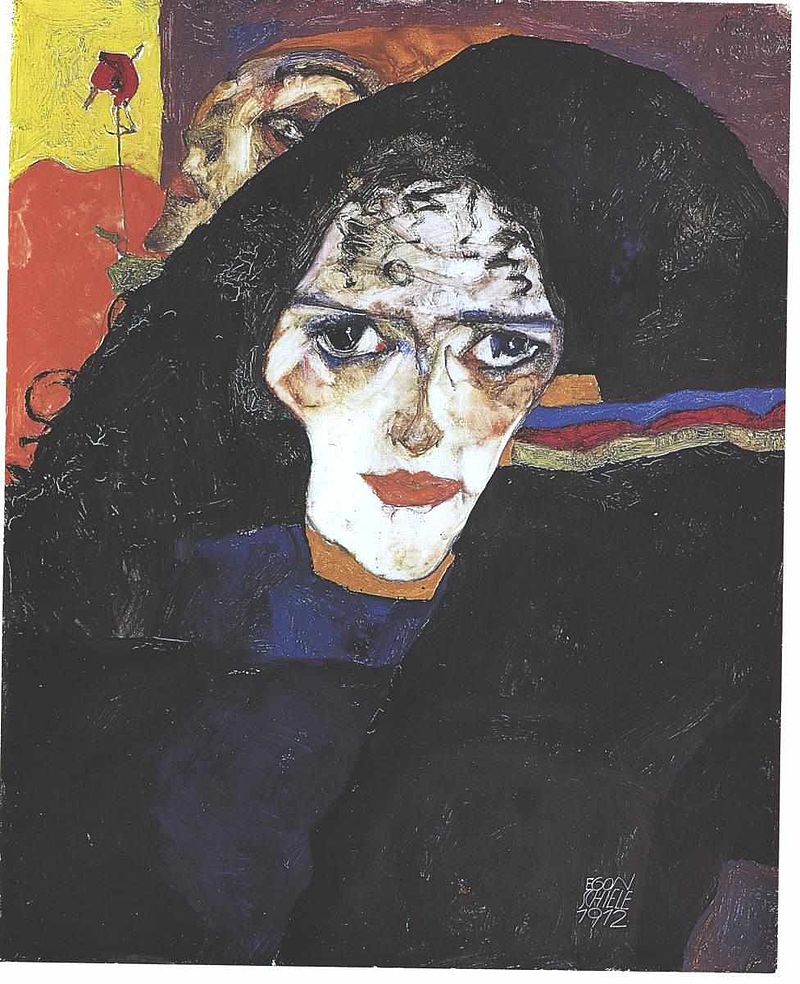
Artwork: Egon Schiele, Trauernde Frau (Mourning Woman), 1912. The retained reproduction is marked public domain by Wikimedia Commons; museum record: Leopold Museum Online Collection.
Behavioural cues are not reliable real-world proof of guilt, innocence, truthfulness, or character.
Keep this reference growing
If this page helped with your reading or game, you can support its upkeep or explore the curated books.
Explore the Bookshop — epics, classics and stories behind imagined worlds.