
Conjuration • Temporary Objects and Crafted Matter
Minor Creation
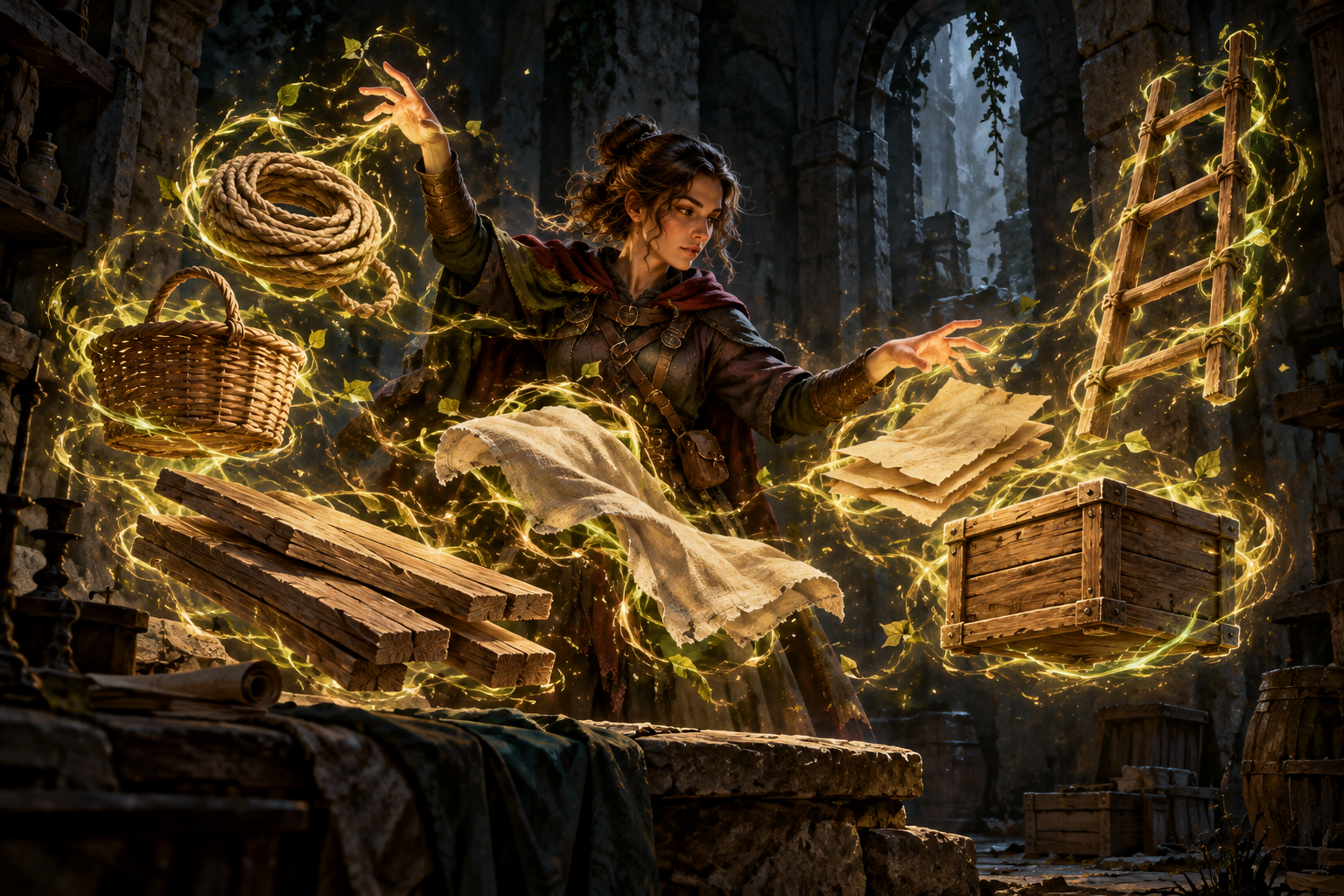
Minor Creation forms a temporary, nonmagical object from nonliving plant matter. Rope, wood, cloth, hemp and wicker may be conjured for an hour or a day’s work, but nothing made by the spell is permanent. The Pathfinder and D&D 3.5e versions are established fourth-level spells; separate optional adaptations are provided for the two fifth-edition rulesets.
Minor Creation at a Glance
| 5.5e / 2024 | Optional 4th-level Conjuration for Sorcerer, Wizard or campaign Witch; 10 cubic feet of nonliving plant matter; 8 hours |
|---|---|
| 5e / 2014 | Optional 4th-level conjuration for Sorcerer, Wizard or campaign Witch; same reduced material limit, 8-hour duration |
| Pathfinder 1e | Official Witch 4, Sorcerer/Wizard 4; Conjuration (Creation); 1 cubic foot per caster level, 1 hour per caster level |
| D&D 3.5e | Official Sorcerer/Wizard 4; Conjuration (Creation); 1 cubic foot per caster level, 1 hour per caster level |
| Browse | Witch Spell Lists • Creation • Major Creation |
Rules distinction: the official fifth-edition Creation spell is a 5th-level Illusion with different materials and casting components. The 2024 Prestidigitation cantrip has a tiny effect also named “Minor Creation”; it is not the 4th-level spell developed here. The modern fourth-level panels are clearly labelled optional adaptations rather than official rules.
Spell Rules by Edition
Minor Creation — 5.5e / 2024
Optional 2024 conversion, not a published spell. A lower-level, plant-matter-only companion to the official Creation spell (5th-level Illusion). Games Master approval is required to add it to a class list.
| Level and School | 4th-level Conjuration |
|---|---|
| Suggested Classes | Sorcerer, Wizard; optional Witch |
| Casting Time | 1 minute |
| Range | 30 feet |
| Components | V, S, M (a small sample of the plant matter you intend to create; not consumed) |
| Duration | 8 hours; no Concentration |
| Effect | One unattended, nonmagical object of nonliving plant matter, up to 10 cubic feet and contained in a 5-foot Cube |
| Saving Throw | None |
| Damage | None directly |
| Complex Workmanship | DC 15 Intelligence check with appropriate Artisan’s Tools; see effect |
| Spell Components | Any created item used as another spell’s Material component causes that spell to fail |
Effect. You create one nonmagical, unattended object of nonliving plant matter (such as wood, linen, hemp, cotton, rope or a wicker basket) in an unoccupied space within range. Its total volume can be no greater than 10 cubic feet, and it must fit wholly within a 5-foot Cube. You must have seen the object’s general form and material before. The object has the ordinary physical properties of its material, but is not magical, alive or permanently valuable. You cannot create metal, stone, gems, food that nourishes, a creature, a magical item, or more than one separate item with one casting. An object formed from several pieces assembled as one functional item counts as a single object at the GM’s discretion.
Workmanship. A simple wooden wedge, rope, crate or cloth needs no check. For a complicated crafted item, make a DC 15 Intelligence check using suitable Artisan’s Tools if proficient. On failure, the casting creates a crude unusable version; the slot is spent. The object vanishes immediately when the spell ends. If it has been moved, sold, burned or broken, any surviving pieces still vanish at that time.
Spell-component restriction. Using anything created by this spell as the Material component of another spell causes that other spell to fail. The creation cannot be sold as permanent merchandise or used to create an enduring structure. An object is subject to normal nonmagical object rules until it disappears; it does not automatically attack or act on your behalf.
Ending and counterplay. The object lasts 8 hours unless the spell is ended early by Dispel Magic or a similar appropriate effect. This adaptation does not require Concentration, a saving throw, or an attack roll. The GM can rule that an object without enough support falls or collapses like any ordinary object.
Official distinction: the 2024 Creation spell is 5th-level Illusion and can create mineral materials as well as plant-based goods, with a different size limit, duration schedule and Material component. The optional Minor Creation above does not replace it. The 2024 Prestidigitation cantrip also contains a tiny effect called “Minor Creation”; that short-lived trinket effect is not this fourth-level spell.
Minor Creation — 5e / 2014
Optional 2014 conversion, not a published spell. A lower-level, plant-matter-only companion to the official Creation spell (5th-level Illusion). Games Master approval is required to add it to a class list.
| Level and School | 4th-level conjuration |
|---|---|
| Suggested Classes | Sorcerer, Wizard; optional Witch |
| Casting Time | 1 minute |
| Range | 30 feet |
| Components | V, S, M (a small sample of the plant matter you intend to create; not consumed) |
| Duration | 8 hours; no Concentration |
| Effect | One unattended, nonmagical object of nonliving plant matter, up to 10 cubic feet and contained in a 5-foot Cube |
| Saving Throw | None |
| Damage | None directly |
| Complex Workmanship | DC 15 Intelligence check with appropriate Artisan’s Tools; see effect |
| Spell Components | Any created item used as another spell’s Material component causes that spell to fail |
Effect. You create one nonmagical, unattended object of nonliving plant matter (such as wood, linen, hemp, cotton, rope or a wicker basket) in an unoccupied space within range. Its total volume can be no greater than 10 cubic feet, and it must fit wholly within a 5-foot Cube. You must have seen the object’s general form and material before. The object has the ordinary physical properties of its material, but is not magical, alive or permanently valuable. You cannot create metal, stone, gems, food that nourishes, a creature, a magical item, or more than one separate item with one casting. An object formed from several pieces assembled as one functional item counts as a single object at the GM’s discretion.
Workmanship. A simple wooden wedge, rope, crate or cloth needs no check. For a complicated crafted item, make a DC 15 Intelligence check using suitable Artisan’s Tools if proficient. On failure, the casting creates a crude unusable version; the slot is spent. The object vanishes immediately when the spell ends. If it has been moved, sold, burned or broken, any surviving pieces still vanish at that time.
Spell-component restriction. Using anything created by this spell as the Material component of another spell causes that other spell to fail. The creation cannot be sold as permanent merchandise or used to create an enduring structure. An object is subject to normal nonmagical object rules until it disappears; it does not automatically attack or act on your behalf.
Ending and counterplay. The object lasts 8 hours unless the spell is ended early by Dispel Magic or a similar appropriate effect. This adaptation does not require Concentration, a saving throw, or an attack roll. The GM can rule that an object without enough support falls or collapses like any ordinary object.
Official distinction: the 2014 Creation spell is 5th-level Illusion and can create mineral materials as well as plant-based goods, with a different size limit, duration schedule and Material component. The optional Minor Creation above does not replace it.
Minor Creation — Pathfinder 1e
| School | Conjuration (Creation) |
|---|---|
| Level | Witch 4, Sorcerer/Wizard 4 |
| Components | V, S, M (a tiny piece of the same type of material to be created) |
| Casting Time | 1 minute |
| Range | 0 ft. |
| Effect | One unattended, nonmagical object made from nonliving plant matter; up to 1 cubic foot per caster level |
| Duration | 1 hour/level (D) |
| Saving Throw | None |
| Spell Resistance | No |
The Pathfinder spell creates a temporary object of vegetable matter, not metal, stone, living matter or a magical item. A complex item requires an appropriate Craft skill check. The object cannot serve as a material component for another spell; attempting to do so causes that spell to fail.
Pathfinder sources: Core Rulebook — Minor Creation; Advanced Player’s Guide — Witch spell list (Witch 4).
Minor Creation — D&D 3.5e
| School | Conjuration (Creation) |
|---|---|
| Level | Sorcerer/Wizard 4 |
| Components | V, S, M |
| Casting Time | 1 minute |
| Range | 0 ft. |
| Effect | One unattended nonmagical object of nonliving plant matter, up to 1 cubic foot/level |
| Duration | 1 hour/level (D) |
| Saving Throw | None |
| Spell Resistance | No |
The created object’s volume cannot exceed 1 cubic foot per caster level. A complex item requires an appropriate Craft or other skill check under the legacy rules.
A created object cannot be used as a material component for another spell. The material component is a tiny sample of the same type of matter you intend to create.
What Changed Between Editions?
- 5.5e / 2024: the optional 4th-level Conjuration creates only nonliving plant matter, up to 10 cubic feet in a 5-foot Cube, for 8 hours. It has its own full casting procedure and no Concentration. The published Creation is 5th-level Illusion, uses a paintbrush and has broader materials.
- 5e / 2014: the separately formatted optional 4th-level conjuration has the same restricted plant-matter design. Official Creation is a 5th-level illusion with a material sample, a 5-foot Cube and duration varying by material.
- Pathfinder 1e: Witch 4 and Sorcerer/Wizard 4, with 1 minute to cast, an unattended nonmagical plant object of up to 1 cubic foot per caster level, and 1 hour per caster level; complex items require a Craft skill check.
- D&D 3.5e: the same legacy quantity and duration formula, but listed as Sorcerer/Wizard 4 rather than a standard 3.5e Witch spell. Complex work needs an appropriate skill check.
- All versions: the item is temporary and cannot provide a working Material component for another spell. The object itself is not enchanted, alive or permanent.
Worked Example: A Bridge Before Nightfall
Explorers reach a flooded gully without enough rope to secure their equipment. The caster wants to conjure a coil of hemp rope rather than conjuring an entire bridge. The created item must be a single, unattended, nonliving object of plant material; the party still needs to fasten it and cross safely by ordinary means.
5.5e / 2024 — optional conversion
A 7th-level Wizard casts the optional 4th-level Conjuration in 1 minute, using a sample of hemp fibre. The rope appears at an unoccupied point within 30 feet. Its volume is much less than the 10-cubic-foot maximum, and it lasts 8 hours. It is ordinary nonmagical rope and supports only what ordinary rope can support. The spell does not require Concentration, and the rope cannot serve as a Material component for a further spell.
5e / 2014 — optional conversion
The same 7th-level Wizard can use the 2014-adapted spell with its own 1-minute casting, 30-foot range, 8-hour duration and nonliving vegetable-matter limits. The fifth-level 2014 Creation spell is not silently substituted: it lasts up to one day for plant matter and permits additional materials that this lesser conversion does not.
Pathfinder 1e — official Witch spell
An 8th-level Witch can create up to 8 cubic feet of nonliving vegetable matter because the limit is 1 cubic foot per caster level. The object remains for 8 hours (1 hour per caster level), unless dismissed. A simple rope needs no elaborate Craft work; a finely made lockable wicker container would require an appropriate Craft check. The spell has no saving throw or spell resistance.
D&D 3.5e — official Sorcerer/Wizard spell
An 8th-level Wizard has the same 8-cubic-foot maximum and 8-hour duration. The item is unattended, nonliving, temporary and nonmagical. An intricate article requires an appropriate skill check. Even a beautifully made wooden object disappears when the spell ends, so a permanent bridge or sold commodity cannot be obtained by this magic.
Games Master’s Rulings and Counterplay
Visible clue. The object appears during a deliberate casting rather than being carried from a workshop. Its sudden origin may be witnessed, but the completed object has the ordinary feel and behaviour of its plant material.
Material restriction. A wooden wedge, linen bandage, length of rope or wicker basket is eligible. Living branches, a breathing animal, metal armour, gemstones and enchanted equipment are not. Mixing plant matter with metal fittings requires replacing those parts with an eligible material or rejecting the item.
Workmanship. The caster must know the object’s intended shape. Pathfinder and 3.5e require appropriate Craft or other skill checks for a complex item. The optional modern versions use the specifically listed DC 15 Intelligence check with suitable Artisan’s Tools.
Not a spell component. If an item created by Minor Creation is used as the Material component of another spell, that attempted spell fails. No amount of apparent value turns this temporary matter into a valid component.
Removal. Dispel Magic can end a persistent magical creation when the chosen edition’s rules allow it. An ordinary observer can cut, burn or move the item as normal. The surviving creation disappears at its expiry time, regardless of where the pieces have been taken.
Counterplay and Limits
The object is nonmagical once created but remains tied to the spell’s duration. Dispel Magic can end the ongoing magic where the edition allows. The spell cannot create mineral, metal, living or magical material.
Mythical Context
The craft of bringing a useful form out of ordinary fibre belongs to Athena in her aspect as patron of weaving and skilled work. In Ovid’s account of Arachne, a mortal weaver challenges the goddess to a contest, each producing extraordinary cloth from thread. Arachne’s fate becomes a tale about pride, craftsmanship and the delicate threads that join created things. Minor Creation is not recorded as an ancient spell, but its sudden production of rope, cloth or carved wood belongs to the same imaginative world of perfected craft.
Arachne and Athena — ancient Greek and Roman sources · Athena and the weaving contest in Ovid’s Metamorphoses
Historical Context
Weaving, carpentry and basket-making demanded specialised tools and considerable time. Archaeological and artistic evidence shows those crafts in detail: an Egyptian tomb scene at Beni Hasan depicts women spinning linen thread and weaving at a ground loom. The Metropolitan Museum of Art preserves a 1931 facsimile of this Middle Kingdom scene, whose original dates to approximately 1897–1878 BCE. It illustrates how laborious the manufacture of cloth could be—work that the magical spell compresses into a minute.
The Met: Weavers, Tomb of Khnumhotep — historical textile production · The Met: Fragmentary Model of a Weavers Shop, Middle Kingdom
Related Magic
- Major Creation — expands the range of temporary materials.
- Creation — the broader later-edition temporary-object spell where available.
- Fabricate — transforms existing material rather than conjuring temporary matter.
Rules Sources and Licensing
5.5e / 2024: the official Creation is a 5th-level Illusion. The same 2024 rules contain a small Prestidigitation option labelled “Minor Creation”, which creates only a brief trinket or illusory image. The 4th-level Minor Creation adaptation on this page is neither of these official features.
5e / 2014: the published Creation is a 5th-level Illusion spell; there is no separate 4th-level core spell by the name Minor Creation. Both fifth-edition conversion panels are newly authored, optional game mechanics and are not represented as published source text. See SRD 5.2.1 and SRD 5.1 (source documents under CC BY 4.0) for the official edition frameworks.
Pathfinder 1e: Minor Creation — Core Rulebook and Witch 4 — Advanced Player’s Guide. D&D 3.5e: Minor Creation — d20 System Reference Document. Both printed legacy spells use a 1-minute casting time and the 1-cubic-foot-per-caster-level limit. These game mechanics are Open Game Content under OGL v1.0a, reproduced with the full licence and the appropriate inherited Section 15 copyright notices below. This page’s artwork, new optional conversions, examples and contextual prose are not designated as new third-party Open Game Content.
Open Game License v1.0a and copyright notices
Permission to copy, modify and distribute the files collectively known as the System Reference Document (“SRD”) is
granted solely through the use of the Open Gaming License, Version 1.0a.
This material is being released using the Open Gaming License Version 1.0a and you should read and understand the
terms of that license before using this material.
The text of the Open Gaming License itself is not Open Game Content. Instructions on using the License are
provided within the License itself.
The following items are designated Product Identity, as defined in Section 1(e) of the Open Game License Version
1.0a, and are subject to the conditions set forth in Section 7 of the OGL, and are not Open Content: Dungeons
& Dragons, D&D, Player’s Handbook, Dungeon Master, Monster Manual, d20 System, Wizards of the Coast, d20
(when used as a trademark), Forgotten Realms, Faerûn, proper names (including those used in the names of spells or
items), places, Red Wizard of Thay, the City of Union, Heroic Domains of Ysgard, Ever-Changing Chaos of Limbo,
Windswept Depths of Pandemonium, Infinite Layers of the Abyss, Tarterian Depths of Carceri, Gray Waste of Hades,
Bleak Eternity of Gehenna, Nine Hells of Baator, Infernal Battlefield of Acheron, Clockwork Nirvana of Mechanus,
Peaceable Kingdoms of Arcadia, Seven Mounting Heavens of Celestia, Twin Paradises of Bytopia, Blessed Fields of
Elysium, Wilderness of the Beastlands, Olympian Glades of Arborea, Concordant Domain of the Outlands, Sigil, Lady
of Pain, Book of Exalted Deeds, Book of Vile Darkness, beholder, gauth, carrion crawler, tanar’ri, baatezu,
displacer beast, githyanki, githzerai, mind flayer, illithid, umber hulk, yuan-ti.
All of the rest of the SRD is Open Game Content as described in Section 1(d) of the License.
More information on the Open Game License can be found at
www.wizards.com/d20.
The terms of the Open Gaming License Version 1.0a are as follows:
OPEN GAME LICENSE Version 1.0a
The following text is the property of Wizards of the Coast, Inc. and is Copyright 2000 Wizards of the Coast, Inc
(“Wizards”). All Rights Reserved.
1. Definitions: (a)”Contributors” means the copyright and/or trademark owners who have contributed Open Game
Content; (b)”Derivative Material” means copyrighted material including derivative works and translations
(including into other computer languages), potation, modification, correction, addition, extension, upgrade,
improvement, compilation, abridgment or other form in which an existing work may be recast, transformed or
adapted; (c) “Distribute” means to reproduce, license, rent, lease, sell, broadcast, publicly display, transmit or
otherwise distribute; (d)”Open Game Content” means the game mechanic and includes the methods, procedures,
processes and routines to the extent such content does not embody the Product Identity and is an enhancement over
the prior art and any additional content clearly identified as Open Game Content by the Contributor, and means any
work covered by this License, including translations and derivative works under copyright law, but specifically
excludes Product Identity. (e) “Product Identity” means product and product line names, logos and identifying
marks including trade dress; artifacts; creatures characters; stories, storylines, plots, thematic elements,
dialogue, incidents, language, artwork, symbols, designs, depictions, likenesses, formats, poses, concepts, themes
and graphic, photographic and other visual or audio representations; names and descriptions of characters, spells,
enchantments, personalities, teams, personas, likenesses and special abilities; places, locations, environments,
creatures, equipment, magical or supernatural abilities or effects, logos, symbols, or graphic designs; and any
other trademark or registered trademark clearly identified as Product identity by the owner of the Product
Identity, and which specifically excludes the Open Game Content; (f) “Trademark” means the logos, names, mark,
sign, motto, designs that are used by a Contributor to identify itself or its products or the associated products
contributed to the Open Game License by the Contributor (g) “Use”, “Used” or “Using” means to use, Distribute,
copy, edit, format, modify, translate and otherwise create Derivative Material of Open Game Content. (h) “You” or
“Your” means the licensee in terms of this agreement.
2. The License: This License applies to any Open Game Content that contains a notice indicating that the Open Game
Content may only be Used under and in terms of this License. You must affix such a notice to any Open Game Content
that you Use. No terms may be added to or subtracted from this License except as described by the License itself.
No other terms or conditions may be applied to any Open Game Content distributed using this License.
3.Offer and Acceptance: By Using the Open Game Content You indicate Your acceptance of the terms of this License.
4. Grant and Consideration: In consideration for agreeing to use this License, the Contributors grant You a
perpetual, worldwide, royalty-free, non-exclusive license with the exact terms of this License to Use, the Open
Game Content.
5.Representation of Authority to Contribute: If You are contributing original material as Open Game Content, You
represent that Your Contributions are Your original creation and/or You have sufficient rights to grant the rights
conveyed by this License.
6.Notice of License Copyright: You must update the COPYRIGHT NOTICE portion of this License to include the exact
text of the COPYRIGHT NOTICE of any Open Game Content You are copying, modifying or distributing, and You must add
the title, the copyright date, and the copyright holder’s name to the COPYRIGHT NOTICE of any original Open Game
Content you Distribute.
7. Use of Product Identity: You agree not to Use any Product Identity, including as an indication as to
compatibility, except as expressly licensed in another, independent Agreement with the owner of each element of
that Product Identity. You agree not to indicate compatibility or co-adaptability with any Trademark or Registered
Trademark in conjunction with a work containing Open Game Content except as expressly licensed in another,
independent Agreement with the owner of such Trademark or Registered Trademark. The use of any Product Identity in
Open Game Content does not constitute a challenge to the ownership of that Product Identity. The owner of any
Product Identity used in Open Game Content shall retain all rights, title and interest in and to that Product
Identity.
8. Identification: If you distribute Open Game Content You must clearly indicate which portions of the work that
you are distributing are Open Game Content.
9. Updating the License: Wizards or its designated Agents may publish updated versions of this License. You may
use any authorized version of this License to copy, modify and distribute any Open Game Content originally
distributed under any version of this License.
10. Copy of this License: You MUST include a copy of this License with every copy of the Open Game Content You
Distribute.
11. Use of Contributor Credits: You may not market or advertise the Open Game Content using the name of any
Contributor unless You have written permission from the Contributor to do so.
12. Inability to Comply: If it is impossible for You to comply with any of the terms of this License with respect
to some or all of the Open Game Content due to statute, judicial order, or governmental regulation then You may
not Use any Open Game Material so affected.
13. Termination: This License will terminate automatically if You fail to comply with all terms herein and fail to
cure such breach within 30 days of becoming aware of the breach. All sublicenses shall survive the termination of
this License.
14. Reformation: If any provision of this License is held to be unenforceable, such provision shall be reformed
only to the extent necessary to make it enforceable.
15. COPYRIGHT NOTICE
Open Game License v 1.0a Copyright 2000, Wizards of the Coast, Inc.
System Reference Document Copyright 2000-2003, Wizards of the Coast, Inc.; Authors Jonathan Tweet, Monte Cook,
Skip Williams, Rich Baker, Andy Collins, David Noonan, Rich Redman, Bruce R. Cordell, John D. Rateliff, Thomas
Reid, James Wyatt, based on original material by E. Gary Gygax and Dave Arneson.
Pathfinder Roleplaying Game Core Rulebook. © 2009, Paizo Publishing, LLC; Author: Jason Bulmahn, based on material by Jonathan Tweet, Monte Cook, and Skip Williams.
Pathfinder Roleplaying Game Advanced Player’s Guide. © 2010, Paizo Publishing, LLC; Author: Jason Bulmahn
END OF LICENSE
Keep this reference growing
If this page helped with your reading or game, you can support its upkeep or explore the curated books.
Explore the Bookshop — epics, classics and stories behind imagined worlds.