
Illusion (Shadow) • Witchcraft and Veiled Passage
Intangible Cloak of Shadows
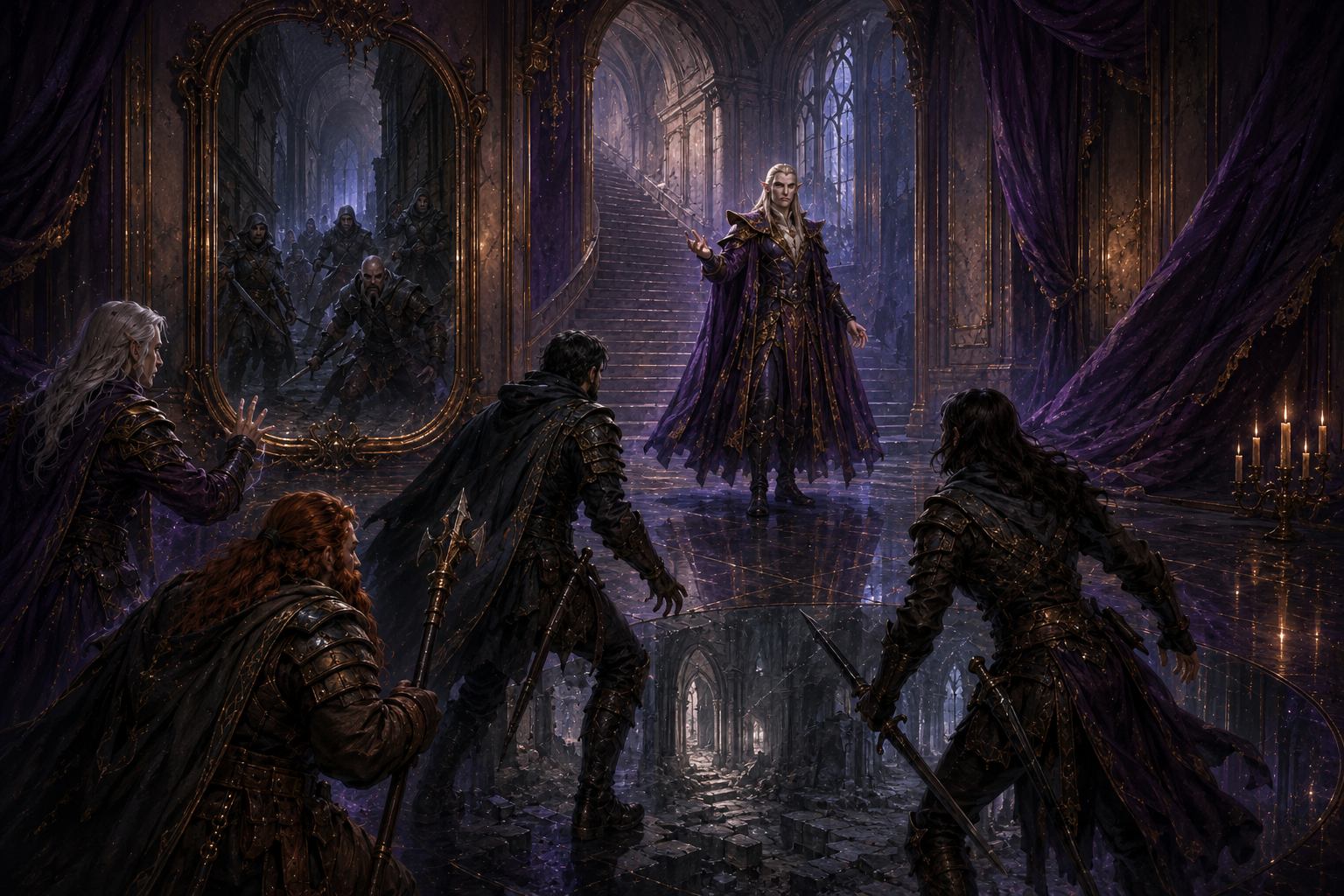
The witch steps into her own shadow and vanishes, leaving only the dark outline by which the world can catch her. Intangible Cloak of Shadows makes its caster silent, elusive and almost insubstantial, but no shadow can pass a sealed wall. Anyone who notices the exposed silhouette may strike it and end the enchantment.
Intangible Cloak of Shadows at a Glance
| 5.5e / 2024 | Optional 4th-level Illusion conversion; Self; Action; Concentration up to 10 minutes |
|---|---|
| 5e / 2014 | Optional 4th-level illusion conversion; Self; 1 action; Concentration up to 10 minutes |
| Pathfinder 1e | Optional Witch 4 / Sorcerer-Wizard 4 conversion; 1 full-round action; 1 minute/level (D); +7 Stealth circumstance bonus |
| D&D 3.5e / Legacy d20 | Preserved third-party 2003 entry by Dominique Crouzet; Witch 4 / Sorcerer-Wizard 4; 1 full-round action; 1 day (D); +7 Hide |
The defining weakness: the caster needs a distinct cast shadow. The body is invisible and intangible, but the shadow remains on a surface. It cannot slip through a sealed wall, and a successful attack against that visible shadow affects the caster and breaks the spell. The modern and Pathfinder entries are clearly labelled adaptations rather than official edition spells.
Spell Rules by Edition
Intangible Cloak of Shadows — 5.5e / 2024
Optional 2024 conversion — not an official spell. This is a complete playable adaptation for campaigns that allow shadow witchcraft; it does not import the older d20 incorporeal rules wholesale.
| Level / School | 4th-level Illusion (shadow; optional conversion) |
|---|---|
| Suggested access | Warlock, Wizard, or optional Witch by GM approval |
| Casting Time | Action |
| Range / Target | Self |
| Components | V, S, M (a strip of fine black velvet worth at least 1 sp; not consumed) |
| Duration | Concentration, up to 10 minutes |
| Saving Throw | None (self) |
| Attacks against shadow | Normal attack roll versus the caster’s AC; a hit affects the caster and ends the cloak |
| Light requirement | Requires a visible cast shadow; ends if the shadow disappears |
Effect. You must have a distinct cast shadow to use this spell. You and equipment you carry merge into a near-insubstantial shadow form; your body cannot be seen or touched normally, makes no sound or scent, and cannot interact with objects. Your cast shadow remains visible and can betray your position. You move along contiguous surfaces that can support the projection of your shadow at your normal Speed, including climbing a vertical surface; you can pass under a door if your shadow can pass through its opening, but not through a sealed opaque wall. You cannot fly, teleport, move into a place where no shadow can fall, or bypass an obstacle that blocks your shadow.
Actions and speech. You cannot speak, hold or manipulate objects, use a weapon, or cast a spell that requires verbal components. If you attempt an attack or cast a spell that would harm another creature, this cloak ends immediately before resolving that attack or spell. A visible shadow can be observed even though your body is unseen.
Attack the shadow. A creature with sight of the visible shadow can target it with a weapon or spell attack normally if it is within the attack’s reach or range; use your normal AC. On a hit, you take the attack’s normal damage or effect and this spell ends. Attacks directed at your unseen body cannot strike it while the cloak lasts. The cloak also ends when dispelled, dismissed, when its duration ends, or if light conditions leave you with no cast shadow.
Spotting the shadow. If the cast shadow is plainly in view, its presence is obvious. When it falls amid other shadows or clutter, a creature can make a Wisdom (Perception) check against your spell save DC to distinguish it. A successful check reveals the location of your shadow, not your body. At the GM’s discretion an observer actively searching may use the Search action to make this check. This observation does not automatically end the spell, but makes its vulnerable shadow targetable.
Intangible Cloak of Shadows — 5e / 2014
Optional 2014 conversion — not an official spell. This is a complete playable adaptation for campaigns that allow shadow witchcraft; it does not import the older d20 incorporeal rules wholesale.
| Level / School | 4th-level Illusion (shadow; optional conversion) |
|---|---|
| Suggested access | Warlock, Wizard, or optional Witch by GM approval |
| Casting Time | 1 action |
| Range / Target | Self |
| Components | V, S, M (a strip of fine black velvet worth at least 1 sp; not consumed) |
| Duration | Concentration, up to 10 minutes |
| Saving Throw | None (self) |
| Attacks against shadow | Normal attack roll versus the caster’s AC; a hit affects the caster and ends the cloak |
| Light requirement | Requires a visible cast shadow; ends if the shadow disappears |
Effect. You must have a distinct cast shadow to use this spell. You and equipment you carry merge into a near-insubstantial shadow form; your body cannot be seen or touched normally, makes no sound or scent, and cannot interact with objects. Your cast shadow remains visible and can betray your position. You move along contiguous surfaces that can support the projection of your shadow at your normal Speed, including climbing a vertical surface; you can pass under a door if your shadow can pass through its opening, but not through a sealed opaque wall. You cannot fly, teleport, move into a place where no shadow can fall, or bypass an obstacle that blocks your shadow.
Actions and speech. You cannot speak, hold or manipulate objects, use a weapon, or cast a spell that requires verbal components. If you attempt an attack or cast a spell that would harm another creature, this cloak ends immediately before resolving that attack or spell. A visible shadow can be observed even though your body is unseen.
Attack the shadow. A creature with sight of the visible shadow can target it with a weapon or spell attack normally if it is within the attack’s reach or range; use your normal AC. On a hit, you take the attack’s normal damage or effect and this spell ends. Attacks directed at your unseen body cannot strike it while the cloak lasts. The cloak also ends when dispelled, dismissed, when its duration ends, or if light conditions leave you with no cast shadow.
Spotting the shadow. If the cast shadow is plainly in view, its presence is obvious. When it falls amid other shadows or clutter, a creature can make a Wisdom (Perception) check against your spell save DC to distinguish it. A successful check reveals the location of your shadow, not your body. At the GM’s discretion an observer actively searching may use the Search action to make this check. This observation does not automatically end the spell, but makes its vulnerable shadow targetable.
Intangible Cloak of Shadows — Pathfinder 1e
Optional Pathfinder 1e conversion — not on the official Witch list. This adaptation deliberately shortens the duration of the 2003 source and converts Hide to Stealth.
| School | Illusion (shadow) |
|---|---|
| Level | Witch 4, Sorcerer/Wizard 4 (optional) |
| Casting Time | 1 full-round action |
| Range / Target | Personal / you |
| Components | V, S, M (fine black velvet worth 1 sp) |
| Duration | 1 minute/level (D) |
| Saving Throw | None (harmless) |
| Spell Resistance | No (harmless) |
| Stealth | A +7 circumstance bonus on Stealth checks while the shadow can be projected in normal lighting |
| Shadow vulnerability | The visible shadow can be attacked against your normal AC; a successful hit affects you normally and ends this spell |
Effect. The caster becomes silent, scentless, invisible and insubstantial except for a visible, tangible shadow. The caster must have a distinct cast shadow when casting and must remain in a place where it can be projected. They can move at their normal speed along surfaces traced by the shadow and through an opening beneath a door if the shadow can pass, but cannot pass a sealed wall or enter a shadowless region. The caster cannot manipulate physical objects, speak or cast spells requiring verbal components. An attack or offensive spell made by the caster ends the effect.
Counterplay. A creature can use Perception opposed by the caster’s Stealth check (which gets the listed +7 circumstance bonus in normal lighting) to spot the shadow if it is not obvious. Any successful attack directed at the shadow’s visible position uses the caster’s normal AC, affects the caster normally and ends the effect. Dispel Magic follows Pathfinder’s normal dispel-check rules. This version lasts one minute per caster level, not the legacy spell’s one day.
Intangible Cloak of Shadows — D&D 3.5e / Legacy d20
Preserved third-party d20 spell, © 2001 Dominique Crouzet, reprinted in Liber Mysterium (2003), p. 143. The 2003 source predates the official D&D 3.5e revision; use these rules as legacy material rather than attributing them to the 3.5e core rulebook.
| School | Illusion (Shadow) |
|---|---|
| Level | Witch 4, Sorcerer/Wizard 4 |
| Components | V, S, M |
| Casting Time | 1 full-round action |
| Range | Personal |
| Duration | 1 day (D) |
| Target | Self |
| Saving Throw | None (harmless) |
| Spell Resistance | No (harmless) |
The spell can be cast only where the caster would naturally project a shadow. While active, the caster becomes invisible, inaudible, scentless and physically insubstantial, but the shadow remains visible and substantial.
- Inaudible: the caster cannot speak or use verbal spell components.
- Insubstantial: ordinary solid matter can be crossed only if the caster’s shadow can pass through or beneath the same obstacle.
- Invisible: the body cannot be seen normally, but the shadow can still be noticed. The legacy spell grants +7 on Hide checks in normal lighting.
Attacks directed at the caster’s shadow can affect the caster and end the spell. A melee attack or offensive spell made by the caster also ends it. The spell cannot continue in total darkness or lighting that produces no shadow.
Material component: a piece of fine black velvet worth 1 sp.
Source clarification. The spell cannot be cast without a naturally projected shadow, and the caster cannot travel where that projection cannot go. The shadow remains tangible; a successful attack against it affects the caster and ends the spell. The original +7 bonus is to Hide in normal lighting, not Pathfinder Stealth or a fifth-edition ability check. Offensive actions made by the caster also end the spell. This legacy version lasts one day and is dismissible.
Edition Boundary
The 2003 source is a third-party d20 spell, not part of the official 2024, 2014 or Pathfinder spell lists. The three newer editions therefore have distinct, fully usable optional adaptations rather than falsely credited official texts. Modern versions use Concentration and a visible attackable shadow; Pathfinder converts Hide to Stealth with a shorter duration; the original d20 duration remains one day.
What Changed?
- 5.5e / 2024: the optional 4th-level Illusion spell uses the Action terminology, a maximum 10-minute Concentration duration and Wisdom (Perception) to locate a hidden shadow.
- 5e / 2014: the optional 4th-level illusion uses 2014 action wording and the same shadow-vulnerability principle, not the d20 Hide skill or its one-day duration.
- Pathfinder 1e: the optional Witch 4 / Sorcerer-Wizard 4 spell has a full-round casting time, 1-minute-per-level duration, Perception versus Stealth and a +7 circumstance bonus in normal light.
- D&D 3.5e / Legacy d20: the preserved 2003 spell by Dominique Crouzet keeps one full-round casting action, a one-day duration, a +7 bonus to Hide in normal light, and attacks against the exposed shadow that end the effect.
Counterplay
Visible clue. The caster has vanished but a moving, human-shaped shadow remains on the floor or wall. Even perfect silence cannot hide its outline when it is visible.
Lighting. Total darkness and strongly diffuse lighting can prevent a useful shadow. The caster cannot use a sealed wall or lightless room as a shortcut; the chosen edition determines whether the spell merely blocks movement or ends outright.
Attack the vulnerable outline. In each chosen panel, a successful attack against the visible shadow affects the caster normally and ends the effect. Modern attacks use the caster’s normal AC; Pathfinder and legacy d20 use their own attack rules.
Magic. Counterspell may interrupt the casting and Dispel Magic can remove an ongoing cloak where those rules permit. Revealing an invisible creature does not itself remove the projected shadow weakness.
Using Intangible Cloak of Shadows in Play
The spell is infiltration magic with a built-in weakness. The caster can cross spaces and avoid ordinary notice only while a usable shadow exists, so careful lighting, total darkness or an observer watching the shadow can turn the spell against its user.
Related Magic
Worked Example: The Shadow Beneath the Door
5.5e / 2024. A 7th-level Witch in a campaign using the optional conversion casts Intangible Cloak of Shadows with a distinct torch-cast shadow. Her body vanishes, but her dark outline remains visible. She moves along the corridor and slips beneath a door with a narrow gap, because her shadow can cross it. She cannot cross a completely sealed stone wall. Her cloak lasts for Concentration, up to 10 minutes. A watchman who can plainly see the shadow does not need a special detection check; he attacks the outline against her normal AC. On a hit, she takes the normal damage and the spell ends.
5e / 2014. The optional 2014 conversion uses a 1-action casting time rather than the 2024 Action terminology; it likewise requires Concentration for up to 10 minutes. If the outline is concealed among other shadows, the guard can Search and attempt a Wisdom (Perception) check against the caster’s spell save DC to identify its location before attacking.
Pathfinder 1e. An 8th-level Witch using the optional Pathfinder conversion casts over one full-round action and lasts for 8 minutes unless dismissed or ended. Her visible outline benefits from the written +7 circumstance bonus to Stealth in normal light. The observer’s Perception is compared with her Stealth before an attack can be directed accurately at the outline.
D&D 3.5e / Legacy d20. The original 2003 Witch 4 / Sorcerer-Wizard 4 spell lasts one day and grants +7 to Hide in normal lighting. A blow against the remaining cast shadow affects the witch normally and ends the spell. The legacy effect has no 5e Concentration mechanic.
Mythical Context
Nyx, the personification of Night, and Erebus, the primordial Darkness, stand at the threshold between light and obscurity in ancient Greek cosmogony. Their myths imagine dark veils crossing heaven and hidden places where sunlight cannot reach. The witch’s shadow-bound passage echoes these visions of a borderland between visibility and absence, though no ancient account gives this game spell its movement or combat mechanics.
Nyx and the dark mantle of Night — ancient sources · Erebus, primordial Darkness
Historical Context
The art of wayang kulit demonstrates how a small form may become a commanding silhouette when light passes behind it. For centuries Javanese storytellers have projected elaborately carved leather puppets onto screens, their figures moving in an illuminated world that the audience cannot physically enter. This theatrical shadow is a historical parallel to the spell’s vulnerable projected outline—not evidence of literal intangibility or invisibility.
UNESCO: Wayang puppet theatre and its history · British Museum: Javanese shadow puppet in a documented collection
Rules Sources and Licensing
Legacy original: “Intangible Cloak of Shadows” © 2001, Dominique Crouzet, reprinted in Liber Mysterium: The Netbook of Witches and Warlocks (2003), p. 143. This is third-party d20 material and is not attributed to an official D&D 3.5e source. Read the source-book transcription, p. 143.
Optional adaptations: the 2024, 2014 and Pathfinder 1e panels are newly authored compatible game adaptations—not entries from the official rules. Their distinct durations, shadow vulnerability and movement restrictions are given in full, with no cross-edition substitution. For general edition frameworks consult Wizards of the Coast SRD 5.2.1 and 5.1 (licensed under CC BY 4.0) and Pathfinder First Edition rules (OGL v1.0a).
Open Game Content designation: original rules mechanics reproduced from the 2003 d20 book are used under its Open Game License 1.0a provisions with the inherited notices below. Original prose, new modern conversions, artwork, campaign examples and context essays are not designated as new third-party Open Game Content.
Open Game License v1.0a & Section 15 Copyright Notices
OPEN GAME LICENSE Version 1.0a
The following text is the property of Wizards of the Coast, Inc.
and is Copyright 2000 Wizards of the Coast, Inc (“Wizards”).
All Rights Reserved.
1. Definitions:
(a) “Contributors” means the copyright and/or trademark owners who
have contributed Open Game Content;
(b) “Derivative Material” means
copyrighted material including derivative works and translations
(including into other computer languages), potation, modification,
correction, addition, extension, upgrade, improvement, compilation,
abridgment or other form in which an existing work may be recast,
transformed or adapted;
(c) “Distribute” means to reproduce, license,
rent, lease, sell, broadcast, publicly display, transmit or otherwise
distribute;
(d) “Open Game Content” means the game mechanic and includes
the methods, procedures, processes and routines to the extent such
content does not embody the Product Identity and is an enhancement over
the prior art and any additional content clearly identified as Open Game
Content by the Contributor, and means any work covered by this License,
including translations and derivative works under copyright law, but
specifically excludes Product Identity;
(e) “Product Identity” means
product and product line names, logos and identifying marks including
trade dress; artifacts; creatures; characters; stories, storylines,
plots, thematic elements, dialogue, incidents, language, artwork,
symbols, designs, depictions, likenesses, formats, poses, concepts,
themes and graphic, photographic and other visual or audio
representations; names and descriptions of characters, spells,
enchantments, personalities, teams, personas, likenesses and special
abilities; places, locations, environments, creatures, equipment,
magical or supernatural abilities or effects, logos, symbols, or
graphic designs; and any other trademark or registered trademark
clearly identified as Product Identity by the owner of the Product
Identity, and which specifically excludes the Open Game Content;
(f) “Trademark” means the logos, names, mark, sign, motto, designs that
are used by a Contributor to identify itself or its products or the
associated products contributed to the Open Game License by the Contributor;
(g) “Use”,
“Used” or “Using” means to use, Distribute, copy, edit, format, modify,
translate and otherwise create Derivative Material of Open Game Content;
(h) “You” or “Your” means the licensee in terms of this agreement.
2. The License:
This License applies to any Open Game Content that contains a notice
indicating that the Open Game Content may only be Used under and in
terms of this License. You must affix such a notice to any Open Game
Content that You Use. No terms may be added to or subtracted from this
License except as described by the License itself. No other terms or
conditions may be applied to any Open Game Content distributed using
this License.
3. Offer and Acceptance:
By Using the Open Game Content You indicate Your acceptance of the
terms of this License.
4. Grant and Consideration:
In consideration for agreeing to use this License, the Contributors
grant You a perpetual, worldwide, royalty-free, non-exclusive license
with the exact terms of this License to Use the Open Game Content.
5. Representation of Authority to Contribute:
If You are contributing original material as Open Game Content, You
represent that Your Contributions are Your original creation and/or
You have sufficient rights to grant the rights conveyed by this License.
6. Notice of License Copyright:
You must update the COPYRIGHT NOTICE portion of this License to include
the exact text of the COPYRIGHT NOTICE of any Open Game Content You are
copying, modifying or distributing, and You must add the title, the
copyright date, and the copyright holder’s name to the COPYRIGHT NOTICE
of any original Open Game Content You Distribute.
7. Use of Product Identity:
You agree not to Use any Product Identity, including as an indication
as to compatibility, except as expressly licensed in another,
independent Agreement with the owner of each element of that Product
Identity.
You agree not to indicate compatibility or co-adaptability
with any Trademark or Registered Trademark in conjunction with a work
containing Open Game Content except as expressly licensed in another,
independent Agreement with the owner of such Trademark or Registered
Trademark.
The use of any Product Identity in Open Game Content does
not constitute a challenge to the ownership of that Product Identity.
The owner of any Product Identity used in Open Game Content shall retain
all rights, title and interest in and to that Product Identity.
8. Identification:
If you distribute Open Game Content You must clearly indicate which
portions of the work that you are distributing are Open Game Content.
9. Updating the License:
Wizards or its designated Agents may publish updated versions of this
License. You may use any authorized version of this License to copy,
modify and distribute any Open Game Content originally distributed
under any version of this License.
10. Copy of this License:
You MUST include a copy of this License with every copy of the Open
Game Content You Distribute.
11. Use of Contributor Credits:
You may not market or advertise the Open Game Content using the name
of any Contributor unless You have written permission from the
Contributor to do so.
12. Inability to Comply:
If it is impossible for You to comply with any of the terms of this
License with respect to some or all of the Open Game Content due to
statute, judicial order, or governmental regulation then You may not
Use any Open Game Material so affected.
13. Termination:
This License will terminate automatically if You fail to comply with
all terms herein and fail to cure such breach within 30 days of becoming
aware of the breach. All sublicenses shall survive the termination of
this License.
14. Reformation:
If any provision of this License is held to be unenforceable, such
provision shall be reformed only to the extent necessary to make it
enforceable.
15. COPYRIGHT NOTICE
Open Game License v 1.0a Copyright 2000, Wizards of the Coast, Inc.
System Reference Document Copyright 2003, Wizards of the Coast, Inc.; Authors Jonathan Tweet, Monte Cook, Skip Williams, Bruce R. Cordell, based on original material by E. Gary Gygax and Dave Arneson.
“Witch-finder” Copyright 2003, Dominique Crouzet.
“Witch Knight”, Copyright 2001, Ravenscyre Grey Daegmorgan.
Ritual Magic rules from Relics & Rituals Copyright 2001, Clark Peterson, Sword and Sorcery Studios.
“Divine Dominion” and “Greater Divine Dominion”, Copyright 2001 Bradely H. Bemis.
“Extra Familiar”, Copyright 2001 Paul King.
“Leprechaun” from the Tome of Horrors, Copyright 2002, Necromancer Games, Inc.; Author Scott Greene, based on original material by Gary Gygax.
“Poppet” and “Create Poppet” from Liber Bestarius, Copyright 2002, Eden Studios. Additional non-OGC permission granted by Eden Studios May 27th, 2003.
Liber Mysterium: The Netbook of Witches and Warlocks is Copyright© 2003, Timothy S. Brannan and the Netbook of Witches Team.
Intangible Cloak of Shadows © 2001: Dominique Crouzet.
All content is considered open for the Open Gaming License, unless otherwise noted. But it is not public domain. Permission is granted to make and redistribute copies of this document as long as this copyright page remains intact.
Keep this reference growing
If this page helped with your reading or game, you can support its upkeep or explore the curated books.
Explore the Bookshop — epics, classics and stories behind imagined worlds.