
Enchantment • Compulsion • Mental Disruption
Daze
Overwhelm a weak opponent’s thoughts for one critical moment and break the rhythm of its next turn.
Daze is a minor enchantment designed for the earliest stages of an adventuring career. It clouds the mind of a weak humanoid long enough to disrupt an attack, delay an alarm, interrupt a retreat, or give an ally time to act. The magic is brief, limited by the strength of the target, and offers no special advantage to attackers beyond the actions or movement it prevents.
Quick Rules Reference
Daze affects one weak humanoid for a single round. The modern conversion restricts its next turn, while the Pathfinder 1e and D&D 3.5e versions prevent it from taking actions.
- Spell level
- Cantrip in all three editions
- Target
- One weak Humanoid
- Defence
- Wisdom or Will saving throw
- Duration
- One round
- Concentration
- Not required
- Legacy limit
- Humanoid of 4 Hit Dice or fewer
- Defences retained
- Normal Armor Class and saving throws
- Direct counter
- Counterspell
Spell Mechanics
Use the rules panel for the edition being played. The SpiralWorlds D&D 5.5e/2024 conversion appears first, followed by the Pathfinder 1e and D&D 3.5e versions.
SpiralWorlds D&D 5.5e/2024 conversion
Daze
- Level
- Enchantment cantrip
- Casting Time
- Action
- Range
- 30 feet
- Components
- V, S, M (a pinch of wool or a similar soft material)
- Target
- One Humanoid of CR 1 or lower
- Saving Throw
- Wisdom negates
- Duration
- Until the end of the target’s next turn
- Available To
- Bard, Sorcerer, Wizard
Choose one Humanoid within range that you can see. The target must have a Challenge Rating of 1 or lower. A Humanoid without a Challenge Rating is eligible only if it is level 4 or lower.
The target makes a Wisdom saving throw. A creature immune to the Charmed condition succeeds automatically.
On a failed save, the target’s thoughts become slow and disconnected until the end of its next turn. On that turn, it can do only one of the following:
- Move up to its Speed.
- Take one Action.
- Take one Bonus Action.
The target cannot combine those choices on the affected turn. It can take Reactions normally, retains its normal Armor Class, makes saving throws normally, and does not grant Advantage to attackers merely because it is dazed.
After a creature fails its saving throw against this spell, it is immune to further castings of this spell for 1 minute.
Not the Stunned condition: this spell does not impose Incapacitated, does not cause automatic failure of Strength or Dexterity saving throws, and does not give attackers automatic Advantage.
Conversion basis: this adaptation uses the restricted-turn structure of the official 2024 Rogue Daze option while preserving the legacy spell’s Humanoid target, low-power ceiling, mental saving throw, one-round duration, and lack of defensive penalties.
Pathfinder First Edition
Daze
- School
- Enchantment (compulsion) [mind-affecting]
- Level
- Arcanist 0, bard 0, inquisitor 0, magus 0, medium 0, mesmerist 0, occultist 0, psychic 0, shaman 0, skald 0, sorcerer 0, spiritualist 0, summoner 0, unchained summoner 0, witch 0, wizard 0
- Casting Time
- 1 standard action
- Components
- V, S, M (a pinch of wool or similar substance)
- Range
- Close (25 ft. + 5 ft./2 levels)
- Target
- One humanoid creature of 4 HD or fewer
- Duration
- 1 round
- Saving Throw
- Will negates
- Spell Resistance
- Yes
- Concentration
- Not required
This enchantment clouds the mind of a humanoid with 4 or fewer Hit Dice. On a failed Will save, the creature is dazed for 1 round and can take no actions.
A humanoid with 5 or more Hit Dice is not affected, even if it would willingly accept the spell.
A dazed subject retains its normal Armor Class and is not treated as stunned, helpless, flat-footed, or paralysed merely because of this spell. Attackers receive no special advantage against it.
After a creature has been successfully dazed by this spell, it is immune to further castings of this spell for 1 minute.
Pathfinder distinction: the one-minute immunity applies only after the creature is successfully affected. A creature that succeeds on its Will save does not gain that immunity.
Dungeons & Dragons 3.5e
Daze
- School
- Enchantment (compulsion) [mind-affecting]
- Level
- Bard 0, sorcerer/wizard 0
- Casting Time
- 1 standard action
- Components
- V, S, M (a pinch of wool or similar substance)
- Range
- Close (25 ft. + 5 ft./2 levels)
- Target
- One humanoid creature of 4 HD or fewer
- Duration
- 1 round
- Saving Throw
- Will negates
- Spell Resistance
- Yes
- Concentration
- Not required
This enchantment clouds the mind of a humanoid creature with 4 or fewer Hit Dice. On a failed Will save, the subject is dazed for 1 round and can take no actions.
Humanoids with 5 or more Hit Dice are unaffected. Spell Resistance applies normally.
A dazed subject is not stunned. It retains its normal Armor Class, does not lose its Dexterity bonus merely because of this spell, and gives attackers no special bonus.
Unlike Pathfinder 1e, the D&D 3.5e spell does not make a successfully affected creature immune to repeat castings. Repeated use is therefore possible if the creature remains eligible and continues to fail its saving throws.
Class lists: see the confirmed SpiralWorlds Bard spell list and Sorcerer/Wizard spell list .
What Daze Actually Does
Breaks Enemy Timing
The spell is strongest when cast shortly before a dangerous low-level opponent acts. One failed saving throw can delay an attack, alarm, withdrawal, pursuit, or other decisive action.
Leaves Defences Intact
Daze disrupts thought and action rather than bodily defence. The target does not become helpless, paralysed, or easier to hit merely because the spell succeeds.
Stops Scaling Quickly
The legacy spell’s 4-HD ceiling makes it deliberately temporary in an adventurer’s career. Stronger humanoids and most important mid-level enemies soon become ineligible.
Daze trades breadth and lasting power for one sharply timed moment of control.
Dazed Is Not Stunned
Dazed
The target loses or severely restricts its actions for a brief period, but its basic defences remain intact. It remains conscious, retains Armor Class, and is not helpless.
Stunned
Stunned is a stronger condition with additional defensive consequences. Rules that trigger from a creature being stunned do not trigger from Daze unless they expressly say otherwise.
Table rule: do not grant automatic critical hits, attack bonuses, Advantage, loss of Dexterity to Armor Class, or automatic saving-throw failures unless the selected edition’s actual dazed rules expressly impose them.
Best Uses
Delay an Alarm
Daze a weak guard, lookout, servant, or messenger before the creature can shout, ring a bell, close a gate, or call reinforcements. In the modern conversion, remember that the target may still choose an Action on its affected turn.
Break Enemy Tempo
Deny or restrict a low-level archer, healer, skirmisher, or other specialist during the turn when its position matters most.
Protect a Withdrawal
Interrupt the nearest eligible pursuer while an injured ally retreats, reaches cover, drinks a potion, or escapes through a doorway.
Create an Opening
Use the disrupted turn to reposition, draw a weapon, shut a door, seize an object, free a prisoner, or complete another task before the target can interfere effectively.
Player Tactics
Watch Initiative Order
The spell is worth most when the target’s next turn is strategically important. Use it before a guard reaches an alarm, an enemy closes an escape route, or a pursuer reaches a vulnerable ally.
Confirm Eligibility First
The spell fails against targets above its Hit Dice, Challenge Rating, or level limit. Use visible clues and prior knowledge before spending an action on an obviously experienced opponent.
Target Important Actions
Choose the creature whose next decision matters most rather than the creature with the fewest Hit Points. A weak enemy operating a lever may be more important than a stronger enemy already committed to a straightforward attack.
Upgrade When Necessary
Once common opponents exceed the spell’s limit, move to stronger enchantments such as Daze Monster or other control magic rather than expecting the cantrip to remain a universal answer.
Game Master Guidance
Apply the Target Limit Strictly
The spell’s strength is balanced by its narrow target. A creature above the stated limit is unaffected; it does not receive a saving throw for a reduced effect.
Preserve the Target’s Defences
Describe hesitation, mental blankness, confusion, or lost concentration without turning the creature into a helpless target. It can still avoid blows and resist effects normally.
Make the Disruption Matter
A successful Daze should alter timing. Doors close, allies reposition, prisoners flee, mechanisms are reached, and plans advance while the target loses its opportunity.
Give Weak Enemies Real Duties
Low-HD guards, apprentices, scouts, and messengers can carry strategically important responsibilities. Daze remains interesting when those duties matter even though the creatures are not powerful combatants.
Edge Cases
Target Already Acted
In legacy play, a duration of 1 round normally continues until the same point in the initiative order on the following round. The target therefore loses the next actions that fall within that duration.
Readied Actions
A Pathfinder 1e or D&D 3.5e target that can take no actions cannot complete a readied action while dazed.
Reactions in 2024
The modern conversion restricts the target’s next turn. It does not prevent Reactions taken outside that turn unless another rule or effect does so.
Spell Resistance
Pathfinder 1e and D&D 3.5e apply Spell Resistance normally. The D&D 5.5e/2024 conversion has no Spell Resistance statistic.
Wrong Creature Type
Animals, dragons, fey, outsiders, undead, constructs, and other non-humanoids are invalid legacy targets even when they have 4 or fewer Hit Dice.
Voluntary Failure
Willing acceptance does not bypass the Hit Dice, Challenge Rating, level, creature-type, immunity, or Spell Resistance requirements.
Counters and Defences
Rules Defences
- A successful Wisdom or Will saving throw negates the spell.
- Creatures above the edition’s target limit are unaffected.
- Invalid creature types cannot be selected.
- Immunity to the Charmed condition prevents the modern conversion.
- Immunity to mind-affecting effects prevents the Pathfinder 1e and D&D 3.5e versions.
- Spell Resistance applies in Pathfinder 1e and D&D 3.5e.
Magical Counters
- Counterspell is the most practical direct answer because it prevents the brief effect before it begins.
- Dispel Magic can end an ongoing spell when the selected edition’s rules permit, although Daze is usually too brief for this to be efficient.
- Protective magic against enchantment, compulsion, mind-affecting effects, or charm may provide immunity or bonuses according to its own rules.
Related Spell Interactions
Daze Monster
Daze Monster extends the basic legacy idea to a wider range of living creatures and a higher Hit Dice limit. It should replace the cantrip once opponents regularly exceed Daze’s eligibility ceiling.
Counterspell
Counterspell prevents the enchantment from resolving when the casting is perceived and the selected edition’s requirements are met.
Dispel Magic
Dispel Magic can remove Daze during its short duration, but doing so usually costs more time and magical power than the cantrip itself.
Use in the World
Daze is commonly taught because its limitations make it safer than stronger compulsions. Apprentices learn how to create a precise mental interruption without inflicting lasting injury, erasing memory, or controlling a victim’s choices.
City guards and military officers still treat the spell seriously. A single dazed sentry may fail to close a gate, sound an alarm, release a signal bird, or stop a prisoner from escaping. Courts therefore recognise that even a minor enchantment can become a serious offence when used during testimony, arrest, negotiation, or the guarding of evidence.
Experienced organisations reduce its usefulness by assigning important duties to veteran personnel, pairing lookouts, and arranging alarms that continue to function when one individual hesitates. The spell remains most dangerous wherever a single inexperienced person controls a decisive mechanism.
Historical and Occult Development
The English word daze has medieval associations with weariness, numbness, bewilderment, and reduced awareness. That history suits a spell which does not seize permanent control of the mind, but creates a short interval in which thought and intention fail to connect.
The pinch of wool gives physical form to the spell’s effect. Wool suggests muffling, softness, sleepiness, and the familiar idea of thought becoming woolly or difficult to organise. During the casting, that symbolic obstruction is transferred from the material component to the target’s mind.
The enchantment differs from prolonged trance, mesmerism, and hypnotic suggestion because it creates no lasting suggestibility. Its magical theory is one of interruption: thought begins, fragments, and must start again after the spell has passed.
Mythological Parallels
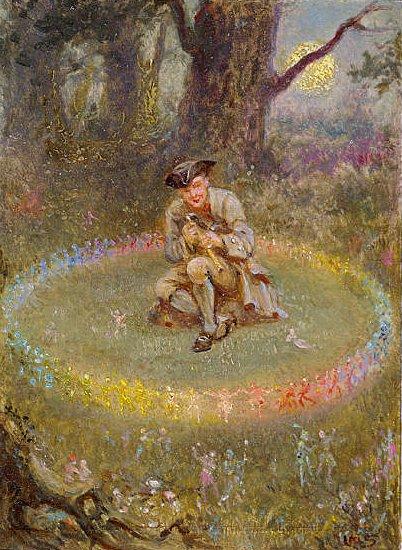
Fairy Rings and Enchanted Music
Fairy-ring traditions commonly associate supernatural circles with music, dancing, lost time, bewilderment, and the temporary surrender of ordinary judgement. Sullivan’s enchanted piper captures that atmosphere of attention suspended by an influence the mortal listener cannot fully resist.
Daze is shorter and more controlled, but the central image is similar: a creature remains physically present while its ability to turn intention into action is briefly displaced by an outside power.
The Sirens and Orpheus
Greek traditions concerning the Sirens describe music powerful enough to arrest ordinary purpose and draw listeners away from safety. In the Argonautic tradition, Orpheus answers their song with music of his own, providing a mythic parallel for enchantment opposed by an equal and timely counter.
Such traditions help explain the spell’s place on the bard list. Voice, rhythm, and patterned sound can be imagined not merely as entertainment, but as forces capable of interrupting thought itself.
Related SpiralWorlds Material
Eligible Targets
Sources and Open Game Content
- D&D 3.5 System Reference Document: Daze
- Archives of Nethys: Pathfinder 1e Daze
- D&D 2024 Basic Rules: Rogue Devious Strikes
- The D&D 5.5e/2024 spell is a SpiralWorlds conversion. It is not an official published 2024 spell.
- Modern conversion design, tactical guidance, world material, edge cases, and historical discussion by SpiralWorlds.
Open Game Content declaration: the legacy D&D 3.5e and Pathfinder 1e game mechanics in this entry are Open Game Content used under the Open Game License version 1.0a. Original SpiralWorlds prose, presentation, examples, and modern conversion are separate adaptations.
Section 15: Open Game License v1.0a, Copyright 2000, Wizards of the Coast, Inc. System Reference Document, Copyright 2000–2003, Wizards of the Coast, Inc.; Authors Jonathan Tweet, Monte Cook, Skip Williams, Rich Baker, Andy Collins, David Noonan, Rich Redman, Bruce R. Cordell, John D. Rateliff, Thomas Reid, and James Wyatt, based on original material by E. Gary Gygax and Dave Arneson.
Pathfinder Roleplaying Game Core Rulebook, © 2009, Paizo Publishing, LLC; Author Jason Bulmahn, based on material by Jonathan Tweet, Monte Cook, and Skip Williams.
Keep this reference growing
If this page helped with your reading or game, you can support its upkeep or explore the curated books.
Explore the Bookshop — epics, classics and stories behind imagined worlds.