
Control Currents Spell
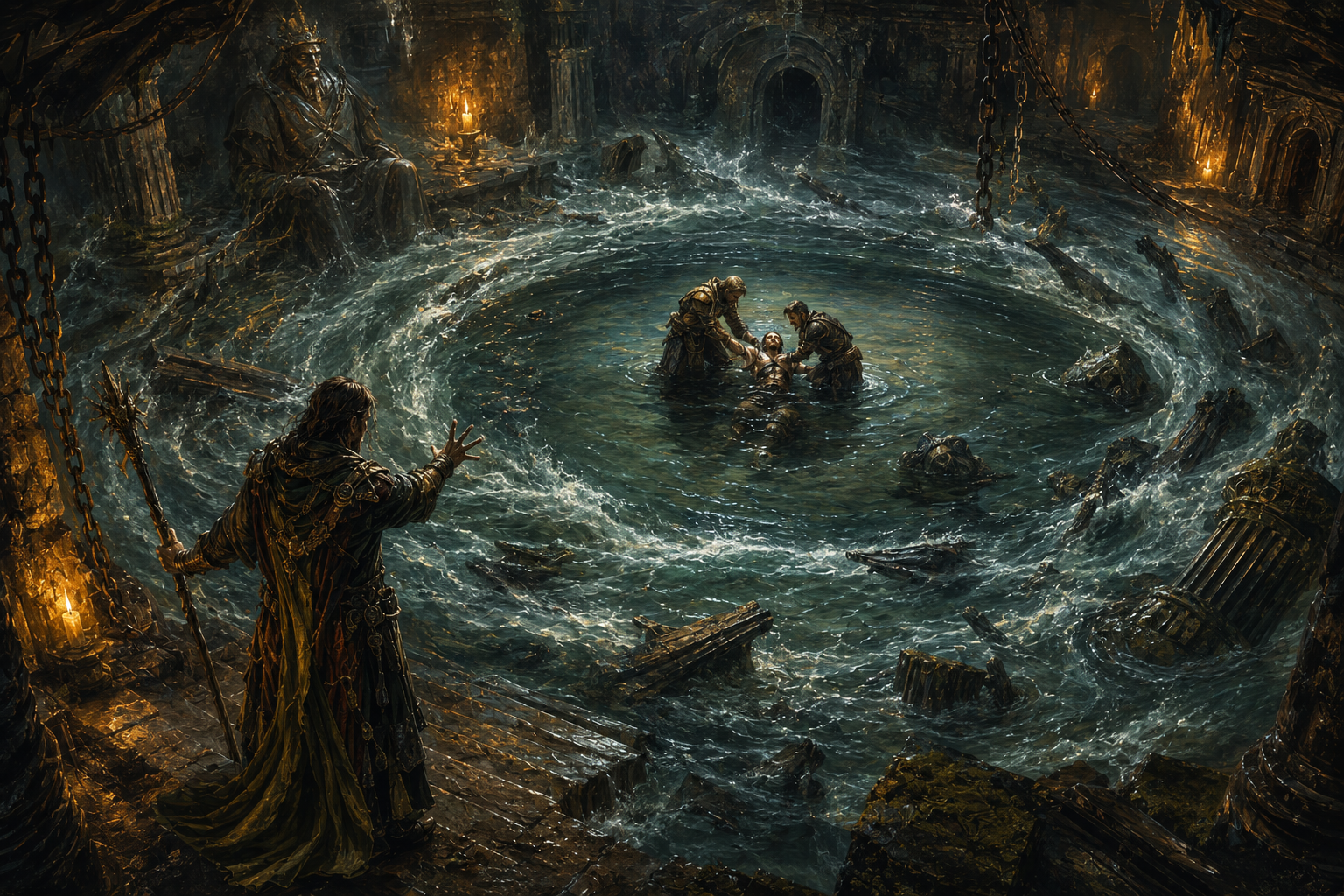
A river can be redirected, strengthened, slowed, rotated, or calmed—but this exact spell belongs to D&D 3.5e Stormwrack.
Control Currents is a D&D 3.5e water-transmutation spell from Stormwrack. It changes the direction and speed of an existing current rather than raising water levels, parting water, or creating a whirlpool as the later Control Water spell does.
There is no direct official D&D 5e / 2014, D&D 5.5e / 2024, or Pathfinder 1e spell with exactly the same identity in their core rules. Those systems use Control Water as the nearest official water-control option.
Quick Rules Reference
- 5.5e / 2024: no direct Control Currents spell; Control Water is the nearest official option.
- 5e / 2014: no direct Control Currents spell; Control Water handles flood, part water, redirect flow, and whirlpool effects.
- Pathfinder 1e: no direct core Control Currents entry; Control Water raises or lowers water rather than using the Stormwrack current-strength procedure.
- D&D 3.5e: Druid 4, Transmutation [Water], 20-ft./level-radius emanation centred on the caster, 10 min./level.
- 3.5e core effect: change current direction, increase or decrease current speed, or cause still water to flow.
- Calm centre: optionally create calm water up to 80 feet in diameter at the centre.
- Current strength: adjust speed by 10 feet for every three caster levels.
Rules
Control Currents by Edition
5.5e / 2024 — Use Control Water
There is no direct 2024 Control Currents spell. The nearest official spell is Control Water.
| Level | 4th-level Transmutation |
|---|---|
| Classes | Cleric, Druid, Wizard |
| Range | 300 feet |
| Area | Cube up to 100 feet on a side |
| Duration | Concentration, up to 10 minutes |
Control Water offers four distinct effects: Flood, Part Water, Redirect Flow, and Whirlpool. Redirect Flow is the closest match to the old Control Currents concept, but the spells are not mechanically identical.
5e / 2014 — Use Control Water
The 2014 Basic Rules contain Control Water rather than Control Currents.
The spell is 4th-level Transmutation, 300-foot range, and controls freestanding water in a cube up to 100 feet on a side for up to 10 minutes with Concentration. Its options are Flood, Part Water, Redirect Flow, and Whirlpool.
Rules boundary: do not import Stormwrack’s caster-level current-speed adjustments into 2014 5e unless the campaign explicitly house-rules them.
Pathfinder 1e — Use Control Water
Pathfinder 1e’s core water-control spell is Control Water, not the Stormwrack Control Currents spell.
Pathfinder Control Water source.
| School | Transmutation [water] |
|---|---|
| Level | Cleric 4, Druid 4; Sorcerer/Wizard 6 and others |
| Range | Long (400 ft. + 40 ft./level) |
| Duration | 10 min./level (D) |
Pathfinder Control Water raises or lowers a large volume of water and has special interactions with water creatures and very large bodies of water. It does not use the 3.5e Stormwrack current-direction/current-speed system.
Control Currents — D&D 3.5e Stormwrack
| School | Transmutation [Water] |
|---|---|
| Level | Druid 4 |
| Casting Time | 1 standard action |
| Components | V, S |
| Range | 20 ft./level |
| Area | 20-ft./level-radius emanation centred on you |
| Duration | 10 min./level |
| Saving Throw | None |
| Spell Resistance | No |
You alter water flow around you: redirect an existing current, strengthen or weaken it, or make still water begin to flow. The chosen direction and speed persist until the spell ends or you concentrate to alter them again.
You can make the overall flow directional or rotational. For every three caster levels, you can increase or decrease current speed by 10 feet. You may also create a calm central area up to 80 feet in diameter.
Table use: the spell relies on the edition’s current and Swim rules for the consequences of stronger or weaker water movement rather than supplying a modern forced-movement save.
What Changed?
- This is not one spell evolving across four editions. Control Currents is a D&D 3.5e Stormwrack spell; later systems use Control Water instead.
- 2024 and 2014 Control Water are broader water-shaping spells with Flood, Part Water, Redirect Flow, and Whirlpool modes.
- Pathfinder 1e Control Water focuses on raising and lowering water rather than setting a current’s speed and rotational pattern.
- The 3.5e Stormwrack spell is uniquely current-focused: it scales the affected radius and current-speed adjustment with caster level.
- The previous modern forced-movement conversion on this page has been removed. Those mechanics were not an official 2024 Control Currents spell.
What Control Currents Does Not Do
Control Currents does not command the ocean as a whole. It does not summon tidal waves, sink ships by itself, control weather, drown enemies automatically, move water through solid walls, command sea creatures, or make the caster immune to water.
It also does not remove the need for ropes, boats, swimmers, anchors, sailors, scouts, divers, or sensible planning. A party that uses the spell carelessly can make a water scene more dangerous for everyone.
The spell is strongest when the caster works with the place rather than pretending the place does not matter. Narrow channels, harbour mouths, submerged gates, ruined bridges, flood tunnels, culverts, mill races, reefs, locks, and shipwreck fields are where it earns its level.
Why This Spell Is Dangerous in the World
Water is not scenery. It is road, border, defence, food source, machine, grave, sewer, moat, trade route, and sacred boundary. A caster who can alter a current can change who arrives, who escapes, who drowns, who pays toll, whose mill turns, whose boat founders, and whose secret route remains hidden.
That makes Control Currents a politically dangerous spell. In a harbour city, it can sabotage trade without leaving a blade mark. In a marsh, it can decide whether soldiers reach a village before nightfall. In a canal town, it can wreck locks, delay barges, or expose smugglers. In a flooded ruin, it can turn a deathtrap into a route of entry.
The spell’s danger is not that it explodes. Its danger is that it makes water obey someone other than the people who depend on it.
Best Uses
Rescue and Recovery
The spell can calm water around a capsized boat, drowning victim, trapped diver, broken bridge, submerged wagon, or flooded chamber. It is one of the best spells for turning a chaotic water emergency into a survivable scene.
Pursuit and Escape
A caster can slow pursuers, foul a crossing, redirect a boat, create a rotating current in a channel, or open a calm path for allies. The spell is especially good when the party is fleeing by river, sewer, marsh, or harbour.
Harbour and Canal Control
In built waterways, the spell becomes a tool of defence, sabotage, smuggling, and civic power. A single caster can make a ship miss the safe line, hold a boat against a quay, or turn a canal junction into a trap.
Underwater Encounter Design
Underwater scenes often become dull when everyone simply floats in place. Control Currents gives the encounter direction, drift, pressure, formation problems, and changing positions.
Ritual, Salvage, and Engineering
Calm water allows divers, masons, priests, corpse-recoverers, salvagers, and bridge workers to do dangerous work. In a medieval world, this makes the spell valuable far beyond combat.
Tactical Use at the Table
Use Control Currents before the fight starts when possible. It rewards preparation: choosing the crossing, reading the water, setting the ambush, calming the dive site, or forcing the enemy boat into the wrong line.
During combat, the spell should create decisions. Enemies may have to choose between attacking, swimming, steering, grabbing a rope, dropping cargo, cutting loose a boat, rescuing an ally, or avoiding a hazard. That is where the spell becomes more interesting than simple damage.
For the best results, make the water physically specific. Add mooring ropes, floating crates, bridge piers, reeds, drowned statues, collapsed arches, chains, mud banks, old pilings, mill wheels, grates, culverts, and wreckage. The spell should turn those details into play.
Edge Cases and Ruling Framework
Can Control Currents move a ship?
Yes, but not like telekinesis. The smaller and more confined the vessel, the more direct the effect. Rafts, skiffs, canoes, punts, loose wreckage, and small boats are very vulnerable. Large ships are influenced by current, but their crews, rigging, rudders, anchors, momentum, and surrounding water still matter.
Can it create a whirlpool?
It can create rotating current. Whether that becomes a true whirlpool depends on depth, confinement, current strength, and available drainage or downward pull. A flooded shaft, round cistern, sea cave, sewer junction, or lock chamber can become genuinely dangerous. A shallow pond merely swirls.
Can it reverse a river?
Locally, yes. It can reverse or redirect flow within the spell’s area. It does not reverse the whole river beyond the area.
Can it empty a flooded room?
Not automatically. It moves water; it does not erase it. If there is an outlet, slope, drain, channel, gate, or broken wall, the spell may help move water out over time. If the room has nowhere for water to go, the water remains.
Can it push creatures underwater?
Not by itself in every case. It can drag creatures toward undertow, grates, submerged tunnels, waterfalls, culverts, wreckage, or other hazards that may pull them under. The danger comes from the current plus the environment.
Does the caster stay safe in the middle?
Only if the spell is shaped that way. A calm central area can protect the caster and nearby allies from the altered current. Without that calm area, the caster is still standing in affected water.
Can it affect magical water?
Usually yes if the magical water behaves like water and is not protected by a stronger effect. It should not casually override a divine flood, cursed river, elemental domain, mythic boundary, or god-touched tide without special adjudication or consequence.
Good Combinations
- Water Breathing: Allows allies to work, fight, search, or rescue while the current is being shaped.
- Freedom of Movement: Lets a key ally operate inside dangerous current while others are hindered.
- Control Water: Pairs larger-scale water level manipulation with precise current direction and flow.
- Wall of Stone: Creates artificial channels, barriers, sluices, and traps in flooded areas.
- Fog Cloud: Hides altered currents during harbour escapes, river ambushes, or smuggling scenes.
- Call Lightning: Keeps enemies exposed in water while pressure comes from above.
- Speak with Animals: Useful when the caster needs help from river creatures, fish, seals, otters, beavers, gulls, or other animals affected by sudden current changes.
Using Control Currents in Your Game
The easiest mistake is to treat Control Currents as a niche utility spell and then forget to build water scenes where it matters. Give the spell places to work.
Use it in ferry crossings, harbour inspections, river ambushes, flooded crypts, marsh pursuits, sewers, canals, storm drains, tidal roads, drowned chapels, collapsing bridges, shipwreck salvage, lake temples, sea caves, and siege moats. The spell becomes memorable when water is part of the problem rather than decoration.
It is also a strong worldbuilding spell. Towns built around rivers would value, regulate, fear, or employ casters who can use it. Harbourmasters might license them. Smugglers might bribe them. Millers might accuse them. Priests might forbid them from altering sacred river flow without ritual permission.
For players, the spell rewards practical imagination. It lets them ask better questions: Where is the current going? What happens if it reverses? Can we calm the water around the wounded? Can we drag the enemy boat into the pilings? Can we make the sewer flow the wrong way? Can we keep the corpse from being swept into the sea?
That is the spell’s real value.
Spellcasting Culture and Worldbuilding Hooks
River druids treat Control Currents as a spell of permission and refusal. A river may allow passage, deny passage, hide the dead, reveal a road, or take back what was thrown into it.
Harbour cities often treat the spell as regulated labour. A licensed current-worker may help ships dock, clear channels, rescue wrecks, or control floodwater. An unlicensed one is a saboteur waiting to happen.
In marshland, the spell is power. Channels are roads, borders, traps, and escape routes. Whoever can alter them can control trade, raids, tolls, fugitives, and armies.
In older sacred places, the spell may have ritual restrictions. Some rivers are not simply water. They are oath-bound, ancestral, divine, haunted, or claimed by powers below the surface. Changing their flow may be useful, but it may also be noticed.
Adventure and Worldbuilding Hooks
The Harbour That Pulls Ships Sideways
Three merchant vessels have struck the same black pilings in the same week. The harbourmaster blames bad seamanship, but dockworkers swear the water bends at dusk. Someone is using current magic to ruin selected cargoes before they reach the quay.
The Reversed Ferry
Each dawn, a ferry crossing runs backward for nine minutes, dragging boats away from the far bank. Locals call it a curse. The truth is a hidden caster preventing something buried across the river from being removed.
The Flooded Chapel
A drowned chapel can only be entered when its central chamber is calmed. The spell opens a safe descent through the water, but once the caster stops shaping the current, the old flow resumes through the crypt and carries loose things toward a sealed reliquary below.
FAQ
Does Control Currents work on rain?
No. Rain is falling water, not a body of water with a current.
Does it work on blood?
No. The spell is intended for bodies of water and water currents, not fluids inside creatures.
Does it work underwater?
Yes. Underwater use is one of the spell’s strongest applications because current can alter positioning, formation, pursuit, escape, and hazard exposure.
Can it create a safe area for allies?
Yes, when the caster creates calm water in the center of the affected area. That calm area can protect allies from current, but not from drowning, cold, pressure, monsters, poison, darkness, or lack of air.
Can it stop rapids?
Locally, yes. It can weaken or calm current in the affected area. It does not remove rocks, drops, waterfalls, or danger beyond the spell’s reach.
Can it be used in a sewer?
Yes, if there is enough water to form a current. In sewers, drains, culverts, and flooded tunnels, the spell can be especially powerful because confined channels make current more decisive.
Can it be used offensively?
Yes, but indirectly. The spell does not simply damage enemies. It moves water, and water can move creatures into danger.
Historical, Mythic, and Maritime Context
Rivers and currents mattered deeply in pre-modern life because they controlled movement, food, trade, labour, defence, and burial. A river was not background scenery. It was a road, a boundary, a source of power, and a danger. Harbours, canals, mills, ferries, moats, bridges, and floodplains all depended on predictable water. For real-world grounding, see Britannica on the importance of rivers to trade, agriculture, and industry.
Water also powered work. Mills, waterwheels, sluices, and controlled channels turned current into labour, grinding grain, fulling cloth, raising water, and supporting local industry. This is why a spell such as Control Currents should matter beyond combat. Used in the wrong place, it can disrupt mills, tolls, ferry routes, harbour traffic, canal locks, cargo movement, and civic order. For useful background, see Britannica on waterwheels and Britannica on canals and inland waterways.
Mythic traditions often treat rivers as more than physical features. They have names, tempers, guardians, sacred crossings, underworld associations, and ancestral claims. In Greek mythology, the Potamoi were river gods, while rivers of the underworld such as Styx and Acheron were bound to death, oath, passage, and judgement.
In that context, Control Currents should not feel like neutral engineering alone. It is a temporary act of command over something people already fear, bargain with, pray beside, and depend upon. The caster is not simply moving water. They are interfering with a force that may support a town, guard a border, power a mill, conceal the dead, carry trade, or mark a sacred crossing.
For campaign use, this gives the spell consequences beyond a single encounter. A river spirit may object. A miller may demand compensation. A harbour guild may treat the caster as a threat. A smuggler route may be exposed. A drowned body may surface. A local ruler may decide that a person who can command water belongs in service, exile, prison, or a shrine.
Keep this reference growing
If this page helped with your reading or game, you can support its upkeep or explore the curated books.
Explore the Bookshop — epics, classics and stories behind imagined worlds.