
5.5e / 2024 · 5e / 2014 · Pathfinder 1E · D&D 3.5e
Armour or Shield of Fortification
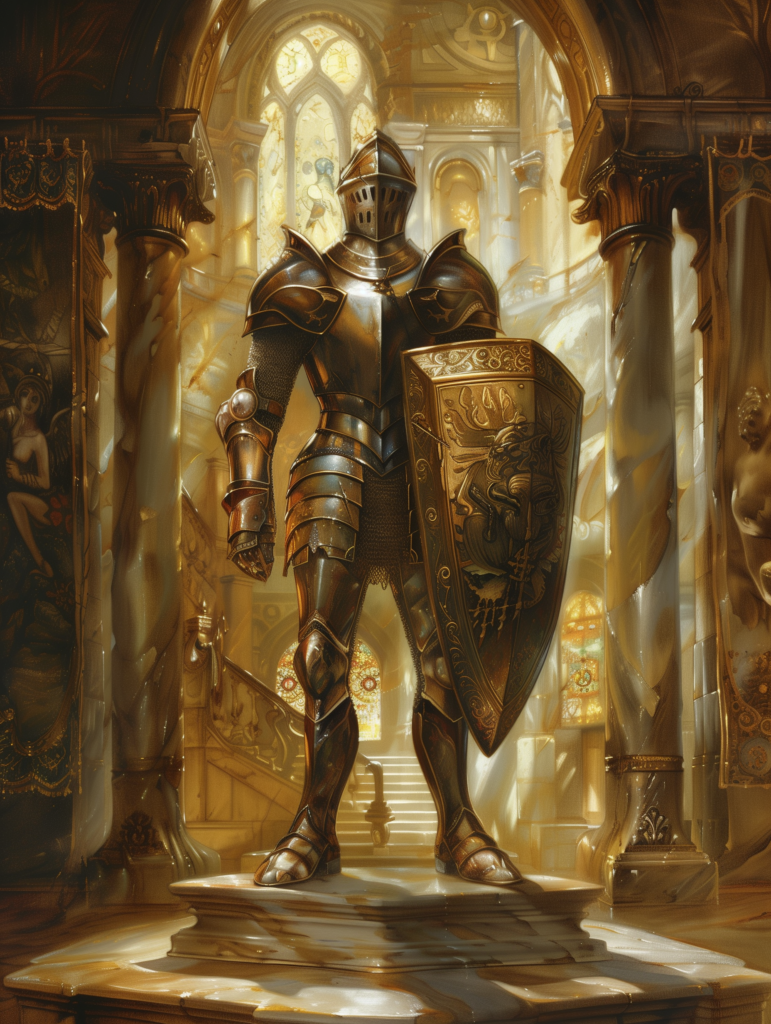
Fortification magic protects a wearer from the most dangerous part of a critical strike. Pathfinder 1E and D&D 3.5e use the named Fortification property with light, moderate and heavy grades. The two 5e rulesets do not use that subsystem.
Rules: choose the edition tab below. The Fortification percentages are not interchangeable between Pathfinder 1E and D&D 3.5e.
Explore: Magic Armour & Shields · Adamantine · Combat
At a Glance
| Property | Fortification |
|---|---|
| Purpose | Reduces the danger of critical hits and, in 3.x, sneak-attack extra damage |
| 5e analogue | Adamantine Armor turns Critical Hits into normal hits |
| Pathfinder 1E | Light 25% · Moderate 50% · Heavy 75% |
| D&D 3.5e | Light 25% · Moderate 75% · Heavy 100% |
5.5e / 2024
There is no core Fortification property with light, moderate and heavy grades. Do not use the Pathfinder/3.5 25%, 75% or 100% negation chances in a 2024 game.
The closest core SRD analogue is Adamantine Armor: while the character wears qualifying adamantine armour, a Critical Hit against that character becomes a normal hit. It is an uncommon magic item and does not use the 3.x enhancement-equivalent system.
A 2024 shield that protects against critical hits would therefore be a specific custom magic item unless an official item supplies its own rule.
5e / 2014
There is no core Fortification property with light, moderate and heavy grades. The 2014 core equivalent is likewise Adamantine Armor: while worn, a critical hit against the wearer becomes a normal hit.
Do not import the 3.x percentage roll, +1/+3/+5 bonus-equivalent pricing, caster level or Craft Magic Arms and Armor requirement into a 2014 game.
Pathfinder 1E
Fortification produces magical protection around vital areas. When a critical hit or sneak attack would apply, roll the fortification chance. On a success, the attack still hits and deals normal damage, but the critical-hit or sneak-attack extra damage is negated as the Pathfinder 1E property specifies.
| Grade | Chance for normal damage | Price modifier |
|---|---|---|
| Light | 25% | +1 bonus |
| Moderate | 50% | +3 bonus |
| Heavy | 75% | +5 bonus |
Aura: strong abjuration · CL: 13th · Construction: Craft Magic Arms and Armor, limited wish or miracle.
Pathfinder deliberately uses lower moderate and heavy chances than D&D 3.5e. Keep the Pathfinder 25/50/75 progression separate from the 3.5e 25/75/100 progression.
D&D 3.5e
D&D 3.5e uses the same three Fortification grades and the same broad purpose: a percentage chance to negate the extra damage from a critical hit or sneak attack while leaving the underlying hit intact.
| Grade | Negation chance | Price modifier |
|---|---|---|
| Light | 25% | +1 bonus |
| Moderate | 75% | +3 bonus |
| Heavy | 100% | +5 bonus |
Aura: strong abjuration · CL: 13th · Construction: Craft Magic Arms and Armor, limited wish or miracle.
Resolve the attack using 3.5e critical-hit, sneak-attack and item-creation rules rather than Pathfinder revisions.
Why Fortification Matters
Fortification is protection against damage spikes rather than ordinary hits. A character can still be struck; the property matters when the attack would otherwise multiply damage or add precision damage.
The most important table rule is edition discipline: Pathfinder 1E deliberately changed the moderate and heavy percentages from D&D 3.5e.
Run It Correctly
- Choose the campaign edition before resolving the hit.
- In 5.5e/2024 or 5e/2014, use the actual magic item’s text; core Adamantine Armor converts the Critical Hit to a normal hit.
- In Pathfinder 1E or D&D 3.5e, roll the appropriate Fortification percentage when the property applies.
- Do not use the 3.x +1/+3/+5 pricing or percentage table in either 5e ruleset.
Related Defence
Adamantine Breastplate · Dwarven Plate · Armour of Invulnerability · Spell Resistance · Magic Armour & Shields
Keep this reference growing
If this page helped with your reading or game, you can support its upkeep or explore the curated books.
Explore the Bookshop — epics, classics and stories behind imagined worlds.