
Augsburg — Free Imperial City of Swabia
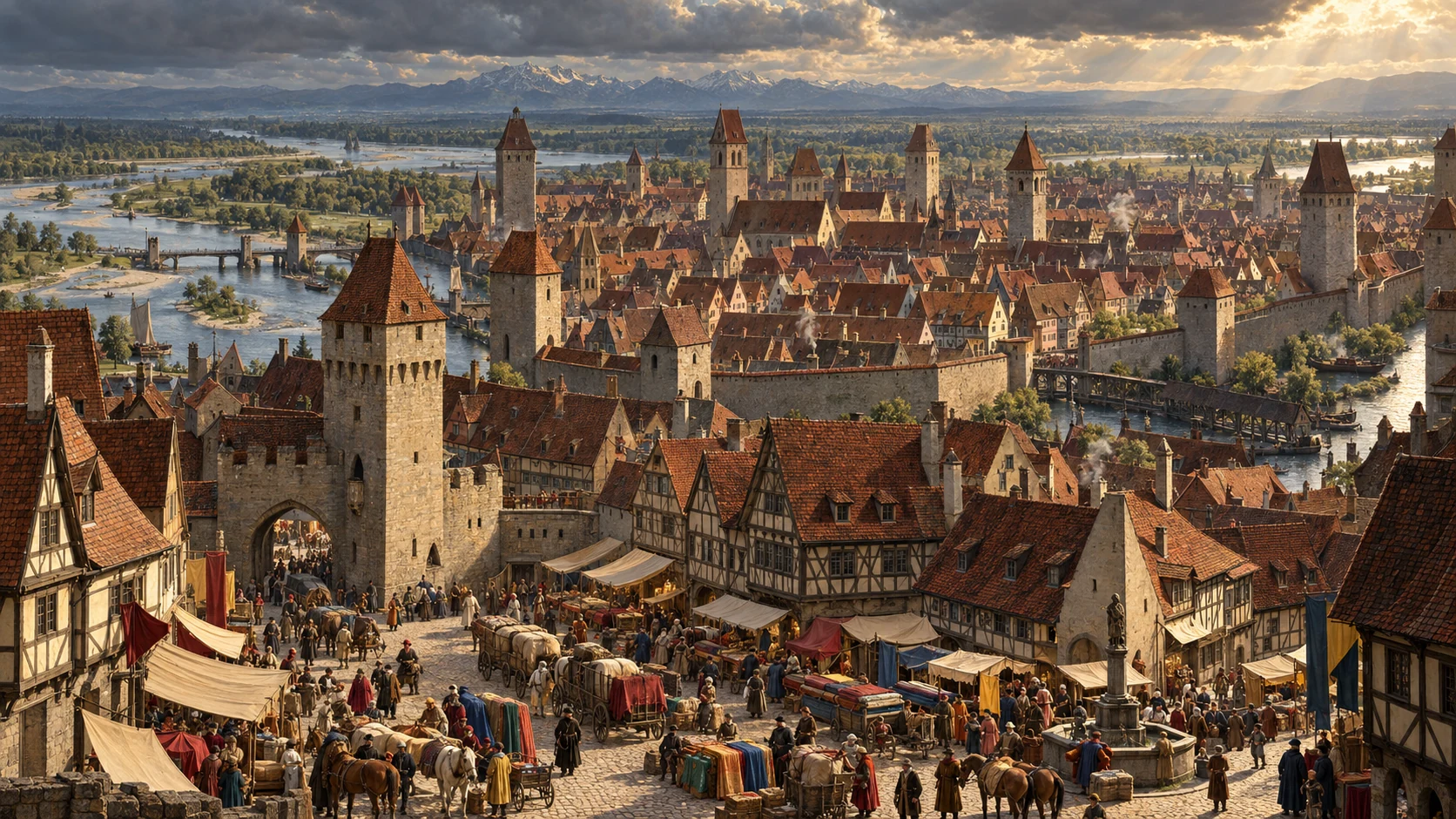
Free Imperial City · Swabia · Between the Lech and Wertach
At a Glance
- Realm
- Holy Roman Empire
- Status
- Free Imperial City, directly subject to imperial authority
- Region
- Swabia, between the Lech and Wertach rivers
- Government
- City council of civic, guild and merchant interests
- Population
- About 17,000 inhabitants, a working campaign estimate
- Settlement
- Prosperous, defended large city
- Trade
- Fustian cloth, cotton, flax, dyes, credit and Italian goods
- Languages
- German; Latin among learned clerks; Italian among some merchants
- Defences
- Walls, gates, watch patrols, militia and guild companies
The Civic Arms

The civic emblem bears a green grape cluster upon a red-and-white shield. Municipal seals also bear the city’s fortified gate. The arms distinguish the council’s authority from that of the neighbouring Prince-Bishopric of Augsburg.
Watchmen recognise the seal upon warrants and toll exemptions, while sworn weighers use it to authenticate measures and cargo.
Augsburg makes its fortune a bolt of cloth at a time. At dawn the workshops ring with looms; by noon carts laden with fustian press towards the markets; at dusk the merchants’ counting rooms still burn with lamplight. A contract signed here may decide whether a distant prince can hire soldiers, repair a fortress or survive the winter.
Behind the prosperity lies a stubborn civic independence. Augsburg is not the capital of the Holy Roman Empire, nor is it governed by the bishop who maintains a separate precinct and territories nearby. Its magistrates guard the city’s privileges, its guilds defend their livelihoods, and imperial officers must reckon with both.
Explore Augsburg and Its Neighbours
Follow the Holy Roman Empire for its politics, the Prince-Bishopric of Augsburg for the adjacent sacred estate, the Via Imperii for a major imperial route, and Munich for the Wittelsbach court.
What Is Happening Right Now?
The council is counting the cost of protection. A proposal to increase gate duties has united some guild masters and enraged caravan owners. A civic clerk has vanished with the accounts that could prove whose purses would benefit.
The cloth merchants are fighting over a missing consignment. Several sealed bales from the Italian road have arrived heavier than their declared weights. One house demands their immediate release; another will pay well to learn what lies between the layers.
The episcopal precinct is resisting a city summons. A fugitive has sought refuge under an older jurisdiction, and the city’s sergeants refuse to enter without permission. Both sides want the prisoner questioned first.
Something is moving beneath the riverside mills. The watch has dismissed reports of the Kanalratten as workers’ talk, yet a miller has recovered a chewed ledger from a locked stone sluice.
Places Adventurers May Actually Visit
The Market and Weighing Places
Bolts of cloth, grain, salt, dyestuffs and imported wares crowd the stalls. Sworn weighers test disputed cargo, while brokers arrange payment by coin or written credit. A false weight can cost a stranger more than the merchandise itself.
The Gothic Council House
The magistrates meet in the older Gothic municipal hall. Its records preserve privileges, toll decisions, guild petitions, property claims and judgments. Petitioners wait in the passageways, making it an ideal place to overhear a powerful quarrel.
The Merchant Streets
Courtyards with locked storehouses, upper counting rooms and guarded strongboxes serve the great trading families. Their servants hear more than the council’s envoys, but a careless question can bring an expensive lawsuit.
The Cathedral Close and Sacred Estate
The ancient cathedral precinct keeps its own customs, archives and ritual chambers. Its bounds create a practical fault line with the city watch. The neighbouring prince-bishopric is a separate territorial power; travellers must not mistake one jurisdiction for the other.
The Perlach Watch and City Gates
A long-standing watch position overlooks the crowded centre. Sentries at the fortified gates inspect wagons, levy lawful dues and record unfamiliar armed companies.
The Lech and Wertach Workshops
Water drives mills, washes fibres, powers workshops and carries refuse beyond the busiest streets. Sluices and narrow service passages offer routes for spies and thieves, but can turn deadly when the flow is diverted.
The Clothworkers’ Lanes
Weavers, finishers, dyers and carters live close to where they labour. A skilled worker can identify a stolen bale by its weave; an angry guild can bring the city’s most profitable trade to a standstill.
People and Powers
The City Council
Experienced guild representatives and patrician interests govern in the name of Augsburg’s imperial privileges. They command the watch, hear petitions, police weights and measures and negotiate with envoys. There is no hereditary duke or single merchant ruler.
The Fugger Merchants
Jakob Fugger the Elder and his kin are among the commercial houses expanding their connections through the cloth trade. The influential Jakob Fugger, the Rich Merchant, can be a patron, a rival or a dangerous creditor; his counting room offers work that need never draw a sword.
The Welser and Rival Houses
Long-established merchant families compete for warehouses, credit, suppliers and routes south. Their heralds may greet each other cordially while their factors plot to underbid a rival consignment.
The Guilds and Civic Watch
Weavers, metalworkers, dyers and merchants defend their chartered occupations. Guild captains can muster trained townsfolk to protect a district, but loyalty to a craft does not always mean loyalty to a magistrate.
The Prince-Bishop’s Officials
Judges, stewards, ritual custodians and diplomatic agents answer to a power distinct from the municipal council. The overlapping claims can turn sanctuary, seized goods and disputed land into dangerous affairs.
Magic, Services and the Marketplace
Augsburg’s wealth draws healers, letter-writers, alchemical suppliers, diviners and dealers in unusual goods. Most transactions pass through ordinary merchants rather than an open magical bazaar. Discreet commissions can be placed through a trusted guild member; costly enchantments require introductions, references and time.
- Useful services: lodging, stables, caravan hiring, copying, translation, legal representation, locksmithing, smithing, repairs and medical care.
- Specialist work: authenticated seals, rare dyes, precision metalwork, protective charms, warded strongboxes and appraisals of suspicious relics.
- Credit and exchange: payment depends on trust in a house, a written instrument and a witness; a forged signature may imperil an entire caravan.
- Arms within the walls: a traveller may own a weapon without having the right to march a private armed troop through the markets.
Dangers in the Free Imperial City
Fraud and false testimony bring ruin without a blade leaving its scabbard. A skilled forger can turn a merchant into an outlaw or a veteran into an unpaid mercenary.
Jurisdictional violence begins when bailiffs from two authorities claim the same prisoner or confiscated chest. Hired guards may be ordered to hold a doorway while negotiators argue over a warrant.
Riverborne threats lurk in flooded cellars, abandoned mill passages and undercut embankments. The Kanalratten tale tells of an immense, aggressive rat that carries sickness through the channels. Whether the stories all concern one creature is far from certain.
Fire and hunger are constant fears in lanes packed with workshops and cloth stores. A small blaze, set deliberately or through carelessness, can spread faster than a watch patrol can organise a bucket line.
Adventure Hooks
- The Ledger Beneath the Mill. A weaver offers payment for the recovery of an account book found below a sluice. It names a respected councillor as the beneficiary of missing wool shipments.
- The Merchant’s Last Seal. A courier dies before entering the north gate. Two rival houses each present a convincing claim to the sealed packet on his body.
- Privilege of Sanctuary. The city watch needs neutral escorts for a prisoner transfer beside the sacred precinct. Someone on each side intends that the exchange never take place.
- Seven Bolts of Black Cloth. A caravan’s finest fabric has been replaced with expert counterfeits. Their unusual thread can be spun by only one workshop.
- The Watch at the Floodgate. Labourers refuse to open a jammed sluice after hearing something speak their names from the water. A rising river threatens the lower streets by morning.
- Silver Without an Owner. An agent offers excellent terms to escort a locked chest to Munich. It bears the city’s seal, but no councillor admits authorising its departure.
Travel, Law and Life in the Streets
Arriving and Leaving
Merchants arriving along the roads from the Alps and imperial cities must navigate tolls, gate hours, inspections and crowded inns. River crossings matter especially after rain or thaw. The Via Imperii connects Augsburg’s concerns with the wider imperial world.
The Rule of the Council
Writs, seals and public witnesses matter. A suspect may demand a hearing, but an outsider accused of theft can be held while sureties are found. Coin and reputation often open doors more quickly than force. Civic and episcopal jurisdictions are not interchangeable.
Where to Find Help
An established innkeeper can recommend a reliable porter or guide. Guild officers certify craftsmen, sworn clerks compare signatures, and a watch captain can secure a threatened street. The quickest guide is rarely the most trustworthy.
Street-Level Encounters
- A dyer asks a passer-by to carry a parcel across a guarded bridge.
- A foreign caravan has the right papers but the wrong heraldic seal.
- Two armed retainers dispute the right to escort the same witness.
- A mill’s waterwheel stops although its channel runs at full force.
Peoples of Augsburg
Human households form the overwhelming majority of the city’s population, but the trading roads also bring visitors of other peoples. Halfling pedlars work the inns and caravan yards; dwarven metalworkers and gnomish specialists find customers among the workshops; an elven visitor may be received as an envoy, guest or curiosity. None of these communities constitutes a separate ruling estate, and the city does not claim a reliable census of its non-human guests.
Acceptance depends as much on guild sponsorship and lawful conduct as ancestry. Yet fear of an unfamiliar creature can still turn rumour into a watch search.
How Augsburg Became Independent
The city’s ancient foundations lie in the Roman settlement of Augusta Vindelicorum. Its position between major rivers and the roads leading south towards Italy helped it survive the changing kingdoms around it. The episcopal establishment remained influential as Augsburg’s merchants and craftspeople won greater independence.
The citizens’ struggle for civic jurisdiction secured the standing of a Free Imperial City. By the early fifteenth century Augsburg’s magistrates dealt directly with imperial authority while the bishop’s temporal rule was largely confined to his separate holdings and cathedral precinct. Guild privileges, fustian production and access to Italian markets make the city wealthy but seldom peaceful.
The celebrated Fuggerei housing complex belongs to a later age and is not yet built. The monumental Renaissance town hall familiar from later views has likewise not replaced the older Gothic hall. The city’s real strength lies in the people trading, judging and organising within the existing walls.
Map and Approaches
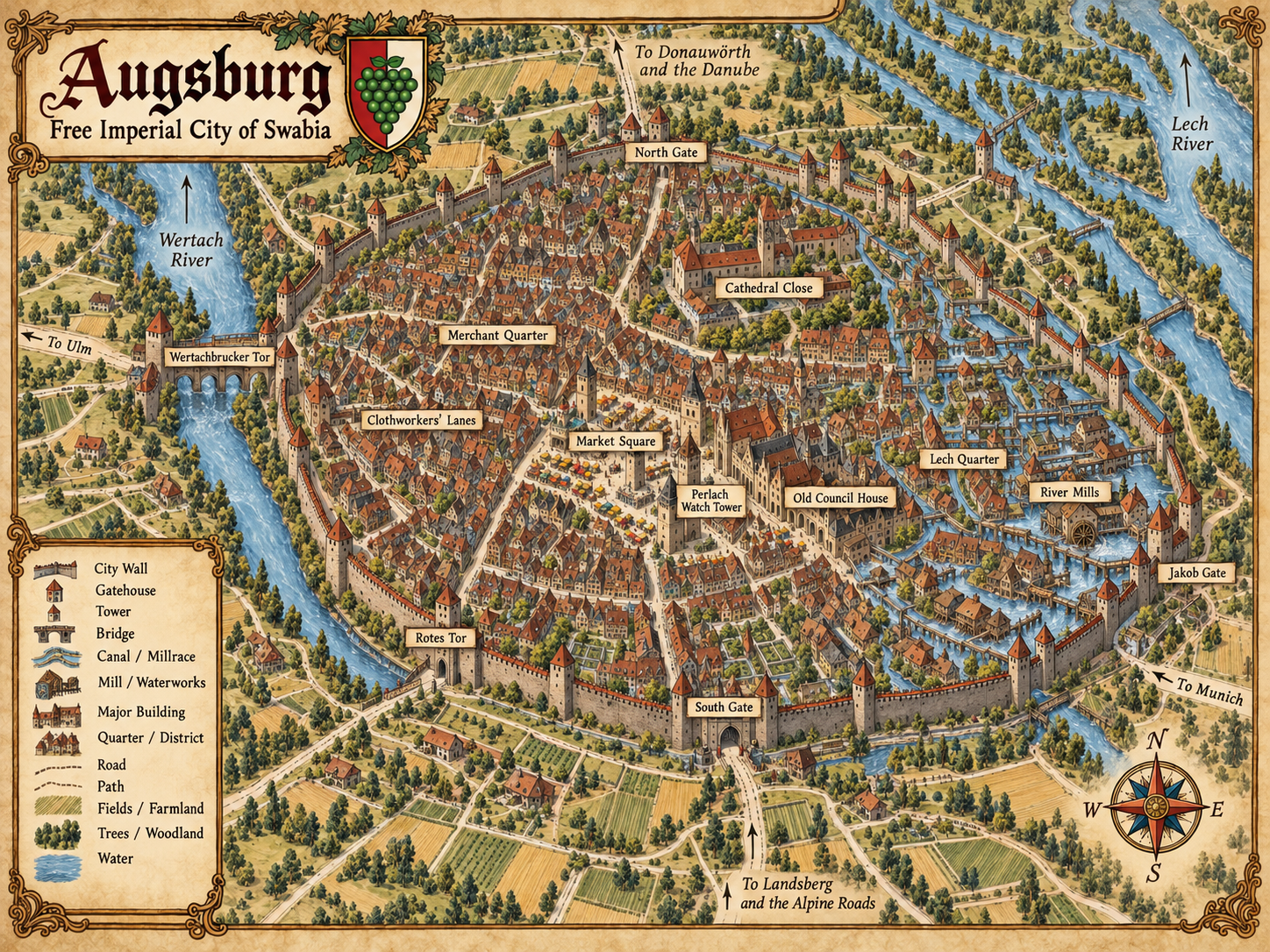
Augsburg stands between the Lech to the east and the Wertach to the west, with roads from the south towards the Alpine crossings, from the north along the Lech valley and from the surrounding Swabian and Bavarian lands. Within the walls, the market, Gothic council house, cathedral precinct, fortified gates, workshop lanes and controlled waterways provide the principal encounter points.
Keep the city and the surrounding prince-bishopric distinct on any route map. When a boundary matters, ask who controls the nearest gate, bridge, channel, hall or estate rather than assuming every street obeys the same warrant.
Sources and Further Reading
- Historisches Lexikon Bayerns: Augsburg’s civic constitution and imperial privileges.
- University of Mainz: government, finance and late-medieval urban society in Augsburg.
- Fugger family history: textile trade and the family’s early rise.
- City of Augsburg: civic arms and the grape and pinecone symbols.
Keep this reference growing
If this page helped with your reading or game, you can support its upkeep or explore the curated books.
Explore the Bookshop — epics, classics and stories behind imagined worlds.