
Argos — The Venetian Stronghold of the Argolid
At a Glance
| Place | Argos, Argolid, north-eastern Peloponnese |
|---|---|
| Campaign present | Late-medieval town held by the Republic of Venice |
| Neighbouring power | The Despotate of the Morea, with rival households and unsettled roads |
| Key sites | Argos market, Larisa hill fortress, ancient theatre and surviving sanctuaries |
| Livelihoods | Olive and grain farming, animal husbandry, crafts, trading and fortress supply |
| Historic connections | Diomedes, Perseus, Hera, Mycenae and heroic-age Argolis |
| Best for | Border politics, lost relics, fortress intrigue and competing accounts of the past |
The road into Argos passes fields and old stones beneath the castle of Larisa. A Venetian officer counts wagons at the gate; two farmers dispute whose animals damaged the olive terraces. Nearby, a scholar has paid for a bronze tablet found in an abandoned well. Its discoverer is missing, and neither the official nor the scholar wants the story told in public.
What Is Happening Right Now?
Argos remains a Venetian holding in the mid-fifteenth century, even as much of the Peloponnese lies under the influence of the Greek despots of the Morea and competing military powers. Its officials have to keep roads and supplies open while neighbouring allegiances shift. A merchant’s property can be protected on one side of a boundary and vulnerable on the other.
Recent upheaval in the Morea has scattered men seeking employment and families seeking safety. The Ninefold Dominion’s occupation of Constantinople troubles the whole eastern Mediterranean, while the human Ottoman state is a separate source of pressure. A traveller from Athens might bring goods, a petition or a rumour worth more than the cart.
Places Adventurers Can Visit
The Market and Workshops
Argos depends on carpenters, smiths, millers, farmers, traders and the officials who organise taxes and stores. A shortage of grain or a forged bill of lading can matter more than an unexplored temple. A character who helps ordinary townspeople gains contacts useful later.
Larisa Hill
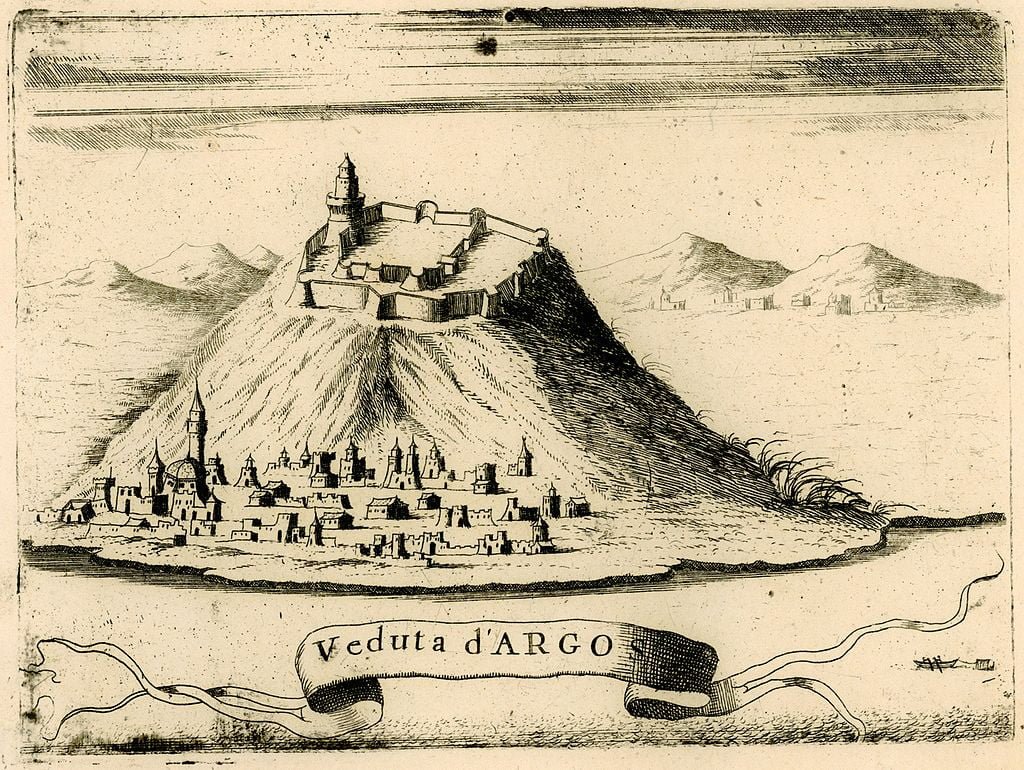
The fortress above the town watches roads and cultivated land. Its layers of construction tell of successive rulers rather than a single unchanged ancient city. Guard rotations, water supplies and the right to bring weapons inside create opportunities for intrigue and reconnaissance.
The Ancient Ruins
Old Argive sanctuaries and the theatre are reminders of a world that produced heroes and rivals before the medieval rulers. They are places to seek inscriptions, lost household records, buried offerings and the memories of local spirits. Relics are not automatically powerful or safe.
Where Travellers Stay and Find Help
The Olive Arch — Off the Market Lane
Damaris keeps the Olive Arch, a modest guesthouse where traders share a meal of beans, bread and preserved olives before sleeping in the loft. Her walled courtyard has space for pack animals and for a cart needing a simple repair. She knows Eleni the olive grower and will offer a free meal to anyone who escorts her stranded niece safely back to town. She does not betray a guest lightly, though she has no guards to defend a party that makes enemies of the garrison.
The Salt Gate House — Near the Fortress Road
Lorenzo, a Venetian factor, rents private rooms to merchants and couriers who can pay a higher price. He has a messenger who knows the coastal route to Nafplio and can arrange introductions to officials, but his accounts reveal more of his patrons than he wants strangers to discover. A visiting scholar can earn work translating letters; a discreet guard may be hired to protect a convoy without being asked to serve one political faction.
Craftsmen and Care
Iason, a smith by the lower workshops, repairs blades, plough iron and armour fittings and sells ordinary tools. Zoe, a healer who serves farm families, treats fever, injuries and sick animals; she sends severe cases to skilled practitioners or a divine patron when necessary. Local guides can escort travellers through the olive country, while the market carries provisions, rope, lamps and animal feed. A rare relic is not a common shop good merely because the city has an ancient past.
The Heraion Above the Plain
Beyond the fields north-east of Argos, the old sanctuary of Hera rests against the hills. Three peacocks walk its deserted court at dusk although no flock is kept nearby. They have been following the young labourer who found a bronze dedication beneath the stones and fled when armed men demanded it. The birds are Hera’s watchers, not trained pets. They will lead anyone who comes in peace towards the hiding place, but shriek when the stolen tablet is carried out of the grove.
Theodoros can translate the dedication. It identifies an object kept in his patron’s collection as a gift removed from the sanctuary long ago. Marco the quartermaster supplied the men who searched for the tablet without knowing why it mattered. Return the gift and the peacocks fall silent; betray the hiding place and a household loses its witness. The consequences reach a farmer’s home long before they reach the ruler’s court.
People and Powers
Marco, the Venetian quartermaster, needs supplies and reliable workers, but his men have taken more than he authorised. Eleni, an olive grower, shelters the frightened labourer who found the tablet and will trust a party that puts his safety before the collector’s reward. Theodoros, an antiquarian, can translate the writing but fears losing his wealthy patron. Each can become an ally; each also has a reason to conceal the truth at first.
The stories of Diomedes of Argos, Perseus and Hera still shape songs, dedications and the names families give their children. The heroes belong to earlier ages, but their relics and the gods they honoured remain important to living neighbours. An Argive soldier may admire Diomedes without pretending that the Trojan War ended last winter.
Magic, Services and Dangers
The Heraion’s peacocks have appeared because a gift was stolen from the goddess’s sanctuary, and Eleni’s household is caught between armed treasure seekers and the need to keep a witness safe. A party can return the object, conceal the labourer or expose Theodoros’s patron. On the ordinary roads, missed grain deliveries, worn cartwheels and wandering hirelings cause trouble enough. Damaris can feed and shelter a party, Zoe can tend injuries, and Iason’s forge keeps working until supplies run short; divine favour cannot be ordered by paying a fixed fee.
Three Adventure Openings
- The vanished bronze. A labourer disappears after finding a metal tablet beneath an ancient wall. A collector offers a reward for the artefact; the family wants the man alive. Recovering both may reveal who commissioned the theft.
- The wrong tax seal. Farmers have paid twice for the same grain, once to a Venetian collector and again to armed men claiming another lord. The characters can expose fraud or avert a reprisal against the villages.
- The silent salt convoy. A shipment from Nafplio never reaches Larisa. Marco suspects bandits; a wounded mule returns to town carrying a merchant’s seal. The last person to see the convoy alive was Lorenzo’s messenger, who has a reason to conceal its change of route.
When the Travellers Return
Restore the Heraion’s gift and Eleni names the party as friends of her household, Damaris keeps a place at the Olive Arch, and the shrine’s peacocks return to their quiet dusk watch. Protect Marco from needless humiliation and he will offer honest work escorting fortress supplies. If Theodoros sells the tablet instead, the labourer’s family flees, the peacocks begin following its new owner and no Argive antiquarian can pretend the theft was harmless.
Travel and Connections
Argos lies among the roads connecting the Venetian harbour of Nafplio, the northern isthmus and Corinth, the western approaches into Arcadia, the southward roads towards Laconia, and the hills leading to Epidaurus. A pack caravan can use the better roads when bridges hold, but armed patrols, weather and demands for escort can lengthen the journey. Damaris and Lorenzo know different guides; choosing one can shape which household hears of the party’s arrival. See Greece and the Balkans for onward destinations.
Deeper History
Ancient Argos was a major centre in the heroic and Classical Greek worlds. Mycenaean stories connect the wider Argolid to dynasties, the Trojan War and a host of old divine claims. The town later passed through Roman, Byzantine and Latin rule. Its present Venetian administration is one layer in that long history, not a reborn Classical polis.
Sources
For Venetian possession of Argos into the fifteenth century see William Miller, The Latin Orient. Fictional supporting characters and mythic encounters are game-setting elements.
Continue Exploring
Keep this reference growing
If this page helped with your reading or game, you can support its upkeep or explore the curated books.
Explore the Bookshop — epics, classics and stories behind imagined worlds.