
Vijayanagara Empire
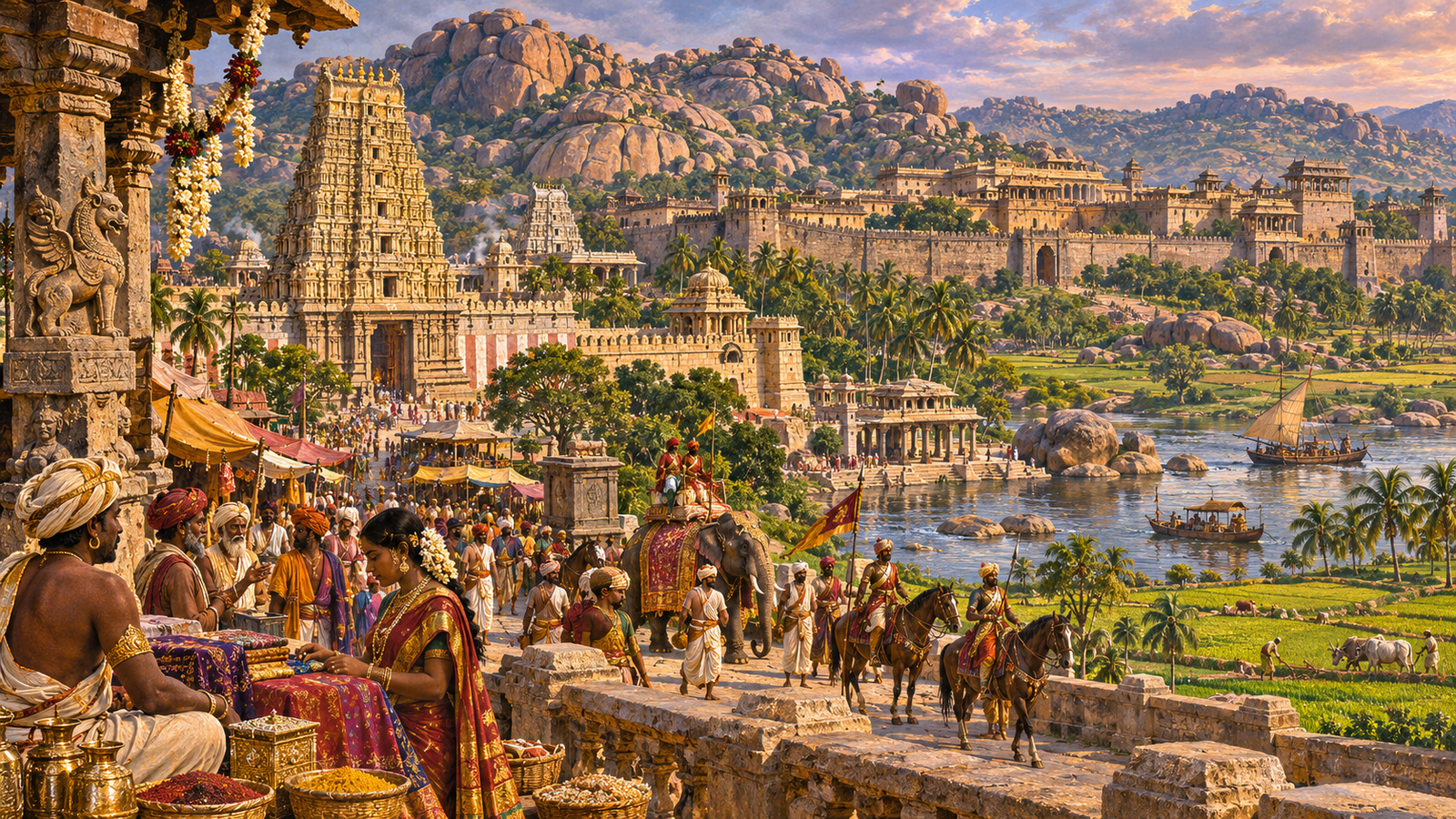
Southern India · Sangama dynasty · Tungabhadra capital · 1454 CE
At a Glance
| Realm | Vijayanagara Empire, the great southern Indian imperial power |
|---|---|
| Capital | Vijayanagara on the Tungabhadra River (modern Hampi) |
| Ruler | Emperor Mallikarjuna Raya, Sangama dynasty |
| Government | Imperial kingship supported by provincial governors, military chiefs, temple estates and subordinate courts |
| Languages | Kannada, Telugu, Tamil and other regional languages; Sanskrit in religious and scholarly settings |
| Sacred traditions | Shaiva, Vaishnava, Shakta, Jain and local traditions; Muslim merchants, soldiers and communities |
| Main rivals | The Bahmani Sultanate to the north and Kapilendra Deva’s Gajapati state in the east |
| Notable dependencies | Southern regional courts including Mysore; local rulers retain their own authority |
| Royal emblem | Varaha, the boar, associated with the sun and crescent moon |
| Character of rule | Imperial order is valued, but rulers, communities and officials act according to their own loyalties and morals |
| Campaign present | 1454 CE |

The road to the imperial capital winds between enormous granite hills and irrigated fields. Under the city’s gates, horse dealers bargain beside jewellers, armourers and grain merchants. Armed messengers hurry toward the palace while pilgrims make their way to the river shrines. A captain claims an eastern fortress is still loyal. The merchant who has just arrived from there says its garrison has opened the gates to another ruler.
What Is Happening Right Now?
Mallikarjuna Raya rules the great southern empire inherited from Deva Raya II. The late emperor’s reign brought military strength, an impressive court and a capital whose wealth amazed visiting travellers. His successor still commands immense resources: fortified cities, royal workshops, wealthy temple estates, trained soldiers and commanders capable of bringing thousands of men into the field. Yet the court is more divided than the splendour of its palaces suggests.
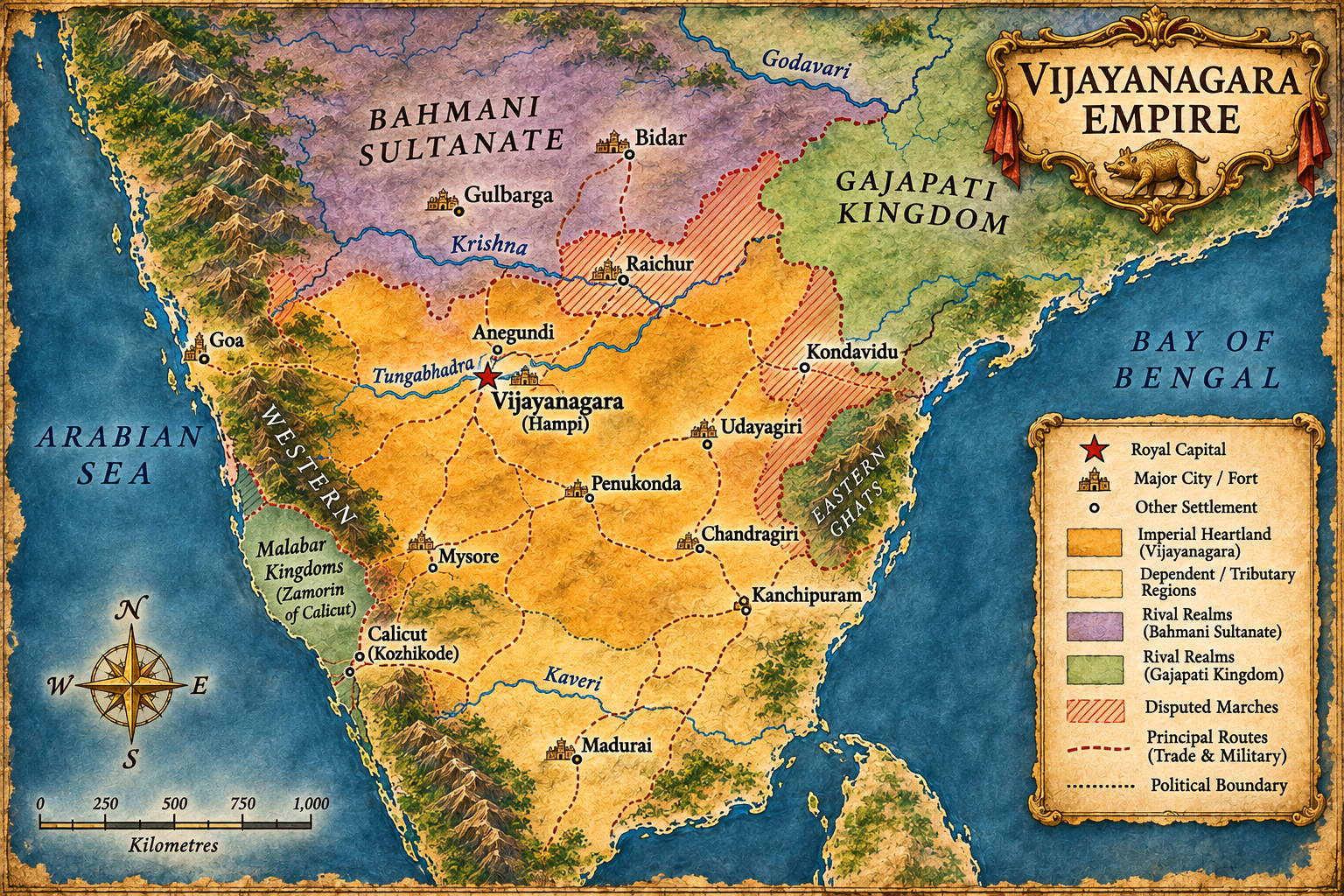
To the north, the Bahmani Sultanate contests forts and fertile river valleys across the Deccan, along with the trade routes needed to supply cavalry horses. It is a wealthy and sophisticated rival, with its own competing commanders and regional interests. The boundary is a succession of garrisons, river crossings and changing allegiances rather than one certain line.
In the east, Kapilendra Deva’s Gajapati power presses southward into the Andhra country. A governor who commands a fortress can change the balance of an entire district. At Vijayanagara, counsellors argue whether the eastern marches or northern heartland deserve the army’s first attention. Royal relatives and ambitious captains listen to these arguments and count their supporters.
Across the empire, merchants, temple communities and village leaders continue their work. The roads still carry pepper, fine cloth, metalwork, grain and precious stones. The throne is threatened, but Vijayanagara is far from defeated.
Landscape and the Roads of Empire
The imperial heartland lies among the dry granite uplands, hills and cultivated valleys of southern India. The Tungabhadra supplies water for canals, tanks and fields near the capital. Southward, river basins and wetter hill country support grain, timber, textiles and trade; eastward, the empire’s reach depends on who holds the Andhra fortresses. Western routes cross the ghats to Arabian Sea ports, where Indian, Arab and Persian merchant houses link the inland courts to a much wider ocean world.
From the capital, mounted couriers ride north toward disputed Deccan forts, east through Telugu-speaking districts, south toward dependent courts, and west through the hills to maritime markets. Royal roads are useful, but they are not equally secure. Floods, shortage of fodder, and rival garrisons can strand caravans for days.
Places to Explore
Vijayanagara, the Tungabhadra Capital
Great granite boulders rise beyond royal enclosures, gardens, workshops and crowded markets. The city spreads across a defended landscape rather than clustering within a single wall. Gatehouses admit armed escorts and caravans. In the markets, merchants offer imported horses, pepper, silk, fine cotton, gems, armour and ordinary provisions. Palace audiences bring together commanders, priests, merchants, envoys and entertainers, each hoping to shape the emperor’s next decision.
The Virupaksha and Pampa Sacred Quarter
Ancient temples stand beside the river. Shiva is honoured here as Virupaksha, alongside the local goddess Pampa. Pilgrims arrive through the market streets, and festivals draw crowds far beyond the temple estates. The sacred precinct is more than a place of worship: its workshops, custodians, learned specialists and donors sustain a web of influence reaching into the royal court.
Anegundi and the Northern Riverbank
Across the Tungabhadra, Anegundi looks toward the frontier. Boatmen and guards control the busy crossings, and older royal associations give the district special prestige. During monsoon floods the river may separate friends who stand within shouting distance. An overlooked landing can be more valuable to a messenger than a fortified bridge.
Hemakuta Hill and the Granite Shrines
Stone paths wind among tall boulders and old sacred buildings above the city. Pilgrims climb to make offerings while guards use the heights to watch the approaches. An ancient inscription or a witness living beside a remote shrine can undermine the testimony of a confident court official.
Southern Courts, Mysore and Regional Lords
The rulers of Mysore and other dependent territories maintain their own households, customs and political ambitions even as they acknowledge imperial power. Some provide troops readily, others prefer bargaining. An imperial envoy who treats a local ruler as a minor servant may learn the difference between nominal authority and power over people on the ground.
Andhra Fortresses and the Eastern Marches
Roads eastward lead to strongholds whose possession can change with a siege, a marriage alliance or a governor’s death. Gajapati agents recruit sympathisers; imperial commanders reinforce stores and walls. Families of soldiers and local farmers live with the consequences of decisions made far away in royal capitals.
People, Power and Factions
Mallikarjuna Raya, the Emperor
Mallikarjuna has dynastic legitimacy, enormous resources and the loyalty of important households. Yet the emperor cannot stand at every frontier gate. His reputation for less decisive government than his father gives rivals room to manoeuvre. Some advisers are capable and principled; others turn every warning from the marches into a bid for personal influence.
Military Chiefs and Governors
Provincial commanders control fortresses, troops and local income. Many sincerely defend the realm, while others protect only their own families and estates. The court rewards successful campaigns, but a powerful chief who refuses an unlawful demand might be more trustworthy than an obedient opportunist. The hierarchy prizes authority and obedience; whether that authority is used for the common good depends upon the ruler and officer.
Merchant Houses and Horse Brokers
Trade networks bring horses from overseas, textiles, spices, metalwork and luxury goods into the capital. A dependable warhorse can be worth as much as a small fortune to an army. Traders therefore have leverage over campaigns without holding a sword. Foreign merchants are not automatically spies or outsiders to city life: many have business partners and households here.
Temple Communities and Scholars
Religious establishments own land, sponsor craft work, teach, feed pilgrims and maintain sacred rites. Shaiva, Vaishnava, Shakta, Jain and local traditions coexist with one another and with Muslim communities. Their interests can clash over patronage or property without becoming a simple division between good and evil.
Gods, Magic and Services
At the river shrines, worshippers honour Virupaksha, a form of Shiva, and Pampa. Others seek the blessings of Ganesha at the start of a difficult undertaking, or give offerings to Vishnu and other powers of the Indian Pantheon. A shrine’s relationship to a deity shapes its obligations, but clergy and worshippers remain individuals with their own motives.
Healers, interpreters, court astrologers, scribes, diviners, armourers and guides are all available somewhere in the imperial capital. Magical assistance is not an anonymous shop service: a respected practitioner may demand a favour, refuse to work against a temple’s interests or be bound by service to a patron. River guardians, naga and older local powers may preserve agreements predating the present imperial dynasty. Treat them as characters with claims and responsibilities rather than as wandering monsters.
Dangers and Rumours
- A governor changes sides. A frontier fortress flies the imperial standard, but the soldiers inside have been promised new pay by another court.
- The river rises. A royal message and a suspected traitor are trapped on opposite banks while the crossings flood.
- Two armies want the same horses. A merchant caravan is carrying cavalry mounts promised to Vijayanagara; Bahmani agents offer twice the price.
- A shrine refuses an order. A commander demands grain from a temple estate, while its custodians insist the stores feed the surrounding villages.
Adventure Starts
The Horse Caravan
A horse dealer has accepted imperial payment for a herd of valuable cavalry mounts. Before reaching the capital, armed men bearing royal insignia order the animals diverted toward a northern fort. Are they following an emergency command, a forged order or the private scheme of a provincial commander? The dealer hires the party to recover both horses and proof before the army pays him twice for the same animals.
The Last Letter from Andhra
Two messengers arrive on consecutive days with opposing reports from the same eastern fortress. Both carry genuine seals. A trusted secretary at court asks the party to travel there and discover whom its commander serves. The garrison is split, civilian families are trying to escape, and an approaching force means there is little time for a peaceful outcome.
The Water of the Lower Fields
A blocked irrigation channel is destroying crops below an estate administered by temple officers. Villagers accuse a governor of diverting water, while the governor insists saboteurs damaged the gate. A river guardian remembers an older agreement over the source. The party must repair the works and establish who has authority over the water before hunger turns a local grievance into revolt.
Travel and Authority
The imperial seal carries weight, but the practical rule of the road belongs to commanders, village leaders and local courts. A traveller may gain protection by securing an introduction from a merchant house or temple patron; an arrogant royal envoy may discover that a dependent ruler still controls his own guards and bridges. Villages maintain their traditions, and rank alone does not decide whether an official acts honourably.
Travel varies with the monsoon. Dry uplands demand dependable wells and pack animals; high rivers can stop wheeled traffic for days. The west-coast sea routes link India to Arabia, Persia and East Africa through established commercial networks. No single imperial road or port supplies the whole realm.
The Empire Before 1454
The Sangama dynasty established Vijayanagara in the fourteenth century, building its capital in an older sacred landscape beside the Tungabhadra. Fortifications, temples, markets, canals and reservoirs supported an expanding court. Through successive reigns its rulers competed with neighbouring powers, formed alliances with local chiefs and governed much of the south through a combination of direct appointments and dependent courts.
Deva Raya II’s reign gave the empire renewed prestige and military strength. Wealth from agriculture, craft production and commerce supported a remarkable capital. After his death in 1446, succession became more troubled. Mallikarjuna’s rule still rests on a powerful empire, but the rising strength of the Bahmani and Gajapati states and the ambitions of local governors make the coming years uncertain.
Connected Places and Powers
India · South Asia · Kingdom of Mysore · Indian Pantheon · Asian Mythology Bestiary.
Historical Sources and Image Credit
Geographical and architectural background: UNESCO, Group of Monuments at Hampi. Sacred precincts: Karnataka Tourism, Hampi Sacred Centre. Dynastic history and political context: INFLIBNET, The Vijayanagara Empire. Royal emblem: Vijayanagara Sexcentenary Commemoration Volume (1936), reproduced in the public domain via Wikimedia Commons.
Keep this reference growing
If this page helped with your reading or game, you can support its upkeep or explore the curated books.
Explore the Bookshop — epics, classics and stories behind imagined worlds.