
Chaotic Rage Epic Feat — D&D 3.5e
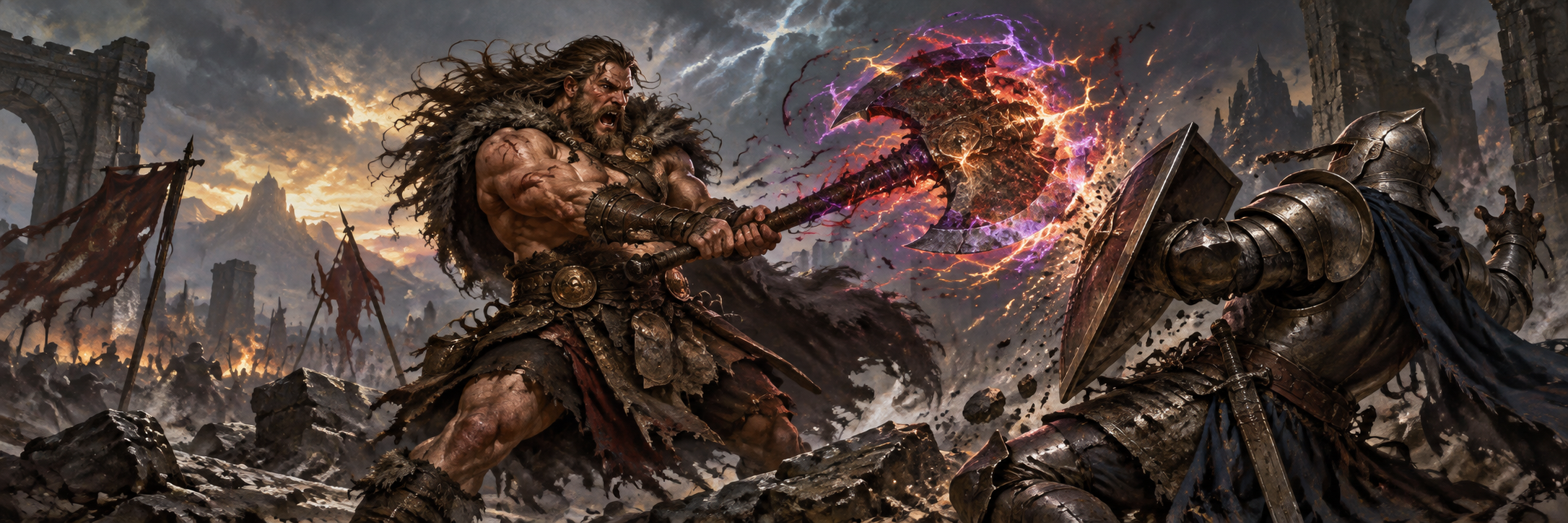
Epic Feat · D&D 3.5e
The Chaotic Rage epic feat turns a raging warrior’s weapons into instruments of chaos. In D&D 3.5e, a chaotic character with rage 5/day treats any weapon they wield during rage as anarchic, dealing an extra 2d6 damage against lawful creatures. The benefit lasts while raging and does not stack with similar abilities.
At a Glance
- Feat type
- D&D 3.5e epic feat
- Prerequisites
- Rage 5/day; chaotic alignment; normal epic feat eligibility
- Benefit
- Wielded weapons are treated as anarchic while raging: chaos-aligned, with +2d6 damage against lawful creatures
- Limits
- No extra damage against neutral or chaotic creatures; similar abilities do not stack
- Edition coverage
- Original 3.5e rules, a related PF1e rage power, and notes for 2014 and 2024 D&D
Chaotic Rage Epic Feat: Rules by Edition
The original feat belongs to D&D 3.5e. Choose the matching edition below: the Pathfinder option has its own benefits, and the modern D&D panels explain the limits of the comparison.
D&D 5.5e (2024) — Edition Note
No direct counterpart is presented in the 2024 Basic Rules. The Chaotic Rage epic feat’s alignment-based anarchic weapon benefit is a 3.5e rule. It is not granted by the 2024 Barbarian’s Rage or by simply reaching an Epic Boon level.
The 2024 Rage Damage bonus applies to attacks using Strength with a weapon or an Unarmed Strike. It scales with Barbarian level and does not depend on whether the target is lawful. A chaotic alignment alone does not add the original feat’s 2d6 damage.
At the table. Use the actual 2024 class and feat descriptions for your character. A Barbarian level that grants several uses of Rage does not establish eligibility for a feat from another edition. Any campaign conversion needs a separately agreed rule.
Source. D&D 2024 Basic Rules — Barbarian.
D&D 5e (2014) — Edition Note
No direct counterpart is presented in the 2014 Basic Rules. The Chaotic Rage epic feat does not automatically carry into a 2014 Barbarian build. Native Rage grants a level-based damage bonus to melee weapon attacks using Strength, rather than extra anarchic damage against lawful creatures.
At the table. Resolve ordinary Rage and any chosen subclass feature according to their own descriptions. A character’s chaotic alignment can guide roleplaying, but this 3.5e feat cannot supply an extra damage rule without an agreed conversion.
The 2014 and 2024 Rage features also differ in their attack requirements and duration rules. Keep the rules for the edition being played together; do not combine a modern Rage feature with the original feat’s prerequisites merely because both use the word “rage.”
Source. D&D 2014 Basic Rules — Barbarian.
Pathfinder 1e — Greater Chaos Totem
Related native option: Greater Chaos Totem is a supernatural Barbarian rage power from the Advanced Player’s Guide. It is a useful thematic comparison to the Chaotic Rage epic feat, with different mechanics.
Prerequisites. Barbarian level 10 and the Chaos Totem rage power. Chaos Totem itself requires Barbarian level 6 and Lesser Chaos Totem.
Benefit. During rage, Greater Chaos Totem grants damage reduction overcome by lawful weapons, with the reduction equal to half the Barbarian’s level. The Barbarian’s weapons and natural weapons count as chaotic for overcoming damage reduction.
Important distinction. This power does not grant the anarchic weapon property’s extra 2d6 damage against lawful targets. Its offensive benefit concerns overcoming damage reduction, while its defensive benefit concerns incoming damage.
Example. At Barbarian level 10, the defensive benefit is DR 5/lawful while raging. An appropriate attack with the Barbarian’s weapon can overcome a creature’s DR/chaotic. These are separate checks: do not add 2d6 damage just because the target is lawful.
Pathfinder’s mythic rules are also a separate progression. This comparison does not make Greater Chaos Totem a mythic feat or a Pathfinder version of the 3.5e epic feat.
Source. Pathfinder PRD — Advanced Player’s Guide Barbarian rage powers.
Chaotic Rage Epic Feat — D&D 3.5e
- Prerequisites Rage 5/day, chaotic alignment.
- Benefit Any weapon you wield while in a rage is treated as an anarchic weapon (it is chaos-aligned and deals an extra 2d6 points of damage against creatures of lawful alignment). This ability does not stack with similar abilities.
Epic eligibility. The normal epic feat rules apply: characters ordinarily select epic feats at character level 21 or higher and must meet the feat’s prerequisites. A Barbarian reaches rage 5/day at class level 16, but meeting that prerequisite does not by itself make the character eligible for an epic feat.
How Chaotic Rage Works
Chaotic Rage is an epic rage option for a chaotic-aligned combatant. Once the character enters rage, a weapon they wield is treated as an anarchic weapon for the feat’s purpose. The important distinction is the target’s alignment: the extra 2d6 damage applies when that weapon strikes a lawful creature. It does not grant the same extra damage against neutral or chaotic creatures merely because the wielder is raging.
Example at the Table
A chaotic barbarian who meets the prerequisite of rage five times per day attacks a lawful opponent while raging. If the attack hits, resolve the weapon’s ordinary damage and then add 2d6 damage from the anarchic property. On a hit against a neutral opponent, the feat does not add those 2d6. Outside rage, this feat does not give the weapon the anarchic property.
What Does Not Stack?
The feat expressly says that this ability does not stack with similar abilities. If a weapon already has the anarchic property from another source, do not add a second identical 2d6 bonus just because Chaotic Rage is active. Keep the ordinary two-weapon, attack-roll, and rage rules in effect; this feat does not itself grant a new attack or an extra use of rage.
Choosing and Using the Feat
- Before selection: Check the character’s chaotic alignment and rage five times per day.
- When rage begins: Note which weapons the character wields; use the anarchic property while the feat applies.
- When an attack hits: Check whether the target is lawful before adding the extra damage.
- When rage ends: Stop applying the feat’s temporary benefit.
Related Rules and Edition
This is a D&D 3.5e epic feat, not an automatic rule for the 2014 or 2024 versions of D&D or Pathfinder 1e. Compare Mighty Rage for enhanced rage ability bonuses, and visit the Epic Feats collection for other high-level choices. The original prerequisites and benefit above remain unchanged.
Damage Examples for the Chaotic Rage Epic Feat
Suppose a hit deals 18 points of ordinary weapon damage after the character’s normal bonuses. Against a lawful foe during rage, roll the extra 2d6. If those dice show 3 and 5, the damage before any applicable defenses is 26. Against a neutral foe, the same ordinary hit remains 18. The feat changes the alignment-dependent part of the damage calculation.
If a raging character hits a lawful creature twice, resolve each hit separately. For example, ordinary damage of 18 and 15, with anarchic rolls of 8 and 6, gives 26 and 21 before applicable defenses. The Chaotic Rage epic feat does not create those attacks: the character must already be entitled to make them under the usual combat rules.
If one attack misses, that attack deals no weapon damage and gains no extra 2d6. The feat is not a separate burst that occurs whenever rage starts. A successful hit and a qualifying target remain necessary to gain its extra damage.
Alignment and Weapon Checks
Lawful good, lawful neutral and lawful evil creatures all have a lawful alignment. The target’s good–evil alignment does not determine whether this feat’s extra damage applies. Conversely, a neutral evil creature is not a lawful target simply because it is hostile, and a disciplined creature is not necessarily lawful.
Use the target’s actual alignment as adjudicated by the DM. The Chaotic Rage epic feat gives no additional ability to detect alignment; the player may not know a creature’s alignment merely because an attack is made. Keep that knowledge separate from the DM’s damage ruling.
For the wielder, chaotic good, chaotic neutral and chaotic evil each satisfy the stated chaotic alignment prerequisite. The feat does not require evil alignment or membership in a particular faction. Check the character’s own eligibility as well as the opponent’s alignment.
Changing weapons during rage does not confine the benefit to the first weapon used. The original wording refers to any weapon you wield while in a rage. Once rage ends, weapons stop receiving this feat’s temporary benefit; a weapon that was already anarchic keeps its independently granted property.
Stacking example. If a weapon already adds 2d6 against lawful creatures because it is anarchic, the feat does not turn that into 4d6. Apply one instance of the similar benefit. Other bonuses still require their own rules checks rather than being presumed to stack or disappear.
Critical Hits and Damage Reduction
The Chaotic Rage epic feat adds extra damage dice, so those dice are not multiplied on a critical hit. Resolve the weapon’s normal critical damage first, then add one roll of 2d6 if the target is lawful. For example, if the weapon’s ordinary critical damage totals 36 and the anarchic dice total 8, the combined amount is 44 before other defenses. A higher critical multiplier does not turn the feat’s 2d6 into 4d6 or 6d6.
Chaos alignment also matters when a creature’s damage reduction calls for a chaotic weapon. A weapon receiving this feat’s benefit can meet that alignment requirement during rage. This does not automatically satisfy unrelated requirements such as a particular material or an epic enhancement bonus; consult the creature’s complete damage reduction entry.
The direction of the slash is easy to confuse. DR 10/chaotic means a chaotic weapon can overcome that reduction. DR 10/lawful calls for a lawful weapon. The Chaotic Rage epic feat grants chaos alignment to the weapon, so it helps with the former requirement. A target’s lawful alignment and its damage reduction entry are two separate facts.
This is also why Greater Chaos Totem in Pathfinder needs its own reading. Its DR/lawful protects the raging Barbarian against attacks that do not meet that requirement. Its outgoing weapons count as chaotic for overcoming an opponent’s damage reduction. Neither clause duplicates the original feat’s extra damage dice.
Rules references. D&D 3.5e SRD — multiplying damage; damage reduction; anarchic weapons.
Common Questions
Does rage 5/day mean five uses must remain? The prerequisite describes the character’s daily rage capability, not an additional cost of five uses each time the benefit applies. The feat provides no new pool of uses and no separate activation listed in its benefit. Track the ordinary rage uses and duration on the character sheet.
Does it improve accuracy? The stated benefit grants the anarchic weapon effect. It does not list an additional attack-roll bonus. Continue calculating attacks from the character’s usual combat statistics, the weapon and any other applicable effects.
Can a character retain the feat after changing alignment? The epic feat rules require prerequisites to use a feat as well as to select it. If the character loses the required chaotic alignment, they cannot use this benefit while that prerequisite is missing. The feat itself does not prevent an alignment change.
Does it affect every creature nearby? No area of effect is given. Its damage benefit is attached to a qualifying weapon hit against a lawful creature. Other enemies standing near the wielder do not take automatic damage when the character enters rage.
How should the benefit be recorded? Keep the ordinary weapon damage and the conditional 2d6 on separate lines. Mark the weapon as chaos-aligned during rage, and remove that temporary note when rage ends. This helps the DM check alignment and defenses without rewriting the weapon’s permanent enchantments.
Source. D&D 3.5e SRD — Chaotic Rage; Barbarian class and rage progression.
Sources and Licensing
This material is Open Game Content, and is licensed for public use under the terms of the Open Game License v1.0a.
The original D&D 3.5e prerequisites and benefit are retained above. The Pathfinder comparison is attributed to the Advanced Player’s Guide PRD; the modern D&D notes refer to each edition’s Basic Rules. Those comparisons do not replace the original feat’s mechanics. The hero illustration is original artwork created for this page.
Keep this reference growing
If this page helped with your reading or game, you can support its upkeep or explore the curated books.
Explore the Bookshop — epics, classics and stories behind imagined worlds.