
Trollhunter (2010)
At a Glance
| Director and writer | André Øvredal |
|---|---|
| Country | Norway |
| Cast | Otto Jespersen, Glenn Erland Tosterud, Johanna Mørck, Tomas Alf Larsen |
| Genre | Found-footage fantasy horror |
| Original title | Trolljegeren |
| Cinematography | Hallvard Bræin |
| Editing | Per-Erik Eriksen |
| Production design | Martin Gant |
| Runtime | 103 minutes |

Three student filmmakers investigating suspicious animal deaths discover that the monsters of Norwegian folklore are alive, and their exhausted government-appointed keeper has had enough of secrecy.
André Øvredal’s Trollhunter is a Norwegian dark fantasy that uses the form of a documentary to imagine the practical problems of living alongside enormous creatures. Its mixture of suspense, dry humour and spectacular wilderness gives it a distinctive identity among found-footage films. Instead of simply presenting trolls as inexplicable monsters, it asks how a modern society might attempt to understand, conceal and regulate their existence.
The Story — Without Major Spoilers
Thomas, Johanna and Kalle are students making a documentary about suspicious bear deaths. Their investigation draws them towards Hans, a solitary traveller whose activities have attracted the attention of local hunters. He initially refuses to cooperate, and the students become increasingly convinced that he is concealing something more significant than ordinary illegal hunting.
When they follow him into the forest, the group discovers that the apparent mystery of the bears is connected with creatures generally regarded as figures of legend. Hans eventually permits them to document his work, provided they follow his instructions. His knowledge of troll behaviour and the government’s arrangements for keeping the creatures hidden opens an entirely different subject for their film.
The students accompany him through forests, mountain roads and remote valleys. As they encounter different varieties of troll, they learn that the official explanation for recent disturbances may be incomplete. Hans’s dissatisfaction with his working conditions and the behaviour of the creatures give the investigation a wider significance. The students are no longer merely recording the activities of an unusual individual; they are accumulating evidence that could challenge an established system of secrecy.
Characters and Performances
Hans (Otto Jespersen). Hans is the film’s most compelling character precisely because he does not behave like a conventional monster hunter. His familiarity with the trolls makes him practical and frequently impatient with the students’ questions. He understands the danger of his occupation, but his complaints about the bureaucracy surrounding it suggest years of frustration rather than a desire for glory. Jespersen, a prominent Norwegian comedian, plays the role with understated seriousness. The contrast between his matter-of-fact delivery and the extraordinary things he describes is central to the film’s humour.
Thomas (Glenn Erland Tosterud). Thomas’s curiosity drives the original investigation. As the film’s subject changes, his determination to keep recording exposes tensions between obtaining useful evidence and protecting the people involved. Tosterud gives the character the recognisable enthusiasm and occasional overconfidence of a young documentarian.
Johanna (Johanna Mørck) records sound and participates in the interviews. Her reactions help communicate the physical danger that the camera cannot always capture. Kalle (Tomas Alf Larsen) is the initial cameraman, whose work largely determines what the audience can see. Malica (Urmila Berg-Domaas) later joins the production team, bringing another perspective to the extraordinary circumstances.
Finn Haugen (Hans Morten Hansen) represents the official organisation responsible for troll secrecy. His dealings with Hans and the students establish a conflict between public accountability and the government’s determination to maintain control. The performance complements Jespersen’s by treating a fantastic administrative problem with complete seriousness.
The World on Screen — Norway’s Hidden Wildlife
Norway’s forests, mountains, bridges and isolated roads are integral to the story. The locations provide both plausible habitats for enormous creatures and natural limitations on the investigators’ ability to observe them. The changing terrain also makes the trolls feel like inhabitants of a larger ecosystem rather than opponents placed conveniently in the path of the protagonists.
The film imagines a secret government arrangement for monitoring troll populations and managing encounters with humans. Ordinary systems of wildlife control, infrastructure and public administration acquire unexpected meanings. Hans has to deal with paperwork and official restrictions as well as the creatures themselves. The humour depends upon the familiarity of these problems, not upon the absurdity of Norway or its people.
Trolls, Folklore and Invented Biology
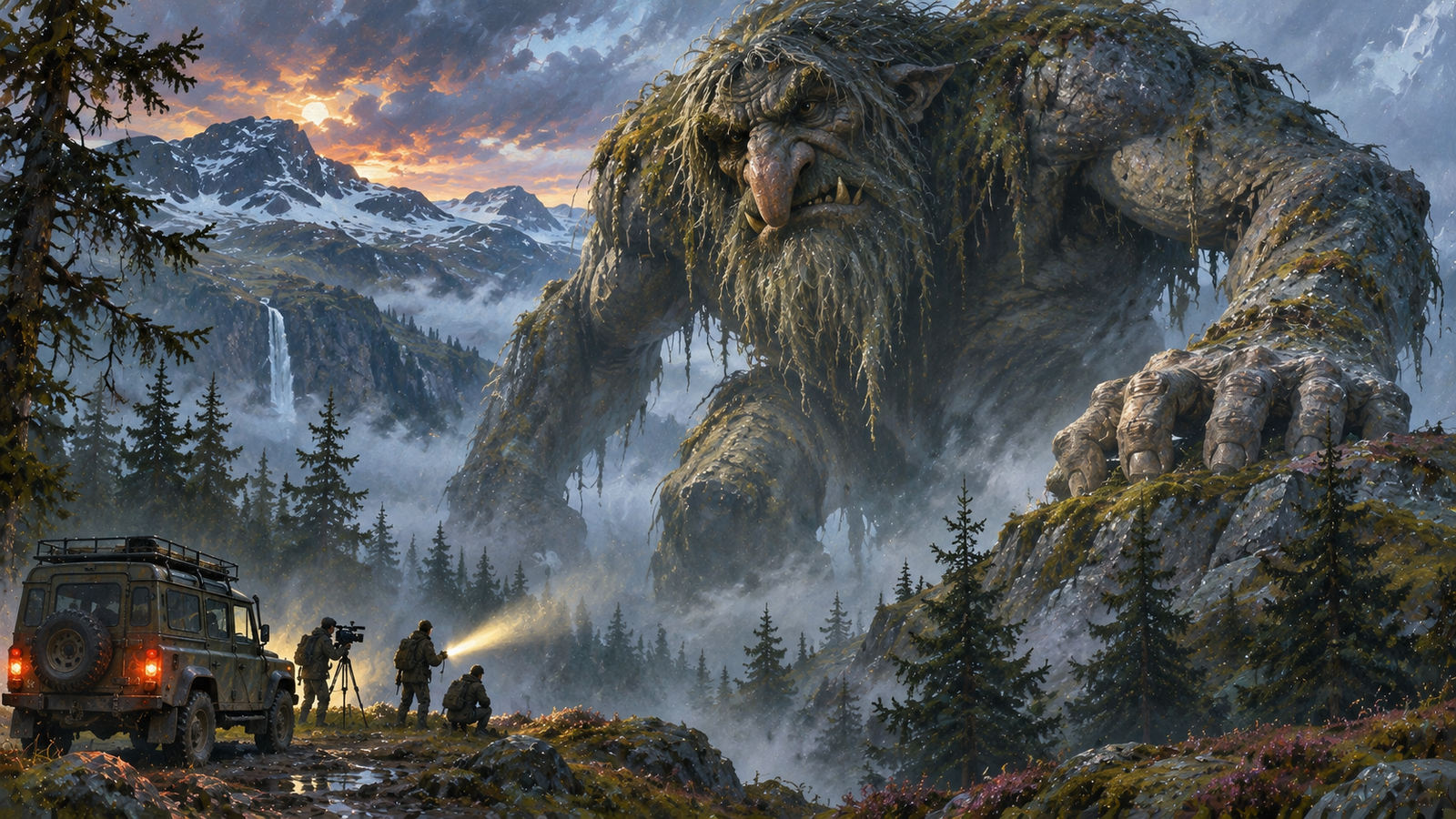
Øvredal’s trolls draw on Norwegian oral traditions and the illustrations of Theodor Kittelsen, but the film invents its own explanations for their appearance and behaviour. Mountain trolls and woodland trolls differ in size and form. Their massive bodies, exaggerated facial features and occasional multiple heads evoke traditional stories while remaining physically grounded within the filmed landscape.
The creatures’ sensitivity to sunlight transforms an old folkloric motif into an apparent biological problem. Hans attempts to explain their behaviour through the knowledge he has acquired over years of work. His explanations are part of the fictional premise, not scientific claims or a comprehensive account of Scandinavian mythology. In particular, the film’s rules concerning scent, sunlight and religious belief should not be applied indiscriminately to every troll in folklore.
One of the film’s more interesting ideas is that the creatures need not be acting maliciously to endanger people. Changes in their movements or health can have consequences for settlements and other wildlife. The investigation therefore has an ecological dimension alongside its supernatural horror.
Behind the Camera
Øvredal wrote and directed the film, drawing on both monster cinema and satirical mockumentary traditions. Cinematographer Hallvard Bræin’s handheld photography makes the characters’ limited viewpoint an essential part of the experience. Editor Per-Erik Eriksen helps preserve the impression that the finished narrative has been assembled from recordings made under unpredictable conditions.
The film relies heavily on the tension between what the investigators can see and what they can hear. Night photography and the uncertain scale of distant objects make the first encounters effective before the audience has a clear understanding of the creatures. The production’s use of real Norwegian locations also provides a convincing visual foundation for digital imagery.
Production Deep Dive — Designing and Animating the Trolls
In his 2011 interview with WIRED, Øvredal explains his interest in the frightening qualities of traditional troll illustrations and the development of Norway’s visual-effects capabilities during production. The creatures’ expressions and movements had to convey more than their size: their behaviour needed to remain consistent with the naturalistic approach of the human performances.
A contemporary Post Magazine report documents Storm Studios’ work on creature models and the transformation of a troll into stone. The latter required an effects treatment that could alter the creature’s surface and structure while retaining its physical relationship with the photographed surroundings. The studio’s technical interview offers additional insight into the construction of the digital creatures.
Norwegian Folklore and the Film’s Origins
The film is an original story rather than a direct adaptation of a single folktale. Its imagery draws on the wider collection of Norwegian stories in which trolls inhabit mountains, forests and remote places. The traditions were recorded by nineteenth-century collectors and became familiar through illustrated publications. Kittelsen’s atmospheric depictions of trolls are especially relevant to the film’s visual treatment of creatures that seem almost to belong to the landscape itself.
In a Guardian interview, Øvredal discusses his combination of traditional stories with documentary comedy and his interest in earlier cinematic examples of those forms. The approach preserves the cultural identity of the creatures while placing them in circumstances that could not exist in the older tales.
Themes, Reception and Legacy
The film’s greatest strength is the seriousness with which it treats its ridiculous central premise. Hans’s weary professionalism, the students’ persistence and the government’s evasiveness give the supernatural discoveries an institutional context. Its trolls are convincing not because every visual effect is flawless, but because the people who encounter them behave as though the consequences matter.
The found-footage format occasionally limits the clarity of the creature encounters. The repetition of investigation, travel and discovery may also frustrate viewers who prefer a more elaborate dramatic structure. Nevertheless, the progression from isolated sightings towards a broader ecological mystery gives the adventure a satisfying sense of increasing scale. The Cineuropa review particularly recognises the relationship between the location photography and the fantastic premise.
The film’s Norwegian release in 2010 was followed by international screenings in 2011, including Sundance. It remains a distinctive example of modern fantasy rooted in a particular landscape and folkloric tradition, and an effective demonstration that supernatural horror can coexist with understated comedy.
Further Viewing
The director interview with ComingSoon discusses the film’s locations and production. The WIRED interview and Storm Studios technical coverage above provide complementary accounts of the creature design.
Explore the Setting and Ideas for the Table
The Troll entry offers independent game lore and mechanics. Explore related cinematic approaches in the Horror Films archive.
The missing livestock. Farmers blame a neighbouring community for unusual animal deaths. An experienced ranger suspects that a change in the movement of giant creatures is responsible. Find the real cause, protect the affected settlements and investigate why the creatures have left their usual territory.
The keeper’s orders. An official charged with watching dangerous creatures is forbidden to warn nearby villages. Discover why the prohibition exists and help establish a response that balances public safety, accountability and the preservation of the creatures’ habitat.
The bridge in the valley. Unusual tracks appear near a bridge used by merchants and travellers. Local accounts differ, and an old agreement may explain why the crossing was built in a particular place. Investigate the history before deciding how to make the route safe.
Sources and Credits
- National Library of Norway — filmography
- Cineuropa — film and release record
- Cast and crew credits
- Post Magazine — creature effects
Film and historical publicity artwork belong to their respective rights holders. Independent criticism and original tabletop ideas.
Keep this reference growing
If this page helped with your reading or game, you can support its upkeep or explore the curated books.
Explore the Bookshop — epics, classics and stories behind imagined worlds.